
De-escalation Techniques Training NJ: Master the Art of Conflict Resolution

You're standing in a crowded New Jersey parking lot when a stranger begins shouting, their face inches from yours. Your heart hammers against your ribs and your palms grow slick with sweat. You aren't just afraid of the confrontation; you're terrified of the legal fallout that follows a physical altercation or the crushing helplessness of not knowing how to stop the noise. Finding the right de-escalation techniques training NJ offers is the difference between a situation that ends in a handshake and one that ends in a police report.
It's a common misconception that self-defense begins with a strike. True mastery lies in the tactical negotiation that happens before the first blow is ever landed. This guide will teach you the specific verbal phrases and psychological strategies required to neutralize aggression and prevent violence in unpredictable environments. We'll explore how to maintain a disciplined "Warrior Mindset" under pressure, giving you the confidence to recognize exactly when words have failed and when physical defense becomes your only option. You'll gain the tools to stay calm and move with purpose.
Table of Contents
Why De-escalation Training is Critical in New Jersey
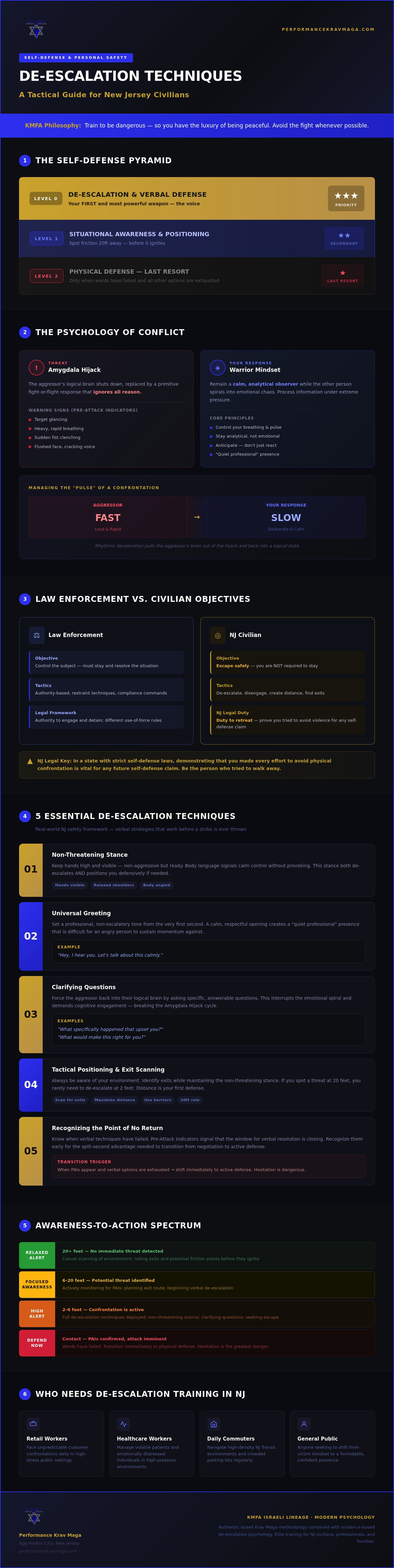
De-escalation is the strategic use of communication to reduce the intensity of a conflict before it turns violent. It's the "Level 0" of any effective self-defense system. In New Jersey, where high-density living and high-stress environments are the norm, friction is an everyday reality. Whether you're on a crowded NJ Transit train or navigating a packed parking lot in Egg Harbor City, the ability to neutralize aggression is a survival skill. It's about recognizing the spark before it becomes a wildfire.
Effective de-escalation techniques training NJ residents can rely on focuses on moving from a position of vulnerability to one of tactical control. By using specific verbal cues and disciplined body language, you dictate the tempo of the interaction. This isn't just about physical safety; it's about legal protection. In a state with strict self-defense laws, proving you made every effort to avoid a physical altercation is vital for any future self-defense claims. You want to be the person who tried to walk away, not the one who escalated the situation.
The Role of Verbal Self-Defense in Personal Safety
Your voice is your first and most important weapon. It can stop an attacker before they ever cross your threshold. Tactical de-escalation differs from simple compliance because you aren't just doing what you're told; you're actively managing the aggressor's emotional state. This preserves your "quiet professional" image. It ensures you remain calm and efficient even when the stakes are high. When you master your voice, you control the room without ever raising a fist.
Beyond the Academy: De-escalation for NJ Civilians
While many programs focus exclusively on law enforcement, de-escalation is a critical tool for everyday NJ civilians. Retail workers, healthcare professionals, and daily commuters face unpredictable public interactions every day. Choosing de-escalation techniques training NJ seminars helps you develop an elite level of awareness. You aren't just reacting. You're anticipating. The training shifts your mindset from being a victim to being a formidable presence. At Performance Krav Maga, we follow the KMFA philosophy: avoid the fight whenever possible. We train you to be dangerous so that you have the luxury of being peaceful.
The Psychology of Conflict: Neutralizing Aggression Instinctively
Conflict isn't just a physical event; it's a neurological one. When an aggressor’s face flushes and their voice cracks, you’re witnessing an "Amygdala Hijack." Their logical brain has checked out, replaced by a primitive fight-or-flight response that ignores reason. To survive this encounter, you must adopt a "Warrior Mindset." This discipline allows you to remain a calm, analytical observer while the other person spirals into emotional chaos. Processing information under extreme pressure is the core objective of the de-escalation techniques training NJ residents use to stay safe.
You must also learn to identify "Pre-Attack Indicators" (PAIs). These are the involuntary physical shifts that signal words are no longer working and a strike is imminent. Watch for target glancing, heavy breathing, or the sudden clenching of fists. When these signs appear, the window for verbal resolution is closing. Recognizing these markers early gives you the split-second advantage needed to transition from negotiation to active defense.
Situational Awareness: The Foundation of De-escalation
High-level safety starts long before the first word is spoken. Mastering situational awareness training allows you to spot potential friction points before they ignite into full-blown confrontations. It’s about tactical positioning. You should always be scanning for an exit while maintaining a non-threatening stance that keeps your hands high and ready. Proactive awareness is the ultimate de-escalation tool in any comprehensive de-escalation techniques training NJ program. If you can identify a threat at twenty feet, you often don't need to de-escalate at two feet.
Managing the "Pulse" of a Confrontation
Control the rhythm of the interaction to force the aggressor to match your tempo. If they speak fast and loud, you respond with slow, deliberate sentences. This rhythmic shift can help pull their brain out of the hijack and back into a logical state. Use "Universal Greetings" to set a professional, non-escalatory tone from the very first second. This approach creates a "quiet professional" presence that is difficult for an angry person to sustain their momentum against. This is where you deploy "Tactical Empathy" to gain the upper hand.
Tactical Empathy is a calculated tool for information gathering and rapport building, not an act of agreement or kindness. It allows you to redirect an aggressor's energy toward a peaceful resolution without compromising your own authority or safety. To see how these psychological principles apply to real-world movement, consider joining one of our self-defense classes in Egg Harbor City. Training your mind is just as important as training your body.
Law Enforcement vs. Civilian De-escalation: Knowing Your Objective
Police training often focuses on "control and custody." Officers have a legal obligation to resolve a situation, secure a suspect, and remain on the scene. As a civilian in New Jersey, your objective is fundamentally different: you seek a "safe exit." Engaging in de-escalation techniques training NJ seminars helps you internalize this distinction. You aren't there to win an argument, prove a point, or make an arrest. You're there to survive and go home. Your success is measured by how quickly you can remove yourself from the friction point.
New Jersey law includes a "Duty to Retreat." This means that if you can safely leave a situation before using force, you're generally expected to do so. De-escalation is your primary tool for fulfilling this legal obligation while maintaining your safety. The "Ethical Protector" mindset applies to everyone, but for you, it means protecting yourself and your family by avoiding unnecessary violence. It's about being the most disciplined person in the environment, even when the person in front of you has lost all control.
The Civilian Objective: Creating Space and Time
Your primary goal is to go home safe. Every word you speak should be aimed at creating the space and time needed to escape. De-escalation acts as a "legal bridge." If the situation does turn physical, your documented attempts to calm the aggressor serve as evidence of your intent to avoid conflict. When words fail, you must transition to tactical self defense immediately. Don't fall into the trap of "over-talking." If an aggressor is closing the distance despite your calm commands, the negotiation is over. Efficiency is key; don't waste breath on someone who has already committed to violence.
Understanding NJ Use of Force for Non-Officers
In New Jersey, de-escalation attempts heavily influence post-incident investigations. Being the "quiet professional" gives you a massive tactical advantage. It allows you to process information clearly while the aggressor is blinded by rage. You must differentiate between a "difficult person" who is just being rude and a "lethal threat" who intends to cause physical harm. One requires patience; the other requires immediate action. Knowing the difference is what keeps you out of the hospital and out of court. Your training should focus on this split-second decision-making process to ensure your response is both legal and effective.
5 Essential De-escalation Techniques for Real-World NJ Safety
Practical safety in New Jersey requires more than just knowing how to throw a punch. It requires a toolkit of tactical communication skills designed to shut down an aggressor before they get within striking distance. Comprehensive de-escalation techniques training NJ seminars teach five core skills that bridge the gap between a heated argument and a physical fight. Mastering these de-escalation techniques training NJ modules ensures you are prepared for the high-friction environments of the East Coast. Use these five pillars to manage any encounter:
The Non-Threatening Stance: Keep your hands at chest level with palms open to bystanders while creating a protective "fence" for yourself.
Clarifying Questions: Use "What" and "How" questions to force the aggressor to engage their logical brain and move away from raw emotion.
The Persuasion Sequence: Follow a professional path of asking for compliance, explaining why it's in their interest, giving them a final choice, and then acting.
Staccato Directives: Use short, sharp commands like "Stop. Stay there." to set hard physical boundaries when someone is closing the distance.
The Exit Strategy: Back away diagonally to maintain visual contact and avoid turning your back on a threat while you create a safe distance.
Verbal Self-Defense: The Power of No
Setting a clear verbal boundary is a prerequisite for our Krav Maga classes. In a road rage scenario on the Parkway or a dispute on public transit, you must project authority without ego. Use scripts like, "I'm not looking for trouble, stay back," or "I understand you're upset, but you need to step away now." This isn't about being "tough." It's about being clear. Removing the ego from your response prevents you from getting sucked into a "monkey dance" where two people escalate just to save face.
The "Level 0" of Krav Maga
We consider de-escalation the "Level 0" of all self defense basics. It's the skill you will use most often to avoid the rare situations that require physical force. Knowing you can defend yourself physically removes the desperation from your voice, making your verbal commands carry an undeniable weight of authority. Integrating these verbal commands into your daily awareness makes you a harder target. To refine these instincts under professional guidance, join our self-defense classes in South Jersey and start your journey from vulnerability to strength.
Performance Krav Maga: Elite De-escalation Training in Egg Harbor City
Performance Krav Maga serves as the definitive hub for de-escalation techniques training NJ residents need to navigate modern threats. Led by Chief Instructor Greg Dziewonski, our Egg Harbor City facility is the national headquarters for the Krav Maga Federation (KMFA). We don't just teach you how to fight; we teach you how to manage human aggression using a blend of authentic Israeli tactics and cutting-edge psychological research. This isn't a sport. It's a disciplined methodology designed for the real world. You'll learn to recognize the pulse of a conflict and use your voice to de-escalate before a single strike is thrown.
Authentic Training at the KMFA Headquarters
Training at a national headquarters ensures you're receiving the highest standard of instruction directly from the source. Our programs focus on reality-based scenarios that you actually encounter in South Jersey, from workplace friction to public confrontations. We strip away the ego and the flashy traditions to focus on what works under extreme stress. Your journey from vulnerability to strength begins here, in an environment where efficiency is the only metric that matters. You'll learn to neutralize threats before they become physical, using the same principles taught to elite units worldwide. We bridge the gap between theoretical communication and physical readiness.
Join the Performance Krav Maga Family
Despite our focus on high-stakes readiness, we maintain a supportive, family-like community. Every student's journey is individual, and our instructors act as humble mentors who prioritize your safety over their own accolades. We build the mental edge you need to stay calm when others panic. Our Krav Maga workout isn't just about physical conditioning; it includes mental stress-testing to forge your focus under pressure. You'll walk out of our doors with a heightened sense of confidence that translates to every area of your life. We provide a safe space to practice high-stress communication techniques until they become instinctive.
Whether you attend a specialized de-escalation seminar or join our regular Krav Maga classes, you'll gain practical tools that work immediately. We provide the tactical justification for every move and the psychological boost that comes from true competence. You won't find hyperbolic marketing fluff here; just lean, functional training for the modern world. Don't wait for a dangerous encounter to realize you're unprepared. Contact Performance Krav Maga today to schedule your first session and experience the difference that elite, disciplined training makes.
Secure Your Safety with Tactical Communication
Conflict is inevitable in high-stress environments, but violence doesn't have to be. By mastering the psychological triggers of aggression and the tactical verbal skills to neutralize them, you shift from a position of vulnerability to one of formidable control. You now understand that your voice is your primary tool for creating a safe exit and building a legal bridge in the event that physical defense becomes necessary. Choosing the right de-escalation techniques training NJ provides ensures you possess the "Warrior Mindset" required to stay calm while others panic.
As the KMFA National Headquarters, Performance Krav Maga offers elite instruction led by Chief Instructor Greg Dziewonski. We serve Egg Harbor City and the broader Atlantic County area with a focus on reality-based safety over sport. Master the art of de-escalation at Performance Krav Maga; Start Training Today. You have the power to protect yourself and your community with disciplined efficiency. Step into our facility and transform your readiness into instinct.
Frequently Asked Questions
Is de-escalation training only for police officers in NJ?
No, de-escalation training isn't just for law enforcement. Civilians in Egg Harbor City face high-friction social dynamics every day. Whether you're a healthcare worker or a commuter, you need the tactical communication skills to neutralize aggression. Performance Krav Maga focuses on the civilian "safe exit" objective. This training helps you meet the legal duty to retreat while maintaining your "quiet professional" image during a high-stakes encounter.
Can de-escalation really work against someone who is under the influence?
De-escalation is more challenging when logic is absent, but it's still effective for environmental management. You won't reason with someone who is intoxicated, so you shift to staccato directives and tactical positioning. The goal is to redirect their energy or set a hard boundary that allows you to escape. You're using these techniques to buy time and space, not to win an argument or change their mind.
What is the first step in de-escalating a road rage incident?
Your first step is maintaining your own emotional discipline. Stay inside your locked vehicle and avoid aggressive eye contact that might be perceived as a challenge. If the other driver approaches, keep your hands visible in a non-threatening "fence" position while scanning for an exit. Prioritize driving away over defending your ego. Comprehensive de-escalation techniques training NJ programs emphasize that a safe exit is always your primary victory.
How does Krav Maga help with verbal de-escalation?
Physical competence is the foundation of verbal authority. When you know you can handle a physical threat, your voice loses the "scared" pitch that aggressors prey upon. Performance Krav Maga trains you to use verbal commands while under physical stress. This integration ensures that your de-escalation attempts are backed by a genuine sense of confidence. You become a harder target because your presence is disciplined and formidable.
Are there specific laws in NJ about using de-escalation before physical force?
New Jersey law emphasizes a "duty to retreat" whenever you can do so with complete safety. While the law doesn't provide a specific script, your attempts to de-escalate provide critical evidence for your self-defense claim. It demonstrates that you weren't the aggressor and that you sought every possible peaceful resolution. Demonstrating that you tried to talk your way out of the fight is vital during any post-incident investigation.
What should I do if my de-escalation attempts are making the person angrier?
You must immediately recognize when words have failed and prioritize your physical safety. If your de-escalation attempts are backfiring, stop talking and focus on your exit strategy. Sometimes a person's emotional state is too volatile for verbal intervention. If your de-escalation techniques training NJ seminar taught you anything, it's that you must move diagonally away from the threat. Don't let your desire to resolve the situation verbally trap you.
How long does it take to learn basic de-escalation techniques?
You can grasp the core psychological strategies and verbal scripts in a single intensive seminar. However, true mastery requires consistent repetition under stress. At our Egg Harbor City headquarters, we integrate these skills into our regular classes so they become instinctive. You don't want to be "thinking" about a technique when someone is shouting in your face. You want your training to take over automatically through disciplined, reality-based practice.
Does Performance Krav Maga offer specific seminars for businesses in Atlantic County?
Yes, we provide specialized training for professional teams throughout Atlantic County. Performance Krav Maga tailors these sessions to your specific workplace environment, whether you're in retail, healthcare, or corporate services. We teach your staff how to manage aggressive behavior and set boundaries without damaging your professional reputation. Contact Greg Dziewonski at our national headquarters to discuss a customized program that builds confidence and safety for your entire team.


Comments