
How to Control Fear and Adrenaline: Survival Strategies for Real-World Stress

Your shaking hands and racing heart aren't signs of weakness; they're actually your body's attempt to turn you into a predator. Most people believe that the goal of self-defense is to eliminate fear entirely, but that's a dangerous misconception that leaves you vulnerable when things get real. You've likely felt that cold knot in your stomach or the sudden loss of fine motor skills when a situation turns tense. It's frustrating to feel paralyzed by the very instincts meant to keep you alive. To truly protect yourself in a high-stakes environment, you must learn to control fear and adrenaline so you can weaponize your body's natural responses.
We're going to bridge the gap between biological panic and tactical precision. This article provides a deep dive into the science of your stress response, offering the same stress inoculation techniques we use at Performance Krav Maga in Egg Harbor City. You'll discover how to recalibrate your nervous system and maintain the quiet professional confidence required to function when others freeze. By the end of this guide, you'll have a clear, actionable roadmap to transform a paralyzing surge into a focused, decisive advantage. It's time to stop fighting your instincts and start leading them.
Table of Contents
Understanding the Biological Surge: Why Fear and Adrenaline Take Control
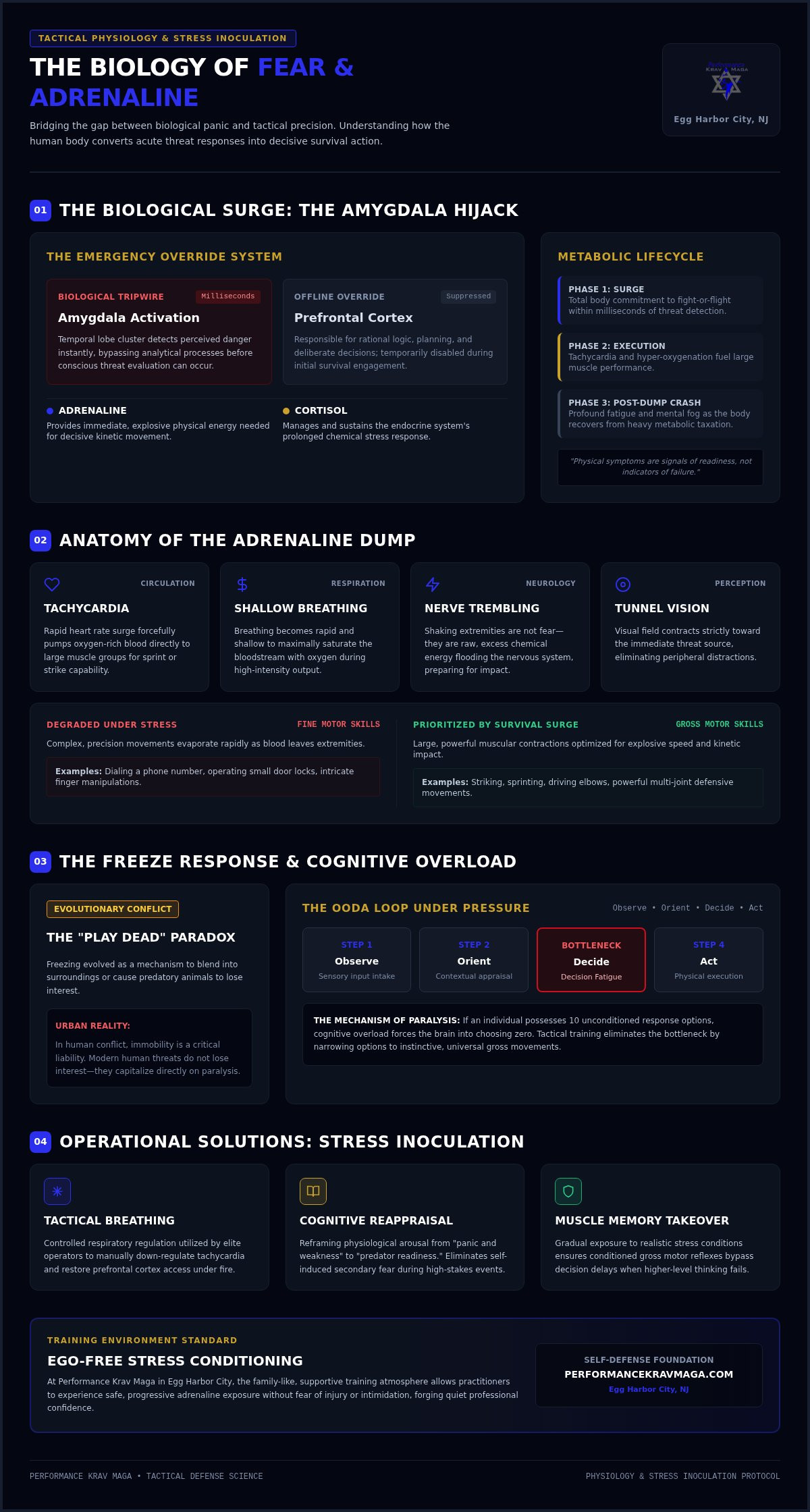
The sensation is unmistakable. Your heart hammers against your ribs; your palms turn slick; your vision narrows until the world feels like a tunnel. This is the adrenaline dump. It's a violent, chemical surge designed to keep you alive during a fight-or-flight response. Before you can even process a threat, your body has already committed to a state of total war. You aren't being a coward when your hands shake; you're experiencing a primal evolution that has saved our species for millennia. To learn to control fear and adrenaline, you have to understand that these physical symptoms are signals of readiness, not indicators of failure.
The Amygdala Hijack: When Logic Fails
The amygdala hijack is the brain's emergency override system. This small, almond-shaped cluster in your temporal lobe acts as a biological tripwire. When it senses danger, it instantly bypasses the prefrontal cortex, which is the part of your brain responsible for logic, planning, and rational thought. This happens in milliseconds. It's the reason you might jump back from a coiled garden hose before realizing it isn't a snake. While this speed is a tactical advantage in a vacuum, it creates a "hijack" where your higher brain functions are temporarily offline. This makes complex decision-making nearly impossible without specific training to bridge the gap between instinct and action.
The Endocrine System's Role in Survival
Your endocrine system fuels this transition with a cocktail of high-performance chemicals. Adrenaline provides the immediate, explosive energy needed for movement, while cortisol manages the body's sustained stress response. Together, they trigger tachycardia, a rapid increase in heart rate that pumps oxygenated blood to your large muscle groups. Your breathing becomes shallow and rapid to further saturate the blood with oxygen. You might notice trembling in your hands; this is simply excess energy flooding your nervous system, preparing you to strike or sprint.
This high-intensity state comes at a heavy metabolic cost. Once the perceived threat passes, you'll likely experience a "post-dump" crash characterized by profound fatigue or mental fog. This exhaustion is your body's way of recovering from the massive tax of the survival surge. When you learn to control fear and adrenaline, you begin to manage this chemical lifecycle rather than being a victim of it. Recognizing that your body is simply preparing for work allows you to stay functional while the surge runs its course.
Deciphering the Freeze Response: Why We Stall Under Pressure
Most people think of survival as a binary choice between aggression or escape. In reality, the most frequent response to sudden violence is total paralysis. This is the freeze response. It occurs when the brain is overwhelmed by the speed or intensity of a situation, leading to a temporary state of behavioral inhibition. Understanding how stress affects the body and mind is the first step toward breaking this cycle. If you don't proactively train to overcome it, the freeze will dictate your outcome during a crisis.
The Fight, Flight, or Freeze Spectrum
Evolutionarily, freezing served a specific purpose. It was a "play dead" tactic designed to make a predator lose interest or to help a prey animal blend into the background. In a modern urban environment, however, this instinct is almost always a tactical liability. Predators in the human world don't lose interest because you stop moving; they capitalize on your immobility. Identifying your personal default response is critical. Do you go quiet? Do you stop breathing? Recognizing these signs early allows you to force a transition into action before the window of opportunity closes.
Cognitive Overload and Decision Fatigue
When the adrenaline dump hits, your ability to perform fine motor skills, like dialing a phone or manipulating a small lock, evaporates. Your body prioritizes gross motor skills, which are large, powerful movements of the arms and legs. This physical shift is often accompanied by cognitive overload. The OODA loop (Observe, Orient, Decide, Act) is the mental process for responding to stimuli. Under extreme stress, the "Decide" phase becomes a bottleneck. If you have ten different ways to respond, your brain may choose none of them. This is why you must learn to control fear and adrenaline by narrowing your options down to the most efficient movements.
Social conditioning plays a massive role in this paralysis. We're taught from childhood to be polite and avoid conflict, which creates a "social freeze" even when our lives are in danger. You have to give yourself permission to fight back. By participating in self-defense classes, you replace complex decision-making with instinctive, aggressive movement. You don't need a hundred techniques; you need three that work every time. This simplicity is what clears the path from paralysis to survival, ensuring you remain a hard target when it matters most.
Tactical Tools for Immediate Adrenaline Management
Understanding the biology of a crisis is only half the battle. To truly learn to control fear and adrenaline, you must possess a toolkit of immediate, actionable interventions. These aren't abstract concepts or long-term habits; they are "seconds-to-impact" techniques designed to keep you functional when the surge hits. By mastering these tools, you move from being a passenger in your own body to becoming the operator of your survival response. You don't need to eliminate the adrenaline; you just need to direct it.
The Power of Tactical Breathing
Elite operators and first responders rely on tactical breathing to maintain precision under extreme duress. The most effective method is the 4-4-4-4 box breathing cycle. Inhale deeply through your nose for a count of four. Hold that breath for four seconds. Exhale slowly through your mouth for four seconds. Finally, hold your lungs empty for another four seconds. Repeat this cycle at least three times. This rhythmic control forces the parasympathetic nervous system to engage, which physically lowers your heart rate and stabilizes your blood pressure. Tactical breathing is the fastest way to signal safety to the nervous system.
Cognitive Reappraisal: Flipping the Switch
The physical sensations of fear and excitement are virtually identical. Both states involve a racing heart, dilated pupils, and a massive energy release. The primary difference is the label your brain chooses to apply. Cognitive reappraisal is the process of intentionally shifting your internal narrative. Instead of telling yourself "I am paralyzed by fear," you tell yourself "My body is prepping for peak performance." Use power verbs in your internal dialogue. Commands like "scan," "breathe," and "move" trigger intent and action. By re-labeling the adrenaline dump as "readiness," you transform a perceived threat into a tactical advantage.
When you feel the "tunnel vision" of a crisis closing in, utilize grounding to re-engage your rational brain. Quickly identify three distinct objects in your environment and two unique sounds. This simple exercise forces the prefrontal cortex to process external data, effectively breaking the internal loop of panic. This prevents the amygdala from maintaining its total hijack of your thoughts. Combine this with directive self-talk to maintain focus. Don't ask questions; give orders. Short, punchy directives like "Hands up" or "Check the exit" keep your mind anchored in the present moment. These tools ensure that even when the surge is high, your ability to act remains higher.
Stress Inoculation: Training the Mind to Perform Under Fire
Knowledge of the "adrenaline dump" is useless if you can't apply it when a threat is inches from your face. To truly learn to control fear and adrenaline, you must undergo stress inoculation. Think of this as a vaccine for panic. By exposing yourself to controlled, gradual levels of pressure in a training environment, you build a psychological immunity to the paralyzing effects of a crisis. This transition from theory to practice is what separates a student of self-defense from a survivor. You don't rise to the occasion; you sink to the level of your training.
Realistic Scenario Training vs. Static Drills
Static drills are necessary for learning the basic mechanics of a strike or a release, but they often create a false sense of security. If your training only happens in a quiet room with a compliant partner, you aren't preparing for reality. You're preparing for a dance. Performance Krav Maga utilizes reality-based training to bridge this gap. We introduce sensory overload, including loud noise, strobe lighting, and verbal aggression, to mimic the chaos of a real-world confrontation. This pressure testing ensures your techniques work when your heart rate is 160 beats per minute. We prioritize simple and aggressive movements because complex, "pretty" techniques are the first things to fail when your fine motor skills evaporate.
Building Instinctive Responses
The goal of our methodology is to turn conscious effort into subconscious reflex. When the brain "quits" due to cognitive overload, your muscle memory must take over. This is the hallmark of the quiet professional: a person who remains calm and dangerous because their body already knows the solution to the problem. This level of readiness is a core pillar of tactical self-defense, moving beyond gear and into elite personal readiness. By repeating high-stress scenarios, you learn to maintain situational awareness even while under fire. This awareness allows you to spot threats early, often preventing the adrenaline dump before it even starts. You become a hard target not through bravado, but through disciplined, repetitive preparation.
Mastering your survival response requires a community that understands the stakes. At our national headquarters in Egg Harbor City, we provide an ego-free environment where you can push your limits safely. If you're ready to stop feeling vulnerable and start building real-world confidence, join our Krav Maga classes and begin your stress inoculation today.
Mastering Fear Through Performance Krav Maga in Egg Harbor City
Performance Krav Maga serves as the national headquarters for the Krav Maga Federation (KMFA). Led by Chief Instructor Greg Dziewonski, our facility in Egg Harbor City isn't just a gym; it's a center for tactical excellence and psychological resilience. Greg’s methodology is built on the belief that physical competence is the foundation for mental strength. Here, you don't just learn to strike; you learn to control fear and adrenaline by understanding exactly how your body functions under fire. We prioritize efficiency and mindset, ensuring that every student develops the "quiet professional" confidence needed to handle real-world stress. This isn't about bravado. It's about readiness.
Elite Instruction in Atlantic County
Training at the national headquarters offers a level of technical pedigree that is rare in the martial arts world. Our curriculum is ruthlessly focused on what works in modern environments, stripping away the rules of sport to focus on absolute survival. When you step through our doors for the first time, you won't face an intimidating atmosphere of ego. Instead, you'll find a family-like community where students of all experience levels support one another. We provide a structured, logical path to safety. If you're searching for self defense classes Atlantic County offers, you'll find that our headquarters in Egg Harbor City sets the gold standard for reality-based instruction.
From Vulnerability to Strength
The shift from being fear-driven to mission-driven is the most profound benefit of our training. You stop reacting blindly to threats and start responding with calculated intent. This transformation doesn't stay on the training floor. The psychological boost that comes from knowing you can defend yourself manifests as a calm, formidable presence in your everyday life. This is the "quiet professional" vibe: a readiness that allows you to navigate the boardroom or the street with the same level of composure. Our Krav Maga classes are designed to remove obstacles to your safety, providing you with the tools to stay functional when the stakes are highest.
South Jersey residents don't have to guess about their ability to perform under pressure. By training at the KMFA headquarters, you're learning from the source of the system. We invite you to experience a class and see how our disciplined approach to self-defense can change your life. Master your biology. Secure your future. It starts with a single step into our Egg Harbor City facility. Join a community that values your safety as much as you do.
Take Command of Your Survival Instincts
Adrenaline isn't an enemy to be suppressed; it is a biological resource that must be managed. By understanding the mechanics of the amygdala hijack and implementing tactical breathing, you bridge the gap between panic and precision. Real-world safety requires more than mental tips. It demands the physical stress inoculation found only in reality-based environments where noise and chaos are part of the curriculum. When you learn to control fear and adrenaline, you stop being a victim of your biology and start using it as a tactical advantage.
At Performance Krav Maga, the national headquarters for the KMFA, Chief Instructor Greg Dziewonski leads a family-like community focused on efficient, ego-free training. We move beyond sport to prioritize your readiness in the street and the boardroom. This is where vulnerability ends and professional competence begins. Claim Your Intro Lesson at Performance Krav Maga Today and transform your stress response into a formidable asset. You have the capacity for elite confidence. It's time to unlock it.
Frequently Asked Questions
Is it possible to completely eliminate fear during a confrontation?
No, you cannot completely eliminate fear, and attempting to do so is actually counterproductive. Fear is a natural survival signal that alerts your body to immediate danger. Instead of trying to suppress it, our Krav Maga classes teach you to channel that energy into decisive action. By accepting fear as a biological tool, you can maintain your composure and execute defense techniques even when your heart is racing and your palms are slick.
How long does it take to learn to control the adrenaline dump?
You will begin to understand the mechanics of the adrenaline dump during your first introductory lesson. However, developing the muscle memory to learn to control fear and adrenaline under extreme pressure typically requires several months of consistent training. At our Egg Harbor City headquarters, we use gradual stress inoculation to ensure your body recognizes the surge as a cue for performance rather than a reason to panic or freeze during a crisis.
What is the difference between fear and anxiety in self-defense?
Fear is an immediate response to a present threat, such as an active attacker, while anxiety is the anticipatory stress regarding potential future confrontations. In our self-defense classes, we address both. We provide the physical tools to handle immediate fear and the situational awareness training to reduce the background anxiety of "what if" scenarios. This dual approach builds a foundation of quiet confidence that carries into your daily life in Atlantic County.
Can tactical breathing really work when someone is attacking you?
Tactical breathing is a proven method used by elite military and law enforcement personnel to stabilize the nervous system during high-stakes encounters. While you may not be able to "box breathe" in the middle of a strike, you can use it the moment you sense a threat or during a tactical reset. It lowers your heart rate and clears cognitive fog, allowing your prefrontal cortex to remain engaged when you need it most.
Why do I shake after a stressful event even if I wasn't hurt?
Shaking is a common physiological response called a neurogenic tremor. It happens because your body has been flooded with adrenaline and glucose to prepare for explosive movement. If that energy isn't fully utilized during the event, your nervous system releases it through trembling once the threat passes. It’s a sign that your survival systems worked correctly, not a sign of weakness. Recognizing this helps you manage the post-dump recovery period effectively.
Does martial arts training help with everyday work-related stress?
Yes, the stress inoculation we practice in Egg Harbor City directly translates to professional environments. When you train your mind to remain calm while someone is actively trying to grab or strike you, a high-pressure deadline or a tense meeting feels far less overwhelming. You develop a "quiet professional" demeanor that allows you to process information logically and make decisive choices even when your environment is chaotic, demanding, or potentially hostile.
What should I do if I feel myself starting to freeze in a dangerous situation?
If you feel a freeze response starting, you must force a physical movement immediately. Shift your weight, yell a command, or strike a target. Breaking the physical paralysis often breaks the mental loop of cognitive overload. In our training, we emphasize simple, aggressive gross motor movements because they are the easiest to execute when your brain stalls. The goal is to move from observation to action as fast as possible to regain the initiative.
Is Performance Krav Maga suitable for someone with no athletic background?
Performance Krav Maga is designed for individuals of all fitness levels and backgrounds. Because our system is based on natural body movements and reflexive responses, you don't need to be an elite athlete to start. Chief Instructor Greg Dziewonski ensures an ego-free, family-like environment where you can build your skills at your own pace. We focus on real-world safety, making this training accessible to anyone in Egg Harbor City who wants to be more secure.


Comments