
How to Improve Reflexes and Coordination: A Tactical Training Guide
- Greg Dziewonski
- 1 day ago
- 11 min read

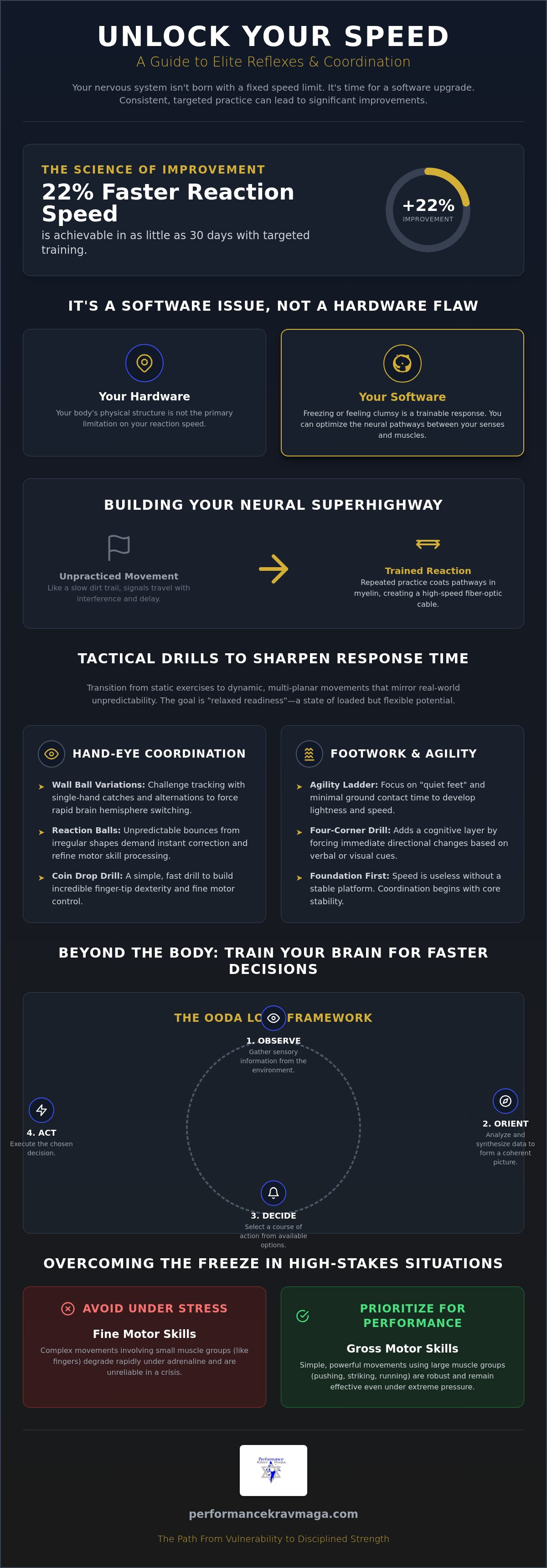
You weren't born with a fixed speed limit on your nervous system. While many believe that lightning-fast reactions are a genetic gift you either have or you don't, the reality is far more empowering. You've likely felt that heavy, lagging sensation when your body fails to keep up with your eyes during a high-pressure moment. It's a common frustration; however, feeling clumsy or freezing under stress is a software issue, not a hardware flaw. Research shows that consistent, targeted practice can lead to a 22% improvement in reaction speed in as little as 30 days. This guide will show you how to improve reflexes and coordination by bridging the gap between tactical instinct and calibrated muscle memory.
You'll master the science-backed drills and mental shifts required to transform your physical precision for real-world performance. We'll explore the specific neuro-fitness techniques that sharpen spatial awareness and build the quiet confidence of a professional who is always ready. From understanding the biology of the "freeze" response to implementing elite-level coordination drills, you're about to build a body that moves as fast as you think. This is the path from vulnerability to disciplined strength.
Table of Contents
The Neurology of Speed: How Reflexes and Coordination Work
Speed isn't an accident. It's a biological calibration. Most people confuse an autonomic reflex, like blinking when dust hits your eye, with a reaction, such as parrying a strike or catching a falling glass. Autonomic reflexes happen involuntarily through the spinal cord, bypassing the brain entirely for maximum speed. In contrast, a reaction requires cognitive processing. When you train to improve reflexes and coordination, you're actually optimizing the neural pathway between your senses and your muscles. Repeated movement coats these pathways in myelin, turning dirt trails into high-speed fiber-optic cables.
Reaction time is the interval between a stimulus and the initiation of a motor response. To shorten this interval, you must build efficient superhighways in your brain. Every time you practice a specific movement, you reinforce the specific neural connections involved. This insulation allows electrical signals to travel faster and with less interference. Alongside this speed, you must develop proprioception. This is your body's internal GPS. It's the ability to know exactly where your limbs are in space without looking at them. Without strong proprioception, speed is wasted because your movements lack precision.
Visual Perception vs. Cognitive Processing
Your eyes track movement and relay high-speed signals to the primary visual cortex. However, the bottleneck usually occurs in the decision-making phase. Hesitation is the biggest killer of speed. If your brain has to choose between five different responses, you'll freeze. Training at Performance Krav Maga focuses on reducing these choices to instinctive, universal movements. Be aware that neural transmission speeds aren't static. Dehydration, poor nutrition, and physical fatigue can lag your system, adding precious milliseconds to your response time.
Why Coordination is the Foundation of Performance
Coordination is the harmonious functioning of muscles or groups of muscles to execute a task. It's the bridge between raw strength and effective action. This begins with core stability. If your trunk is weak, your limbs cannot move rapidly or accurately because they lack a solid anchor. What many people dismiss as clumsiness is usually just a lack of practiced motor patterns. By repeating tactical drills, you replace awkward, conscious effort with fluid, unconscious competence. You don't just get faster; you get more efficient.
Tactical Drills to Sharpen Your Physical Response Time
Static drills serve as your foundation, but they aren't the finish line. To truly improve reflexes and coordination, you must transition into dynamic, multi-planar movements that mirror the unpredictability of the real world. One of the most overlooked aspects of speed is "relaxed readiness." If your muscles are locked in tension, they cannot ignite instantly. Think of a coiled spring; it requires a state of loaded but flexible potential. This state is central to a high-level Krav Maga workout, where the goal is to move from a neutral posture to an explosive response without telegraphing your intent.
Hand-Eye Coordination: Drills for Instant Accuracy
Precision starts with the hands. Use wall ball variations to challenge your tracking; try single-hand catches, alternating hands, or even behind-the-back snatches to force your brain to switch hemispheres rapidly. For a higher level of difficulty, introduce reaction balls. Their irregular shape creates unpredictable bounces that demand instant correction. This type of training reinforces the neurological basis of motor skills, refining how your brain processes sudden changes in the environment. For fine motor control, the "coin drop" drill is excellent. Hold a coin at shoulder height, drop it, and try to catch it before it hits the floor. It's simple, fast, and builds incredible finger-tip dexterity.
Footwork and Agility: Building a Stable Foundation
Speed is useless without a stable platform. Agility ladder sequences should focus on "quiet feet" and minimal ground contact time. You want to be light, not heavy. The "four-corner" drill adds a cognitive layer; have a partner shout numbers or colors associated with specific corners to force an immediate change in direction. This mirrors the mental demands of a Krav Maga workout, where physical movement is always tied to environmental awareness. Remember that balance is the prerequisite for speed. Incorporate single-leg drills to build the ankle stability needed for sharp, aggressive pivots. Without this stability, your body will naturally slow down to protect itself from injury.
Finally, incorporate shadowing. This involves reacting to a partner's movements in real-time without a pre-set pattern. It bridges the gap between solo drills and live application. If you're ready to test these skills in a high-energy environment, consider joining our Krav Maga classes in Egg Harbor City to see how these principles apply to real-world safety. Mastering your response time is about more than just speed; it's about the confidence that comes from knowing your body will obey your instincts when it matters most.
Beyond the Body: Training Your Brain for Faster Decisions
Physical speed has a ceiling, but mental processing is virtually limitless. When you work to improve reflexes and coordination, you aren't just training muscles; you're upgrading your brain's ability to recognize patterns. Raw fast-twitch fiber is helpful, but it's secondary to cognitive efficiency. Most high-pressure failures occur because the brain is overloaded with data it hasn't learned to filter. Elite performers don't react faster; they see earlier. By identifying the initial stages of a movement, you gain a massive temporal advantage over someone who waits for the full action to unfold. Research indicates that visual training interventions can improve athlete reaction times by 5% to 27%, proving that your eyes are just as trainable as your biceps.
To truly improve reflexes and coordination, you must master the art of anticipation. This involves reading an opponent's "tells," such as a shift in weight or a slight tension in the shoulder, before a strike is even launched. When you understand these pre-indicators, you are no longer reacting to a finished event; you are participating in its development. This shift from reactive to proactive movement is the hallmark of elite tactical training.
The OODA Loop: Processing Under Pressure
The OODA Loop (Observe, Orient, Decide, Act) is a four-stage cycle that governs every human interaction under stress.
Observe: Use your peripheral vision to gather data without fixating on a single point. This prevents "tunnel vision," which is common during high-adrenaline events.
Orient: This is the most critical phase where you filter out "noise" to focus only on relevant threats or targets. Your brain must quickly determine what matters and what doesn't.
Decide and Act: You reduce the gap between thought and movement by utilizing pre-planned, instinctive responses. The fewer choices your brain has to make, the faster your body moves.
Visual Scanning and Peripheral Awareness
Your eyes are the primary intake for the data your brain needs to move. The "clock" drill is an effective way to train this; stare at a fixed point straight ahead and try to identify objects or movements at the 12, 3, 6, and 9 o'clock positions in your peripheral field. You must also learn the difference between soft focus and hard focus. Soft focus allows you to take in the entire environment, while hard focus is used for the split second you need to execute a precise movement. Additionally, eye-tracking exercises can improve the speed of saccadic eye movements, which are the rapid jumps your eyes make between points of interest. Faster eye movements lead to faster data acquisition, which ultimately leads to faster physical responses.
Overcoming the Freeze: Coordination in High-Stakes Situations
The "freeze" isn't a lack of courage. It's a biological circuit breaker. When your heart rate climbs above 145 beats per minute, your ability to perform complex, fine motor skills begins to evaporate. You might find it impossible to dial a phone or manipulate a small lock. However, your gross motor skills remain functional. To effectively improve reflexes and coordination for high-stakes environments, your training must center on large, simple movements that the body can execute even when the brain is screaming. This focus on simplicity is a core pillar of tactical self defense, ensuring your response is robust enough to survive an adrenaline dump.
Muscle Memory vs. Conscious Thought
Conscious thought is the enemy of speed. If you're "thinking" about where your hand should go, you're already behind the curve. Autonomic movement occurs when the neural pathways are so well-worn that the body moves without a command from the prefrontal cortex. While the 10,000-repetition rule is a popular benchmark, tactical efficiency is actually about leveraging natural human instincts. Krav Maga uses your existing flinch responses as a foundation, allowing you to improve reflexes and coordination by refining what your body already does under pressure.
Stress Inoculation: Training Under Realistic Conditions
Training in a calm, well-lit room creates a false sense of security. To bridge the gap between practice and reality, you must introduce environmental stressors that force your brain to filter out distractions. Common stress inoculation techniques include:
Low-Light Drills: Practicing in dim or flickering light to challenge visual tracking.
Auditory Overload: Using loud music or shouting to simulate the chaos of a confrontation.
Physical Exhaustion: Performing coordination tasks immediately after high-intensity intervals to test your "relaxed readiness" under fatigue.
By simulating these threats, you desensitize your nervous system. This ensures that your first "real" confrontation isn't the first time your brain has dealt with chaos. Building this level of readiness requires a disciplined, professional environment. If you want to transform your survival instincts into calculated precision, come experience our self-defense classes in Egg Harbor City. We focus on the reality of high-stress encounters so you can move with confidence when it matters most.
Elite Training at Performance Krav Maga in Egg Harbor City
Performance Krav Maga stands as the premier destination for those looking to improve reflexes and coordination in Atlantic County. Led by Chief Instructor Greg Dziewonski, our facility serves as the national headquarters for the Krav Maga Federation (KMFA). This isn't a traditional martial arts school focused on choreographed forms or point-scoring competitions. Instead, every class is a high-intensity laboratory designed to sharpen your instinctive responses. We focus on reality, not theory. By training here, you are learning from a lineage of experts dedicated to practical, modern safety. Speed is a byproduct of discipline, and we provide the structure to achieve it.
Every session is a reflex workout by design. We strip away the fluff of traditional sports to focus on the raw mechanics of survival. You'll find that the drills we utilize don't just build muscle; they build a more efficient nervous system. This methodology ensures that your physical precision remains intact even when your heart rate is redlined. It's about being a "quiet professional" who is ready for anything, anywhere, at any time.
Why Krav Maga is the Ultimate Reflex Training
Krav Maga is unique because it demands the simultaneous execution of defense and attack. This is the pinnacle of coordination. While traditional systems might teach you to block and then strike, we train you to do both in a single, fluid motion. This forces the brain to manage multiple motor patterns at once, cutting down your total reaction time. You will also develop 360-degree awareness. Real-world threats rarely come from a single, predictable direction. Training to handle multiple attackers ensures that your peripheral vision and spatial orientation are constantly engaged. We train for the street, not the trophy.
Join the Family: Starting Your Journey in South Jersey
Many people feel a sense of hesitation before their first class. That's natural. We have built a family-like community in Egg Harbor City where students of all experience levels support one another. There is no room for ego on our mats. As you improve reflexes and coordination, you will notice a significant psychological boost. Physical competence breeds a quiet, formidable confidence that carries over into every aspect of your life. You cease to be a spectator in your own safety and become an active participant in your personal protection.
The transition from vulnerability to strength begins with a single step. Whether you are a complete beginner or an experienced athlete, our programs are structured to meet you where you are and challenge you to grow. Stop wondering if you have what it takes and start proving it to yourself. Book your first lesson at Performance Krav Maga today! and start building the elite precision your future self deserves.
Build the Body That Obeys Your Instincts
Speed is a perishable skill that requires constant calibration. You've seen how the neurology of reaction time can be rewired through deliberate practice and how the OODA loop provides a framework for processing chaos. By prioritizing gross motor skills and natural instincts, you ensure that your body remains functional under the most extreme pressure. The path to improve reflexes and coordination isn't found in a textbook; it's forged on the mats through reality-based training. This is where theory meets the concrete.
Performance Krav Maga is the national headquarters for the Krav Maga Federation (KMFA), offering a disciplined environment for students in Egg Harbor City and across Atlantic County. Under the guidance of Chief Instructor Greg Dziewonski, you'll transform from a reactive spectator into a proactive defender. This training isn't just about safety; it's about the psychological boost that comes from physical competence. You'll build a level of precision that stays with you long after you leave the facility.
Start your journey to elite coordination at Performance Krav Maga. You have the blueprint for faster reactions. Now, take the first step toward becoming truly formidable. We're ready when you are.
Frequently Asked Questions
Can I really improve my reflexes if I've always been clumsy?
Yes, clumsiness is typically a symptom of unrefined motor patterns rather than a permanent biological trait. You can improve reflexes and coordination by systematically building neural pathways through repetitive, tactical movement. By shifting from conscious effort to unconscious competence, your body learns to bypass the hesitation that causes awkwardness. It is a matter of biological calibration and disciplined practice, not innate luck.
How long does it take to see noticeable improvements in coordination?
You can experience measurable changes in your response time in as little as 30 days with consistent practice. Research indicates that focused reaction training can yield a 22% improvement in speed within a single month. While elite-level mastery is a long-term pursuit, your nervous system begins adapting to new stimuli almost immediately. The key to success is the frequency of the stimulus rather than the length of individual sessions.
Are video games actually helpful for real-world reaction time?
Video games improve visual processing and screen-based reaction, but they rarely translate to physical, real-world movement. While they sharpen your ability to observe and decide, they lack the physical "Act" component required for tactical situations. To bridge this gap, you must pair cognitive speed with full-body drills. This ensures your gross motor skills are engaged in a three-dimensional environment rather than just your fingertips.
What is the best exercise to improve hand-eye coordination quickly?
Wall ball drills using a reaction ball are among the most effective ways to improve reflexes and coordination rapidly. Because the ball's irregular shape causes unpredictable bounces, your brain must constantly adjust its motor commands in real-time. This forces your visual cortex and your limbs to work in tighter synchronization. Practicing this single drill for just ten minutes a day will produce significant, functional results.
How does stress affect my ability to react and move?
High stress triggers an adrenaline dump that prioritizes gross motor movements while often degrading fine motor control. When your heart rate exceeds 145 beats per minute, your coordination will suffer if you haven't trained under realistic pressure. This is why tactical training centers on simple, repetitive actions. You don't rise to the occasion during a crisis; you sink to the level of your most basic training.
Do I need special equipment to train my reflexes at home?
You don't need expensive gear or specialized technology to start training effectively at home. A simple tennis ball, a coin for drop drills, or a partner for shadowing can provide professional-level results. The focus should always be on the quality of the movement and the speed of the decision-making process rather than the tools. Discipline and consistent repetition are your most valuable pieces of equipment.
Is Krav Maga suitable for someone with no martial arts experience?
Krav Maga is designed specifically for individuals with zero prior experience and no background in combat sports. It's based on natural human instincts and universal flinch responses, making it the most accessible system for building functional safety. Our classes in Egg Harbor City foster a supportive, family-like community where beginners are welcomed into a disciplined environment. You start with the basics and build toward elite physical competence.


Comments