
Krav Maga vs Karate: Which System Actually Keeps You Safe in 2026?
- Greg Dziewonski
- Jun 9
- 12 min read

If you were cornered in a dimly lit parking garage tonight, would you rather rely on a choreographed sequence of movements or a raw instinct to neutralize the threat and escape? It's a question that keeps many people awake as modern environments become increasingly unpredictable. You likely worry about wasting precious time on "fancy" moves that fail when adrenaline spikes and rules disappear. When comparing Krav Maga vs karate, the choice isn't just about which looks better in a uniform. It's about deciding whether you want to master a traditional art form or a tactical survival system designed for the chaos of 2026.
You deserve to feel capable and secure in your ability to protect yourself and your family. This guide breaks down the fundamental differences between these two paths so you can stop second-guessing your training and start building real-world competence. We'll examine how Krav Maga prioritizes immediate efficiency and aggressive defense, while Karate focuses on discipline, historical form, and the long-term journey of the artist. By the end, you'll have a clear understanding of which school matches your personal safety goals and your need for high-intensity physical conditioning.
Key Takeaways
Understand the fundamental shift from artistic discipline to rapid threat neutralization by comparing the core objectives of traditional forms versus modern survival systems.
Compare the training methodologies of Krav Maga vs karate to see how high-stress scenario drills build reflexive instincts that point-based competitions cannot replicate.
Identify the "sport vs. street" gap and learn why 360-degree situational awareness is critical for surviving encounters involving multiple attackers or modern urban threats.
Evaluate your personal time-to-competency and discover how tactical conditioning accelerates your ability to handle real-world violence compared to traditional martial arts paths.
Discover the benefits of training at a National Headquarters where elite instruction focuses on the psychological readiness and physical efficiency of the "quiet professional."
Table of Contents
The Core Distinction: Traditional Martial Art vs. Modern Survival System
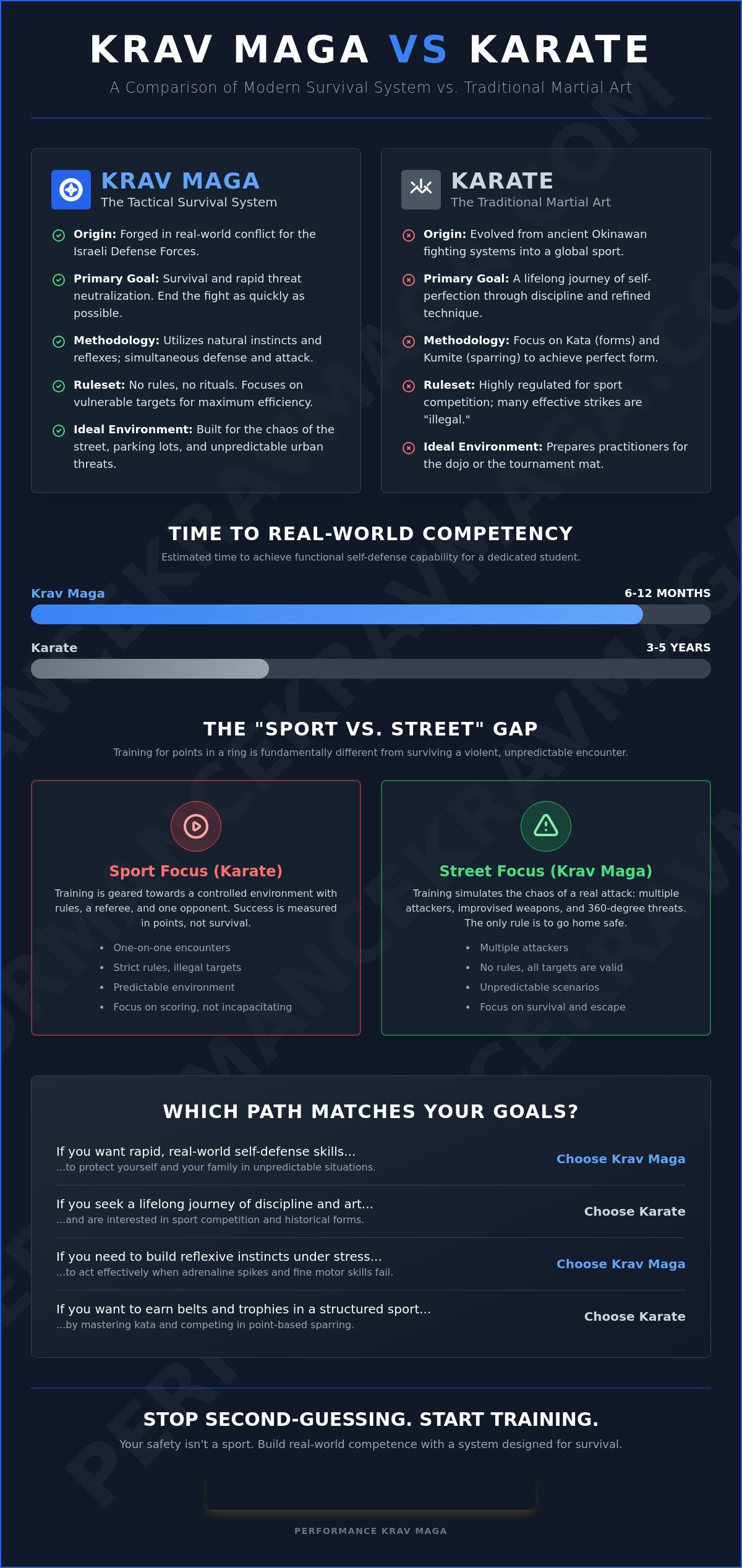
The debate over Krav Maga vs karate often begins with a misunderstanding of intent. While both involve striking and defensive movements, they exist for entirely different reasons. Karate is a traditional martial art that prioritizes the "Do" or the way; it's a lifelong journey toward self-perfection through discipline and refined technique. Krav Maga is a tactical system. It's a utilitarian toolset designed for one thing: self-preservation. In 2026, as residents in Atlantic County face a shifting landscape of personal safety, choosing between these paths requires an honest assessment of your goals. Do you want to master a cultural heritage, or do you want to survive a violent encounter?
The Origins of Karate: From Okinawa to the Olympics
Karate evolved from ancient Okinawan fighting systems into a globally recognized sport and method of character development. Training typically revolves around two pillars: Kata and Kumite. Kata consists of pre-arranged patterns of movement that simulate combat against imaginary opponents, emphasizing perfect form and balance. Kumite is the sparring aspect, which has become highly regulated for safety in modern competitions. Because sport Karate must adhere to strict rules, many effective but dangerous strikes are considered "illegal." This creates a mindset focused on scoring points rather than neutralizing a predatory threat. For the practitioner, the reward is often a belt rank or a trophy, symbolizing their dedication to the art's historical lineage.
The Origins of Krav Maga: Born in Conflict
Krav Maga was forged under the pressure of real-world violence. Developed by Imi Lichtenfeld to protect the Jewish community in Bratislava and later refined for the Israeli Defense Forces, it relies on natural human reflexes rather than rigid stances. This is why Krav Maga is classified as a system rather than a martial art. There are no rituals, no bows, and no "illegal" moves. The curriculum is ruthlessly efficient, focusing on simultaneous defense and attack to end a confrontation as quickly as possible. You can explore the detailed history of Krav Maga to understand how it transitioned from military use to the gold standard for civilian self-defense. It's built for the person who doesn't have ten years to master a form but needs to be capable of defending themselves by next month.
The fundamental gap between these two systems comes down to the environment they prepare you for. Karate prepares you for the dojo or the tournament mat. Krav Maga prepares you for the street, the parking lot, and the home invasion. While Karate builds an athlete, Krav Maga builds a survivor. In a world where threats don't follow a rulebook, your training shouldn't either.
Philosophy in Action: Kata and Competition vs. Instinct and Efficiency
The difference between a dojo and a tactical training center becomes clear the moment the "freeze" response kicks in. In a high-stress confrontation, your brain doesn't look for the most beautiful technique; it looks for the most immediate solution. This is where the training methodologies of Krav Maga vs karate diverge most sharply. Karate relies on ritualized discipline and complex muscle memory developed over years of repetition. Krav Maga, however, utilizes tactical discipline to sharpen your existing natural instincts, ensuring you can act effectively even when your heart rate skyrockets and fine motor skills fail.
Traditional Training: The Long Road to Mastery
Karate practitioners often spend decades perfecting "Kata," which are detailed patterns of movements practiced solo. To appreciate the depth of these traditions, one can study the History and Philosophy of Karate, which reveals a system built on spiritual and physical refinement. This path prioritizes aesthetic precision, balance, and the "point system" found in Kumite (sparring). While this builds incredible coordination and character, the focus on scoring points can inadvertently train a student to "pull" their punches or stop after a single successful strike. In a real-world fight, stopping after one hit is a dangerous habit that can leave you vulnerable to a counter-attack.
Tactical Training: The Shortest Path to Safety
Krav Maga operates on the principle of "Retzev," or continuous motion. The goal isn't to score a point; it's to end the threat by any means necessary. This involves targeting highly vulnerable areas that are strictly forbidden in Karate competitions, such as the eyes, throat, and groin. Because the system is built on gross motor skills, it's designed to be effective under extreme duress. The KMFA mastery levels are specifically structured to move a student from raw instinct to tactical proficiency as quickly as possible. This "no rules" approach ensures that your response is as aggressive and efficient as the situation demands.
Discipline in Karate is often about bowing, silence, and following ancient protocols. In Krav Maga, discipline is tactical. It's the ability to maintain situational awareness, recognize a pre-attack cue, and execute a defense while under intense physical pressure. If you want to see how these instincts are forged in a supportive yet challenging environment, consider visiting a self-defense class to experience the difference firsthand. Transitioning from the rigid stances of a traditional art to the fluid, explosive movements of a survival system provides the psychological boost that comes from knowing you are truly ready for the modern world.
Real-World Effectiveness: Addressing the Sport vs. Street Gap
Real-world violence is never a fair fight. It doesn't happen on high-density foam mats under bright fluorescent lights with a referee standing by to pause the action. In the unpredictable landscape of 2026, an altercation is more likely to occur in a cramped Egg Harbor City parking lot or a narrow hallway where traditional stances become liabilities. When evaluating Krav Maga vs karate, you must look beyond the dojo and analyze how each system handles the variables of modern urban safety.
Scenario 1: The Multiple Attacker Problem
Most sport-based martial arts struggle when the odds are stacked against the defender. Karate training typically emphasizes a "line" of attack where you face a single opponent in a controlled exchange. This mindset can be fatal in a street scenario where a second or third aggressor might strike from the flank or rear. Krav Maga utilizes aggressive movement and "human shielding" to ensure you are never pinned between multiple threats. Tactical positioning is the decisive factor that allows a defender to turn a group ambush into a series of manageable one-on-one engagements. By constantly scanning the environment, you prevent the "tunnel vision" that often leads to being surrounded.
Scenario 2: Weapon Threats and Modern Dangers
While Karate includes "Kobudo" (the study of traditional Okinawan weapons), these skills rarely translate to the threats found in 2026. Mastering a wooden staff is an impressive feat of coordination, but it won't help you when facing a concealed blade or a firearm. Krav Maga treats weapon defense as a high-stakes problem requiring a simultaneous "defend and counter" response. You don't wait for your turn; you burst into the attacker's space to redirect the line of fire while delivering debilitating strikes. It's also vital to remain aware of the evolving legal landscape in New Jersey. As of 2026, understanding the nuances of "duty to retreat" and "reasonable force" is just as important as the physical techniques themselves. Your training should focus on stopping the threat quickly so you can legally and safely exit the area.
Choosing Your Path: Which Discipline Matches Your Goals?
Deciding between Krav Maga vs karate requires an honest assessment of your ultimate objective. If you're looking for a lifelong journey of artistic refinement, Karate offers a structured path toward physical and spiritual growth. However, if your priority is the ability to protect yourself and your family in an increasingly volatile world, your training must reflect that urgency. The conditioning required for each is also distinct. While Karate builds sport-specific endurance, a combat-ready fitness program focuses on the explosive power and anaerobic capacity needed to survive a high-stakes encounter.
The "time-to-competency" is perhaps the most significant factor for beginners. Karate is a marathon; it often takes years of dedicated practice to reach a level where techniques become reflexive in a fight. Krav Maga is a sprint to functional safety. Because it builds on natural movements, most students feel a significant boost in their defensive capabilities within just a few months. Mental benefits also differ. Karate provides traditional meditation and "zen" focus, whereas Krav Maga offers stress inoculation. You learn to manage the "adrenaline dump" and maintain clarity while under physical duress.
Use this 3-question checklist to identify your primary motivation:
Do I need to feel capable of defending myself against a larger attacker within the next six months?
Is my goal to master a cultural tradition or to survive a modern urban threat?
Do I prefer a training environment with strict rules or one that simulates real-world chaos?
When Karate is the Right Choice
Karate is an excellent choice for children who benefit from the high level of discipline, respect, and structure found in traditional dojos. It's also ideal for those who enjoy the competitive aspect of martial arts and wish to test their skills in a regulated, sport-based environment. The cultural and historical appreciation of Japanese arts provides a deep sense of connection to the past, making the "Do" (the way) a rewarding path for lifelong personal development.
When Krav Maga is the Only Choice
For women in Egg Harbor City seeking immediate protection, Krav Maga is the gold standard. It's also the necessary choice for law enforcement officers and high-risk professionals who don't have the luxury of "pulling" strikes or following a point system. Functional safety outweighs artistic mastery when the stakes are life and death. If you're ready to stop being a spectator and start building real-world competence, find a self-defense class that prioritizes your survival over a trophy.
Mastering Defense at Performance Krav Maga in Egg Harbor City
The choice between Krav Maga vs karate ultimately reveals what you value most: the preservation of a tradition or the preservation of your life. If you've decided that efficiency and survival are your primary drivers, the next step is finding an environment that matches that intensity. Performance Krav Maga serves as the KMFA National Headquarters, providing a standard of tactical instruction that goes far beyond the typical martial arts school. Led by Chief Instructor Greg Dziewonski, our facility maintains a "quiet professional" atmosphere. We don't rely on ego or theatrics. We focus on the calculated transition from vulnerability to formidable strength.
Our curriculum bridges the gap between your raw survival instincts and tactical mastery. We understand that in a high-stress encounter, your brain defaults to its most basic programming. Our training sharpens those natural responses, turning a flinch into a counter-attack and hesitation into decisive action. You'll develop the psychological boost that comes from physical competence, knowing you have the tools to handle a real-world threat in Atlantic County or wherever your journey takes you.
The KMFA Advantage: Authentic Israeli Instruction
Our lineage is direct and our standards are uncompromising. We offer authentic Israeli self-defense rooted in the original principles of the system, but adapted for the specific threats of 2026. While we maintain a disciplined environment, we've built a family-like community where every student's individual journey is supported. You aren't just another body on the mat; you're part of a collective focused on mutual growth and readiness. The Performance edge is the precise combination of elite physical fitness and brutal tactical efficiency. This dual focus ensures that you have the gas tank to stay in the fight and the skills to end it quickly.
Start Your Journey in South Jersey
We've created a low-friction entry point for new students in Egg Harbor City. Whether you're a professional seeking high-level training or a resident of Mays Landing or Galloway looking for basic safety, you'll find a welcoming path here. Walking through the door for the first time is often the hardest part of self-defense training. Our instructors act as elite but humble mentors, guiding you through the initial stages of your development without judgment. You don't need to be in peak condition to begin. You only need the discipline to show up and the desire to improve. Join a Krav Maga class today and transform your vulnerability into strength.
Secure Your Future With Tactical Readiness
Choosing between Krav Maga vs karate isn't about disrespecting tradition; it's about aligning your training with the reality of the world you live in. You now understand that while Karate offers a beautiful path of artistic growth and discipline, it often lacks the raw efficiency required to neutralize a modern threat. Krav Maga provides the shortest path to functional safety by utilizing your natural instincts and focusing on reality-based scenarios that don't follow a rulebook. Whether you're facing multiple attackers or navigating a high-stress environment, your preparation determines your outcome.
At Performance Krav Maga, the National Headquarters for KMFA, we bridge the gap between vulnerability and elite physical competence. Led by Chief Instructor Greg Dziewonski, our reality-based training is specifically engineered for 2026 urban safety. You don't have to feel exposed in unpredictable environments any longer. Take the first step toward becoming a quiet professional who is ready for anything. Claim Your First Tactical Self-Defense Lesson in Egg Harbor City and start building the confidence that only comes from true physical readiness. Your journey from uncertainty to strength begins today.
Frequently Asked Questions
Is Krav Maga harder to learn than Karate for a beginner?
No, Krav Maga is generally more intuitive for beginners because it builds upon natural human reflexes. Karate requires students to master specific, often rigid stances and complex forms called kata that can take years to feel natural. Krav Maga bypasses these artistic requirements to focus on immediate, instinct-based movements that you can apply effectively after just a few sessions.
Can I use Karate moves in a Krav Maga class?
You can certainly bring your existing skills to the mat, but they must be adapted for tactical efficiency. If a specific strike from your Karate background is functional and works under high stress, it has value. However, you'll need to move away from a point-scoring mindset. Krav Maga prioritizes continuous motion and simultaneous defense and attack rather than the "stop-start" rhythm of traditional sparring.
How long does it take to become "street ready" in Krav Maga vs Karate?
Krav Maga students typically feel capable of defending themselves against common threats within three to six months of consistent training. In the Krav Maga vs karate comparison, time-to-competency is a major factor. Traditional Karate often requires several years of dedicated practice before a student can effectively apply their techniques against a non-compliant, aggressive attacker in an unscripted environment.
Which is better for weight loss: Krav Maga or Karate?
Krav Maga generally offers a more intense caloric burn because the classes are structured like high-intensity interval training. While Karate provides a solid workout through repetitive drills and sparring, Krav Maga involves constant explosive movement and stress-based drills. This tactical conditioning is designed to build functional lean muscle and improve cardiovascular endurance rapidly to ensure you can survive a prolonged encounter.
Is Krav Maga safe for older adults or those with no experience?
Yes, Krav Maga is highly accessible because it doesn't require pre-existing athletic ability or exceptional flexibility. Instructors at Performance Krav Maga scale the intensity of each drill to match your current physical condition. The goal is your personal survival and safety, not matching the performance of a professional athlete. It's a supportive environment where your individual progress is the primary focus.
Does Karate training include defense against modern weapons like knives?
Most traditional Karate schools focus on historical Okinawan weapons such as the Bo staff or Sai. While some modern dojos might touch on knife defense, it's rarely a core component of the curriculum. Krav Maga was specifically engineered to address modern dangers, including edged weapons and firearms. This focus makes it a more practical choice for addressing the specific safety variables of 2026.
What should I wear to my first Krav Maga lesson in Egg Harbor City?
You should wear standard athletic clothing that allows for a full range of motion, such as a t-shirt and gym shorts or sweatpants. Avoid any clothing with sharp zippers or jewelry that could cause injury during contact drills. Most students train in clean athletic shoes that provide good lateral support. You don't need a traditional uniform or specialized gear to begin your first session.
Are there belts or rankings in Krav Maga like there are in Karate?
Yes, Krav Maga utilizes a structured ranking system to track your progress and ensure you're learning techniques appropriate for your skill level. While Karate uses colored belts, Krav Maga often uses levels or patches to signify advancement. In the Krav Maga vs karate landscape, both systems value the discipline of a ranking hierarchy, which provides a clear roadmap from beginner to tactical master.


Comments