
Self-Defense for Commuters: Tactical Safety in Public Spaces (2026)
- Greg Dziewonski
- 11 minutes ago
- 12 min read

What if your greatest vulnerability on the morning train isn't the person standing behind you, but the six inches of space you've already surrendered? Most people view a crowded bus or subway car as a cage where they're at the mercy of their environment. You feel the walls closing in, the exits blocked, and the rising anxiety of unpredictable behavior in a confined space. It's a valid concern. Effective self defense for commuters isn't about carrying illegal gadgets or looking for a fight; it's about mastering the tactical management of space and your own physiological response to threat.
At Performance Krav Maga, we believe safety is a proactive discipline. This guide provides the elite situational awareness skills and close-quarters Krav Maga techniques required to stay safe during your daily commute. We'll strip away the confusion over defense tools and replace it with the 'Warrior Mindset' cultivated at our Egg Harbor City headquarters. You'll learn how to navigate high-traffic areas with confidence, identify threats before they escalate, and execute simple, high-impact physical responses when there's nowhere left to run.
Table of Contents
Mastering Situational Awareness: The First Line of Commuter Defense
Krav Maga for Confined Spaces: Fighting When You Can’t Escape
Weapons vs. Skills: The Reality of Tactical Readiness on Transit
High-Risk Scenarios: Navigating Platforms, Terminals, and Parking Garages
Performance Krav Maga: Building Elite Readiness in Egg Harbor City
Mastering Situational Awareness: The First Line of Commuter Defense
Awareness isn't a state of paranoia; it's a proactive mental posture that allows you to dictate the terms of any encounter before it turns physical. Most people move through public transit in a fog of complacency, but effective self defense for commuters begins with the conscious decision to remain engaged with the environment. By Mastering Situational Awareness, you transform from a passive passenger into an active participant in your own safety, identifying potential threats while they are still manageable distances away.
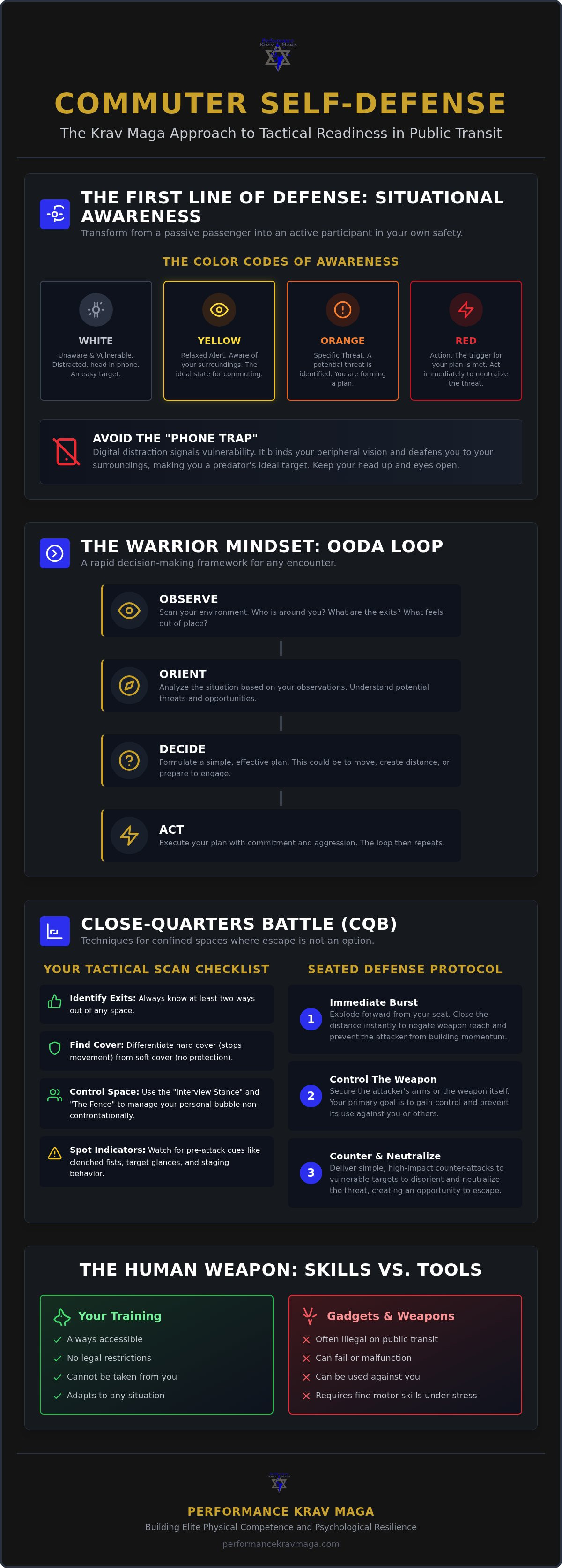
The OODA Loop serves as a rapid decision-making framework where you Observe your surroundings, Orient yourself to potential threats, Decide on a course of action, and Act with precision. To apply this effectively, we utilize the Color Codes of Awareness. Condition White is total vulnerability, like being asleep or staring at a screen. You should strive for Condition Yellow: a state of relaxed alert where you're scanning for anomalies without being stressed. Condition Orange indicates a specific potential threat has been identified, requiring a plan, while Condition Red is the trigger for immediate tactical action.
Digital distraction is the primary predator magnet in modern transit hubs. When you're buried in your phone, you've effectively blinded your peripheral vision and deafened your surroundings with earbuds. This "Phone Trap" signals to a predator that you're an easy target who won't see an approach until it's too late. Put the device away. Keep your head up. Your phone is a tool, but your eyes are your primary survival gear.
The 360-Degree Scan: Evaluating Your Environment
Every time you board a vehicle, perform a tactical scan. Identify at least two exits and differentiate between "hard cover," like steel pillars that stop movement, and "soft cover," like plastic seats that offer no protection. Watch for pre-attack indicators in others: clenched fists, heavy breathing, or shifting weight. Don't pin yourself against the doors where you can be easily trapped or pushed out; instead, find a position that maintains a clear line of sight to the entire car and offers multiple paths for movement.
Managing Personal Space in Crowds
In tight spaces, you must defend your centerline using the "Interview Stance." Stand with your feet staggered and your hands held naturally at chest level, appearing non-confrontational while ready to establish "The Fence." This physical barrier uses verbal boundaries and palm-out hand positioning to stop an approach. Be alert for "Target Glances," where an aggressor looks at your pockets or neck, and "Staging" behavior, such as someone moving into your path to block your exit. Recognizing these patterns early allows you to relocate before the space is compromised.
Krav Maga for Confined Spaces: Fighting When You Can’t Escape
Public transit isn't a sparring mat; it's a high-density, low-mobility environment where escape routes are often non-existent. When you're trapped in a narrow bus aisle or a crowded subway car, traditional martial arts that require wide stances or complex footwork often fail. This is the reality of Close-Quarters Battle (CQB). Effective self defense for commuters requires techniques that work when your back is against a wall or your movement is restricted by other passengers. Israeli Krav Maga solves this by harnessing instinctive movement, turning natural flinches into tactical counters that function regardless of the space available.
Success in these environments depends on utilizing the landscape as a tactical asset. A metal pole isn't just a handhold; it's a barrier or a tool for leverage. A seat back is a brace to generate power. Following Public transit safety protocols is your first step, but when those fail, your training must take over. You must be prepared to transform your environment from a cage into a weapon.
Seated Defense: 5 Steps to Neutralize a Threat
Being seated is often perceived as a position of weakness, but it can be turned into a tactical advantage if you move with explosive intent. Use these steps to regain control:
Step 1: Immediate Burst: Close the distance instantly. This negates the reach of a weapon and prevents the attacker from building momentum.
Step 2: Controlling Long Weapons: Secure the attacker’s arms immediately. By managing their limbs, you neutralize their ability to strike or draw a secondary tool.
Step 3: Creating a Base: Drive your weight into the seat back. This creates a solid foundation to generate power for your own strikes since you can't use your legs for traditional rotation.
Step 4: Counter-Striking: Deliver short, explosive movements to vulnerable areas like the throat, eyes, or groin. Efficiency is vital when you have inches, not feet, of clearance.
Step 5: Evacuate and Reassess: Create enough space to stand and move toward an exit. Never stay in a seated position longer than necessary to neutralize the immediate threat.
Defending Against Grabs and Chokes on Transit
In a packed train, an attacker may attempt to pin you against a wall or grab you from behind. If you are pinned, use the "plucking" technique to aggressively strip the hands from your throat while simultaneously delivering a counter-strike. For those standing in a crowded aisle, a rear grab requires a sharp drop in your center of gravity and a rapid elbow strike to create an opening. You can find more technical details on how to escape a choke hold through our specialized training modules. Building these instincts is a core part of the self-defense classes we offer in Egg Harbor City, where we focus on the "Warrior Mindset" needed to survive high-stakes transit encounters and master self defense for commuters.
Weapons vs. Skills: The Reality of Tactical Readiness on Transit
Self defense for commuters isn't something you can buy at a sporting goods store and clip to your belt. It's a physiological and psychological state of readiness that exists within you. Many people fall into the trap of "tool reliance," believing that carrying pepper spray or a tactical folder makes them safe. However, in a real-world transit encounter, that spray is often buried at the bottom of a backpack or tangled in a pocket. If you can't deploy a tool in under 1.5 seconds while under extreme stress, you don't actually have it. Relying on a gadget you can't reach is a tactical failure that creates a false sense of security.
Your body and mind are the only tools guaranteed to be with you in every jurisdiction. Whether you're traveling through South Jersey or navigating international transit hubs with strict carry laws, your training is your only legal, permanent asset. Effective self defense for commuters requires the ability to turn ordinary objects into tactical assets. A heavy water bottle becomes a flail. A tactical pen becomes a reinforced striking surface. A laptop bag becomes a shield against a blade. These aren't gadgets; they're environmental multipliers for the "Human Weapon" cultivated through disciplined practice.
The Myth of the 'Magic Gadget'
High-stress environments trigger a massive adrenaline dump that compromises fine motor skills. Trying to find a small button on a canister or flicking open a folding knife becomes nearly impossible when your heart rate exceeds 140 beats per minute. There's also the critical issue of weapon retention. If you pull a tool and fail to use it effectively, it becomes a secondary threat that the attacker can seize and use against you. Real-world safety comes from practical training that prioritizes gross motor movements and instinctive responses over product purchasing.
Legal Compliance and the 'Reasonable Force' Standard
Carrying a dedicated weapon often complicates your legal standing during a self-defense claim. In New Jersey, the standard of "reasonable force" is strictly applied, meaning you must be able to justify that your response was proportional to the threat. Authentic Krav Maga training allows you to scale your response, moving from verbal de-escalation and soft controls to high-impact strikes when necessary. Professional instruction in tactical self defense ensures you have the judgment to match the force to the danger, protecting you both on the platform and in the courtroom.
High-Risk Scenarios: Navigating Platforms, Terminals, and Parking Garages
The "Transition Zone" is where your commute is most vulnerable. These are the spaces between the safety of your destination and the controlled environment of the vehicle. Parking garages, station exits, and stairwells offer predators concealment and isolation. Effective self defense for commuters requires a shift in mindset as you cross these thresholds. Use the "Four-Second Rule." Every time you enter a new environment, take four seconds to scan 360 degrees for exits, cover, and potential threats. If your intuition signals an anomaly, don't ignore it. Relocate immediately.
Your posture is your first line of defense. Walk with a purposeful pace and upright posture to project a "Hard Target" persona. Predators look for the path of least resistance. If you look like you have a plan and are aware of your surroundings, you're statistically less likely to be selected. In open terminals, managing multiple attackers requires constant movement. Don't get static. Use the "lining up" strategy to keep one aggressor between you and the others, preventing them from flanking you in the open space. Mastering these protocols is essential for comprehensive self defense for commuters in urban environments.
Parking Garage Safety: Vehicles as Obstacles and Tools
Don't fall for the "keys in hand" myth. Fumbling with keys while approaching your car makes you a "Soft Target" because your attention is on your pocket, not the environment. Keep your hands free until you are within a few feet of the vehicle. Scan under and around cars before you approach to ensure no one is crouching nearby. If you suspect you're being followed, use the "Circle Back" strategy. Change direction and head toward a populated area or security station. Never lead a threat to your car where you can be pinned inside a confined space.
Platform and Terminal Awareness
On the platform, the "Yellow Line" Rule is non-negotiable. Stay at least six feet from the edge to prevent shoving attacks or accidental falls. Seek "back-to-the-wall" positioning. This eliminates 180 degrees of vulnerability, allowing you to focus your attention forward. When using stairwells or elevators, prioritize visibility. Stay on the outside of stairwell turns to see what's coming and never enter an elevator if your gut signals an anomaly. Building the instincts to navigate these transition zones is a core focus of the self-defense classes we offer at our Egg Harbor City headquarters.
Performance Krav Maga: Building Elite Readiness in Egg Harbor City
Performance Krav Maga stands as the definitive authority for tactical readiness in South Jersey. Led by Chief Instructor Greg Dziewonski, our facility serves as the national headquarters for the Krav Maga Federation (KMFA). This lineage ensures that every student receives instruction in authentic Israeli Krav Maga, a system designed for maximum efficiency in real-world violence. We operate with a "Quiet Professional" vibe, prioritizing results and readiness over the ego often found in traditional martial arts schools. In our Egg Harbor City facility, we've cultivated a supportive, family-like community where the focus remains entirely on your personal growth and safety.
Effective self defense for commuters is a practical problem that requires a practical solution. We don't just teach you how to strike; we build the "Warrior Mindset" necessary to stay calm and decisive in high-stakes environments like public transit. By training in a disciplined yet welcoming environment, you'll transition from a state of vulnerability to a position of formidable strength. Our methodology is lean and utilitarian, focusing on the removal of obstacles and the mastery of instinctive movement that works when space is tight and the stakes are high.
What to Expect in Your First Self-Defense Class
Your journey begins with a high-energy Krav Maga workout that emphasizes functional conditioning and explosive power. We don't just drill techniques in a vacuum. Our instructors simulate high-stress commuter scenarios in a safe environment, forcing you to apply your skills while navigating narrow aisles or defending from a seated position. This stress inoculation is critical for building the muscle memory required for real-world application. You'll move through a structured path from beginner basics to tactical mastery, all while under the guidance of elite-level instructors.
Join the Performance Krav Maga Family
Training at the national headquarters for KMFA in Egg Harbor City gives you access to a depth of knowledge and certification that is unmatched in the region. Beyond the physical techniques, you'll experience a significant psychological boost. Physical competence breeds a quiet confidence that changes how you carry yourself in public spaces. This shift in posture and presence is often enough to deter a predator before a conflict even starts. We invite you to step onto the mat and experience the discipline of the "Warrior Mindset" firsthand. Start your journey toward becoming a Hard Target today.
Take Control of Your Daily Journey
Safety on public transit isn't a matter of luck; it's a result of deliberate preparation and tactical awareness. We've explored how mastering your environment and maintaining the Warrior Mindset can transform you from a potential target into a formidable presence. By prioritizing instinctive movement over unreliable gadgets and understanding the nuances of transition zones, you ensure that your primary weapon, your mind, is always ready. Mastering self defense for commuters requires more than just reading; it demands the kind of reality-based training that only a professional environment can provide.
At Performance Krav Maga, the national headquarters for the Krav Maga Federation (KMFA), we focus on the efficiency and real-world results you need for modern public spaces. Under the guidance of Chief Instructor Greg Dziewonski, you'll learn to navigate any high-stakes environment with disciplined authority. Don't wait for a crisis to test your readiness. Claim your introductory self-defense lesson at Performance Krav Maga today and join a community dedicated to your strength. You have the power to move through the world with confidence; we're here to help you unlock it.
Frequently Asked Questions
Is Krav Maga effective for commuters with no martial arts experience?
Krav Maga is specifically designed for individuals with zero combat background. It relies on natural human reflexes rather than complex, choreographed movements. Beginners at Performance Krav Maga start by learning gross motor skills that remain effective even when the body is under extreme stress. You don't need years of training to see results; the system is built to make you safer from your very first session.
What are the best self-defense tools I can legally carry on public transit?
The most reliable tools are your own mind and body. While transit authorities often restrict items like knives or large pepper spray canisters, everyday objects like tactical pens or sturdy umbrellas are usually permitted. Avoid relying on gadgets that require fine motor skills to activate. Instead, focus on mastering your environment and using your physical training to turn any accessible object into a tactical asset if needed.
How do I defend myself if I am cornered in a train car?
When you have zero room to retreat, you must immediately close the distance to negate the attacker's reach. Use explosive, short-range strikes like knees, elbows, and palm heels to create an opening. Utilize the walls or seat backs to stabilize your base and generate power. Once you've disrupted the attacker's momentum, move aggressively toward the nearest exit or a more populated area of the vehicle.
Are there specific self-defense classes for women commuters in South Jersey?
Performance Krav Maga offers comprehensive self defense for commuters tailored to the unique threats women face in public spaces. These classes focus on escaping common grabs, managing larger aggressors, and identifying predatory behavior before it escalates. Our Egg Harbor City headquarters provides a supportive, ego-free environment where women can build the physical competence and confidence necessary to navigate transit hubs and parking garages safely.
How long does it take to learn basic commuter self-defense techniques?
You can achieve a functional level of proficiency in just a few weeks of consistent training. While true mastery is a lifelong journey, basic skills like situational awareness and primary striking can be learned quickly. Most students report a significant boost in their confidence after their first month on the mat. Regular practice ensures these responses remain instinctive rather than something you have to think about during a crisis.
What should I do if I see someone else being harassed on my commute?
Your priority is to maintain your own safety while seeking assistance for the victim. Alert transit staff or call emergency services immediately to ensure professional help is on the way. If you choose to intervene, do so by creating a distraction or enlisting the help of other passengers to draw attention to the situation. Never compromise your tactical position or block your own exit path while attempting to assist others.
Is it better to run or fight in a crowded public space?
Always prioritize escape whenever a safe path is available. Fighting is a tactical necessity only when you are trapped or facing an immediate physical threat. In a crowded environment, "running" may simply mean moving to a different train car or a well-lit platform. If escape is impossible, you must engage with maximum intensity until you've created the space needed to flee. Effective self defense for commuters is always about survival.
Where can I find tactical self-defense training in Egg Harbor City?
Elite training is available at Performance Krav Maga, which serves as the national headquarters for the Krav Maga Federation (KMFA). Our facility in Egg Harbor City is led by Chief Instructor Greg Dziewonski and focuses on authentic Israeli Krav Maga. We provide reality-based self-defense classes designed to prepare you for the high-stakes environments of South Jersey transit systems, terminals, and urban transition zones.


Comments