
Self-Defense for Travelers: Tactical Safety Beyond Gadgets (2026 Guide)
- Greg Dziewonski
- 6 days ago
- 12 min read

Your most effective weapon isn't a gadget you pack in your suitcase; it's the software running between your ears. Many travelers spend hours researching the latest tactical flashlights or worrying about whether a personal alarm will trigger a 13,000 dollar TSA fine, yet they remain vulnerable because they rely on hardware that can be confiscated at any border. If you've ever felt that cold spike of anxiety while navigating a dimly lit backstreet in a foreign city, you know that a plastic tool is a poor substitute for true readiness.
We understand that navigating international weapon laws is confusing and being targeted as a tourist is a legitimate fear. This guide provides a clear strategy for self defense for travelers by focusing on high-efficiency skills that pass every customs checkpoint. You'll learn to master the mindset and physical techniques required to stay safe in any country, regardless of local restrictions. We are moving beyond the gear and into the realm of the quiet professional. By the end of this article, you'll have a tactical roadmap to travel solo with genuine authority, utilizing simple movements that work when your adrenaline is redlining and your safety is on the line.
Table of Contents
The Reality of Travel Safety: Why Gadgets Aren’t Enough
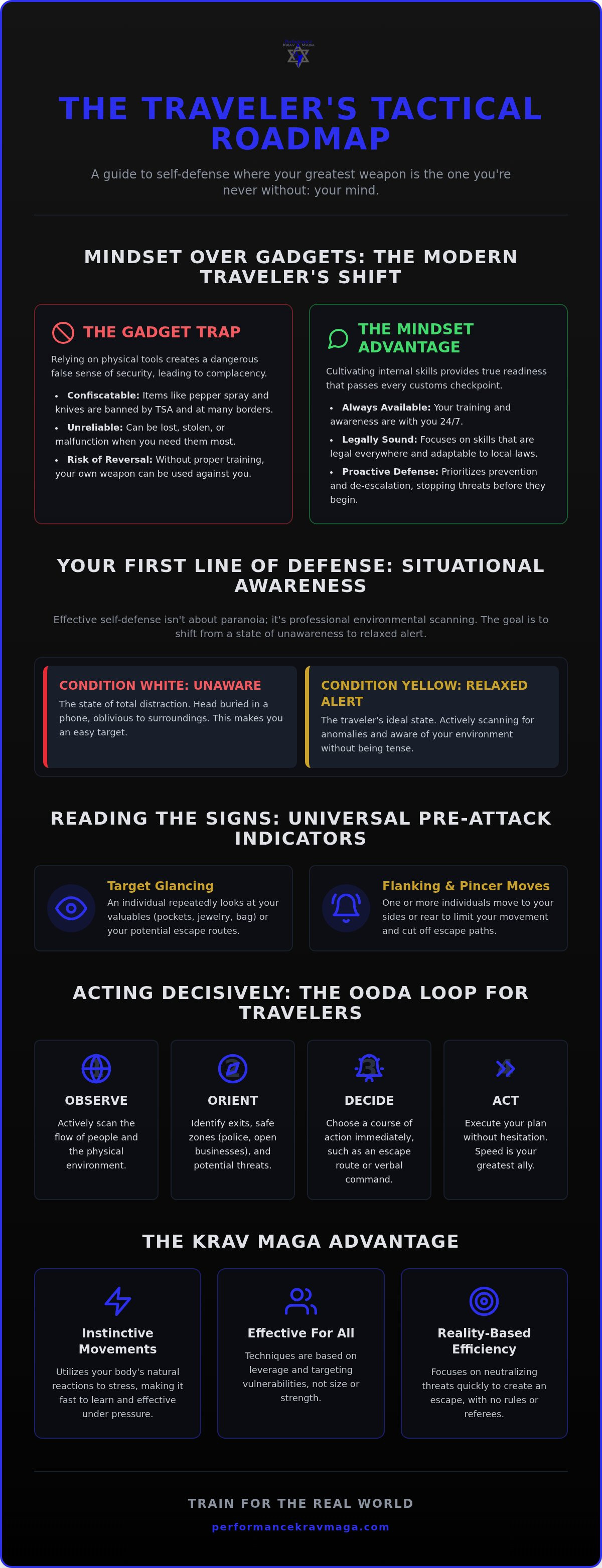
Safety isn't a product you purchase at an airport kiosk; it's a discipline you cultivate. Real self defense for travelers is a three-pronged strategy that integrates prevention, de-escalation, and physical response. If you skip the first two, you've already lost the tactical advantage. Many people fall into the "False Sense of Security" trap. They believe a gadget makes them safe, but this mindset is dangerous because it leads to complacency. You stop scanning your surroundings because you think your keychain alarm will save you. It won't.
Your brain is the only weapon that can't be lost, stolen, or confiscated at a border crossing. While gadgets are external, training is internal. It's the difference between carrying a map and knowing how to navigate a city by instinct. Sport-based martial arts often focus on points, rounds, and rules. In a foreign city, there are no referees and no weight classes. You need reality-based efficiency. This is where the general principles of self-defense transition from theory into practical survival. You must be prepared to act with total commitment if the situation demands it.
The Problem with Physical Self-Defense Tools
TSA amnesty bins are overflowing with pepper spray, pocket knives, and multi-tools. If your safety plan relies on these items, you're effectively defenseless the moment you clear security. Beyond legality, there's the risk of weapon retention. Without professional training, your own tool can be turned against you in a struggle. Gear often acts as a distraction; you might spend precious seconds fumbling for a canister instead of executing a strike or escaping the area. True self defense for travelers relies on what you can do, not what you can carry.
The Krav Maga Advantage for Travelers
Krav Maga is built on instinctive movements. It doesn't require decades of dedication to become proficient because it utilizes your body's natural reactions to stress. This makes it the ideal choice for modern nomads who need results now. We focus on building a "Warrior Mindset" that keeps you calm in high-pressure environments. This training is egalitarian. It's designed for people of all sizes and strengths. By focusing on efficiency over aesthetics, you gain the ability to neutralize threats quickly, remove obstacles, and continue your journey with confidence.
Mastering Situational Awareness: Your First Line of Defense
Situational awareness is your primary shield. It isn't about living in a state of paranoia; it's about professional environmental scanning. Most tourists live in Condition White, a state of total unawareness where they are focused on their phones or their surroundings with zero tactical filter. To stay safe, you must shift into Condition Yellow. This is a state of relaxed alert. You aren't looking for a fight, but you are actively scanning for anomalies that don't fit the baseline of your environment. This mental shift is the foundation of effective self defense for travelers.
Professional scanning allows you to identify "pre-attack indicators" long before a physical confrontation occurs. Look for target glancing, where an individual repeatedly checks your pockets, jewelry, or the location of your exit. Watch for flanking, a tactic where someone moves to your side or rear to limit your movement. In a foreign setting, these behavioral cues are universal. Recognizing these patterns early is a critical component of situational awareness training, allowing you to bypass danger before it closes the distance.
The OODA Loop for Travelers
The OODA Loop—Observe, Orient, Decide, Act—is a decision-making cycle designed to reduce the hesitation gap. When you enter a transit hub or a crowded plaza, observe the flow of people and orient yourself by identifying exits and "safe zones" like police kiosks or open businesses. If you identify a threat, decide on an escape route immediately and act without waiting for permission. Speed is your greatest ally. Refining these instincts is a major focus of our self-defense classes, where we bridge the gap between theory and real-world application.
Hard Target Body Language
Your physical presence communicates your level of vulnerability. The "Tourist Stance" is characterized by a slumped posture, a wandering gaze, and a head buried in a smartphone. This signals that you are distracted and easy to surprise. In contrast, a "Confident Traveler" maintains an upright posture with shoulders back and eyes scanning the horizon. This 360-degree awareness makes you a "hard target." Predators look for the path of least resistance; by projecting competence and readiness, you often convince a potential attacker to look elsewhere. Use your phone as a tool, but never let it blinker your vision. Check your maps in a secure spot, then move with purpose.
Navigating Legal Restrictions: Self-Defense When Weapons are Banned
The law is a rigid boundary that doesn't care about your intent; it only cares about the code. Many travelers assume that a tool legal in their home state is permissible abroad, but this is a dangerous misconception. In the United Kingdom and Canada, pepper spray is classified as a prohibited weapon. Carrying it can lead to immediate arrest and long-term legal consequences. Effective self defense for travelers requires an understanding that your safety strategy must prioritize legal compliance to avoid the nightmare of foreign incarceration. You aren't just fighting an attacker; you're navigating a complex legal landscape that often favors the "reasonable force" standard.
Reasonable force is a global legal concept. It dictates that your physical response must be proportionate to the level of threat you face. If you escalate a minor scuffle into a lethal confrontation, you become the aggressor in the eyes of the law. This is why tactical self defense training focuses on neutralizing a threat and escaping, rather than staying to win a fight. Discipline dictates your response. You must have the presence of mind to stop the moment the threat is no longer active.
The Legal Trap: Intent vs. Utility
In many jurisdictions, the legality of an object depends entirely on why you have it. If you tell a police officer in London that you're carrying a tactical pen for protection, you've just admitted to carrying an offensive weapon. This is the "Intent Trap." A standard high-quality flashlight or a heavy, hardcover book carries no such stigma. These are tools with clear utility. They pass through security checkpoints without a second glance. In a high-stress encounter, the best weapon is the one already in your hand that doesn't land you in a jail cell afterward.
Improvised Weapons for the Modern Nomad
The world is full of force multipliers if you know how to look for them. A stainless steel water bottle is a formidable blunt object that provides reach and impact. A sturdy leather belt can be used for distance control or as a flail. Even a laptop bag serves as a mobile shield against edged weapons or blunt strikes. These items are essential for self defense for travelers because they are socially acceptable and functionally invisible. By mastering the use of everyday accessories, you transform your standard travel gear into a tactical toolkit without attracting unwanted attention from local authorities.
High-Efficiency Krav Maga: Essential Skills for the Modern Nomad
Krav Maga is the science of ending a confrontation quickly. For the modern nomad, it is the most logical choice because it doesn't rely on brute strength or complex choreography. The core principle is simultaneous defense and attack. You don't block and then strike; you do both in one explosive motion. This efficiency is critical for self defense for travelers where every second spent in a struggle increases the risk of injury or legal complication. By targeting the eyes, throat, and groin, you bypass an attacker's muscle mass and strike at their biological vulnerabilities. This approach is especially vital for practical self defense for women, providing the tools to neutralize a larger aggressor instantly through instinctive, high-impact responses.
Explosive movement is your primary tool for creating an exit window. When you strike, you must do so with total commitment, using your entire body weight to drive through the target. This isn't about sparring; it's about creating enough shock to the attacker's system that they cannot immediately pursue you. Once you break their momentum, you don't stay to trade punches. You move. This philosophy ensures that your training remains focused on real-world survival rather than sport-based competition.
Escaping Common Travel Grabs
Threats often begin with a grab. A wrist snatch in a crowded market or a clothing pull in an alleyway is designed to control your movement and isolate you. To break a wrist grab, rotate your arm toward the weakest point of the grip; the space between the attacker's thumb and fingers. If you're caught in a bear hug or a choke hold, prioritize your airway and use your weight to disrupt their balance immediately. These techniques are built on natural human reflexes, making them easy to recall during a high-stress encounter. If you want to master these mechanics before your next trip, join our self-defense classes to build muscle memory that works under pressure.
Neutralizing the Threat and Exiting
Winning isn't about a knockout. For a traveler, winning is returning to a safe zone unharmed. Once you've neutralized the immediate threat, perform a "Check-and-Scan." This is a tactical 360-degree sweep to ensure no secondary attackers are closing in. Never assume the threat is singular. Once you've reached safety, contact the local authorities. Provide a clear, factual account of the incident, focusing on the attacker's aggressive actions and your necessity to defend yourself. This professional approach protects your physical safety and your legal standing in a foreign jurisdiction.
Preparing for the Unknown: Training at Performance Krav Maga
Knowledge is a foundation, but muscle memory is the structure that keeps you standing. You can memorize every legal restriction and environmental cue, but if your body hasn't rehearsed the response, hesitation will take over during a crisis. Performance Krav Maga serves as the national headquarters for the Krav Maga Federation (KMFA). Led by Chief Instructor Greg Dziewonski in Egg Harbor City, our facility provides the authentic Israeli training required to turn theory into instinct. We focus on a "quiet professional" vibe where ego is checked at the door and efficiency is the only metric that matters. This is the ultimate pre-trip boot camp for anyone serious about self defense for travelers.
Our training methodology bridges the gap between a controlled classroom and the chaotic reality of a foreign street. We don't just teach you how to strike; we teach you how to function when your heart rate is at 180 beats per minute. Through our Krav Maga classes, you develop the ability to process information and execute movements simultaneously. This high-stress conditioning ensures that when you face a genuine threat, your response is automatic, precise, and effective. We offer a pre-travel "Tactical Audit" designed to identify your specific vulnerabilities based on your destination and travel style, ensuring you leave the country with a personalized safety roadmap.
Pre-Trip Training in Egg Harbor City
Standard drills aren't enough for the modern nomad. We customize our sessions to simulate the specific environments you'll encounter abroad. This includes practicing escapes in confined spaces like simulated hotel rooms or narrow transit corridors. We focus heavily on managing the "adrenaline dump," the physiological surge that can freeze an untrained person. By training in these high-fidelity scenarios, you build the physical conditioning and mental resilience needed for long-haul travel. You'll learn to maintain your composure during a sudden confrontation, allowing you to execute the necessary techniques to secure your exit and reach a safe zone.
Joining the Performance Krav Maga Community
We pride ourselves on a family-like atmosphere that welcomes students of all experience levels. Whether you are a seasoned traveler or planning your first solo trip, our KMFA-certified team provides disciplined, expert instruction tailored to your individual journey. We are a community of innovators who respect tradition but remain ruthlessly focused on what works in the modern world. Safety is a perishable skill. It requires regular maintenance and a supportive environment to flourish. Your next flight is approaching. Book an introductory session at our Egg Harbor City facility today and ensure that you are the most prepared person in any room you enter. True self defense for travelers begins long before you reach the boarding gate.
Own Your Safety on the Global Stage
True safety isn't something you pack in a suitcase; it's a discipline you carry within yourself. You've learned that effective self defense for travelers relies on a proactive mindset and the ability to turn everyday objects into tactical tools. By mastering situational awareness and high-efficiency physical responses, you remove the "False Sense of Security" that gadgets provide. You don't need to fear the unknown when you have the skills to navigate it with authority. Professional readiness means being prepared to act when de-escalation fails while staying within the boundaries of international law.
If you're ready to transition from vulnerability to strength, start your journey at the National Headquarters for the Krav Maga Federation (KMFA). Led by Chief Instructor Greg Dziewonski, our reality-based training is designed for real-world safety. We'll help you build the muscle memory needed to stay calm and effective under pressure. Secure your safety before your next trip—Join a Krav Maga session today. The confidence to explore the world solo is waiting for you. We look forward to seeing you on the mats.
Frequently Asked Questions
Is it legal to carry a tactical pen on a plane in 2026?
Tactical pens are currently permitted in carry-on luggage, but TSA officers have the final authority. If a pen features sharp edges or appears weaponized, it may be confiscated. To avoid a civil penalty that can exceed 13,000 dollars, stick to high-quality pens that look like standard writing instruments. Always verify current TSA regulations before your flight, as agents may view a tactical pen as a prohibited martial arts weapon depending on the specific design.
What are the best TSA-approved self-defense items for solo travelers?
The most reliable TSA-approved tools for carry-on luggage are tactical flashlights, personal alarms, and whistles. High-lumen flashlights can disorient an attacker, while alarms create immediate social pressure. Unlike pepper spray or stun guns, which must be packed in checked baggage, these items pass through security without issue. They are essential for self defense for travelers because they provide defensive utility without the risk of legal complications or confiscation at the boarding gate.
Can I learn enough self-defense in one month to be safer on my trip?
One month of intensive training is enough to significantly improve your safety profile. You won't become a master, but you can build the muscle memory for three or four high-efficiency Krav Maga strikes and escapes. Focus your time on situational awareness drills and neutralizing common grabs. This short-term commitment allows you to transition from a soft target to a hard target, giving you the tactical edge needed to navigate unfamiliar streets with genuine confidence.
What should I do if I am being followed in a foreign city?
If you suspect you're being followed, immediately change your pattern. Cross the street, enter a crowded cafe, or head toward a police station. Avoid your hotel, as you don't want the individual to know where you are staying. Use the reflection in store windows to confirm the threat without looking back. If the individual persists, use a personal alarm to draw attention. Speed and reaching a populated safe zone are your primary tactical objectives.
Is pepper spray legal in the UK or Europe for tourists?
Pepper spray is strictly prohibited for tourists in the United Kingdom and many European nations. In the UK, it is classified as a prohibited firearm, and possession can lead to arrest and prosecution. Many countries across Europe have similar bans or require specific permits that tourists cannot obtain. Relying on chemical sprays is a liability; instead, focus on improvised tools and physical techniques that pass through customs without triggering a legal crisis.
How do I explain a self-defense encounter to local police who don’t speak my language?
Stay calm and use a translation app to state that you were attacked and acted in self-defense. Avoid detailed explanations until you have a certified translator or an official from your embassy present. Use universal hand gestures to indicate the attacker's aggression and your defensive posture. In many foreign jurisdictions, the first person to report the incident is often viewed more favorably, so reach a safe area and contact the authorities as soon as possible.
What is the most effective martial art for a traveler to learn quickly?
Krav Maga is widely considered the most effective discipline for travelers due to its focus on reality-based scenarios and instinctive movements. Unlike sport-based martial arts that require years of training, Krav Maga utilizes your body's natural stress responses. It is designed to end a confrontation in seconds by targeting biological weak points. This efficiency makes it the ideal choice for nomads who need a high-impact safety strategy that works regardless of local weapon restrictions.
How can a smaller person defend themselves against a larger attacker in a hotel room?
In a confined space like a hotel room, use furniture to create a barrier between you and the aggressor. A smaller person must prioritize striking biological vulnerabilities such as the eyes, throat, or groin. These targets are not dependent on muscle mass. Use explosive movement to create a gap, then immediately exit the room and head toward a public area or the front desk. Your objective is to create enough shock to facilitate a clean escape.


Comments