
Self Defense in Confined Spaces: Tactical Krav Maga for Close Quarters
- Greg Dziewonski
- 1 day ago
- 13 min read

A cramped elevator or a narrow hallway is only a cage if you don't understand the tactical value of the architecture surrounding you. While most people feel a surge of panic when their exit is blocked, a disciplined practitioner sees every wall and corner as a force multiplier. You likely know that tightening in your chest when a stranger steps too close in a small space, or the fear that your size makes you an easy target when you're backed into a corner. It is a rational concern; traditional fighting styles often collapse when there is no room to step back or circle an opponent.
We are going to replace that vulnerability with tactical competence by mastering self defense in confined spaces. This guide provides the biomechanics and mindset required to neutralize threats in environments where movement is a luxury you don't have. You will learn how to use environmental leverage to your advantage and execute Close Quarters Combat (CQC) techniques that work in the real world. By the end of this article, you will understand how to turn a restricted environment into your primary weapon, ensuring you have the confidence to navigate any space with the quiet authority of a professional.
Table of Contents
Tactical Reality: Why Confined Spaces Change the Fight
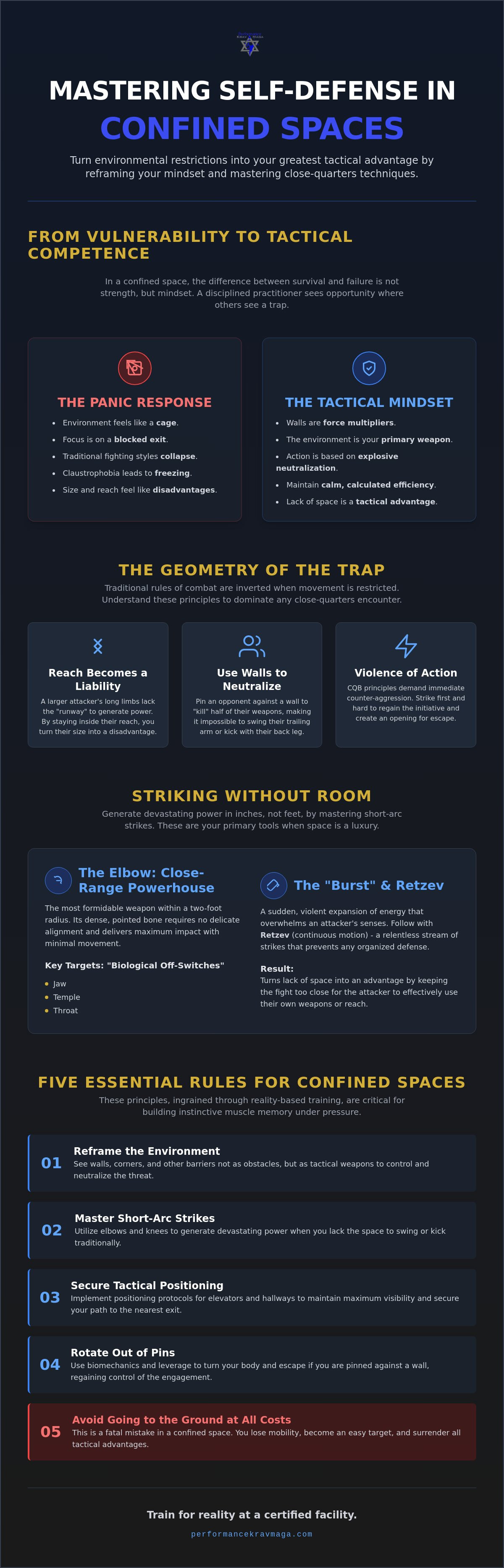
Confined space defense is the disciplined art of neutralizing a threat when you have zero room for retreat. In an open environment, your first instinct might be to create distance or escape. However, when you are backed into an elevator corner or pinned in a narrow hallway, the concept of "getting away" is physically impossible until the threat is removed. This shift in reality demands a total re-evaluation of your tactical priorities. Mastering self defense in confined spaces is not about fancy footwork; it is about the brutal efficiency of using the space you have to end the encounter immediately.
In these environments, traditional advantages like weight classes and reach often lose their significance. A larger attacker with long limbs actually faces a disadvantage in a tight corridor because they lack the "runway" needed to generate momentum for a full-power punch. When you occupy the space inside their reach, their size becomes a liability. The principles of Close-Quarters Battle (CQB) emphasize that speed and violence of action are the ultimate equalizers when movement is restricted. This is where the mindset of the "Quiet Professional" takes over. It is a state of calm, calculated efficiency where you do not panic at the lack of space, but rather treat the environment as a partner in your defense.
While sport fighting occurs on open mats with referees to break up a clinch, street reality involves walls, sharp corners, and heavy furniture. These are not just obstacles. They are tools. If you understand how to use them, a wall becomes a secondary weapon to pin an attacker's arm or a surface to drive their head against, ending the fight before it truly begins.
The Geometry of the Trap
Understanding "dead zones" is critical for survival. These are areas where your movement is restricted by physical barriers, such as the corner of an ATM vestibule or the space between parked cars. Instead of trying to find an exit that isn't there, you must use these barriers to limit the attacker's limb movement. By pinning an opponent against a wall, you effectively "kill" half of their weapons, making it impossible for them to swing their trailing arm or kick with their back leg. This tactical shift moves you from a mindset of evasion to one of explosive neutralization.
Psychological Pressure of Close Quarters
The sudden loss of personal space often triggers a claustrophobic "fight or flight" response that can lead to freezing. Developing situational awareness in transitional spaces, like stairwells or parking garage entries, allows you to identify a threat before the space closes in. You must train your brain to recognize that the wall behind you is a source of stability, not a sign of defeat. Krav Maga prioritizes immediate counter-aggression in tight spots because the luxury of time evaporates when you are physically pinned against an immovable object. By striking first and striking hard, you regain the initiative and create the opening needed to escape.
Biomechanics of Short-Range Power: Striking Without Room
Traditional martial arts often rely on the luxury of distance. They require a full hip rotation, a deep step, and several feet of clearance to generate meaningful impact. In the reality of self defense in confined spaces, those several feet don't exist. When your back is against a cold elevator wall or you're wedged between a car seat and a door, you must generate power in inches, not feet. This is the science of short-arc strikes. By utilizing rotational torque and explosive weight shifts rather than long extensions, you can produce enough force to neutralize a threat even when your range of motion is severely compromised.
Krav Maga solves the space problem through the "Burst" technique. This involves a sudden, violent expansion of energy that overwhelms an attacker's sensory input. It isn't just about one punch; it's about Retzev, or continuous motion. When you cannot disengage or create distance, you must stay "in the pocket," delivering a relentless stream of short-range strikes that prevent the attacker from mounting an organized offense. This approach turns the lack of space into a tactical advantage by keeping the fight so close that the attacker cannot effectively use their own reach or weapons.
The Power of the Elbow and Knee
Within a two-foot radius, the elbow is the most formidable weapon at your disposal. It is a dense, pointed bone that doesn't require the delicate alignment of a fist. By driving the elbow into "biological off-switches" like the jaw, temple, or throat, you can end a confrontation instantly. Similarly, the vertical knee strike is designed for zero-distance survival. When you're pinned against a surface, you don't need to wind up. Instead, you grab the attacker's head or shoulders, pull them into your space, and drive your knee upward into the groin or solar plexus. These movements are compact, efficient, and require almost no room to execute with maximum lethality.
Leverage Against the Wall
The environment acts as a force multiplier if you know how to use it. A wall isn't just a boundary; it's an anvil. By driving an attacker into a hard surface, the wall becomes a "second strike," causing secondary impact trauma that can disorient or disable them. You can also use the wall to stabilize your own base. Pressing your shoulder or back into a solid surface provides the "anchoring" effect needed to drive more power into your strikes without losing balance. The wall becomes the ground behind you, allowing you to push off and deliver strikes with your entire body weight. To see these principles in action, you can explore the curriculum at Performance Krav Maga, where we specialize in translating these technical mechanics into instinctive reactions.
Anchoring allows you to maintain a stable platform for striking even when your feet cannot move into a traditional fighting stance.
Common Scenarios: Elevators, Hallways, and ATMs
Real-world safety happens in the transitions. You spend significant portions of your day in hallways, elevators, and vehicles where self defense in confined spaces is the only relevant skill set. While some generic advice suggests simply "avoiding" these areas, a tactical professional recognizes that these spaces are often unavoidable. You must know how to navigate them with a clear, actionable plan. In these environments, the goal is to prevent the pin before it happens or to neutralize the threat instantly if the space has already closed.
Hallways are what tactical experts call "linear danger areas." Movement is funneled into a single track, which makes your path predictable. When walking through a corridor, maintain a position that allows you to see around corners before you reach them. If a threat materializes, don't wait to be backed into a dead end. Use the narrowness of the hallway to your advantage by intercepting the attacker early. By forcing them into the wall, you disrupt their balance and limit their ability to use both arms. At ATMs or in corners, your primary objective is pre-emption. Never let a stranger close the distance to the point where they can trap your back against a surface. If the space is closing, move laterally to clear the corner and regain your mobility.
The Elevator Protocol
An elevator is a mobile cage. Survival depends on three immediate actions. First, identify the control panel and position yourself near it, but keep your back toward a corner. This gives you control over the floors and ensures no one can get behind you. Second, maintain a non-aggressive ready stance. Keep your hands up near your chest as if gesturing naturally; this hides your readiness while keeping your hands close to your face for protection. Third, if grabbed in the small cabin, use the "plucking" technique. This involves hooking your fingers like a claw to violently strip an attacker's hands from your throat or clothing, followed immediately by the short-arc strikes that overwhelm their sensory input.
Seated Defense in Cars
Defending yourself while belted into a car seat is one of the most restrictive scenarios you can face. You are anchored in place, which severely limits your hip movement and striking power. To neutralize a threat from the passenger or back seat, you must use the vehicle's interior for tactical leverage. The steering wheel, headrest, and door frame can be used to brace your body or trap an attacker's limbs. Focus on driving your weight into the attacker rather than pulling away. Mindset is the deciding factor in these seconds. Developing the mental resilience to fight from a disadvantaged position is a core component of tactical self defense. You must be prepared to turn the very seat that restrains you into a stable platform for a violent counter-attack.
Neutralizing Grabs and Pins in Tight Spots
In a sport wrestling context, a pin is a momentary loss of position. In a stairwell or a crowded hallway, a pin is a life-threatening obstacle. While some grappling systems suggest out-wrestling an attacker to the ground, Krav Maga follows a different rule: never go to the ground if a wall or exit is available. Hard concrete surfaces and the lack of visibility in tight quarters make the floor a high-risk zone. Instead, you must learn to use biomechanics to rotate out of a larger attacker's pressure. By shifting your weight and creating a pivot point against the wall, you can redirect their force and slip behind them, turning the very surface they used to trap you into your primary tool for escape.
Effective self defense in confined spaces requires you to be comfortable with extreme physical proximity. When your back is obstructed, you cannot retreat to gather power, so you must find it in the rotation of your torso and the leverage of your skeletal structure. This is the "Quiet Professional" approach to violence: calm, calculated, and ruthlessly efficient. You aren't looking for a long-term engagement; you are looking for the "Space-Maker" strike. This is a violent, compact blow designed to buy you the one-second window required to reach a door or a stairwell.
Escaping the Wall Choke
When an attacker drives you into a wall with a choke, your airway is the priority. The "pluck and strike" methodology ensures immediate clearance. Use your hands like hooks to violently strip their grip while simultaneously driving a counter-strike into the throat or chin. If the attacker is significantly larger, small-frame strategies become essential. You can find these detailed in our women's self defense Egg Harbor City checklist. Focus on high-impact disruptions like groin strikes and eye gouges to break their concentration. These are not "dirty" moves; they're necessary tools for survival when your movement is restricted.
Bear Hugs in Hallways
A bear hug in a narrow hallway often leads to being lifted or moved against your will. To prevent this, immediately lower your center of gravity. Drop your weight as if sitting into a chair. This makes you significantly harder to move. Once anchored, utilize head butts and short-range knees to force a release. You don't need a full swing to cause damage. A sharp head butt to the nose or a repeated knee to the inner thigh will create the pain response needed to break their grip. Follow this with tactical footwork to regain the "outside" position, ensuring you are between the attacker and the nearest exit. To master these high-pressure techniques under the guidance of elite instructors, join our self-defense classes and start your journey from vulnerability to strength today.
Mastering Close Quarters in Egg Harbor City
Reading about tactics is a necessary start, but it isn't survival. When your back is pinned against a wall and your heart rate triples, your brain won't recall a paragraph from a screen; it will only recall what your body has practiced. In 2026, muscle memory is the only reliable commodity in personal safety. This is why self defense in confined spaces cannot be mastered through theory alone. It requires a live, controlled environment where you can feel the physical pressure of a partner and the literal restriction of a barrier. You must move the training from your head to your hands.
Performance Krav Maga serves as the national headquarters for the Krav Maga Federation (KMFA). Led by Chief Instructor Greg Dziewonski in Egg Harbor City, our facility is engineered for reality-based training rather than point-scoring sport. We focus on the transition from vulnerability to strength. You'll join a family-like community in Atlantic County where every student is on a disciplined, individual journey toward physical competence. We strip away the ego found in many gyms and focus ruthlessly on what works in the modern world. It is the voice of a bold innovator respecting tradition while prioritizing efficiency.
Stress Inoculation Training
Theory fails when the adrenaline hits. To ensure your techniques remain effective, we utilize stress inoculation training to simulate the exact environments discussed in this guide. We recreate the cramped conditions of elevators, narrow hallways, and tight corners right on our training floor. Through repetitive, pressure-tested drills, you move from feeling trapped to becoming formidable. This process desensitizes the panic response. It allows your tactical training to take over instinctively. For a deeper look at our specific curriculum, explore our guide to self defense classes Atlantic County for full course details.
Your First Step Toward Readiness
The hardest part of any training program is walking through the door for the first time. We've removed that friction entirely. No prior martial arts experience is required to begin your journey with us. Every elite practitioner in our building started as a beginner. In your first CQC session, you'll be welcomed into a professional environment where safety and efficiency are the primary goals. You'll learn the foundational movements of self defense in confined spaces alongside instructors who respect your pace and your progress. It's time to stop feeling like an easy target and start building the confidence that comes from competence. Join the elite community at Performance Krav Maga today.
Own Your Environment: From Vulnerability to Tactical Strength
True safety isn't found in avoiding tight spaces, but in possessing the technical competence to dominate them. You now understand that a wall is not a trap; it is a force multiplier that provides the stability and leverage needed to neutralize a larger threat. By mastering short-arc biomechanics and the specific protocols for "linear danger areas" like hallways, you've taken the first step toward total readiness. Self defense in confined spaces is a discipline that requires more than theory; it demands the muscle memory that only comes from dedicated, reality-based training.
At Performance Krav Maga, the national headquarters for the Krav Maga Federation (KMFA), we specialize in this transition from vulnerability to strength. Under the expert instruction of Greg Dziewonski, you'll engage in pressure-tested drills designed for all experience levels. Don't wait for a high-stakes encounter to discover if your skills work under stress. Build the instinctive reactions you need in a supportive, professional environment. Start Your Tactical Training in Egg Harbor City today. You have the potential to be your own best protector; it's time to unlock it.
Frequently Asked Questions
Is self defense in confined spaces different for smaller people?
Smaller individuals must rely more on biomechanical leverage and high-impact disruptions rather than raw strength. Because you lack the reach of a larger attacker, you must close the distance quickly and use rotational torque to generate power. This levels the playing field in tight quarters where size and reach are naturally mitigated by the lack of room. Focus on soft-tissue targets to end the encounter quickly.
Can I use Krav Maga if I'm pinned against a wall?
Krav Maga is specifically engineered for these high-pressure scenarios. You use the wall as a stabilizer for your own base while executing compact, short-arc strikes. Instead of fighting directly against the attacker's pressure, you utilize a pivot-and-rotate movement to redirect their energy. This allows you to clear your airway or limbs and regain the initiative even when your back is obstructed.
What is the best strike to use in an elevator?
The elbow strike is the most effective tool in a cabin with a two-foot radius. It doesn't require the extension of a traditional punch and delivers massive force through a dense bone. Targeting the jaw or temple with a horizontal or vertical elbow can neutralize a threat instantly. This compact movement is the cornerstone of effective self defense in confined spaces.
Do I need special equipment to train for confined space defense?
You don't need specialized gear, but you do need a realistic environment. Training involves using existing architecture like walls, door frames, and corners to simulate real-world traps. While basic protective gear is recommended for safety during drills, the primary requirement is a live partner. This provides the necessary physical resistance and pressure testing required to build genuine muscle memory.
How do I defend myself inside a car?
Use the vehicle's structural components to create leverage. If you're attacked from the passenger seat, drive your weight into the attacker and use the door frame or headrest to brace your strikes. Focus on soft-tissue targets like the eyes or throat. Because you are belted in, your power must come from explosive upper-body rotation and sharp, short-range movements rather than footwork.
Is it better to run or fight in a tight hallway?
Your priority is always to reach a safe exit, but you cannot run if your path is blocked. If the attacker is between you and the only door, you must fight to create an opening. Once you've landed a strike that disorients the threat, you immediately transition to an explosive escape. Fighting in this context is simply the means to achieve the goal of safe egress.
How long does it take to learn confined space defense basics?
You can learn the foundational mechanics of short-range striking and wall escapes in a single focused session. However, building the instinctive muscle memory required to perform under extreme adrenaline typically takes several months of consistent practice. Regular participation in reality-based drills ensures these techniques become a permanent part of your protective toolkit, allowing you to react without hesitation during a crisis.
Are there specific self-defense classes in Egg Harbor City for this?
Performance Krav Maga in Egg Harbor City offers specialized training that addresses these exact scenarios. As the national headquarters for the KMFA, we provide expert instruction led by Chief Instructor Greg Dziewonski. Our curriculum includes dedicated modules for self defense in confined spaces, ensuring students are prepared for the tactical realities of elevators, hallways, and other high-risk transitional environments found in daily life.


Comments