
Situational Awareness Training: The Ultimate Guide to Real-World Readiness (2026)

Your smartphone is the most effective weapon ever used against you, not because of its technology, but because it forces you to ignore the world around you. We’ve all felt that spike of anxiety in a crowded terminal or a dark parking lot, realizing too late that we’ve been walking with our heads down. It's a common struggle to feel disconnected and vulnerable in public, especially when you're unsure how to identify a threat before it happens. Through disciplined situational awareness training, you can bridge the gap between being a target and being a hard target.
This guide will show you how to reclaim your focus and transform your personal safety through active observation. You’ll master the mental skills needed to identify pre-attack indicators and make split-second decisions before a situation escalates. We will explore the mechanics of the OODA Loop, the discipline of Cooper’s Color Code, and how professional Krav Maga classes provide the physical foundation for real-world readiness. Recent data shows that 94.5% of participants in instructor-led awareness courses feel better prepared to observe their environment. By the end of this article, you will have a structured, logical path to maintaining a mindset of relaxed alertness in any setting.
Key Takeaways
Understand why active observation is your first and most critical line of defense in any personal safety strategy.
Identify the specific mental hurdles within the "Orient" phase of the OODA Loop that cause most people to hesitate during a crisis.
Shift your mindset from constant anxiety to a state of "relaxed alertness," allowing you to navigate public spaces with total confidence.
Implement simple, daily drills designed to keep your situational awareness training sharp and instinctive during your regular commute.
Learn how professional Krav Maga classes provide the necessary stress testing to bridge the gap between mental awareness and physical action.
Table of Contents
Defining Situational Awareness: More Than Just Looking Around
The Psychology of Safety: OODA Loops and Cooper’s Color Code
Paranoia vs. Preparedness: Finding Balance in Atlantic County
Practical Drills for Everyday Awareness: Training Your Instincts
Elevating Awareness at Performance Krav Maga in Egg Harbor City
Defining Situational Awareness: More Than Just Looking Around
Situational awareness is the mental architecture of survival. It isn't just a buzzword; it's the ability to perceive, understand, and effectively respond to your environment before a threat becomes a physical confrontation. This is the first and most critical line of defense in any serious self-defense strategy. Without it, even the most advanced physical skills are useless because you'll never see the attack coming. Effective situational awareness training shifts you from a state of "passive looking" to one of "active observation."
Most people move through public spaces in a "smartphone trance," a digital fog that has effectively lobotomized our natural survival instincts. We’ve traded our safety for a social media feed, making ourselves easy prey for anyone looking for a distracted target. Reclaiming your safety requires a return to disciplined observation. It means acknowledging that your environment is constantly providing data. You just have to be willing to see it.
The Three Levels of Awareness
True Situational Awareness operates on three distinct levels. Perception is the first stage, where you gather raw data through your senses without judgment. You notice the car idling at the curb or the individual standing too close in the elevator. Comprehension follows, where you synthesize that data to understand the "now." You realize the car has no driver and the person in the elevator is blocking the buttons. Finally, Projection allows you to predict what happens next. You anticipate the threat and create an exit plan before the first move is even made.
Why SA Fails: The Biological and Psychological Barriers
Even with situational awareness training, your brain can work against you. The most common hurdle is normalcy bias. This is the dangerous tendency to believe that because nothing bad has happened yet, nothing bad will happen now. It’s the voice that tells you the person following you is just going the same way. You must actively fight the urge to rationalize away potential danger.
Another barrier is cognitive tunneling. Under sudden stress, your vision and focus narrow, often blinding you to peripheral threats. This is why professional Krav Maga classes emphasize training under pressure; it teaches you to keep your "eyes up" when your body wants to look down. Finally, you must learn to trust your intuition. That "bad feeling" or "gut instinct" is actually your brain performing high-speed data processing based on patterns it recognizes before your conscious mind can catch up. If something feels wrong, it is wrong. Act accordingly.
The Psychology of Safety: OODA Loops and Cooper’s Color Code
Survival is a race against time, but the clock doesn't start when the first punch is thrown. It starts the moment a threat enters your environment. To win this race, you must understand the OODA Loop, a decision-making model developed by military strategist John Boyd. OODA stands for Observe, Orient, Decide, and Act. While this framework is a staple in Situational Awareness for Law Enforcement, its application in civilian life is the difference between being a victim and being a victor. The goal of situational awareness training is to cycle through these four stages faster than your adversary, effectively "getting inside" their loop to disrupt their plans.
Most people fail at the "Orient" phase. While you might observe something unusual, your brain filters that data through your previous experiences and biases. If you’ve never seen a pre-attack indicator, your brain might dismiss a threat as a simple coincidence. Fixing this requires building mental maps through consistent practice. You must train your mind to recognize patterns of aggression so your orientation is accurate and your reaction is immediate. The OODA loop is a continuous cycle of survival.
Mastering the OODA Loop for Civilians
Shortening your reaction time is the primary objective of high-level training. At Performance Krav Maga, we focus on stress-testing your decision-making. When you can orient yourself to a threat in milliseconds, you gain the initiative. You can also disrupt an attacker’s loop by changing the geometry of the encounter. Simply moving to a different position or making eye contact can force an aggressor to restart their entire OODA cycle, buying you the time needed to escape or engage. If you want to sharpen these mental gears, joining Krav Maga classes is the most efficient way to build tactical intuition.
Cooper’s Color Code: Your Internal Traffic Light
While the OODA Loop handles the "how" of decision-making, Cooper’s Color Code manages the "what" of your mental state. This system, developed by Jeff Cooper, categorizes your level of readiness into four distinct colors. Understanding these states is a cornerstone of effective situational awareness training.
Condition White: Total vulnerability. Your head is in your phone, and you're unaware of your surroundings. Avoid this state entirely when you are in public.
Condition Yellow: Relaxed alertness. This is the "quiet professional" state. You aren't looking for a specific fight, but you're scanning for anything out of place. This should be your default lifestyle.
Condition Orange: Specific alert. You’ve identified a potential threat. You are now formulating a plan: "If he does X, I will do Y."
Condition Red: The fight is on. Your mental trigger has been tripped, and you are executing your plan with total commitment.
Moving from Condition White to Condition Yellow isn't about living in fear. It's about living with intent. When you adopt Yellow as your baseline, you remove the element of surprise from the predator's toolkit. You become a difficult target simply because you are present and prepared.
Paranoia vs. Preparedness: Finding Balance in Atlantic County
A common misconception about situational awareness training is that it turns you into a paranoid recluse. In reality, the opposite is true. Paranoia is a state of constant, unguided fear that limits your life. Preparedness is a disciplined mental framework that grants you the freedom to move through the world with confidence. Being "on edge" is exhausting and unsustainable. Being "ready" is a quiet, professional state of existence that allows you to enjoy your surroundings because you know exactly how to read them. You aren't looking for trouble; you're simply scanning for the absence of the normal.
In Atlantic County, your baseline awareness changes depending on your immediate environment. The atmosphere of a quiet residential street in Egg Harbor City is vastly different from a high-traffic gas station or a crowded South Jersey shopping center. Developing a "baseline" means understanding what looks right in a specific location so you can immediately spot what looks wrong. It’s about recognizing the natural rhythm of your community. When you know the standard patterns of behavior for your local area, anomalies stand out like a flare in the night. This mental clarity removes the guesswork from personal safety.
The Baseline Strategy: Reading the Room
Every location has a unique signature. At a local grocery store, people are typically focused on their tasks, moving at a steady pace, and respecting personal space. At a transit hub, the baseline shifts toward faster movements and a sense of urgency. Spotting anomalies requires you to look for people who don't fit the established pattern. This might be someone loitering without an apparent purpose or someone whose body language is incongruent with the setting. Mastering these self defense basics is the first step toward total environmental mastery.
Pre-Attack Indicators: What Danger Looks Like
Predators rarely attack without a preliminary evaluation. They often perform "The Interview," a series of verbal or non-verbal tests designed to gauge your awareness and willingness to comply. They might ask for directions or the time just to see if you're distracted by your phone or easily intimidated. During this phase, watch for target glancing, where the individual repeatedly looks at your valuables or your exit routes. Grooming behaviors, such as touching the face or adjusting clothing, often signal the physiological stress of an impending confrontation. Trust your instincts. That "Gift of Fear" is your body’s way of validating a threat before your conscious mind can process the details. Don't ignore it.
Practical Drills for Everyday Awareness: Training Your Instincts
Knowledge without application is useless. You can read every tactical manual available, but situational awareness training only works if it's integrated into your daily routine. It's a perishable skill. If you stop practicing, your reaction time slows and your recognition of environmental baselines fades. Treat your daily commute in Egg Harbor City as a low-stakes training ground. This practice transforms passive travel into an active exercise in mental readiness, ensuring your instincts remain sharp when you actually need them.
One effective method is an adaptation of "Kim's Game," a classic memory drill used by scouts and elite units. Spend ten seconds looking at a storefront or a park bench, then look away. Try to recall five specific details: the color of a jacket, the number of cars, or the direction of the wind. This drill forces your brain to prioritize relevant data over background noise. Over time, your observation speed will increase, allowing you to process complex environments in seconds rather than minutes.
The "Exit Search" and "Three-Person" Drills
Start with the Exit Search. Every time you enter a building, immediately identify two exits that aren't the front door. This builds a mental map for escape before you even sit down. Next, use the Three-Person Drill. Pick three people in your vicinity and note one unique physical characteristic for each, such as a specific tattoo, a distinctive gait, or a brightly colored bag. Finally, play the "What If" game. Mentally rehearse your response to a sudden anomaly, like a fire alarm or an aggressive individual, to reduce hesitation during a real crisis.
Expanding Your Sphere of Awareness
You don't need to look like a security guard to be safe. Effective scanning is subtle and non-confrontational. Use your peripheral vision to monitor movement while keeping your head in a neutral position. This allows you to expand your sphere of safety without drawing attention to yourself or appearing aggressive. Utilize reflections in shop windows or car mirrors to monitor your "six" without physically turning around. Effective situational awareness training is about scanning for exits as much as scanning for threats. If you're ready to put these drills into practice under professional supervision, join our self-defense classes to pressure-test your skills in a controlled environment.
Elevating Awareness at Performance Krav Maga in Egg Harbor City
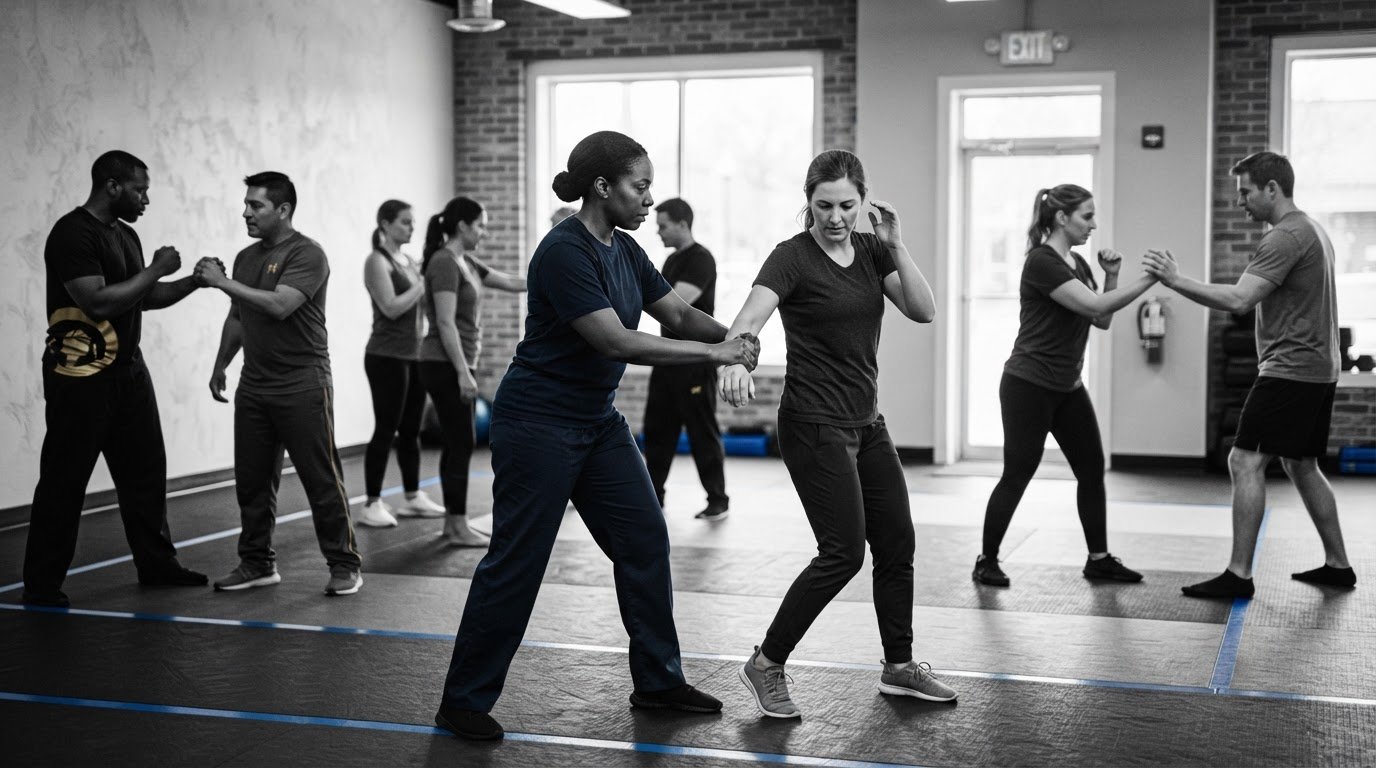
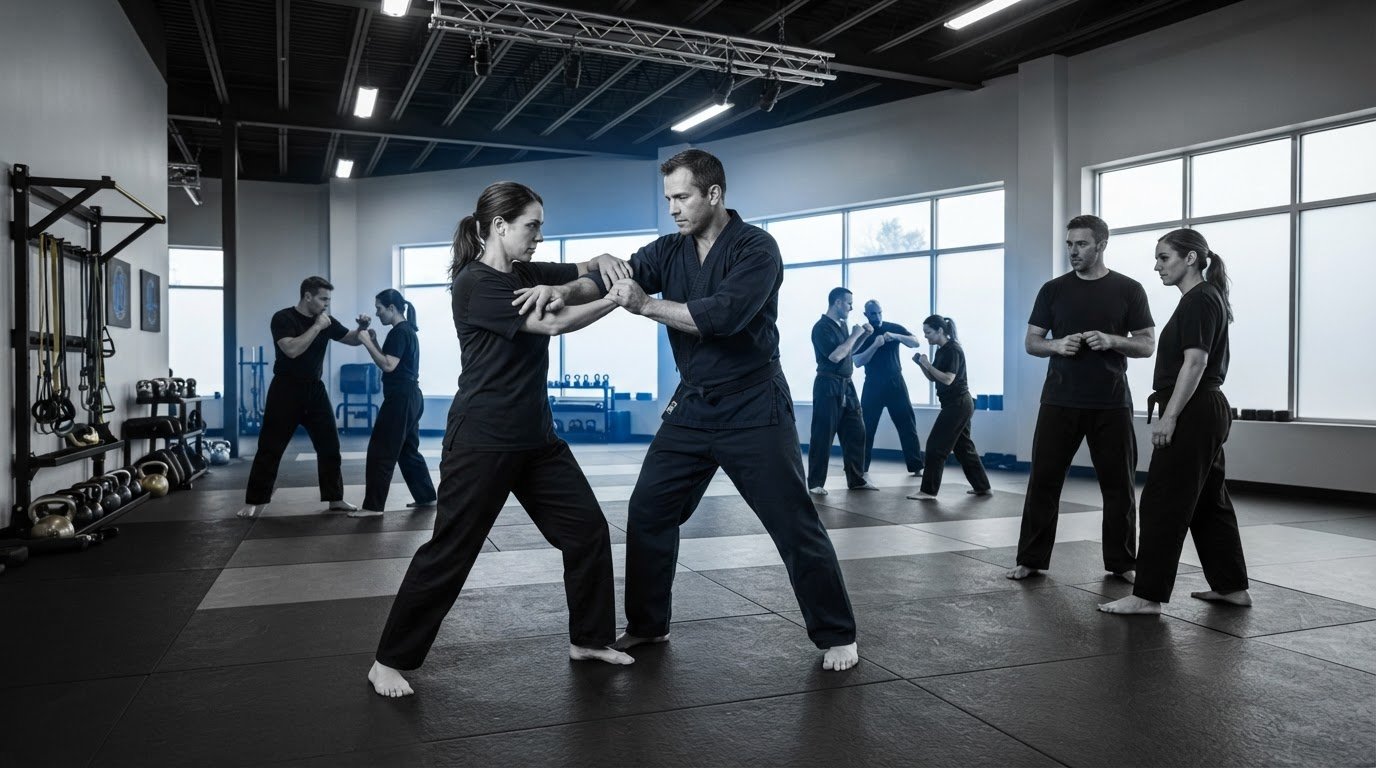
Mental drills provide the foundation, but they aren't the complete structure. Physical training serves as the ultimate stress test for situational awareness training. It's one thing to spot a threat in a calm environment; it's another to maintain that awareness when your heart rate is 160 beats per minute and your fine motor skills begin to degrade. At Performance Krav Maga, we bridge this gap. Our curriculum ensures that mental observation is woven into every physical movement we teach. You don't just learn to strike. You learn to scan, identify exits, and communicate effectively while managing the physiological effects of stress.
Transitioning from theory to tactical competence requires a environment that mirrors real-world volatility. While online courses can explain the mechanics of a threat, they cannot replicate the physical pressure of a human-on-human encounter. We focus on results. This means moving past the "what if" scenarios and into active, scenario-based training that forces you to make decisions in real time. This transition from vulnerability to strength is where true confidence is built.
The Krav Maga Edge: Mental and Physical Continuity
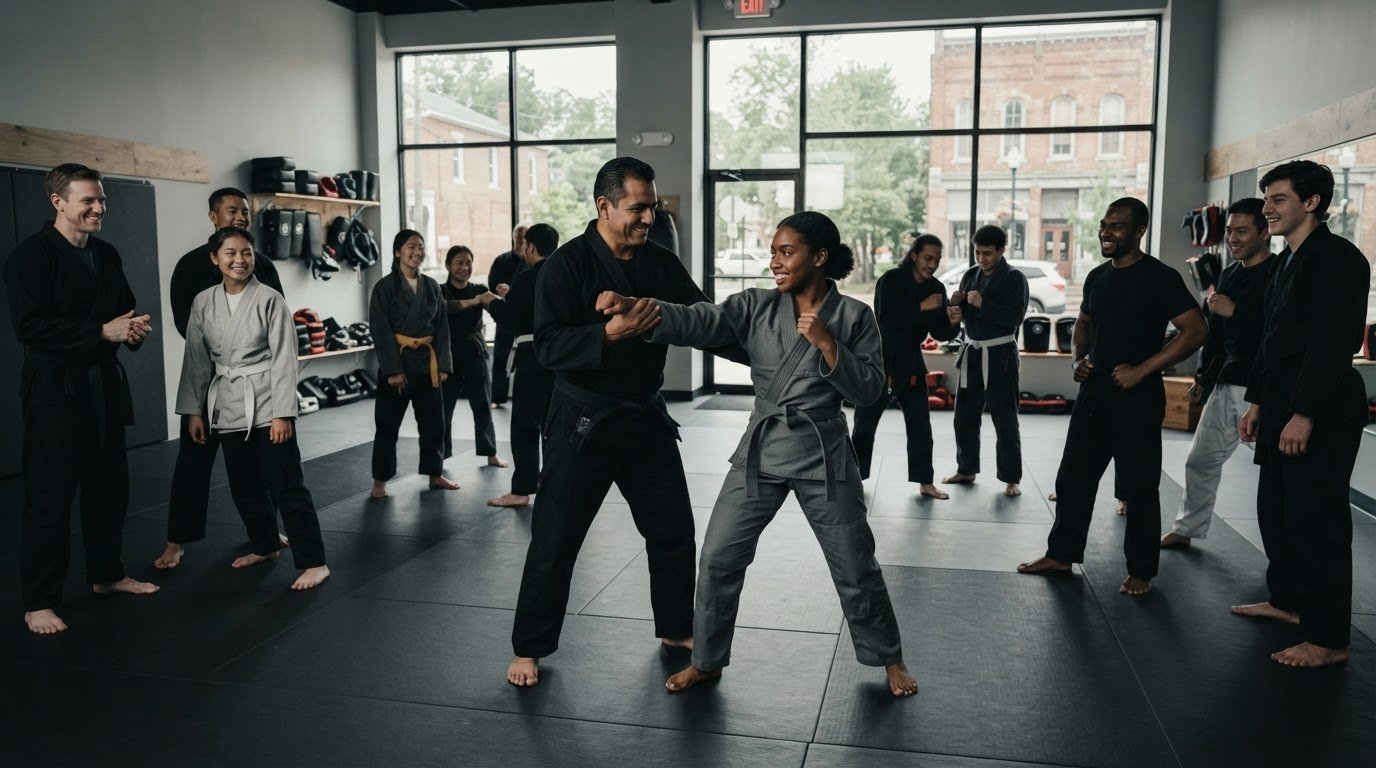
We use scenario-based training to pressure-test your OODA loop until your reactions become instinctive. In our self defense classes Atlantic County, the focus remains on the "quiet professional" vibe. There is no room for ego in our training. Instead, we emphasize developing formidable skills that remain accessible even when you're exhausted or surprised. This continuity between mind and body ensures that your situational awareness doesn't fail when the stakes are highest.
Join the Performance Family in Egg Harbor City
Our facility is led by Chief Instructor Greg Dziewonski, a 5th-degree black belt with a direct lineage to the founder of Krav Maga. We provide a supportive, family-like community where every student's individual journey is respected. In your first class, expect a focus on readiness and efficiency. You won't find flowery movements here; only utilitarian techniques designed to work in the modern world. We invite you to experience the psychological boost that comes from physical competence. Start your journey today and transform your awareness into a disciplined, life-saving skill.
Step into a Life of Tactical Readiness
Safety isn't a passive state. It's a discipline built through repetition and expert mentorship. You've explored the mechanics of the OODA loop and the importance of environmental baselines. By moving away from the digital fog and adopting a mindset of relaxed alertness, you reclaim the freedom to navigate any environment with total confidence. True competence requires more than reading. It demands that you pressure-test your instincts in an environment that mirrors real-world volatility.
Investing in situational awareness training is the most effective way to ensure you never become a soft target. Performance Krav Maga is the National Headquarters for the KMFA, offering authentic Israeli Krav Maga training led by Chief Instructor Greg Dziewonski. We provide the structured, logical path you need to transition from vulnerability to formidable strength. You possess the tools to identify threats before they escalate. Now, it's time to sharpen them.
Join an Elite Krav Maga Class in Egg Harbor City Today and take command of your personal safety. You've got what it takes to be ready for anything.
Frequently Asked Questions
Is situational awareness training just for military or police?
Situational awareness training is a foundational life skill designed for anyone who prioritizes their personal safety. While these methods originated in elite military and law enforcement units, they're equally effective for civilians navigating daily life. Predators look for easy targets who are distracted or unaware. By mastering these mental skills, you remove yourself from the "victim" category and gain the confidence to move through public spaces without fear.
How can I be more aware without looking paranoid or aggressive?
You can maintain high levels of awareness by adopting a state of "relaxed alertness" rather than one of active confrontation. This means keeping your head up and your eyes moving naturally without staring or appearing aggressive. Use your peripheral vision to monitor your surroundings and look for environmental anomalies. True professionals don't look like they're on guard; they simply look present and engaged with the world around them.
Can situational awareness actually prevent a physical fight?
Yes, situational awareness is your most effective tool for preventing a physical confrontation before it even begins. Most attacks require the element of surprise to be successful. When you identify a potential threat early, you gain the time needed to change your route, enter a secure building, or prepare a defense. Identifying pre-attack indicators allows you to "break the loop" of an aggressor and avoid the fight entirely.
How do I teach situational awareness to my children?
Teaching children awareness is best achieved through gamification rather than fear-based instruction. Play games like "I Spy" to help them identify exits in a restaurant or describe a person they just saw. This builds their observation muscles without causing unnecessary anxiety. Focus on teaching them to recognize "tricky behavior" rather than just "stranger danger," empowering them to trust their instincts when something feels out of place.
What is the most common mistake people make regarding their personal safety?
The most frequent mistake is the "smartphone trance" combined with normalcy bias. People often assume that because they're in a familiar or "safe" area, nothing bad can happen. This leads to total distraction by technology, which signals to a predator that you're an easy target. Breaking this habit requires a conscious decision to put the phone away and acknowledge that danger can manifest in any environment at any time.
Does situational awareness training require any special equipment?
No special equipment is required for situational awareness training because the primary tool is your own mind. You don't need tactical gear or expensive gadgets to observe your environment or identify exits. The focus is entirely on mental discipline and the ability to process information quickly. However, pairing this mental training with physical self-defense classes provides the necessary skills to act if your awareness identifies a threat you cannot avoid.
How long does it take to see results from situational awareness drills?
You'll likely experience a shift in your perception immediately after your first few drills, but building a permanent habit takes consistent effort. Most students report feeling significantly more confident and observant within the first few weeks of daily practice. Like any physical skill, awareness is perishable. It requires ongoing discipline to keep your instincts sharp and your reaction times fast enough to handle real-world challenges.
Comments