
Tactical Self-Defense: Beyond Gear to Elite Personal Readiness

What if the $65 assault pack and $90 multi-tool you carry are actually providing a false sense of security? It's a stark reality that while 29.8% of Americans now carry concealed handguns, a significant number still feel unprepared for high-stress, unpredictable environments. You've likely felt that gap between the gear you own and the confidence you need when a situation turns volatile. Owning the tools is only the first step; mastering the tactical self defense mindset is what actually keeps you safe.
This article promises to bridge that gap by showing you how to build elite personal readiness through disciplined training and situational awareness. We'll explore how to transition from a gear-reliant mindset to a "built-in" defense system that functions when tools fail. We'll also examine the vital differences between sport martial arts and real-world survival protocols, giving you a clear path to becoming your own most effective weapon. It's time to stop collecting equipment and start developing capability.
Key Takeaways
Reframe your perspective to prioritize a formidable defensive mindset over passive vulnerability.
Understand the mechanics of tactical self defense and why gross motor movements are more reliable than complex techniques during a crisis.
Avoid the common "knife fallacy" by ensuring your capability to retain and use tools precedes the purchase of hardware.
Master the tactical geometry needed to navigate multiple-attacker scenarios and protect loved ones in unpredictable environments.
Explore how the "quiet professional" approach to training at the KMFA National Headquarters bridges the gap between theory and survival.
Table of Contents
What is Tactical Self-Defense? Defining the Modern Capability
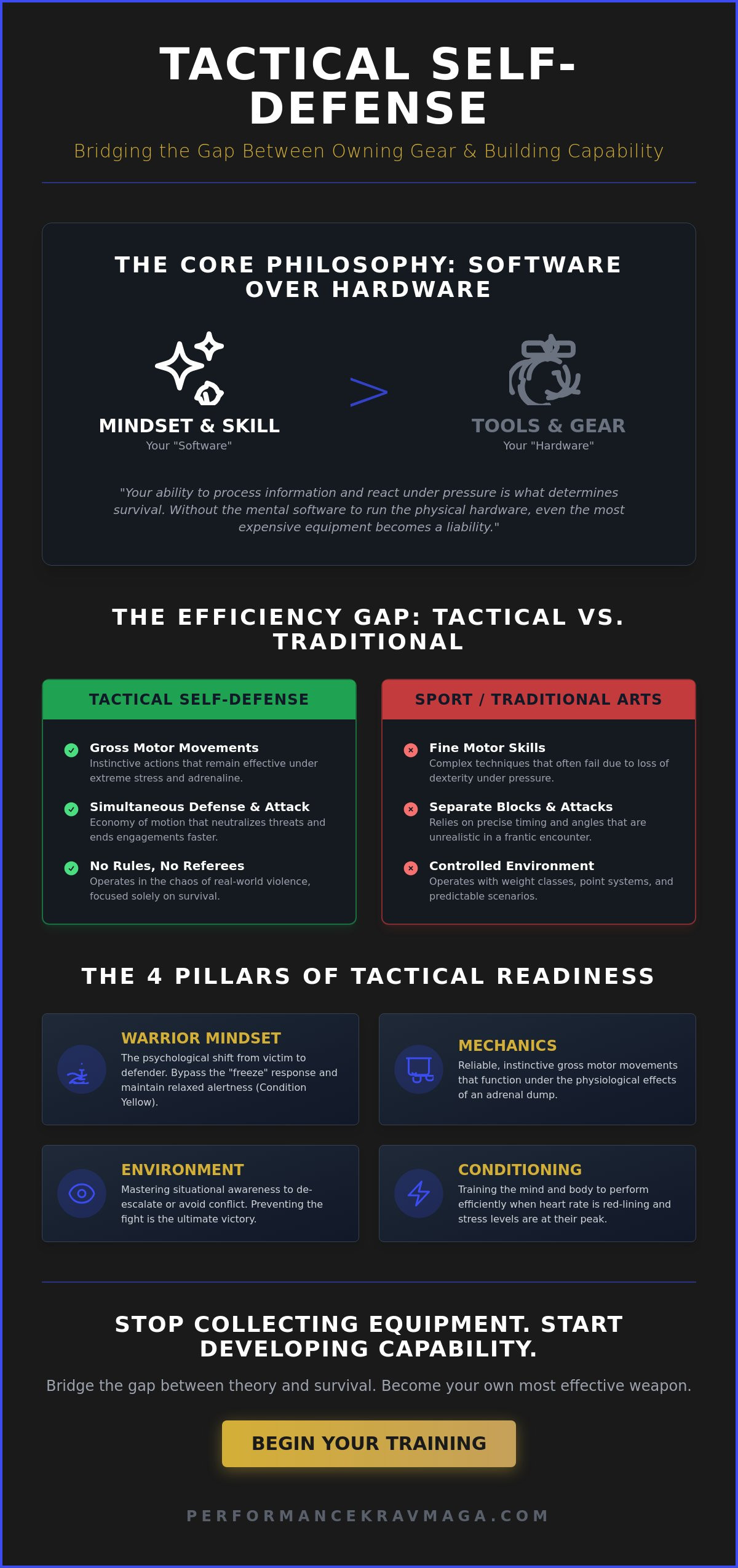
True tactical self defense is not a product you can buy or a kit you can strap to your belt. It is a refined capability that exists at the intersection of mindset, skill, and environmental awareness. While many gear manufacturers suggest that a rugged knife or a high-lumen flashlight equates to safety, these are merely accessories to the primary weapon: your brain. This "Software over Hardware" philosophy dictates that your ability to process information and react under pressure is what determines survival. Without the mental software to run the physical hardware, even the most expensive equipment becomes a liability in a crisis.
Unlike sport-based martial arts that rely on weight classes, referees, and point systems, tactical defense operates without rules. It also diverges from traditional martial arts that often prioritize rigid forms or historical rituals. In a real-world encounter, you don't have the luxury of a warm-up or a controlled environment. You need a system that works when the "adrenal dump" hits. This physiological response can cause loss of fine motor skills and tunnel vision. Because of this, tactical training focuses on instinctive, gross motor movements that remain effective even when your heart rate is redlining and your stress levels are at their peak. It's about building a system that is as reliable as it is ruthless.
The Evolution of Tactical Training
Modern survival strategies have moved far beyond the rigid battlefield techniques of the past. The shift began with the development of Israeli Krav Maga, a system designed for rapid deployment and high-pressure efficiency. It was born from the necessity of defending against immediate, life-threatening violence where there was no time for elaborate setups. As global threats have shifted toward unpredictable civilian environments, modern martial arts have had to evolve. This evolution prioritizes Situational awareness and the ability to adapt to multiple attackers or weapon-based threats. It's a transition from purely military application to a comprehensive personal readiness framework that anyone can master.
Tactical vs. Traditional: The Efficiency Gap
The gap between traditional styles and tactical systems becomes apparent the moment a conflict turns chaotic. Traditional blocks often rely on precise timing and specific angles that frequently fail in the frantic, high-speed reality of a street encounter. A tactical approach replaces these separate movements with simultaneous defense and attack. By neutralizing a threat while simultaneously delivering a counter-strike, you disrupt the attacker's momentum and end the engagement faster. This economy of motion is a hallmark of elite readiness. Tactical efficiency is the shortest path to safety.
The Pillars of Tactical Readiness: Beyond the Gear
Elite readiness is built on four distinct pillars that function independently of any tool you carry. While a high-end folding knife offers a psychological crutch, it cannot replace the physical mechanics or mental clarity required to survive an ambush. True tactical self defense relies on the synergy of mindset, mechanics, environment, and conditioning. If one pillar crumbles, the entire defensive structure fails. You must train to become the weapon, rather than relying on the one in your pocket. This transition is what separates the prepared individual from the mere gear enthusiast.
Developing the Warrior Mindset
The psychological transition from victim to defender is the most critical step in your journey. Most people live in a state of "unaware," which makes them easy targets for predators. By engaging in warrior mindset training, you prepare your brain to bypass the natural "freeze" response. You learn to operate according to Cooper's Color Code, specifically maintaining Condition Yellow: a state of relaxed alertness where you are aware of your surroundings without being paranoid. This mental hardening ensures that when a threat moves to Condition Red, your response is proactive and decisive rather than panicked. It's about refusing to be a victim long before a confrontation begins.
Situational Awareness: Preventing the Fight
Preventing a fight is the ultimate tactical victory. Predators look for signs of distraction, and the threat of modern technology to personal safety is real; phones and headphones create a "digital blindfold" that invites trouble. To maintain elite readiness in Atlantic County public spaces, follow these protocols:
Scan the hands of anyone approaching your personal space, as hands carry the immediate threat.
Identify at least two exits in every building or crowded area you enter.
Maintain a 360-degree perimeter check every few minutes to break "tunnel vision."
Recognizing pre-attack indicators, such as target glancing or weight shifting, allows you to maneuver out of danger before it crystallizes into a physical assault. This proactive positioning is a core component of tactical self defense that no piece of equipment can replicate.
Mechanics and Combat Conditioning
Under high stress, your fine motor skills will likely fail. Tactical defense utilizes gross motor movements: large, simple actions like palm strikes and hammer fists that are easy to recall when your heart is pounding. This physical efficiency must be backed by combat fitness. You don't need the physique of a bodybuilder, but you do need the anaerobic capacity to fight with 100% intensity for those critical first sixty seconds. If you're ready to test your limits, consider joining our self-defense classes to build this functional strength and ensure your body can follow the directives of your mind.
Tactical Tool Integration: Why Skill Must Precede Hardware
Carrying a high-end tool without the competence to retain it is simply providing your attacker with an upgrade. This is the "Knife Fallacy" in its most dangerous form. Many individuals believe that a $90 tactical folder or a rugged multi-tool provides an automatic layer of safety; however, hardware is merely a force multiplier for existing skill. If you lack the mechanics to keep that tool in your possession during a struggle, it becomes a liability. Effective tactical self defense focuses first on weapon retention, ensuring that any gear you introduce into a conflict stays in your hands and doesn't end up being used against you.
In the Krav Maga framework, your body is the primary delivery system. Whether you're holding a flashlight, a pen, or a dedicated defensive tool, the striking mechanics remain the same. Your hands and elbows are the only gear that's always "on" and never out of reach. By mastering gross motor movements like the hammer fist or the elbow strike, you develop a "built-in" weapon system that functions regardless of what you're carrying. Skill is the foundation. Hardware is the secondary support.
The Legal Realities of Tactical Defense
Possessing a tool also carries a heavy burden of responsibility. Understanding the core principles of personal protection means realizing that avoidance and de-escalation are your most important "tactical" assets. In New Jersey, the legal landscape is strict; as of June 2026, the state does not have a "Stand Your Ground" law. While the "Castle Doctrine" permits force within your home, you have a general duty to retreat before using deadly force in public if you can do so safely. Tactical training teaches you to use verbal commands as a primary tool to resolve conflict before physical intervention becomes a legal necessity. Showing that you've sought professional instruction demonstrates your intent to be a responsible, law-abiding citizen rather than an aggressor.
Weapon Defense and Disarms
Elite readiness also means knowing how to neutralize an aggressor who is already armed. Tactical defense utilizes the "360-degree" defense principle to handle unexpected threats from knives or blunt objects. This system prioritizes simultaneous defense and counter-attack to overwhelm the attacker's decision-making process. However, the most effective tool in your arsenal isn't a strike; it's distance management. By maintaining a tactical gap, you buy yourself the time needed to recognize a threat, deploy a verbal deterrent, or exit the area entirely. If you can't maintain distance, you must have the explosive capability to close it and neutralize the threat immediately. There is no middle ground in a high-stakes encounter.
Tactical Scenarios: Managing High-Stakes Encounters
Skill and hardware mean nothing if you're pinned in a corner or overwhelmed by numbers. In a real-world crisis, the environment is rarely a flat mat with clear boundaries. High-stakes encounters often involve multiple aggressors, confined spaces like elevators or cars, and the added pressure of protecting a loved one. True tactical self defense requires you to manage the geometry of the fight. You must move with purpose to prevent being surrounded and use the terrain to your advantage. Survival is not about winning a trophy; it's about creating an opening to escape safely.
Confined spaces demand a specific type of tactical movement. In a hallway or a vehicle, your range of motion is restricted, making traditional wide strikes ineffective. You must rely on compact, explosive movements like vertical elbows and knees. Similarly, while sport martial arts often celebrate ground fighting, a tactical mindset views the ground as a "death zone." Being on the floor makes you vulnerable to secondary attackers and limits your mobility. Your primary objective if you fall is to use tactical get-up techniques to return to your feet immediately. Staying mobile is staying alive.
Surviving the Multiple Attacker Scenario
Being outnumbered is a statistical nightmare, but it's a reality of modern violence. To survive, you must employ the "Stacking" technique. This involves moving constantly to keep the attackers in a single line, effectively forcing them to block each other. By "lining up" your opponents, you turn a three-on-one situation into a series of one-on-one engagements. You can find more granular details on these maneuvers in our guide to multiple attacker defense. Remember that your goal is an exit strategy. You are fighting to clear a path to the nearest door or safe zone, not to neutralize every person in the room.
Tactical Movement and Positioning
Elite positioning relies on the "Flanking" principle. This means moving to the "dead side" of an attacker—the side furthest from their secondary weapon or free hand. By staying off the center line, you force the aggressor to turn, which buys you a fractional advantage in reaction time. Once a threat is neutralized, the work isn't over. You must perform a "Tactical Scan" by looking over both shoulders to check for secondary threats or environmental hazards you missed during the initial tunnel vision of the fight. A tactical reset is mandatory after every encounter to ensure you are physically and mentally prepared for what comes next. If you want to pressure-test these scenarios in a controlled environment, join our Krav Maga classes and start building your capability today.
Elite Tactical Training in Egg Harbor City
Performance Krav Maga serves as the National Headquarters for the Krav Maga Federation (KMFA). This facility is more than a local training center; it is the definitive source for elite instruction in the region. Under the guidance of Chief Instructor Greg Dziewonski, the curriculum focuses on the "quiet professional" approach to personal safety. There is no room for ego here. Instead, the focus remains entirely on the student's ability to execute tactical self defense under pressure. This disciplined environment ensures that every minute spent on the mat translates directly to increased capability in the real world.
Residents across Atlantic County choose Performance for its no-nonsense reputation. In a landscape where many programs prioritize sport or ritual, our training remains ruthlessly focused on efficiency. We understand that your goal is to return home safely to your family. Because of this, we strip away the fluff and focus on the mechanics that work when you're tired, stressed, and outnumbered. It is a formidable standard of training that provides the psychological boost only physical competence can deliver.
The KMFA Pedigree: Authentic Israeli Roots
Lineage is the foundation of effective defensive training. The curriculum at our Egg Harbor City facility is rooted in authentic Israeli systems, ensuring that students receive the most direct and effective instruction possible. This pedigree matters because Krav Maga classes should never be watered down or modified for aesthetics. We teach battle-tested techniques that have been specifically adapted for New Jersey civilian life. This includes managing threats in public spaces while navigating the specific legal requirements of the state. You aren't just learning to fight; you're learning to survive within the modern world's constraints.
Joining the Performance Community
The atmosphere at Performance Krav Maga balances intense discipline with a supportive, family-like community. We believe that strength is built together. Whether you are a complete beginner or an experienced practitioner looking to sharpen your tactical self defense skills, you'll find a place here. In your first session, you can expect a high-energy environment that prioritizes safety and fundamental mechanics. We introduce you to immediate threat response and the "built-in" weapon systems discussed throughout this article. You'll leave your first class with more than just a workout; you'll leave with a new perspective on your own potential. Start your tactical journey at Performance Krav Maga today and bridge the gap between owning gear and possessing true capability.
Master Your Capability Today
Elite readiness is a conscious decision to prioritize capability over equipment. You've learned that true tactical self defense is built on a foundation of situational awareness and instinctive mechanics rather than just the tools in your pockets. By mastering the geometry of high-stakes encounters and refusing the "gear trap," you transform from a potential victim into a formidable defender. This capability stays with you when tools are out of reach or when technology fails. It is the ultimate insurance policy for your personal safety.
It's time to bridge the gap between theory and survival. Performance Krav Maga stands as the National Headquarters for the KMFA, led by Chief Instructor Greg Dziewonski. We have served Atlantic County and Egg Harbor City for years, providing the no-nonsense training required to navigate modern threats with confidence. Our community is built on mutual support and disciplined growth. Don't wait for a crisis to discover your limits. You deserve to walk with the confidence that comes from genuine competence.
Claim Your Intro Tactical Session at Performance Krav Maga and start developing a built-in defense system that never fails. You have the potential to be your own most effective weapon. We are ready to help you unlock it.
Frequently Asked Questions
Is tactical self-defense different from regular martial arts?
Tactical self-defense focuses entirely on real-world survival rather than competition rules or ceremonial forms. While regular martial arts often take place in controlled environments with weight classes and referees, tactical training prepares you for unpredictable, high-stress encounters. It utilizes gross motor movements and simultaneous defense and attack to neutralize threats quickly. The goal isn't to win a trophy; it's to ensure you return home safely regardless of the environment or the size of the aggressor.
Do I need to be in peak physical condition to start tactical training?
You don't need to be an elite athlete to begin your journey. Our programs are designed to build functional "combat fitness" regardless of your current starting point. The training focuses on movements that work for your specific body type and physical capabilities. As you progress, your conditioning will naturally improve, allowing you to sustain the high intensity required for short, violent engagements. We meet you where you are today and build your strength from there.
Can tactical Krav Maga help me if I already carry a self-defense tool?
Owning a tool is only half the battle; tactical Krav Maga provides the "software" to run that hardware. Training ensures you have the weapon retention skills to prevent your tool from being taken and used against you. It also teaches you the legalities of force and how to use your body as a primary delivery system. This bridges the gap between carrying gear and actually possessing a functional tactical self defense capability that works when tools are out of reach.
How long does it take to become 'tactically proficient'?
You will develop basic, life-saving proficiency within your first few months of consistent training. Tactical systems are designed for rapid absorption, focusing on natural instincts rather than complex, multi-step choreography. However, elite readiness is a perishable skill that requires ongoing refinement and pressure testing. Most students find that while they feel significantly more capable after just a few weeks, true mastery comes through long-term, disciplined practice in various realistic scenarios.
Is tactical training safe for beginners in Egg Harbor City?
Safety is our absolute priority at our Egg Harbor City facility. We utilize a structured, "quiet professional" approach that allows beginners to learn high-intensity techniques in a controlled and supportive environment. Every drill is supervised by certified instructors who ensure proper form and appropriate intensity levels. You'll be training alongside a community that values discipline and mutual respect, making it an ideal entry point for anyone serious about their personal safety.
What is the 'Warrior Mindset' and can it be learned?
The Warrior Mindset is the psychological transition from a passive state to one of proactive readiness and resilience. It is a trainable skill that involves learning to manage the "freeze" response and maintaining constant situational awareness. Through stress-exposure drills, you learn to stay calm and decisive when others panic. This mental hardening is a core component of tactical self defense, ensuring your mind remains your most powerful asset during a crisis.
Does Performance Krav Maga offer tactical seminars for groups?
We provide specialized seminars tailored for corporate teams, community groups, and families seeking a collective safety solution. These sessions focus on specific environmental threats and team-based situational awareness. By training as a group, you develop a shared language of safety and a coordinated response plan for high-stakes encounters. These seminars are an efficient way to introduce elite defensive principles to those who may not be able to attend regular weekly classes.
What should I wear to my first tactical self-defense class?
Wear comfortable, durable athletic clothing that allows for a full range of motion. A standard T-shirt and workout pants or shorts are ideal for your first session. Since the training involves movement and contact, avoid clothing with zippers, buttons, or jewelry that could cause injury. Most students train in clean athletic shoes or barefoot, depending on the specific mat requirements. The focus is on utility and movement, ensuring you can train effectively without obstacles.


Comments