
How to Learn Practical Fighting Skills Fast: The 2026 Tactical Guide

Violence doesn't wait for you to earn a black belt. If you want to learn practical fighting skills fast, you must abandon the idea that self-defense requires years of memorizing complex forms or sport-based rules. Most people feel a growing sense of vulnerability in public spaces, yet they're often overwhelmed by a sea of martial arts options that seem more focused on trophies than personal safety. It's a common fear that training will take a lifetime to become useful, but the reality of modern conflict demands a more efficient approach.
This 2026 tactical guide provides a clear, high-speed path to functional confidence. We'll show you how to leverage your body's natural instincts and gross motor skills to survive real-world encounters. You'll learn the most effective ways to recognize threats before they escalate, along with two or three high-probability techniques designed to stop common attacks instantly. By focusing on what works under extreme stress rather than aesthetic perfection, you can transform from a soft target into a prepared individual in a fraction of the time. We're stripping away the fluff to focus on the lean, utilitarian methods that keep you safe when it matters most.
Table of Contents
Why Traditional Martial Arts Take Years (and How to Shortcut the Process)
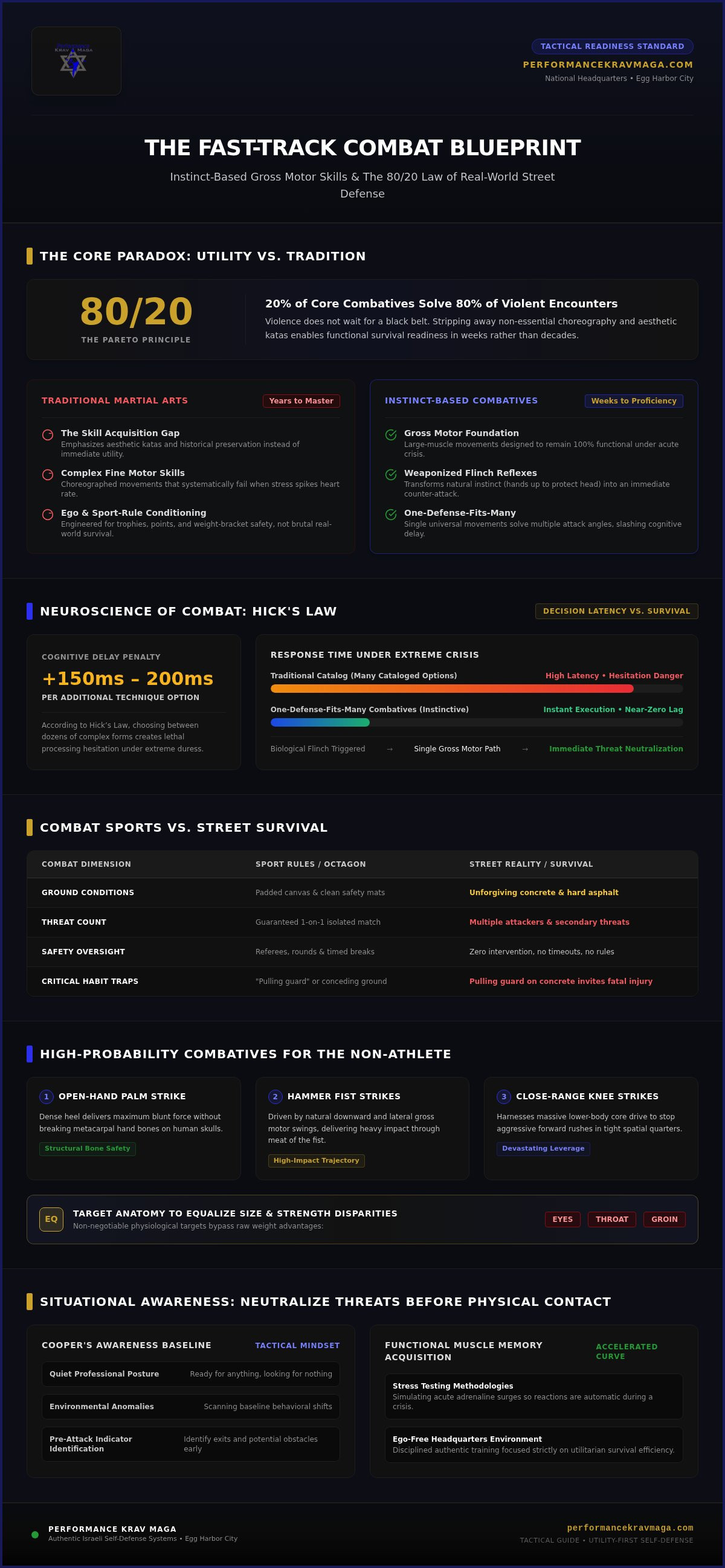
Practical fighting skills are instinctive actions used to neutralize threats immediately. Most traditional martial arts focus on "Art," which emphasizes aesthetics and historical preservation through complex katas. This creates a significant "Skill Acquisition Gap" for those who need to defend themselves tomorrow, not ten years from now. To learn practical fighting skills fast, you must prioritize "Utility" over tradition. Survival is about efficiency, not elegance.
Modern tactical training focuses on gross motor skills as the foundation for rapid mastery. These are simple, large-muscle movements that remain functional even when your heart rate spikes during a crisis. Research into military combatives systems shows that stripping away complex choreography allows students to reach functional proficiency in weeks. According to Hick’s Law, every additional technique you have to choose from increases your cognitive processing latency by 150 to 200 milliseconds. By narrowing your focus to a few high-percentage movements, you eliminate the hesitation that leads to injury.
The Difference Between Combat Sports and Street Survival
Combat sports operate within the safety of rules, referees, and weight classes. The street offers no such luxury. Many sport-based habits, like waiting for a referee to intervene or "pulling guard" on concrete, can be dangerous in a real encounter where multiple attackers may be present. Unlearning these sport-specific reflexes often slows down your real-world readiness. Instead, we utilize the "one-defense-fits-many" principle. This approach reduces cognitive load by using the same foundational movement to stop a variety of different attacks, ensuring you react instantly regardless of the specific strike coming your way.
Why Instinct-Based Systems Rule the Learning Curve
The fastest way to build competence is to refine the movements your body already makes. When someone throws a sudden strike at your face, you naturally flinch and bring your hands up to protect your head. This biological response isn't a mistake; it's the foundation of effective defense. Rather than fighting your nature, instinct-based systems weaponize these responses. This provides a massive psychological advantage because you aren't trying to remember a complex sequence while under extreme duress. You're simply executing a sharpened, aggressive version of a move you've known since birth. Practical self-defense is the shortest distance between a threat and safety.
The Core Skill Sets: The 20% of Techniques That Solve 80% of Encounters
You don't need a black belt to be formidable. A common misconception in the martial arts world is that safety requires a decade of dedication, but reality tells a different story. If you want to learn practical fighting skills fast, you must focus on the Pareto Principle: identify the 20% of techniques that resolve 80% of violent physical confrontations. These are known as combatives. We prioritize simple, high-impact strikes like palm heels, knees, and hammer fists because they're easy to learn and devastating to receive. Understanding the timeline of an attack is equally vital. By recognizing pre-attack indicators before a conflict turns physical, you can often neutralize a threat before the first strike is even thrown.
While physical prowess is important, soft skills often do the heavy lifting in street survival. Developing tactical situational awareness allows you to monitor your environment for anomalies and maintain a sustainable baseline of alertness in public spaces. This mental preparation ensures that if a conflict becomes unavoidable, you've already identified your exits and potential obstacles. It's about being a "quiet professional" who is ready for anything but looking for nothing. If you're ready to move from theory to practice, attending Krav Maga classes provides the structured environment needed to sharpen these instincts.
Striking for the Non-Athlete
For a beginner, the open-hand palm strike is far safer and more effective than a closed-fist punch. Punching a hard surface like a human skull often results in broken metacarpals, effectively ending your ability to defend yourself. Palm strikes use the dense heel of the hand to deliver shock while protecting your own structure. We teach students to target vulnerable points like the eyes, throat, and groin to level the playing field against larger attackers. Instead of relying on raw muscular strength, you'll learn to drive through the target using your body's natural weight and momentum. This makes your strikes powerful regardless of your athletic background.
Defending the Most Common Attacks
Violent encounters often involve circular attacks like wide punches or stabs. We utilize the 360-degree defense, a simultaneous block and counter-strike that uses your natural flinch response to create a protective shell. This method is the fastest way to learn practical fighting skills fast because it works against a variety of angles with a single movement. Additionally, mastering basic chokehold escapes is essential for survival. These techniques rely on leverage and mechanics rather than power, teaching you how to escape a choke hold by attacking the attacker's weakest point: their thumbs. By focusing on these high-probability scenarios, you build a functional defense system that works when you need it most.
Fast-Track Methodology: How to Build Muscle Memory in Weeks
Speed in a violent encounter is not just about physical velocity. It is about the time required for your brain to process a threat and trigger a response. To learn practical fighting skills fast, you must utilize a training methodology that prioritizes neurological consolidation over mere repetition. We employ the "Slow is Smooth, Smooth is Fast" principle. By practicing movements at a reduced speed with perfect form, you allow the nervous system to map the correct pathways without the interference of frantic, wasted energy. Once the mechanics are fluid, speed becomes a natural byproduct of efficiency.
This approach is backed by motor skill acquisition research, which indicates that the primary motor cortex requires specific conditions to move skills from conscious effort to subconscious reflex. High-frequency, low-complexity drilling is the catalyst for this transition. Rather than learning dozens of niche techniques, we drill a handful of high-utility movements until they become as natural as breathing. Scenario-based training then bridges the gap between the controlled environment of a gym and the unpredictable nature of the street, ensuring your skills don't evaporate when the environment changes.
The Power of Stress Drills
Static practice has limited utility in a real fight. When the adrenaline dump hits, your body undergoes massive physiological shifts, including tunnel vision and auditory exclusion. We use stress testing to simulate these conditions in a safe, controlled environment. By training under high levels of physical fatigue or sudden sensory overload, we force the brain to bypass hesitation and rely entirely on sharpened instincts. Twenty minutes of high-intensity stress-drilling is often more valuable than two hours of static punching at a bag. It teaches you to maintain composure and execute your defense while your heart is racing at 160 beats per minute.
Consistency Over Intensity
Skill retention is a product of frequency. We recommend the "Rule of Three": attending three classes per week provides the optimal balance for building muscle memory without overtaxing the body. This consistent exposure ensures that the "Warrior Mindset" stays at the forefront of your daily life. Mental preparation doesn't stop when you leave the mat. Visualizing potential scenarios during your daily commute or while walking through a parking lot reinforces your training and builds a deeper level of tactical self defense readiness. This combination of physical drilling and mental rehearsal is what allows a student to go from vulnerable to formidable in a matter of weeks.
Situational Awareness: The Skill That Wins the Fight Before It Starts
Violence is a sequence. It rarely happens without warning. To learn practical fighting skills fast, you must master the mental game of situational awareness. The most effective way to win a fight is to ensure it never begins. This starts with the OODA Loop, a tactical framework of observing, orienting, deciding, and acting. By processing information faster than an aggressor, you disrupt their decision-making process. If you can spot a threat from twenty feet away, you have time to escape, find a barrier, or prepare a defense. Not being there is the ultimate tactical advantage.
We utilize Colonel Jeff Cooper’s Color Code to define your state of readiness. Condition White is the state of total unawareness, often seen in people focused on smartphones or wearing headphones in public. You cannot afford to stay there. Your sustainable baseline should be Condition Yellow, a state of relaxed alertness where you're constantly scanning for anomalies. Condition Orange is a specific alert triggered by a pre-attack indicator, such as someone closing distance aggressively, target glancing, or flanking. Condition Red is the moment of action. Shifting through these states quickly is what separates the victim from the survivor.
Scanning Your Environment Like a Pro
Scanning is a deliberate habit. It begins the moment you enter a space. You must always identify at least two exit strategies, ensuring you never get pinned in a corner. Look for anomalies, the people or behaviors that don't fit the baseline of your current environment. For instance, if you're commuting on the NJ Transit Atlantic City Rail Line, someone wearing a heavy coat in mid-July is an anomaly. Use reflective surfaces like store windows or vehicle glass to maintain a 360-degree view without constantly looking over your shoulder. This positioning allows you to monitor your six while maintaining a forward-facing profile.
Verbal De-escalation and Boundaries
Physical defense is your last resort. Before things turn violent, use verbal de-escalation and the "Tactical Fence." This involves keeping your hands up in a non-aggressive, palms-out position. It creates a physical barrier while keeping your hands ready to strike if necessary. Use short, authoritative commands like "Stop" or "Stay back" to set clear boundaries and alert bystanders. Watch for the "Interview," a tactic where an attacker asks a seemingly harmless question to test your reaction and proximity. Recognizing these indicators allows you to shut down a threat before it escalates. If you want to develop these life-saving habits in a disciplined environment, join our self-defense classes to begin your journey toward total readiness.
Implementing Your Training in Egg Harbor City
Theory is a starting point, but physical competence requires a dedicated environment. To learn practical fighting skills fast, you must train in a facility that prioritizes real-world outcomes over sport-based accolades. Performance Krav Maga serves as the national headquarters for the Krav Maga Federation (KMFA), led by Chief Instructor Greg Dziewonski. This lineage ensures you are learning authentic Israeli Krav Maga designed for survival. Our "quiet professional" atmosphere removes the ego often found in traditional dojos, replacing it with a disciplined, family-like community. We focus on the transition from vulnerability to strength, ensuring every student feels both challenged and protected.
Instruction here is specifically tailored for the realities of South Jersey. Whether you are commuting along the White Horse Pike or navigating public transit, your training must reflect the environments you actually inhabit. We strip away the fluff of traditional arts to focus on the utilitarian movements that work in modern conflict. By training at the national headquarters, you gain access to high-level certification and a methodology that has been refined for decades. It is a structured, logical path to achieving the safety and confidence you deserve.
Finding the Right Training Environment
The wrong gym can actually hinder your progress. You should avoid "ego gyms" that prioritize trophies and flashy, non-functional movements. These environments often foster a "tough guy" culture that alienates beginners and ignores the psychological aspects of self-defense. Instead, look for an instructor with a verifiable lineage and a focus on accessibility. A true mentor carries their expertise without ego, focusing entirely on your individual journey. If you're looking for local Egg Harbor City details, our Krav Maga classes provide the definitive authority on practical defense in New Jersey.
Your First Steps to Becoming Formidable
First-class anxiety is normal, but it shouldn't be an obstacle. In your first 60 minutes, you'll be introduced to the foundational principles of stance, movement, and the palm strike. You don't need to "get in shape" before you start training. Functional fitness is a byproduct of the work we do on the mat. We build your conditioning and your defensive skills simultaneously, ensuring your body is as ready as your mind. We invite you to join a Krav Maga workout to experience how elite fitness and real-world readiness are forged in the same session. Your journey from curiosity to conviction starts with a single, low-friction invitation to participate.
Take Control of Your Personal Safety
Personal safety isn't a gift; it's a skill you build through disciplined, focused training. By stripping away the complex choreography of traditional arts and focusing on high-probability combatives, you can learn practical fighting skills fast. We've explored how sharpening your situational awareness and training under stress bridges the gap between theory and reality. You don't need years of practice to become a formidable protector of yourself and your family. You only need the right methodology and a commitment to the process.
Performance Krav Maga offers a reality-based curriculum at the KMFA National Headquarters. Led by Chief Instructor Greg Dziewonski, our program provides the expert instruction and ego-free environment necessary for rapid growth. Whether you're looking to build functional fitness or master life-saving defenses, we provide the structured path you need to succeed. Start your journey from vulnerable to formidable at Performance Krav Maga in Egg Harbor City today. You have the instinct; we give you the tools. Now is the time to step into your own strength.
Frequently Asked Questions
How long does it take to learn Krav Maga basics for self-defense?
Functional proficiency can be achieved in as little as 6 to 12 weeks of consistent training. Unlike traditional arts that require years of kata practice, our curriculum focuses on immediate utility. Students often feel a significant boost in confidence after their first few sessions. At our Egg Harbor City facility, we prioritize high-percentage threats to ensure you reach a baseline of safety quickly without wasting time on aesthetic movements or complex choreography.
Can I learn practical fighting skills fast if I'm not athletic?
Yes, because our system is built on natural biological responses rather than athletic prowess. You can learn practical fighting skills fast regardless of your current fitness level because we leverage gross motor skills and instinct. We don't expect you to get in shape before you start; instead, you build functional conditioning and defensive ability simultaneously during our classes in Egg Harbor City. This approach makes professional safety accessible for everyone.
What is the most effective martial art for street safety in 2026?
Authentic Israeli Krav Maga remains the definitive choice for modern street safety because it lacks the restrictive rules of sport-based systems. While combat sports like BJJ or Muay Thai are excellent for physical development, they often ignore multi-attacker scenarios or weapon threats. Our reality-based training at the KMFA headquarters focuses exclusively on neutralizing threats and escaping to safety in real-world NJ environments where rules, referees, and weight classes don't exist.
Is it possible to learn self-defense skills online or do I need a gym?
While online videos can introduce concepts, true muscle memory requires a physical training environment and a resisting partner. You cannot simulate the adrenaline dump or the physical pressure of a real encounter through a screen. Training at a dedicated facility like Performance Krav Maga ensures you receive expert correction from Chief Instructor Greg Dziewonski. This hands-on guidance is essential for developing movements that actually work under the extreme stress of a physical confrontation.
How often should I train to see real progress in my fighting skills?
We recommend training three times per week to achieve optimal skill retention and neurological consolidation. This frequency allows your body to recover while keeping the Warrior Mindset fresh in your daily life. Consistent exposure to our stress-drilling methodology ensures that your defensive reflexes become second nature. Regular attendance at our Egg Harbor City facility allows you to react without hesitation during a crisis, transforming your natural flinch into a decisive counter-attack.
What are the most common attacks I should learn to defend first?
Beginners should prioritize defending against circular strikes, common grabs, and front chokes. These represent a high percentage of physical altercations. Our curriculum focuses on the 360-degree defense and leverage-based escapes that don't require superior strength. By mastering these high-probability scenarios first, you build a functional foundation that addresses the most likely threats you might encounter in South Jersey. We ensure you have reliable solutions for the most common dangers immediately.
Are self-defense classes safe for beginners with no experience?
Absolutely. Our self-defense classes are designed to be accessible and welcoming to the uninitiated, fostering a family-like community where everyone supports each other's progress. We maintain a disciplined, ego-free environment where safety is the top priority. Every drill is scaled to the individual's current ability, ensuring you can challenge yourself and grow stronger without the risk of unnecessary injury. You'll find a supportive classroom environment that focuses on your individual journey from day one.
Do I need to buy special equipment to start learning Krav Maga?
You do not need any specialized gear to begin your training at Performance Krav Maga. Comfortable athletic wear and a willingness to learn are the only requirements for your first session. While we provide professional instruction and a world-class facility, we focus exclusively on teaching skills rather than selling equipment or supplies. This keeps your focus entirely on the physical and mental aspects of your development as you transition from vulnerability to strength.


header.all-comments