
Krav Maga vs Karate for Self-Defense: Tactical Reality vs. Traditional Art
- Greg Dziewonski
- Aug 11
- 11 min read

If you were cornered in an unlit parking lot tonight, would you rather rely on a centuries-old art form or a system designed for immediate survival? It's a heavy question that many people ask when they start feeling vulnerable in public spaces. You aren't alone in your confusion over which discipline is actually effective. Most people worry about wasting months on flashy moves that fail the moment a real confrontation begins. You want a disciplined environment where every minute of training counts toward your safety.
This guide breaks down the core differences of Krav Maga vs Karate for self defense to help you choose the right path for your personal protection. One is an art. The other is a tactical solution. While Karate emphasizes the beauty of traditional movement and competition, Krav Maga is a ruthless system built for the chaos of the modern world. We'll explore which methodology builds faster results and provides the psychological boost you need to handle physical threats with professional efficiency. You'll gain a clear understanding of how to transition from feeling exposed to standing with the formidable confidence of a trained protector.
Table of Contents
Krav Maga vs Karate: Defining the Goal of Your Training
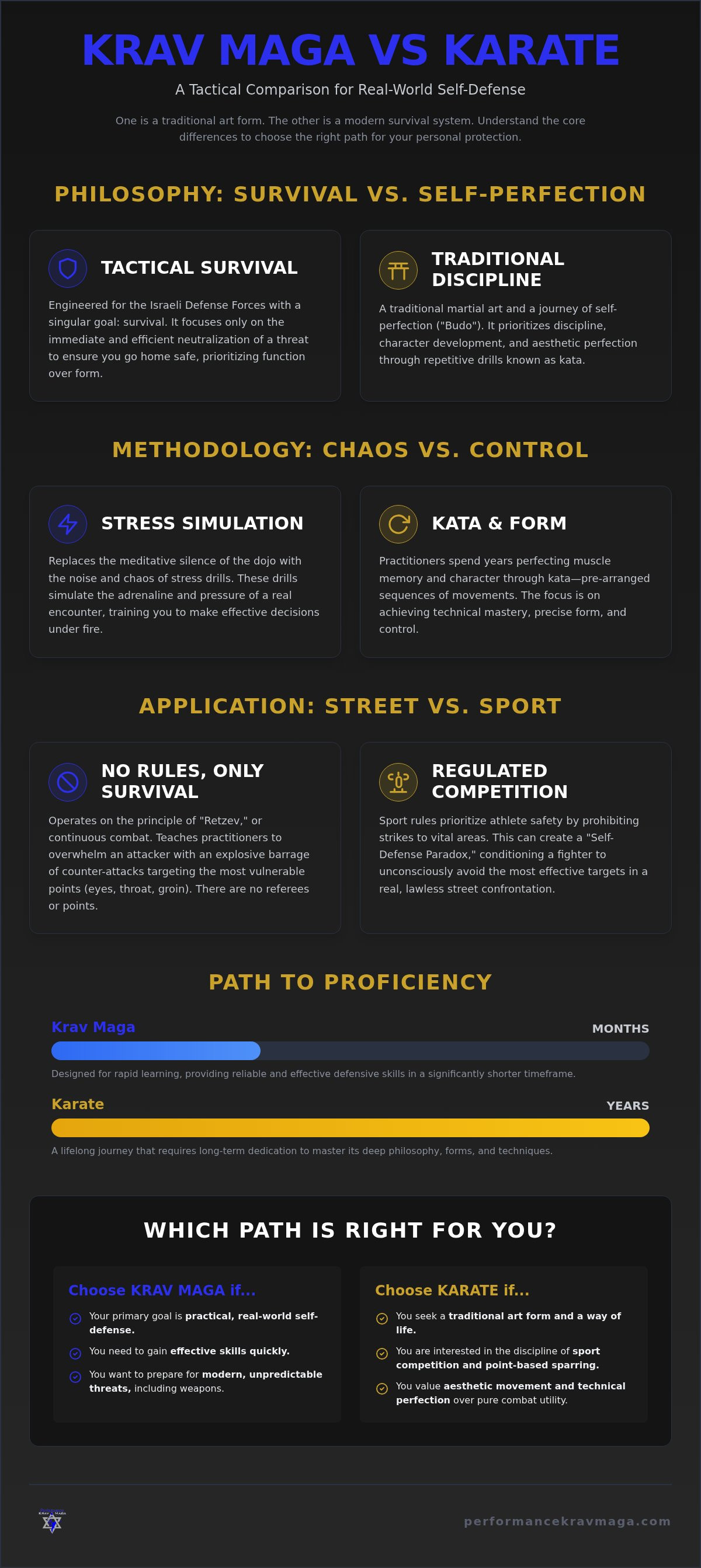
Choosing between Krav Maga vs Karate for self defense requires you to first identify your ultimate objective. Karate is a traditional martial art that prioritizes discipline, aesthetic form, and regulated sport competition. It's a journey of self-perfection where the student refines their character through repetitive drills known as kata. In contrast, Krav Maga is a tactical self-defense system engineered for the Israeli Defense Forces. It doesn't care about the beauty of a movement. It only cares about survival. While Karate focuses on the technical "how" of a strike, Krav Maga focuses on the immediate neutralization of a threat to ensure you go home safe. The Self-Defense Paradox occurs when the muscle memory developed for regulated sport competition creates hesitation that can be fatal in a lawless street fight.
The Origins of Karate: From Okinawa to the World
Karate began in Okinawa as a localized method of protection before evolving into a global phenomenon focused on character development. This history is rooted in the concept of "Budo," which transforms combat techniques into a path for self-improvement. The transition from a battlefield art to a regulated sport introduced referees and point systems. These rules prioritize speed and control over raw impact. This evolution emphasizes the "Do," or the way of life, where the martial artist seeks to master themselves through precise movements. While this builds incredible focus, it often distances the practitioner from the messy, unpredictable violence of modern reality.
The Origins of Krav Maga: Born in Conflict
Krav Maga emerged from the necessity of survival in pre-WWII Europe. Imi Lichtenfeld developed the system to help Jewish communities defend themselves against fascist gangs in the streets of Bratislava. He realized quickly that traditional boxing and wrestling weren't enough to handle multiple attackers or weapons. After moving to Israel, he refined these techniques for the IDF, creating a system that could be taught quickly to soldiers under extreme pressure. There is no sport version of Krav Maga. It remains a purely utilitarian tool designed for close-quarters combat where there are no points, no weight classes, and no referees to stop the fight. Every movement is calculated to end the encounter as fast as possible.
The Core Philosophies: Traditional Discipline vs. Tactical Survival
The environment where you forge your skills determines your readiness for a real-world threat. In a traditional Karate dojo, the atmosphere is defined by ritual, deep bows, and a focus on aesthetic perfection. This builds incredible character and discipline, but it can create a gap between the safety of the mat and the danger of the street. If you compare Krav Maga vs Karate for self defense, you'll find that Krav Maga replaces the meditative silence of the dojo with the noise and chaos of stress drills. These drills simulate the adrenaline dump of a real encounter, forcing you to make decisions under pressure rather than executing a pre-arranged kata.
Muscle memory is the foundation of any combat system, but the goals differ wildly. In the debate of Krav Maga vs Karate for self defense, the distinction often comes down to the "finish." Karate practitioners spend years perfecting the technical arc of a kick or the precise rotation of a punch. Krav Maga, however, prioritizes instinctive reaction over perfect form. You won't see high kicks or flashy movements in a tactical session because they are inherently risky. On a wet sidewalk or in a crowded hallway, a high kick compromises your balance and leaves you vulnerable. Krav Maga favors low, brutal strikes that are difficult to block and easy to execute under stress.
Rules vs. No Rules: The Fighting Mindset
A primary limitation of sport-based martial arts is the psychological boundary created by rules. In Karate, strikes to the groin, eyes, or throat are strictly prohibited to ensure the safety of the athletes. While this is necessary for competition, it can condition a fighter to ignore the most effective targets in a life-or-death situation. Krav Maga operates on the principle of "Retzev," or continuous motion. This philosophy teaches you to overwhelm an attacker with an explosive, non-stop barrage of counter-attacks until the threat is neutralized. You move from a state of vulnerability to strength by refusing to reset or wait for a referee's whistle.
Weapon Defense and Environmental Awareness
Traditional Karate is primarily an unarmed art, but modern threats often involve weapons. Krav Maga integrates defenses against knives, sticks, and firearms into its core curriculum from day one. You'll learn to identify exits and use common objects, like a chair or a bag, as makeshift shields. This comprehensive approach to tactical self defense ensures that your training is relevant to the dangers you might actually face in your community. Real-world readiness requires more than just knowing how to punch; it requires the ability to scan a room and recognize a threat before it reaches you. If you're ready to build these life-saving skills, you can join a community of disciplined protectors at a professional facility.
Street Effectiveness: Why Rules Change the Outcome
A common argument in the Krav Maga vs Karate for self defense debate is that traditional arts offer superior discipline. While Karate builds artistic discipline through the perfection of form, Krav Maga develops tactical discipline. This is the ability to maintain cognitive function and execute movement when your heart rate spikes to 180 beats per minute. Consider a surprise mugging in a dark Atlantic County alley. A Karate practitioner might instinctively look for a clean strike or wait for a clear opening, habits often reinforced by point sparring rules. A Kravist is trained to explode through the freeze response, using immediate, overwhelming aggression to create a window for escape. This focus on the adrenal dump is why many consider it the best martial art for self defense in urban environments where the rules of the dojo don't apply.
Dealing with Multiple Attackers
Karate is built for the duel. Its techniques assume a single opponent standing directly in front of you, which becomes a significant liability in a group assault. Krav Maga utilizes a technique called stacking. This involves physically maneuvering to keep one attacker between you and the others, effectively using your primary threat as a shield. The goal isn't to win a trophy or prove technical superiority. It's to survive and exit the area as quickly as possible. Tactical positioning is a requirement for survival, not an optional skill for a competition mat.
Ground Fighting and Escaping Holds
Traditional Karate is a stand-up discipline that lacks a comprehensive answer for what happens when you are tackled. Krav Maga recognizes that many violent encounters end up on the pavement, especially during a struggle for a purse or phone. Training focuses on escaping chokes, pins, and bear hugs from a disadvantaged position. This is a core component of women’s self defense Egg Harbor City programs, where students learn to use leverage and explosive movement to neutralize larger attackers. Staying on the ground is a death sentence in a street fight; Krav Maga gives you the tools to stand back up immediately.
Choosing Your Path: Factors to Consider for Personal Safety
Determining the right path depends on your timeline and your definition of success. If your primary concern is the immediate safety of your family on the streets of Egg Harbor City, the time-to-proficiency becomes your most critical metric. Karate is a beautiful, complex discipline that often takes years of dedicated practice before a student feels capable of applying techniques under pressure. Krav Maga was built for a different reality. It uses natural body movements and reflexive responses, meaning the basics can be internalized in just a few months. When comparing Krav Maga vs Karate for self defense, you must decide if you have years to wait for results or if you need a tactical edge by next season.
Physical conditioning also plays a major role in your choice. A traditional Karate class builds endurance through repetitive stances and high-volume striking drills. Conversely, the Krav Maga workout focuses on explosive power and functional strength, simulating the short, high-intensity bursts of a real struggle. This training builds a specific type of mental resilience; it's a warrior mindset that thrives in chaos rather than seeking the controlled environment of a tournament. You're training to be a quiet professional, ready for the unpredictable nature of the modern world.
Who is Karate Best For?
Karate is an excellent choice for individuals who value the historical lineage and artistic mastery of martial arts. It's particularly effective for children, as the structured environment of the dojo fosters long-term discipline, respect, and focus. The athletic rigor required for high-level Karate is impressive, offering a path to physical excellence for those who view combat as a sport or a method of self-perfection rather than a tactical necessity. If you enjoy the process of refining a single movement over a lifetime, the traditional dojo will feel like home.
Who is Krav Maga Best For?
Krav Maga is designed for the adult learner who prioritizes efficiency and practical results. It appeals to the efficiency-driven individual who wants to strip away the fluff and focus on what works in a parking lot or a public space. This utilitarian approach is why professionals in high-stakes fields often seek out self defense classes Atlantic County to ensure they are prepared for modern threats. If your goal is to build the confidence to handle a physical confrontation with professional-grade efficiency, you can start your training today at an elite facility.
Mastering Modern Self-Defense at Performance Krav Maga
Performance Krav Maga stands as the definitive authority for tactical training in South Jersey. Led by Chief Instructor Greg Dziewonski, our facility brings authentic Israeli defensive tactics directly to Egg Harbor City. While the debate of Krav Maga vs Karate for self defense often focuses on abstract concepts, we focus on the immediate application of survival skills. We provide a disciplined environment where the goal is clear: your safety. You won't find the ego often associated with "fight gyms" here. Instead, you'll enter a community that functions like a family, where every member is committed to the collective growth and protection of the group. This environment allows you to shed vulnerability and build a formidable presence through consistent, high-energy training.
The KMFA Advantage: National Headquarters Excellence
Training at the national headquarters for the Krav Maga Federation (KMFA) provides a level of instruction that is rare in the martial arts world. Our curriculum is not a collection of random moves; it is a structured, logical progression designed to take you from a beginner to a high-level protector. This methodology ensures that your progress is measurable and your skills are reliable under extreme stress. The "quiet professional" vibe of our center means that whether you are a corporate executive, a stay-at-home parent, or a first responder, you are welcomed with respect. We bridge the gap between traditional discipline and modern tactical reality, focusing on the removal of obstacles to your personal safety through efficient, instinct-based movements.
Start Your Journey in Egg Harbor City
The path from feeling vulnerable in public spaces to standing with formidable confidence begins with a single, low-friction step. We have removed the obstacles to starting your training, offering a welcoming entry point for those with zero previous experience in combat arts. When you evaluate Krav Maga vs Karate for self defense, you are ultimately choosing between a traditional hobby and a life-saving skill set. Taking the first step into our facility is an investment in your future readiness and psychological competence. You don't need to be in elite shape to start; you just need the willingness to learn and the discipline to show up for yourself. Join a community that prioritizes your survival and empowers your daily life with the tools of an elite protector.
Step Into Your Strength as a Modern Protector
Deciding between Krav Maga vs Karate for self defense ultimately comes down to your personal objective. If you seek a path of artistic perfection and traditional discipline, the dojo offers a lifetime of study. However, if your goal is the immediate ability to neutralize real-world threats and protect your family, a tactical system is the only logical choice. You've seen how sport-based rules can limit your effectiveness and how stress drills prepare your mind for the chaos of a street encounter. Training at the National Headquarters of the KMFA ensures you receive reality-based instruction that is both efficient and formidable. Under the expert guidance of Chief Instructor Greg Dziewonski, you'll join a family-like community focused on your individual journey from vulnerability to strength. Don't wait for a crisis to discover your limits.
Master your safety with elite Krav Maga classes in Egg Harbor City. It's time to build the instinctive readiness you need for the modern world. We look forward to seeing you on the training floor.
Frequently Asked Questions
Is Krav Maga harder to learn than Karate for a beginner?
Krav Maga is generally easier for beginners because it relies on natural body reflexes rather than complex, rigid stances. While Karate requires years of refining specific forms and aesthetic movements, Krav Maga focuses on gross motor skills. This allows a new student to internalize defensive movements much faster. You don't need to master the "art" to be effective in a tactical situation.
Can I use Karate for self-defense if I already have a black belt?
Yes, a black belt in Karate provides a strong foundation of striking power and timing. However, the transition to the street requires adapting those skills to a lawless environment. Sport-based habits, like pulling punches or stopping after a single strike, can be liabilities. In the context of Krav Maga vs Karate for self defense, the former teaches you how to bridge the gap between tournament rules and real-world survival.
Is Krav Maga too violent for someone who just wants to stay safe?
Krav Maga is as aggressive as the situation demands, focusing on the minimum force necessary to neutralize a threat and escape. While the training is intense, it's designed to build a protective mindset rather than promote violence. You learn to be a quiet professional who is capable of formidable action but prefers to avoid conflict entirely through situational awareness and de-escalation.
How long does it take to see results in Krav Maga compared to Karate?
You will typically see functional results in Krav Maga within three to six months, whereas Karate often requires years to achieve similar proficiency. Krav Maga’s curriculum is streamlined for rapid absorption, focusing on the most common street threats first. This efficiency-driven approach is ideal for those who don't have a decade to spend in a dojo before feeling confident in their personal safety.
Do I need to be in elite shape to start Krav Maga classes in Egg Harbor City?
No, you do not need to be an athlete to begin your training at Performance Krav Maga. Our classes are designed to build your physical conditioning as you learn the techniques. We meet you at your current fitness level and help you transition from vulnerability to strength. The focus is on technical efficiency, which often allows a smaller person to overcome a larger attacker.
What happens if I have to defend myself against a weapon in Karate vs. Krav Maga?
Traditional Karate rarely addresses modern weapon threats like knives or firearms in its core curriculum. Krav Maga integrates weapon defense from the earliest stages of training. You learn to redirect the line of fire or the path of a blade while simultaneously counter-attacking. This integrated approach ensures you aren't helpless when a confrontation escalates beyond empty-hand strikes. It's a fundamental shift in tactical preparation.
Are there age limits for starting Krav Maga at Performance Krav Maga?
We welcome students of almost all ages who are committed to their personal safety and growth. While the training is high-energy, it is adaptable to the individual's physical capabilities. Our family-like community includes young adults, professionals, and seniors alike. The goal is to provide every student with the tools they need to stay safe regardless of their stage in life. Safety is a universal human requirement.
Which system is better for women’s self-defense?
Krav Maga is widely considered superior for women's self-defense because it focuses on neutralizing larger, stronger attackers. It teaches you to use leverage, explosive movement, and strikes to vulnerable areas like the eyes and throat. When comparing Krav Maga vs Karate for self defense, Krav Maga's emphasis on escaping chokes and pins is specifically relevant to the types of assaults women are more likely to face.


Comments