
Overcoming Fear of Confrontation: A Tactical Guide
- Greg Dziewonski
- Aug 13
- 11 min read

True confidence isn't the absence of fear; it's the physical certainty that you can handle the consequences of speaking up. You know the feeling when a difficult conversation looms. Your heart hammers against your ribs, your hands shake, and your voice thins out. It's a physiological hijack that forces you to back down, leaving you with nothing but resentment and missed opportunities. Learning how to overcome fear of confrontation isn't about becoming aggressive or seeking out fights. It's about recalibrating your nervous system so you can stand your ground without the crushing weight of guilt or panic.
This guide provides a tactical framework to transform your response to conflict. We'll strip away the mystery of the "freeze" response and replace it with a disciplined, quiet professional mindset rooted in physical competence. You'll learn how to set firm boundaries and maintain your composure when the pressure mounts. By mastering the psychological and physical foundations of confidence, you will turn every confrontation into a tool for personal growth rather than a source of dread. We are moving from vulnerability to strength through readiness and a warrior mindset.
Table of Contents
Why Confrontation Triggers Your Fight-or-Flight Response
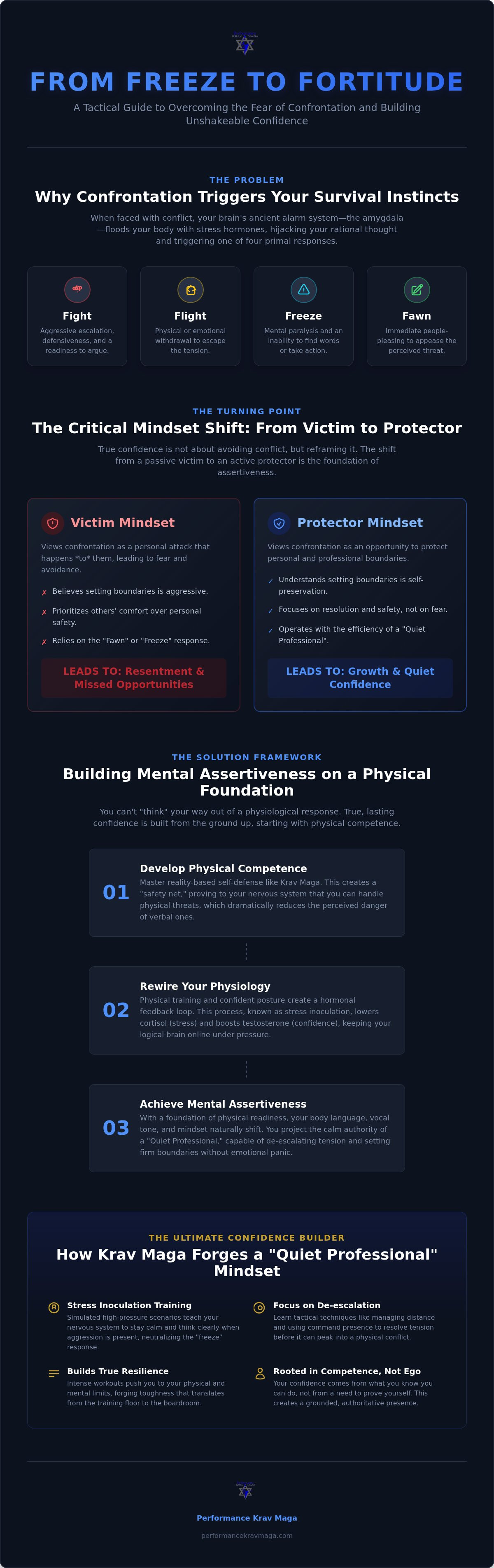
Your brain is an ancient survival machine. When someone raises their voice or challenges your boundaries, your amygdala, the almond-shaped alarm system in your temporal lobe, sounds the siren. It doesn't care that you're in a climate-controlled office; it perceives a threat to your social standing as a threat to your life. This trigger initiates the Fight-or-Flight Response, flooding your system with cortisol and adrenaline.
Suddenly, your heart races. Your hands tremble. You might experience "brain fog" as blood shunts away from your prefrontal cortex, the center for logical reasoning, toward your large muscle groups. This is why you often think of the perfect comeback ten minutes after the argument ends. Your biology literally locked you out of your own intelligence. Understanding how to overcome fear of confrontation begins with recognizing these four distinct survival patterns:
Fight: Aggressive escalation and immediate defensiveness.
Flight: Physical or emotional withdrawal to escape the tension.
Freeze: Mental paralysis where you feel stuck and can't find words.
Fawn: Immediate people-pleasing used to appease the perceived predator.
The Neurobiology of the Freeze Response
The freeze response is the most frustrating barrier for those seeking growth. During a freeze, your parasympathetic and sympathetic nervous systems fire simultaneously, creating a state of high-arousal immobility. You aren't being weak; your brain has simply decided that staying still is the safest path to survival. Stress inoculation is the tactical antidote to this biological hijack, involving controlled exposure to pressure to keep your decision-making centers online.
From Victim to Protector Mindset
Most people view confrontation as something that happens to them. This is the victim mindset. To truly master how to overcome fear of confrontation, you must reframe these moments as opportunities for protection. Setting a boundary isn't an act of aggression; it's an act of self-preservation that ensures your professional and personal safety. People-pleasing, often labeled as kindness, is frequently a fawning response used to avoid the discomfort of a perceived threat. Shifting to a protector mindset allows you to manage conflict with the efficiency of a quiet professional, focusing on resolution rather than fear.
The Physical Foundation of Mental Confidence
Mental assertiveness is a byproduct of physical readiness. Most people try to think their way out of anxiety, but your body usually sends the first signal before your mind can catch up. The "Safety Net" Principle suggests that when you possess the tools to defend yourself, the psychological urgency to fight actually disappears. You don't have to prove anything because you already know what you're capable of. Understanding how to overcome fear of confrontation requires this physical anchor. This shift fundamentally changes your body language and vocal tonality. Instead of a high-pitched, defensive tone, you develop a grounded, resonant voice that signals authority.
Research into the feedback loop between physical posture and hormones shows that expansive, upright positions can lower cortisol and boost testosterone. This isn't just a mental trick; it's a physiological shift. When you carry yourself like a "quiet professional," you project an energy that often prevents conflict from starting. Bridging the gap between the gym floor and real-world social interactions becomes natural when your confidence is rooted in competence rather than just positive thinking.
Why Krav Maga is the Ultimate Confidence Builder
Building a tactical self defense mindset involves more than just learning strikes. It requires desensitizing your brain to aggressive energy. In a controlled environment, you face simulated threats that mirror real-world intensity. This training floor exposure is a critical step in how to overcome fear of confrontation because it teaches your nervous system that aggression is just information, not an immediate death sentence. You learn to remain calm, adopting the "Quiet Professional" vibe that emphasizes readiness over ego.
Building Resilience Through Physical Training
The intensity of a Krav Maga workout is designed to build mental toughness by pushing you to your physical limits. When you are exhausted, your ability to think clearly becomes your most valuable asset. Learning to breathe and maintain focus under physical strain translates directly to high-pressure social or professional interactions. By mastering Verbal De-escalation Techniques while your heart rate is elevated, you ensure that "simulated stress" prepares you for real-world scenarios. If you want to experience this transformation firsthand, consider joining a training session at Performance Krav Maga to start building your foundation.
Verbal Self-Defense: De-escalating Tension Before it Peaks
Effective communication in high-stakes moments requires more than just the right words. It requires a tactical approach to managing human energy. Once you've built a physical foundation of safety, you can apply the three steps of tactical de-escalation: distance, tone, and resolution. Maintaining physical distance creates a buffer that protects your personal space and provides critical reaction time. Your tone should remain low and steady, projecting a "command presence" that signals you're in control without being aggressive. Finally, focus on resolution by offering a clear path forward that allows both parties to exit the conflict with their dignity intact. Mastering these steps is a core part of how to overcome fear of confrontation because it removes the unpredictability of the encounter.
Think of this as "Verbal Judo." Instead of meeting force with force, you redirect the other person's aggression. If someone is shouting, lowering your volume forces them to lean in and listen, effectively breaking their momentum. You aren't just talking; you're managing a dynamic situation. However, you must also identify the "point of no return." If the other person's body language shifts from verbal frustration to physical preparation, the time for talking has ended. Recognizing this threshold allows you to stay safe and maintain the upper hand in any environment.
Situational Awareness in Conversation
Mental clarity during a disagreement depends on your ability to read the environment. You must look for pre-attack cues such as target glancing, weight shifting, or a bladed stance. Even during a professional argument, you should maintain "exit awareness," knowing where the doors are and keeping your path clear. This is why situational awareness training is indispensable. It teaches you to process social cues as data points rather than emotional threats, which is essential for anyone learning how to overcome fear of confrontation in the real world.
The Power of the Strategic Pause
Reaction is instinctive; response is intentional. When tension peaks, the most powerful tool at your disposal is the strategic pause. By choosing not to speak immediately, you regain control of the conversation's rhythm and force the other person to sit with their own words. This silence creates a vacuum that the aggressor often feels compelled to fill, frequently revealing their true intentions or de-escalating their own tone. Tactical breathing is the secret to making this work. A deep, diaphragmatic breath stabilizes your vocal cords and prevents the high-pitched "shaky voice" that often accompanies anxiety. This simple physical act keeps your brain online and ensures you respond with the precision of a quiet professional.
Building Your Exposure Ladder Through Controlled Training
The training floor is a laboratory for the human spirit. It's the only place where you can safely replicate the high-octane stress of a real-world dispute without professional or personal fallout. If you want to know how to overcome fear of confrontation, you must experience it in a controlled environment first. This process is known as an exposure ladder. You start with basic technical movements and gradually increase the intensity until you're operating under significant pressure. Krav Maga classes provide this structure by offering real-time feedback on your presence and your ability to maintain composure when someone is in your space.
An elite mentor acts as the safety net for this transformation. They understand the psychological hurdles of the "freeze" response and guide you through the process of desensitization. This isn't about reckless aggression. It's about disciplined readiness. You learn to manage your adrenaline so that it becomes fuel rather than a paralyzing toxin. By facing simulated threats, you realize that the physical symptoms of anxiety are manageable data points rather than reasons to retreat.
Stress Inoculation Drills
Stress inoculation drills are designed to bridge the gap between theory and reality. For instance, the "Eyes Closed" drill forces you to react to a sudden stimulus, building pure instinct rather than over-calculated thought. You practice de-escalation while physically exhausted, which is the ultimate test of how to overcome fear of confrontation. When you can maintain a steady voice and clear boundaries after twenty minutes of high-intensity work, "Office Confidence" becomes a natural extension of your "Mat Confidence." You've already faced the worst case scenario on the mat; a difficult boardroom meeting is simple by comparison.
The Community Factor
You don't have to face this journey alone. Training with like-minded individuals in Egg Harbor City creates a unique culture of mutual respect and shared growth. The family-like environment at Performance Krav Maga ensures that every student feels supported as they push their boundaries. Group accountability is a powerful catalyst. It speeds up the process of overcoming social fears because you are surrounded by people who are equally committed to their own evolution. If you are ready to stop backing down and start standing up, book your first class today and experience the "quiet professional" difference for yourself.
Performance Krav Maga: Empowering Your Journey in Egg Harbor City
Performance Krav Maga stands as the national headquarters for the Krav Maga Federation (KMFA), positioning it as the definitive authority in South Jersey for real-world survival. Led by Chief Instructor Greg Dziewonski, the curriculum is designed to strip away the "sport" elements of martial arts and focus entirely on practical self-protection. For those seeking how to overcome fear of confrontation, this environment provides the exact stress inoculation needed to bridge the gap between anxiety and action. You aren't just learning to punch; you are learning to manage high-stakes pressure under the guidance of an elite mentor with a deep historical lineage.
In your first self defense classes Atlantic County, you will experience a structured path from beginner to formidable. The curriculum is logical and layered, ensuring that every movement you learn builds upon the last. We focus on efficiency and instinct, removing the obstacles that keep you from setting firm boundaries in your daily life. This transition from vulnerability to strength is a disciplined process that respects the tradition of Krav Maga while staying ruthlessly focused on what works in the modern world.
A Disciplined Approach to Personal Safety
Our instruction is unapologetically focused on real-world application. Training at the KMFA national headquarters means you are receiving the highest level of technical precision available. This isn't about trophies or points; it is about the "Warrior Mindset" necessary for personal safety. We offer tailored programs including women's self defense Egg Harbor City, which specifically addresses the unique social and physical threats women face. By training in a reality-based environment, you develop the psychological boost that comes from genuine physical competence.
Take the First Step Toward Confidence
The hardest part of your journey is walking through the door. At Performance Krav Maga, we maintain a strict "No Ego" policy. Everyone starts somewhere, and our community is a family-like environment where students support each other’s individual progress. You don't need to be in shape to start; the training itself will build the fitness and resilience you require. This is the most effective way to learn how to overcome fear of confrontation because it replaces theory with lived experience. If you are ready to trade your hesitation for a quiet professional confidence, Join a class today at Performance Krav Maga and begin your transformation.
Master Your Response and Own the Room
Overcoming the instinct to freeze requires more than just willpower. It requires a system. By understanding the biological triggers of your nervous system and building a foundation of physical readiness, you transform conflict from a threat into a manageable event. You've learned that "quiet professional" confidence isn't about aggression; it's about the certainty that you can protect your boundaries in any environment. Mastering how to overcome fear of confrontation is a tactical evolution that replaces hesitation with decisive action.
Performance Krav Maga, the national headquarters for the Krav Maga Federation (KMFA), offers the disciplined environment you need to forge this mindset. Under the guidance of Chief Instructor Greg Dziewonski in Egg Harbor City, you'll move through a structured curriculum designed for real-world results. This training serves Atlantic County by turning vulnerability into formidable strength. It's time to stop backing down and start standing your ground with conviction. Start Your Journey to Confidence with Krav Maga Classes and redefine what you're capable of achieving. Your transformation begins with the first step onto the mat.
Frequently Asked Questions
Why do I get so nervous during confrontation?
You get nervous because your brain interprets social conflict as a physical threat to your safety. This triggers a surge of adrenaline and cortisol that speeds up your heart rate and sharpens your senses. It's an evolutionary survival mechanism designed to prepare you for a fight or escape. Understanding this biology is the first step in learning how to overcome fear of confrontation. Once you recognize the symptoms, you can use tactical breathing to stay in control.
Can learning self-defense really help with social anxiety?
Learning self-defense builds a foundation of physical competence that directly combats social anxiety. When you know you can handle a worst-case physical scenario, the stakes of a verbal disagreement aren't as high. This "safety net" allows you to enter social interactions without the underlying dread of vulnerability. You develop a quiet professional presence that signals readiness, which naturally reduces the internal pressure to avoid conflict or please everyone around you.
How do I stop my voice from shaking when I'm angry or scared?
A shaking voice is caused by shallow, rapid breathing that tightens your vocal cords. To stop it, you must engage in diaphragmatic breathing to stabilize your core and regulate your oxygen intake. Don't let the panic take over; focus on exhaling slowly and grounding your feet firmly on the floor. This physical anchoring sends a signal to your brain that you are safe, allowing you to maintain a steady, resonant tone during the pressure of confrontation.
What is the 'fawn' response and how do I break it?
The fawn response is a survival strategy where you immediately please or appease an aggressor to avoid conflict. You break this cycle by practicing small, low-stakes boundary setting in a controlled environment. Training on the mat teaches you to prioritize your safety over the comfort of an attacker. As you build physical confidence, you'll find it easier to replace the impulse to pacify others with the ability to stand your ground and speak your truth.
Is it possible to learn to be assertive if I'm naturally shy?
Assertiveness is a tactical skill that anyone can develop through disciplined practice. It isn't about changing your personality; it's about expanding your toolkit for communication. Shy individuals often find that physical training provides the "internal permission" they need to be firm. By learning how to overcome fear of confrontation in a supportive classroom, you'll discover that being assertive is simply a matter of clear communication and maintaining your personal space with confidence.
How long does it take to build confidence through Krav Maga?
Most students report a noticeable boost in their confidence within the first four to six weeks of consistent training. This initial shift comes from learning basic, high-efficiency movements that provide an immediate sense of agency. However, deep transformations don't happen overnight. Over several months, the repeated stress inoculation of reality-based drills hardens your resolve and makes your calm, professional demeanor a permanent part of your character and warrior mindset.
What if I'm afraid of getting hurt in a self-defense class?
Safety is our primary objective on the training floor. We utilize a "No Ego" policy and structured drills to ensure every student can push their limits without unnecessary risk. You'll work with partners who are committed to mutual growth, and instructors provide constant supervision to maintain a professional environment. The goal is to build your resilience, not to cause injury. It's about learning to manage stress in a supportive and controlled classroom.
How do I set boundaries with people who are aggressive?
Setting boundaries with aggressive individuals requires "command presence" and clear, non-negotiable language. Maintain a bladed stance to protect your space and use a firm, low-volume tone to state your requirements. Avoid justifying or over-explaining your position, as this can signal weakness to an aggressor. By combining situational awareness with tactical de-escalation, you retain control of the interaction. You aren't asking for permission to have boundaries; you are simply stating that they exist and must be respected.


Comments