
Self Defense Against a Larger Attacker: Krav Maga Strategies for Size Disparity
- Greg Dziewonski
- Aug 10
- 12 min read

In a real-world confrontation, physics doesn't care how much you bench press. Most people walk through life with a deep-seated fear of being overpowered, assuming that a weight disadvantage is an automatic sentence of defeat. You've likely felt that surge of adrenaline and doubt when imagining a conflict with someone significantly larger. It's a common skepticism to wonder if traditional training actually holds up when the stakes are high and the opponent is massive. However, effective self defense against a larger attacker isn't about matching strength for strength; it's about exploiting universal biological "off-switches" that ignore weight classes entirely.
You don't need to be an elite athlete to protect yourself. You need the "quiet professional" mindset of Krav Maga. This guide will show you how to neutralize physical advantages through biomechanics and tactical targeting. We'll examine how to disrupt an attacker's balance and strike with precision at high-impact zones that don't require brute force to be effective. By focusing on efficiency and instinct, you'll discover a clear path toward professional training that replaces vulnerability with disciplined competence. Let's look at the methodology that turns size into a liability rather than an asset.
Table of Contents
The Physics of Danger: Why Size Matters (and Where It Fails)
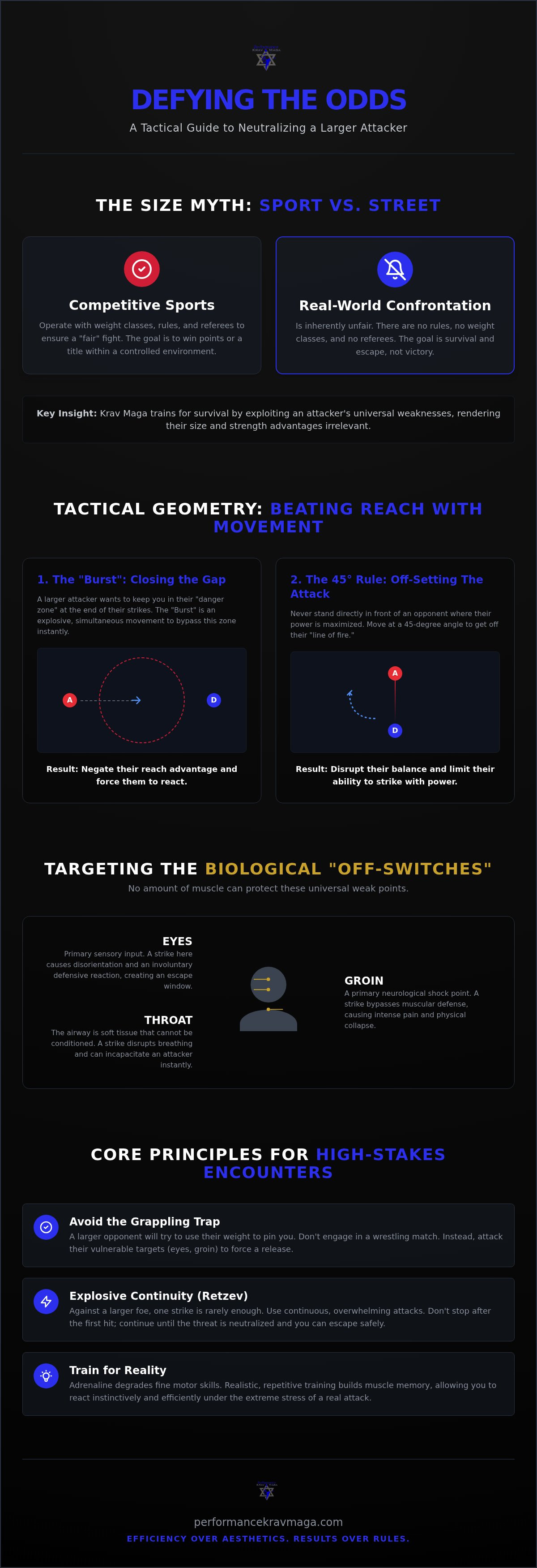
Size isn't just a number; it's a structural reality. Mass generates force, and longer limbs provide a significant reach advantage. In a vacuum, these are objective physical superiorities. However, the street isn't a vacuum. Combat sports like boxing, wrestling, or MMA use weight classes to ensure a "fair" fight, but effective self defense against a larger attacker relies on the fact that real-world violence is inherently unfair. We don't train to win a trophy or a belt. We train to survive and go home. This requires a shift from the competitive athlete's mindset to that of a "quiet professional."
The quiet professional doesn't meet aggression with ego. They meet it with cold, calculated readiness. Instead of trying to out-muscle a threat that outweighs you by fifty pounds, you must focus on neutralization. Your goal is to move from a position of vulnerability to a position of dominance by exploiting the mechanical flaws inherent in a larger frame. You aren't looking to "beat" them in a traditional sense; you're looking to shut down their ability to continue the assault. This is the core philosophy of Krav Maga: efficiency over aesthetics, and results over rules.
The Reach Advantage Myth
A taller, heavier opponent wants to keep you at the end of their strikes. This space is the "danger zone," where they can hit you while remaining safely out of your range. If you stay on the perimeter, you're playing their game. You must close the gap. By moving inside their reach, you negate their ability to generate full power through extension. This tactical entry, often called "bursting," forces the attacker to reset their balance and rethink their strategy. Movement is your primary shield. A stationary defender is a target, but a moving one is a complex problem that requires a larger attacker to constantly adjust their center of gravity.
Why Strength Cannot Protect Soft Tissue
No amount of weightlifting can strengthen a human eyeball or reinforce the cartilage of a throat. Biological "off-switches" are universal across all body types. While a larger attacker might have massive pectoral muscles or dense bone structure, their nervous system remains remarkably vulnerable. Krav Maga focuses on these high-percentage targets because they require very little force to produce a significant physiological response.
The Eyes: Vision is the primary sensory input for any attacker; disrupting it creates an immediate window for escape.
The Throat: The airway is a soft target that cannot be conditioned to resist pressure.
The Groin: This area serves as a primary neurological shock point that bypasses muscular defenses.
Krav Maga prioritizes the immediate neutralization of a threat through the most direct and efficient means possible, regardless of the physical size or strength of the aggressor.
Tactical Geometry: Beating Reach with Movement
Movement is life. A stationary target is a defeated target. If you stand your ground against a heavy-hitter, you're essentially providing them with a static punching bag. Effective self defense against a larger attacker depends on your ability to move with purpose. You must master tactical geometry. This isn't about running away in a straight line. It's about shifting the battlefield to a place where their size becomes a hindrance rather than a help.
The "Burst" technique is your bridge. It is an explosive, simultaneous movement that closes the distance instantly. It allows you to bypass the long-range strikes of a larger opponent and enter the close-quarters range where your lack of reach no longer matters. Before the first strike is even thrown, your posture dictates the outcome. We utilize a non-aggressive stance. Your hands are up and palms are open. You appear de-escalatory to bystanders but remain fully coiled for action. This posture hides your intent and allows you to transition into a defensive burst without telegraphing your movement.
The 45-Degree Rule
Standing directly in front of a larger opponent is a fatal error. This is where their power is maximized. You must step off the "line of fire" immediately. By moving at a 45-degree angle toward the attacker's "weak" side, you force them to rotate their entire mass to track you. This movement disrupts their center of gravity and prevents them from using their trailing hand or leg with full force. Footwork is the engine of survival in any high-stakes encounter.
Explosive Continuity
Against a massive size disparity, one strike is never enough. This is where the concept of Retzev, which means continuous motion, becomes critical. You must deliver an overwhelming barrage of strikes in a single, fluid heartbeat. By maintaining explosive continuity, you overload the attacker's nervous system. Their brain cannot process the defense because you are already delivering the next three strikes. This seamless transition from defense to offense defines the methodology of the quiet professional. If you want to build this level of instinctual response, joining self-defense classes in Egg Harbor City provides the structured environment needed to master these movements under pressure.
Targeting the Biological Off-Switches
In a high-stakes encounter, you can't afford to trade punches. Trading blows with a 250-pound aggressor is a losing strategy. Genuine self defense against a larger attacker relies on identifying targets that are physically incapable of being strengthened or armored. While a larger frame offers more muscle mass to absorb impact to the torso or limbs, it provides no protection for the neurological and respiratory "off-switches" of the human body. These targets are the ultimate equalizers.
We prioritize targets based on their probability of ending the fight instantly. This systematic approach ensures that every strike serves a tactical purpose. Secondary targets like the fingers, shins, and ribs are valuable for creating openings, but the primary focus remains on the areas that cause immediate physiological failure. However, we must also address the legal reality. In self defense against a larger attacker, the use of force must be reasonable and proportional to the threat. Your objective is to stop the aggression and escape, not to inflict unnecessary punishment once the danger has passed.
The Great Equalizers: Eyes and Throat
The throat is perhaps the most vulnerable area on the human body. Even a 300lb attacker cannot "flex" their windpipe to resist a focused strike. Impact here disrupts the respiratory system and triggers an immediate panic response in the brain. Similarly, attacking the eyes provides immense psychological shock. When an aggressor loses their vision, even momentarily, their offensive momentum evaporates. Unlike generic "dirty fighting" advice, we train to set up these strikes through the tactical movement discussed previously, ensuring you aren't just reaching blindly but striking with precision under stress.
Attacking the Base (Knees and Balance)
A larger person's weight is their greatest weapon, but it is also their greatest liability. Their stability depends entirely on the integrity of their base. Low, oblique kicks to the shins or lateral pressure applied to the knee joint can compromise that stability instantly. The knee is a hinge joint; it is not designed to handle significant force from the side. By attacking the base, you force the attacker to focus on their own balance rather than their assault. Attacking the base is critical because compromising the attacker's center of gravity forces their weight to shift, creating the necessary structural instability for you to break a pin and regain mobility.
Escaping the Clinch: When Size Tries to Pin You
If a 250-pound aggressor grabs you, they are trying to dictate the terms of the fight. They want to use their mass to anchor you and limit your mobility. The number one rule in self defense against a larger attacker is simple: don't play their game. You aren't a wrestler, and you aren't trying to score points on a mat. Engaging in a prolonged grappling match with a significantly heavier opponent is a recipe for exhaustion and structural injury. You must treat every grab as a temporary obstacle to be cleared with immediate violence of action.
We utilize "plucking" techniques to clear the airway or break a grip. Instead of trying to pry fingers off with raw strength, you use explosive, hooked movements to rip the attacker's hands away from your throat or clothing. Crucially, your defense and offense must happen simultaneously. You don't escape and then strike. You strike while you are escaping. When practicing self defense against a larger attacker, a well-placed knee or palm heel strike during the transition prevents the aggressor from immediately re-grabbing and keeps them on the defensive. This creates the necessary space to reset or disengage entirely.
The Bear Hug Escape
When an attacker wraps their arms around you, your first priority is to drop your center of gravity. You must become heavy. By widening your stance and sinking your hips, you make it significantly harder for them to lift you off the ground. Once you've established a stable base, use the tools closest to the target. Deliver sharp head butts to the face or repetitive groin strikes to force a release. For a deeper look at the mechanics of clearing your airway, you can read about how to escape a choke hold and other high-pressure situations. Space is your objective; strikes are the means to achieve it.
Ground Survival Basics
The ground is the most dangerous place to be when facing a size disparity. Gravity and mass work entirely in the larger person's favor. Your primary goal is to get back to your feet immediately. If you find yourself on the floor, use your legs. Your quadriceps and glutes are your strongest muscle groups. Keep your feet between you and the attacker at all times. Use defensive kicking to target their shins or knees, creating a window of opportunity to perform a technical stand-up. You aren't looking to "win" a ground fight. You're looking for the exit.
Mastering these transitions requires consistent practice in a controlled environment. If you're ready to build these survival skills, consider enrolling in Krav Maga classes to train with experts who understand how to handle real-world violence.
Training for Reality in Egg Harbor City
Theory ends where the pavement begins. You can study every mechanical principle of self defense against a larger attacker, but without physical repetition, your body will likely freeze when the adrenaline spikes. Stress inoculation is the only way to ensure your response is instinctual. At Performance Krav Maga, we move beyond the "what" and focus intensely on the "how." Our philosophy is built on elite-level methodology delivered to the everyday person. We don't train for the ring or for points. We train for the high-stakes reality of the world outside our doors.
Your first session isn't about being perfect. It's about starting the transition from vulnerability to strength. You'll enter an environment designed to build your "Warrior Mindset." This isn't about raw aggression; it's about a disciplined refusal to be a victim. You'll learn to maintain focus while your heart rate climbs. This ensures that the biomechanics and tactical entries we've discussed become second nature rather than something you have to "think" through during a crisis. Efficiency is born in the classroom and perfected through repetition.
The PKM Community Advantage
Training at our national headquarters in Egg Harbor City provides more than just technical skill. Under the guidance of Chief Instructor Greg Dziewonski, you join a family-like community that values progress over ego. Our Krav Maga classes are specifically structured to simulate the chaos of real-world stress. We use controlled, high-pressure drills to test your ability to execute self defense against a larger attacker in real time. This is where theory becomes survival. You'll find that the formidable confidence you build on the mat carries over into every aspect of your daily life, providing a psychological boost that is just as valuable as the physical techniques.
Take the First Step Toward Readiness
Readiness is a choice. You don't need a background in martial arts or a specific fitness level to begin. Our programs are designed to be accessible to everyone, regardless of their starting point. The path to competence starts with a single decision to show up and do the work. We invite you to experience our training firsthand with a trial class at our facility. Stop wondering if you could handle a threat and start knowing that you can. Join our elite community and start your training today.
Master Your Response to Any Threat
Physical size is a biological advantage, but it isn't an absolute one. By mastering tactical geometry and targeting universal biological vulnerabilities, you can effectively navigate self defense against a larger attacker without relying on brute strength. You've learned that closing the gap negates reach and that continuous, explosive motion disrupts the center of gravity of even the most massive aggressor. These aren't just theories; they're the practical foundations of a system built for the real world.
True readiness requires more than reading. It demands the stress inoculation found only in a professional environment. As the national headquarters for the Krav Maga Federation (KMFA), Performance Krav Maga offers a disciplined, ego-free space to hone these skills under the guidance of Chief Instructor Greg Dziewonski. We focus on results, efficiency, and the transition from vulnerability to formidable strength. Don't wait for a crisis to test your limits. Enroll in Egg Harbor City's Elite Krav Maga Training and build the confidence that comes from genuine competence. You have the tools to survive; now it's time to sharpen them.
Frequently Asked Questions
Is Krav Maga really effective for a smaller person?
Yes, Krav Maga is specifically designed for smaller individuals to overcome larger aggressors. It relies on biomechanics and targeting biological vulnerabilities rather than brute strength. By focusing on simultaneous defense and attack, a smaller defender can disrupt the momentum of a heavier opponent. This system prioritizes efficiency, making it the premier choice for self defense against a larger attacker in real-world environments where weight classes don't exist.
Do I need to be in great shape to start self-defense training?
You don't need to be an elite athlete to begin your journey. Training at Performance Krav Maga is designed to build your physical competence and cardiovascular endurance over time. The techniques themselves rely on leverage and instinctual movement rather than raw power. Whether you're a complete beginner or an experienced practitioner, the focus remains on practical application and the transition from vulnerability to formidable strength.
What is the most important target on a larger attacker?
The most effective targets are the eyes, throat, and groin. These areas represent biological "off-switches" that cannot be strengthened through weightlifting or conditioning. Impacting these zones causes an immediate physiological response that bypasses the attacker's size and strength. By focusing on these high-percentage targets, a defender creates the necessary window to escape a dangerous situation and seek safety without needing to match the opponent's mass.
How long does it take to learn basic self-defense against size disparity?
You can learn basic, life-saving techniques within your first few weeks of consistent training. While mastery of complex scenarios takes years of dedicated practice, the fundamental principles of self defense against a larger attacker are designed to be intuitive. Most students report a significant increase in their confidence and situational awareness after just a handful of sessions. This rapid progress is a hallmark of the Krav Maga methodology.
Can women effectively defend themselves against much larger men?
Yes, women can and do successfully defend themselves against much larger male aggressors using Krav Maga. The system emphasizes using the strongest parts of your body against the weakest parts of theirs. By combining tactical movement with aggressive targeting of soft tissue, women can neutralize the physical advantages of reach and weight. Our classes provide a supportive environment where women can build the mindset needed to prevail in high-stakes encounters.
What should I do if a larger attacker pins me to the ground?
If you are pinned, your primary objective is to create enough space to regain your mobility. Don't waste energy trying to out-wrestle a heavier person. Use your hips to create leverage and your legs to keep the attacker at bay. Target the attacker's face or groin to force them to shift their weight, then perform a technical stand-up to get back to your feet and exit the situation immediately.
Are there self-defense classes near Egg Harbor City for beginners?
Performance Krav Maga in Egg Harbor City offers specialized classes tailored for beginners of all experience levels. Our facility serves as the national headquarters for the Krav Maga Federation (KMFA) and provides authentic Israeli training. We focus on real-world safety and practical self-protection. Beginners are welcomed into a family-like community where ego is checked at the door and the focus is entirely on your individual growth and safety.
What is the difference between Krav Maga and traditional martial arts for size disparity?
Traditional martial arts often focus on sport, rules, or aesthetic forms, whereas Krav Maga is ruthlessly focused on efficiency. In a street confrontation, there are no referees to stop a larger attacker from using their weight. Krav Maga removes the "sport" aspect and focuses on ending the threat as quickly as possible. This includes using environmental objects and targeting areas that are typically banned in competitive martial arts.


Comments