
The Psychological Edge: Best Martial Arts to Improve Mental Toughness in 2026
- Greg Dziewonski
- Aug 14
- 11 min read

True mental toughness isn't a personality trait; it's a physiological state forged through calculated stress. Many people find themselves paralyzed by anxiety during high-pressure professional meetings or sudden physical confrontations, feeling as though their focus has simply vanished when they need it most. You aren't alone in this struggle. We understand the weight of that powerlessness and the desire to replace it with a disciplined, "quiet professional" confidence that doesn't falter under fire.
In this guide, you'll discover how specific reality-based martial arts to improve mental toughness can literally rewire your brain for resilience. Recent 2026 research indicates that disciplined combat training significantly elevates psychological control and challenge dimensions compared to traditional exercise. We'll examine the top disciplines for 2026, the science of stress inoculation, and how internalizing these tactical skills creates a warrior mindset that carries over into your daily life. Prepare to transition from vulnerability to an unbreakable sense of readiness and improved decision-making when the stakes are highest.
Table of Contents
Defining Mental Toughness in Martial Arts
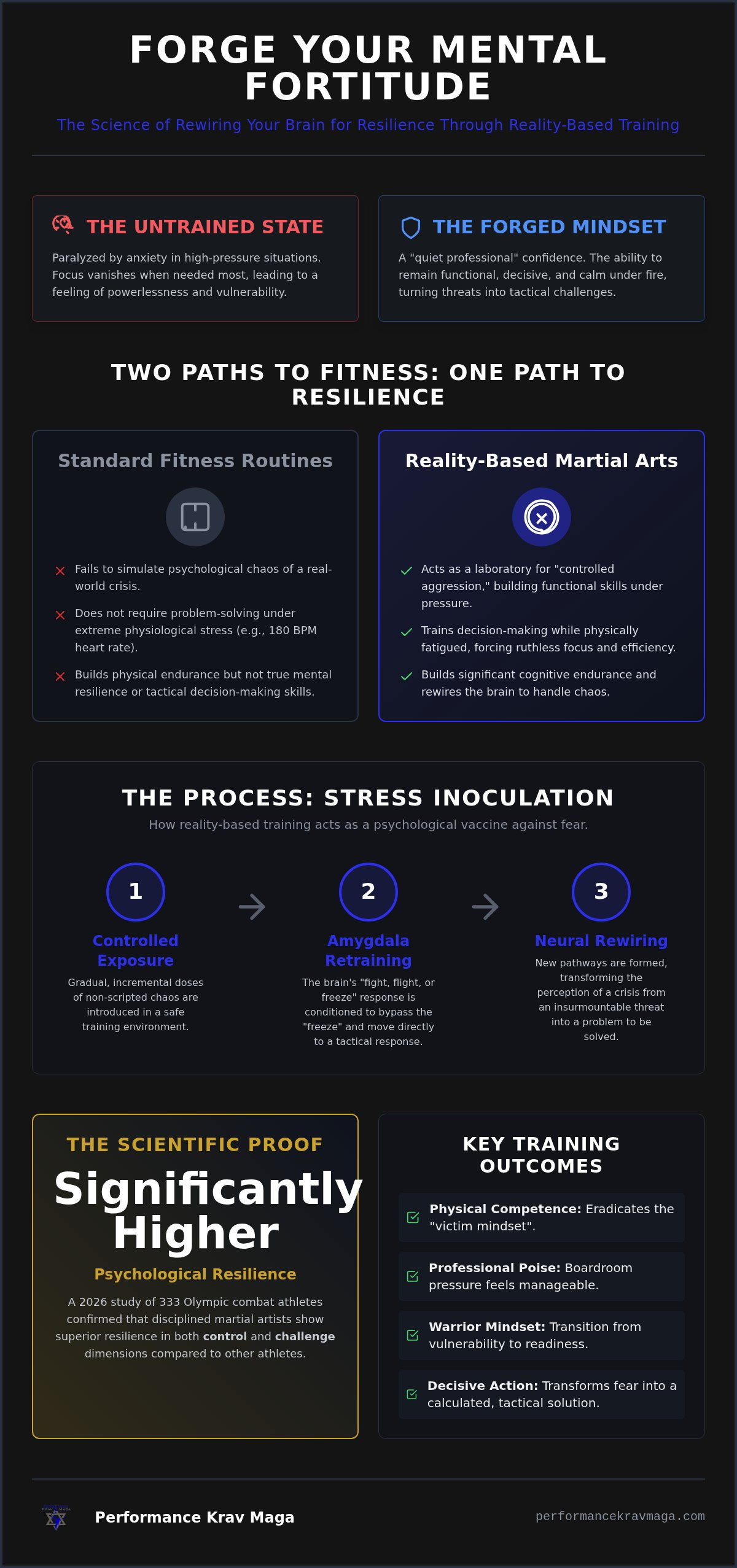
Mental toughness is not a vague personality trait or a motivational slogan. It is the specific, tactical ability to remain functional and decisive under extreme pressure. While a standard gym workout might build cardiovascular endurance, it fails to simulate the psychological chaos of a real-world crisis. Traditional fitness routines don't demand that you solve problems while your heart rate is at 180 beats per minute and a threat is closing the distance. Authentic martial arts to improve mental toughness provide a laboratory for "controlled aggression." This is the process of moving from paralyzing anxiety to a state of calm, physical competence. It creates the "quiet professional" vibe; a state of readiness where you aren't seeking conflict, but you are entirely prepared to end it.
The Difference Between Discipline and Resilience
Discipline is the engine that gets you to the training center when you'd rather stay on the couch. Resilience is the fuel that keeps you fighting when your lungs are burning and your technique is starting to fray. In a high-pressure environment, the constant repetition of complex movements under duress builds significant cognitive endurance. This training allows your brain to process information faster than the situation evolves. An elite but humble mentor facilitates this growth, fostering a community where students focus on their individual journey. You learn that failure during a drill is not a setback. Instead, it is valuable data that refines your ability to persist through exhaustion.
Why Physical Competence Boosts Psychological Strength
There is a direct, biological link between physical competence and psychological strength. When you know, with absolute certainty, that you can defend yourself, your everyday confidence in professional and personal settings undergoes a radical shift. By removing the "victim" mindset through physical empowerment, you begin to project a formidable presence. A 2026 study of 333 Olympic combat sports athletes confirmed this, finding that martial artists showed significantly higher psychological resilience in both control and challenge dimensions. Mental toughness is the bridge between instinct and execution. It is the internal mechanism that transforms a raw fear response into a calculated, efficient, and tactical solution.
Stress Inoculation: How Reality-Based Training Rewires the Brain
Stress inoculation acts as a psychological vaccine. It works by exposing you to controlled, incremental doses of chaos to build immunity against the paralyzing effects of fear. When you utilize reality-based martial arts to improve mental toughness, you are essentially training your amygdala. This part of the brain governs the "fight, flight, or freeze" response. In high-stakes situations, an untrained mind often defaults to freezing. Through gradual exposure to non-scripted, chaotic scenarios, you rewire your neural pathways. You stop perceiving a crisis as an insurmountable threat and begin seeing it as a tactical challenge to be solved with efficiency and poise.
Krav Maga and the Science of Survival
Krav Maga is uniquely effective for psychological conditioning because it relies on instinctive movements. These are natural reactions your body already possesses, which means they don't disappear when adrenaline floods your system. Developing a true warrior mindset requires more than just physical repetition; it demands tactical self-defense training that addresses the psychological load of a real confrontation. This preparation translates directly to professional poise. When you have successfully managed simulated violence in a controlled environment, a heated boardroom argument or a high-pressure deadline feels significantly more manageable. It provides a level of calm that others simply haven't earned.
Decision-Making Under Fatigue
The rhythm of reality-based training mirrors the actual pulse of a conflict. You alternate between high-intensity physical exertion and moments that require technical precision. This is the ultimate mental exercise. Making the right choice while you are physically exhausted forces you to develop a ruthless focus. It strips away the noise and leaves only the most efficient actions. This disciplined approach is why many high-performers choose Krav Maga classes to sharpen their resilience. It isn't about winning a trophy; it's about what works in the modern world. You move from a state of vulnerability to one of formidable strength, backed by technical justification and physical competence.
Comparing Martial Arts Styles for Resilience
Choosing the most effective martial arts to improve mental toughness depends entirely on your objective. Sport-based disciplines like Brazilian Jiu-Jitsu (BJJ) or Muay Thai offer incredible resilience through the "grind" of competitive sparring. You learn to handle a single, skilled opponent within a set of rules. However, reality-based systems like Krav Maga provide a more direct path to mental confidence for beginners. You don't spend years mastering a tournament sport; instead, you focus on immediate survival. This approach builds a formidable mindset by addressing the specific, chaotic variables of a real-world crisis, such as multiple aggressors or uneven terrain. It is the difference between winning a match and surviving an ambush.
The methodology is the differentiator. Sparring is vital for timing and physical conditioning, but stress drills are what truly forge the warrior mindset. These drills simulate the sensory overload of a real confrontation. You might train in low-light conditions, defend against simulated weapon threats, or manage a verbal de-escalation while physically exhausted. This environment requires a family-like community where psychological safety is prioritized. You must feel supported by your peers and mentors to push past your comfort zone without ego getting in the way. An elite but humble mentor ensures that the training remains challenging yet accessible, allowing you to build the psychological boost that comes from genuine physical competence.
Traditional Arts and the Power of Discipline
Traditional arts like Karate and Taekwondo excel at building focus through structured forms and historical tradition. They provide a clear path of progression and instill a deep respect for lineage. However, these arts often fall short in modern, tactical readiness. They were designed for a different era and frequently prioritize aesthetics or point-scoring over functional efficiency. For those seeking readiness in the modern world, it's essential to integrate traditional discipline with a system focused on contemporary threats. You need a methodology that respects the past but is ruthlessly focused on what works today.
The Krav Maga Edge for Mental Fortitude
Krav Maga is the bold innovator of the martial arts world. It ruthlessly discards what doesn't work and optimizes what does. By focusing on real-world self-defense, students build immediate, functional confidence. This system addresses the fear of the unknown by providing a structured, logical response to common attacks. It is the most efficient choice for those using martial arts to improve mental toughness because it prepares the mind for the reality of the street, not the safety of a sports arena. You aren't training for a trophy; you're training for the psychological edge that ensures you walk home safe.
Developing the Warrior Mindset: Practical Drills
Mindset is not a theoretical concept; it is a physical practice. While visualization has its place, true resilience is forged through specific, repetitive drills that simulate real-world pressure. If you are looking for martial arts to improve mental toughness, you must start with situational awareness. This is the first pillar of readiness. It focuses on preventing a confrontation before it ever begins. By scanning your environment and identifying exits as a daily mental habit, you move from a state of being unaware to "relaxed alert," commonly known as Condition Yellow. This proactive stance significantly reduces the anxiety of the "unknown" because you are no longer a passive observer of your surroundings.
Situational Awareness Training
Developing a formidable presence starts with how you perceive space. In our training environment, we emphasize three core habits for environmental scanning:
Perimeter Checks: Consistently scanning the 360-degree area around you in public spaces.
Exit Identification: Locating at least two ways out of any room or building immediately upon entry.
Baseline Recognition: Identifying what is "normal" for an environment so that anomalies stand out instantly.
These habits do more than keep you safe; they build a baseline of calm. When you aren't surprised by your environment, your heart rate remains steady, and your decision-making remains sharp.
Managing Fear Through Technical Competence
Fear is often misunderstood. It shouldn't be a barrier that stops you; it should be a tool that sharpens your focus. In a high-stakes environment, the goal is to replace the "freeze" response with decisive, tactical movement. Practical self-defense classes provide the technical justification for courage by giving you a proven roadmap for handling aggression. When you know exactly how to move and where to strike, the biological fear response becomes manageable. It transforms from a paralyzing weight into high-octane fuel for your survival instincts.
The "Never Quit" drill is perhaps the most vital exercise for building a warrior mindset. In these sessions, you are pushed to continue moving and defending despite physical exhaustion or simulated obstacles. This instinct to persist is what translates most effectively to corporate stress and personal challenges. When a high-pressure project hits a snag or a personal crisis emerges, your brain defaults to the resilience you've practiced on the mat. You maintain your poise. You make efficient decisions under fire. You project the calm confidence of a disciplined expert. To experience this transformation firsthand, you can join our Krav Maga classes and begin building your own psychological edge today.
Mastering Fortitude at Performance Krav Maga
Performance Krav Maga stands as the national headquarters for the Krav Maga Federation (KMFA). Located in Egg Harbor City, this facility isn't just a gym; it's a center for tactical readiness and psychological transformation. Chief Instructor Greg Dziewonski leads the instruction with a philosophy centered on building a "disciplined expert" persona. This mindset is the ultimate goal for those seeking martial arts to improve mental toughness. It requires you to be humble enough to learn but formidable enough to act when the situation demands it. Residents from across South Jersey choose this environment because it lacks the ego often found in traditional dojos. Instead, it offers a supportive community focused on individual progress and collective strength.
Authentic Israeli Krav Maga in Egg Harbor City
Training at the national headquarters means you're learning at the source. The pedigree of Greg Dziewonski and the KMFA ensures that every technique is grounded in practical, real-world application. The curriculum is meticulously designed to provide a comprehensive Krav Maga workout while simultaneously honing your mental edge. We serve the Atlantic County community with elite, tactical instruction that prioritizes efficiency over aesthetics. In your first session, you won't just learn how to strike. You'll learn how to breathe, how to scan, and how to maintain your composure when your body is under physical stress. As we enter late 2026, our adult classes remain open for those ready to commit to this transition from vulnerability to strength.
Empowerment for All Levels
Building mental fortitude is a universal journey, but it takes on a specific urgency in the context of women's self-defense. We focus on empowering every student to move from a state of potential vulnerability to one of absolute strength. The "family-like" atmosphere at Performance Krav Maga provides the psychological safety needed to push your limits. It's a place where you're challenged to be better every day, but always within a framework that keeps you safe and supported. This balance is what makes us the premier choice for martial arts to improve mental toughness in 2026. You'll find that the confidence you build on the mat doesn't stay there; it carries over into your professional life and personal interactions.
Ready to build an unbreakable mind? Join a class at Performance Krav Maga today.
Forge Your Unbreakable Mindset
True resilience is a calculated outcome of disciplined training. We've explored how reality-based stress inoculation rewires the brain, replacing the instinctual freeze response with efficient, tactical movement. By engaging in martial arts to improve mental toughness, you aren't just learning a physical skill set; you're cultivating a "quiet professional" confidence that holds steady under extreme pressure. This psychological edge transforms how you navigate corporate boardrooms and personal challenges alike. It's the bridge between raw fear and decisive execution.
Performance Krav Maga stands as the National Headquarters for the KMFA, led by Chief Instructor Greg Dziewonski. We're proud to serve Egg Harbor City and the South Jersey community with elite instruction that prioritizes real-world readiness over sport. Our mentor-led environment ensures you have the technical justification to face any obstacle with poise. Don't let anxiety or uncertainty dictate your limits any longer. Start Your Journey to Mental Toughness at Performance Krav Maga and discover the formidable strength that comes from authentic physical competence. Your transition to a warrior mindset begins today.
Frequently Asked Questions
Which martial art is best for mental toughness?
Reality-based systems like Krav Maga are often considered the best martial arts to improve mental toughness because they focus on survival rather than sport. While BJJ builds resilience through grappling, Krav Maga uses stress inoculation to prepare you for multi-attacker scenarios and high-stakes crises. This training rewires the brain to remain decisive when your heart rate spikes, providing a practical psychological edge that carries over into professional environments.
Can martial arts help with anxiety and stress?
Yes, martial arts training acts as a powerful tool for managing anxiety by teaching you to control your physiological response to stress. A 2026 meta-analysis of 14 peer-reviewed studies found that martial arts training has a significant effect on reducing internalizing mental health problems like anxiety. By practicing "controlled aggression" in a supportive environment, you replace the paralyzing fear of confrontation with a sense of physical competence and calm.
How long does it take to see mental benefits from martial arts?
Most students report increased confidence and situational awareness within the first four to six weeks of consistent training. While physical mastery takes years, the shift in your "quiet professional" persona begins almost immediately as you learn to manage adrenaline. By the three-month mark, the habit of scanning environments and maintaining focus under pressure usually becomes an instinctive part of your daily routine.
Are Krav Maga classes in Egg Harbor City beginner-friendly?
Absolutely. Our Krav Maga classes at the national headquarters are designed to take uninitiated students and build them into disciplined experts regardless of their starting point. We prioritize a family-like community where psychological safety allows you to push your limits without ego. You'll progress at your own pace under the guidance of Chief Instructor Greg Dziewonski, focusing on efficient movements that work regardless of size or strength.
What is the 'warrior mindset' in self-defense?
The warrior mindset is the psychological commitment to remain functional and proactive during a crisis. It is the bridge between instinct and execution, ensuring you don't freeze when faced with an obstacle. In our training, this mindset is forged through "Never Quit" drills that build the instinct to continue moving despite exhaustion. It's about developing the fortitude to solve problems tactically while others might succumb to panic.
Is Krav Maga better than Karate for building confidence?
Krav Maga often provides a faster path to real-world confidence because it focuses on modern, functional efficiency rather than traditional forms or aesthetics. While Karate builds focus through discipline and tradition, Krav Maga addresses contemporary threats directly. Knowing you have the technical justification to defend yourself against an actual ambush provides a specific type of psychological boost that sport-based or traditional systems often lack.
How does reality-based training differ from sport martial arts?
Reality-based training focuses exclusively on survival and pragmatic solutions, whereas sport martial arts are governed by rules and tournament formats. Systems like Krav Maga integrate principles from psychology and criminology to address pre-conflict and post-conflict stages. You won't find referees or weight classes here. Instead, you'll learn to manage the sensory overload of non-scripted, chaotic scenarios that mirror the unpredictability of the modern world.
Can older adults build mental toughness through martial arts?
Yes, adults of all ages can use martial arts to improve mental toughness and physical conditioning. The training is scalable, allowing older practitioners to focus on efficiency and situational awareness rather than raw athleticism. Building physical competence in your later years provides a formidable sense of empowerment. It proves that readiness and mental fortitude aren't reserved for the young, but are available to anyone willing to commit to the journey.


Comments