
How to Feel Safer in My Neighborhood: A Practical Action Guide

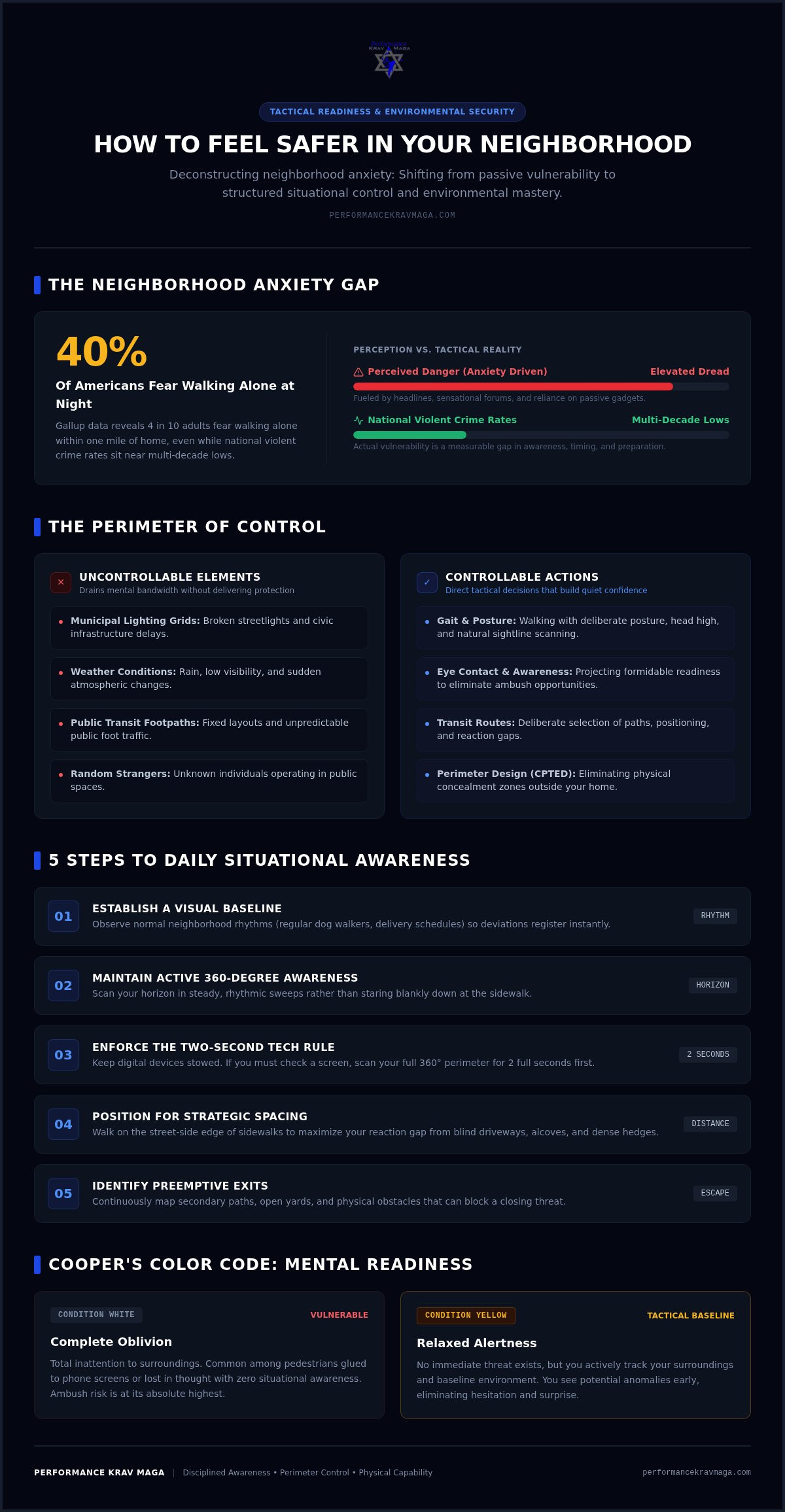
According to Gallup, 40% of Americans fear walking alone at night within a mile of their home, even while national violent crime rates sit near multi-decade lows. If you catch yourself gripping your keys between your knuckles, jumping at sudden footsteps, or constantly wondering how to feel safer in my neighborhood, that daily anxiety is exhausting. You shouldn't have to rush through your evening routine or feel vulnerable on your own street.
True personal security doesn't come from passive gadgets, paranoid neighborhood apps, or hoping for the best. It comes from disciplined awareness, clear perimeter control, and decisive physical capability. In this guide, you will discover actionable strategies to eliminate daily fear, sharpen your environmental awareness, and build real security that holds up under pressure. We will break down practical home-hardening steps, operational awareness habits like Cooper's Color Code, and the foundational self-defense skills that transform hesitation into quiet, unshakeable confidence.
Table of Contents
Deconstructing Neighborhood Anxiety: Shifting from Vulnerability to Situational Control
Five Proven Steps to Cultivate Sharp Situational Awareness Every Day
Hardening Your Immediate Environment: CPTED Principles and Home Perimeter Security
Practical Movement Protocols for Commuting, Walking, and Parking Safely
Forging Unshakable Peace of Mind Through Practical Self-Defense Training
Deconstructing Neighborhood Anxiety: Shifting from Vulnerability to Situational Control
Most people misunderstand why they feel vulnerable on their own streets. Perceived danger is fueled by isolated headlines, sensational neighborhood forums, and dark corners; actual tactical vulnerability, by contrast, is a measurable gap in awareness, timing, and preparation. When you rely solely on deadbolts, motion-activated lights, or pure luck, your subconscious registers that you have outsourced your survival to passive objects. This passive dependence breeds psychological dread. You spend your evenings bracing for an ambush you feel entirely unequipped to manage.
To eliminate that constant unease, you must make a decisive mental shift. You are not a helpless bystander hoping to remain unnoticed. You are an informed, observant resident actively managing your environment. True safety is the operational confidence to recognize, avoid, and resolve threats. When you stop treating personal defense as someone else's emergency response job and claim it as a daily discipline, the underlying question of how to feel safer in my neighborhood shifts from wishful thinking to practical tactical control.
The Psychology of Environmental Fear
Dark streets and unfamiliar figures immediately trigger primal stress responses. Your heart accelerates, your vision tunnels, and your muscles tense. Waiting for external intervention, such as relying on a patrol car to pass by at the exact moment trouble emerges, creates a fragile illusion of safety that crumbles under real stress. You defeat this paralysis by embracing personal responsibility. The moment you decide to own your security, fear transforms into focused readiness.
Recognizing What You Can and Cannot Control
Worrying about broken streetlights, civic infrastructure, or random foot traffic drains your mental bandwidth without delivering a shred of protection. Understanding how to feel safer in my neighborhood starts with drawing a clear perimeter between external realities and your immediate choices.
Uncontrollable elements: Municipal lighting grids, weather conditions, public transit footpaths, and unpredictable strangers.
Controllable actions: Your gait, posture, eye contact, transit routes, and physical capability to defend yourself.
Perimeter design: Applying systematic principles like Crime Prevention Through Environmental Design (CPTED) to eliminate physical concealment zones outside your home.
Adopt the mindset of quiet professionalism. Walk with deliberate posture, scan natural sightlines, and hold your head high. You project formidable awareness, eliminate ambush opportunities, and keep your attention completely locked on what you can command.
Five Proven Steps to Cultivate Sharp Situational Awareness Every Day
Real personal safety isn't built on nervous glances over your shoulder or organized community committees. It requires an active, internal radar that reads street dynamics in real time. Knowing how to feel safer in my neighborhood means establishing an everyday baseline so deviations immediately stand out. By deploying deliberate sensory scanning, you deter opportunists before an encounter can develop.
Establish a visual baseline: Observe normal neighborhood rhythms, such as regular dog walkers, scheduled delivery vans, and typical foot traffic, so anomalies register instantly.
Maintain active 360-degree awareness: Scan your horizon in rhythmic sweeps rather than staring blankly at the sidewalk beneath your feet.
Enforce the two-second tech rule: Keep devices stowed; if you must look at a phone screen, scan your complete perimeter for two full seconds first.
Position for strategic spacing: Walk on the street-side edge of sidewalks to maximize your reaction gap from blind driveways, alcoves, and dense hedges.
Identify preemptive exits: Continuously map secondary paths, open yards, and physical obstacles that can block a closing threat.
Applying the Cooper Color Code to Daily Walks
Defensive practitioners structure readiness using Col. Jeff Cooper's Color Code. Condition White is complete oblivion, common among pedestrians glued to screens. Condition Yellow represents relaxed alertness: no immediate threat exists, but you are actively tracking your surroundings. When an anomaly appears, such as someone loitering unnaturally near your driveway, you shift smoothly into Condition Orange to formulate a response. Staying in Yellow burns zero nervous energy while instantly signaling to predatory spotters that you are an alert target.
Eliminating the Digital Distraction Trap
Noise-canceling earbuds eliminate your earliest warning detection system: directional audio. Walking blind to sound turns you into low-hanging fruit for ambush crimes. Keep your chin parallel to the ground, square your shoulders, and deliver deliberate, one-second glances at approaching individuals. That steady visual contact asserts control and communicates that you see them coming from twenty yards away.
Mapping Exits and Environmental Cover
Every suburban block offers escape routes and physical barricades if you know how to read them. Federal security frameworks, such as the DOJ Guide on CPTED and Problem-Solving, emphasize using terrain structure to control human movement. Distinguish between mere visual concealment, like a thin garden hedge, and functional physical cover, like an engine block or brick retaining wall. If you want to refine these observation reflexes into physical capability, structured training through Performance Krav Maga classes turns tactical principles into second-nature habits for your daily routine.
Hardening Your Immediate Environment: CPTED Principles and Home Perimeter Security
Criminals seek easy targets that offer concealment, fast access, and minimal friction. When evaluating how to feel safer in my neighborhood, your first tactical priority is stripping those advantages away. The global framework for this is Crime Prevention Through Environmental Design (CPTED), codified internationally under ISO 22341:2021. Rather than turning your property into an armed bunker, CPTED uses architectural layout, clear sightlines, and physical deterrence to signal that your perimeter is actively defended. A hardened exterior stops opportunistic threats before they reach your front door.
Maximizing Natural Surveillance and Clear Sightlines
Ambush points exist only where property owners allow blind spots to grow. Apply the universal CPTED landscaping rule: prune all foundation shrubs down to a maximum height of two to three feet, and trim tree canopies up to at least six to seven feet from the ground. This preserves an unobstructed horizontal sightline between your entryway and the street curb. Pair this visual corridor with overlapping, motion-activated illumination across driveways and dark corners, matching recommendations found in the Department of Homeland Security personal safety guidelines.
Establishing Territorial Reinforcement
Territorial reinforcement creates psychological barriers that warn trespassers they are exposed. Clean border edges, neat walkways, and well-maintained fencing establish that the property is under constant human supervision. Burglars look for quiet cues like stacked packages or overflowing mailboxes to confirm an empty structure. Beyond visual cues, secure your primary physical access points against forced entry:
Upgrade latch hardware: Replace factory 3/4-inch casing screws in your exterior strike plates with 3-inch case-hardened screws that anchor directly into the structural wall studs.
Select certified deadbolts: Install ANSI/BHMA Grade 1 auxiliary deadbolts, tested to withstand 250,000 operation cycles and repeated high-impact blunt strikes.
Secure sliding tracks: Fit hardened interior track braces and anti-lift pins along ground-level patio doorways.
Building Organic Community Alliances
Bureaucratic neighborhood watch associations often collapse under administrative burnout and unproductive gossip. Organic, direct relationships with your three immediate neighbors yield far superior tactical value. Swap direct phone numbers with the households facing and flanking your home. Agree on basic, zero-friction protocols: text immediately if an unknown vehicle idles in a private driveway, flag uncollected deliveries, and monitor property lines when traveling. That tight, immediate communication network creates active community surveillance, giving you practical answers for how to feel safer in my neighborhood without relying on committee meetings.
Practical Movement Protocols for Commuting, Walking, and Parking Safely
Most violent confrontations do not occur in open daylight. They happen in transitional zones where people drop their guard. If you want to know how to feel safer in my neighborhood, you must master the seconds between points of security. Stepping from your car to your doorstep or walking the dog past parked SUVs requires systematic movement, not casual drifting. When you control these daily micro-transitions, you remove the tactical openings predators search for.
Mastering the Transitional Spaces
Transitional spaces include parking lots, open carports, building vestibules, and private driveways. These locations are vulnerable because your attention naturally fractures while shifting tasks. Eliminate hesitation windows with three immediate operational rules:
Stow items before moving: Never dig through bags or rummage for keys while standing in the open. Have door keys locked between your fingers before leaving your car or office.
Perform the vehicle pause: Before unlocking your vehicle doors, conduct a deliberate 360-degree scan of adjacent vehicles and nearby shadows.
Clear your threshold: When arriving home, check your entryway from the curb before stepping onto the walkway, ensuring no one is lingering out of sight.
Commanding Space Through Body Language
Predatory spotters target visual hesitation. Slouching shoulders, a downcast gaze, and hands buried deep in coat pockets signal compliance and surprise. Stand tall with your spine erect, shoulders drawn back, and hands resting relaxed above waist level. Walk with rhythmic, purposeful strides that broadcast direction and intent. When you look directly at people you pass, you deny them the element of stealth. That single adjustment transforms you from passive prey into a formidable obstacle.
Setting Immediate Verbal and Spatial Boundaries
Never allow social politeness to compromise your physical perimeter. Maintain a reactionary gap of at least six feet from approaching strangers. If someone alters their trajectory toward you or asks for the time, drop your hips into a balanced stance, raise your open palms in a universal shielding gesture, and project a firm command: "Stop right there." That decisive verbal line instantly strips away an aggressor's cover story.
True physical readiness means knowing how to back up your boundaries if words fail. Build reflexive movement, instinctive defense, and real physical capability by enrolling in self-defense classes at Performance Krav Maga today.
Forging Unshakable Peace of Mind Through Practical Self-Defense Training
You cannot buy true peace of mind at an electronics store. Smart cameras and alarms merely record a crime; they cannot intervene when someone grabs your wrist in your driveway. The deepest answer to how to feel safer in my neighborhood isn't found in hardware, but inside your own nervous system. When you know your hands can neutralize an immediate physical threat, the chronic fear of walking your dog or returning home late completely dissolves.
Why Real-World Defense Outperforms Gadgets and Paranoia
Gadgets fail, batteries die, and panic can freeze your limbs. Relying on an app or an aerosol spray during an ambush often backfires under stress. Authentic physical preparation conditions your body to react reflexively while your heart rate spikes. This doesn't produce reckless swagger or aggressive bravado. It creates quiet, professional poise. Opportunistic aggressors look for hesitation and panic; they routinely bypass individuals whose posture radiates grounded physical competence.
The Krav Maga Advantage for Everyday Protection
Sport martial arts rely on weight classes, clean mats, and referee whistles. Real street survival offers none of those luxuries. Krav Maga strips away decorative forms, relying entirely on instinctive human reactions and explosive gross-motor mechanics that function under adrenal overload. It trains you to solve sudden, violent emergencies:
Explosive release mechanics: Instantly break out of wrist grabs, bear hugs, and clothing holds without relying on superior physical size.
Airway and choke defenses: Neutralize aggressive front and rear chokes while launching simultaneous counter-attacks to create an escape window.
Edged weapon tactics: Deflect and redirect sudden weapon threats using decisive, street-tested body positioning.
Under Chief Instructor Greg Dziewonski, the national headquarters for the Krav Maga Federation (KMFA) right in Egg Harbor City brings authentic Israeli lineage directly to Atlantic County residents. The training emphasizes practical street defense, empowering men and women of all athletic backgrounds to take control of their immediate safety.
Taking the Decisive First Step Toward Lasting Security
Staying locked in chronic neighborhood dread is a choice, but so is developing the skills to conquer it. When you actively train your instincts alongside a supportive community, you replace vulnerability with definitive capability. Stop letting daily anxiety dictate your movements. Step onto the mats and experience authentic instruction through Krav Maga classes to build genuine, lasting security for your everyday life.
Reclaim Your Streets and Take Command of Your Safety
Living in constant apprehension is exhausting. Discovering how to feel safer in my neighborhood isn't about barricading yourself behind triple locks or retreating indoors before sunset. True security comes from mastering your transitional spaces, eliminating environmental blind spots, and cultivating the physical competence to handle sudden danger. When sharp situational awareness becomes second nature, chronic dread gives way to quiet, formidable calm.
You don't have to navigate your community feeling vulnerable or unprepared. At Performance Krav Maga in Egg Harbor City, KMFA Chief Instructor Greg Dziewonski teaches a battle-tested defense system built on natural human reflexes rather than complex sports choreography. Training takes place in a welcoming, ego-free environment designed to empower everyday adults of all fitness levels. Transform anxiety into decisive strength with authentic Krav Maga classes and step outside with genuine, earned peace of mind.
Frequently Asked Questions
How can I feel safer walking alone in my neighborhood at night?
Ditch your headphones, keep your hands out of your pockets, and walk with a deliberate, rhythmic pace. Stick to illuminated walkways, scan your surroundings using relaxed alertness, and keep your mobile device stowed away. If you are wondering how to feel safer in my neighborhood after dark, sharp situational awareness and assertive body language project confidence, immediately making you an unappealing target to opportunistic criminals.
Does having a neighborhood watch actually reduce local street crime?
Formal watch committees often fizzle out due to bureaucratic burnout, but close-knit informal networks genuinely deter opportunistic theft. Exchanging phone numbers with your immediate three or four neighbors creates faster, practical communication than organized meetings. When nearby residents actively watch driveways, report suspicious anomalies, and keep eyes on street corridors, trespassers lose the cover of anonymity and move elsewhere.
What should I do immediately if I suspect someone is following me home?
Never lead an unknown pursuer directly to your front doorstep, porch, or driveway. Cross the street at a diagonal angle to confirm their intent, increase your stride, and head straight toward a well-lit, populated commercial space. Call emergency dispatch immediately while stating your location clearly. If cornered before help arrives, turn to face them, drop into a balanced defensive stance, and loudly command them to stay back.
Can regular self-defense training really eliminate daily neighborhood anxiety?
Yes, developing practical defensive skills replaces chronic dread with internal, operational confidence. Daily anxiety thrives on the terrifying feeling of physical helplessness. By mastering practical, gross-motor responses to grabs, holds, and sudden assaults, your nervous system learns how to process stress without freezing. Discovering how to feel safer in my neighborhood starts within yourself, transforming hypervigilance into calm readiness during every evening walk.
Is Krav Maga practical for beginners who have never taken martial arts?
Krav Maga is specifically designed for ordinary adults with zero prior combat experience. Rather than requiring gymnastic flexibility or memorizing complex sports choreography, it leverages natural human startle reflexes and direct counter-tactics. At Performance Krav Maga in Egg Harbor City, beginners across Atlantic County learn functional self-defense classes in an ego-free, welcoming setting tailored to all body types and fitness levels.
What are the most vulnerable transitional spaces around a residential home?
Driveways, detached carports, dark entry porches, and building vestibules are your home's most critical exposure points. These zones leave you vulnerable because your focus naturally splits while shifting between tasks, like unloading groceries or fishing for keys. Eliminate exposure by having keys ready in hand, scanning your property from the street curb, and keeping entryway landscaping trimmed to remove ambush shadows.
How do I set clear boundaries with aggressive strangers without escalating a fight?
Maintain a six-foot reactionary gap, raise your open hands to chest height, and give a firm, neutral command. Using an assertive voice to say "Stop right there" or "Back up" sets a clear boundary without insulting the person. Raising your open palms projects non-escalation to bystanders while stealthily positioning your arms to shield your head and counter immediately if they attack.


Comments