
Self Defense Basics: A Practical Guide to Real-World Safety in 2026

Your goal in a crisis isn't to win a fight; it's to end the threat and get home alive. Many people walk through public spaces feeling vulnerable because they believe they're too small or too weak to resist an attacker. It's a common fear, and with crime data showing conflicting trends in areas like Egg Harbor City, that anxiety is understandable. You deserve to move through the world with the confidence that comes from actual competence rather than just hope.
This guide breaks down the self defense basics you need to master the fundamental mindset, verbal de-escalation, and physical techniques required for real-world survival in 2026. We'll examine the legal realities of New Jersey's duty to retreat under N.J.S.A. 2C:3-4 so you know exactly when force is justifiable. You'll also gain a clear mental checklist for identifying danger and three reliable physical moves taught in professional self-defense classes and Krav Maga sessions. By the end of this article, you'll have a structured path to replace hesitation with efficient, instinctive action.
Key Takeaways
Shift from a reactive mindset to a proactive one by applying the Cooper Color Code to your daily routine for superior situational awareness.
Master the self defense basics of verbal de-escalation, including how to use the "Fence" position to protect your personal space without escalating conflict.
Prioritize efficiency over aesthetics by targeting vulnerable soft-tissue areas like the eyes and throat to neutralize larger, stronger attackers quickly.
Discover tactical responses for common street encounters, such as the "Pluck" technique for escaping a front choke-hold with precision.
Understand the necessity of stress-testing your skills to ensure you can perform under pressure when your heart rate spikes during a real encounter.
Table of Contents
The Foundation of Self Defense Basics: Awareness and Prevention
Real self-defense begins long before a hand is raised. It is a proactive survival system designed to ensure you never have to throw a punch. While many people view self defense basics as a collection of strikes and blocks, the most effective tool you possess is your brain. By treating safety as a continuous process rather than a reactive event, you remove yourself from the "victim" category before a predator even selects a target. This strategic approach turns you into a "hard target" that is simply too much trouble to engage.
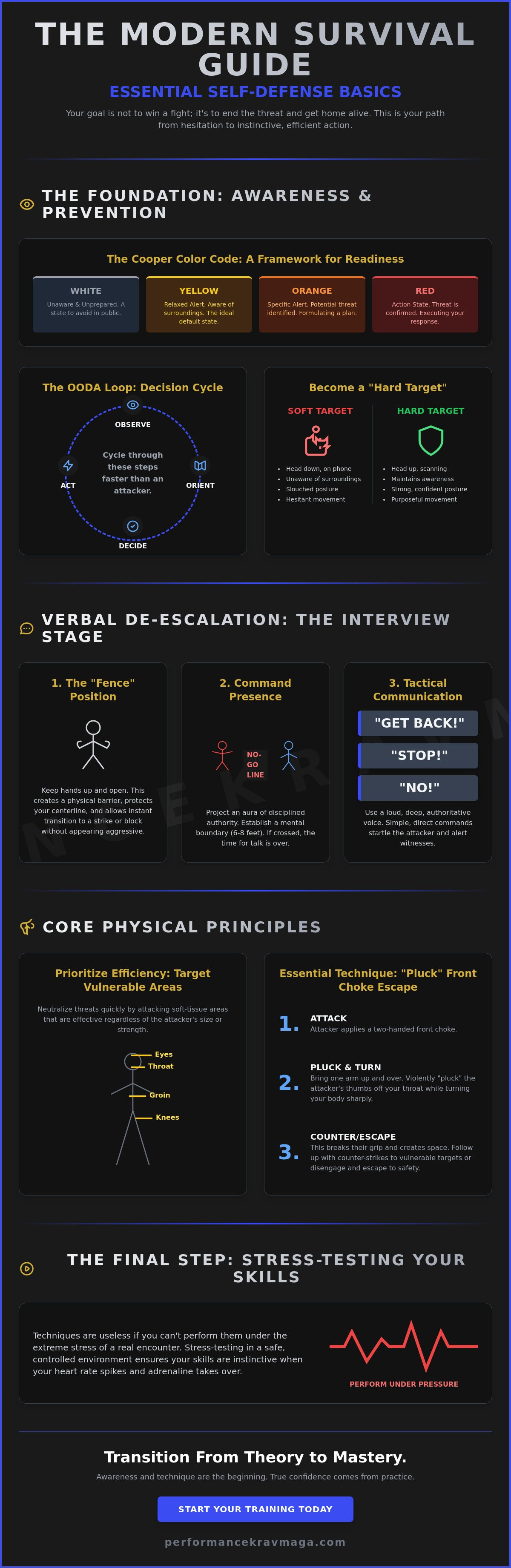
To manage your readiness effectively, you must adopt a structured mental model. The Cooper Color Code provides a proven framework for situational awareness. Most people live in Condition White, which is a state of being completely unaware and unprepared for their surroundings. You must shift into Condition Yellow. This is a state of relaxed alert where you're aware of who is behind you and where the exits are located. If you spot something unusual, you move to Condition Orange, focusing your attention and formulating a plan. Condition Red is the trigger for action; the threat is confirmed, and you're executing your response without hesitation.
This mental preparation is supported by the OODA Loop: Observe, Orient, Decide, and Act. You must constantly observe your environment. Orient yourself by identifying potential improvised tools, such as a heavy water bottle or a sturdy umbrella, and locate every available exit. Once a potential threat is identified, decide on your escape or defense strategy immediately. The goal is to cycle through these steps faster than an attacker can react, allowing you to dictate the terms of the encounter.
The "Quiet Professional" Mindset
Readiness is a quiet confidence, not a loud display of aggression. It is the transition from vulnerability to a state of constant, calm preparedness that doesn't rely on paranoia. You must learn to trust your intuition. Those "gut feelings" are your biological radar processing micro-signals and environmental anomalies that your conscious mind hasn't fully categorized yet. The Warrior Mindset is the unwavering refusal to be a victim.
Prevention Strategies for Daily Life
Predators are looking for easy opportunities. In parking lots, public transit, or when walking at night, your body language is your first line of defense. Maintain a strong posture and keep your head up; looking at your phone in public makes you a soft target. Scan for pre-attack indicators that signal intent. Watch for "target glancing," where an individual repeatedly looks at your valuables or your neck, and be wary of "flanking," where a stranger moves to your side or rear to cut off your path. For a comprehensive overview of self-defense, it is vital to recognize that mastering these self defense basics often prevents the physical encounter from ever happening. By identifying "grooming gestures" or suspicious movements early, you can exit the area before the situation escalates.
Verbal De-escalation and Setting Hard Boundaries
When situational awareness fails to prevent a direct encounter, you enter a phase known as the "Interview." This is a psychological probing stage where a potential aggressor tests your boundaries to see if you are a soft target. To survive this stage, you must master the "Fence" position. By keeping your hands up and open in front of your chest, you create a physical barrier that protects your centerline while remaining non-aggressive to bystanders. This stance is a core component of self defense basics because it allows you to transition instantly to a strike or a block if the situation turns violent.
Command Presence is your primary tool for dictating the space between you and a stranger. It is not about being a bully; it's about projecting an aura of disciplined authority that signals you are prepared to defend yourself. You must establish a "No-Go" line. This is a mental boundary, usually about six to eight feet away, where any further advancement by the stranger triggers a decisive response. If they cross that line, the time for polite conversation has ended.
Tactical Communication Scripts
Your voice is a weapon. Use simple, punchy phrases that leave no room for misinterpretation. Commands like "Stop," "Get back," or "I don't have any money" should be delivered with maximum volume. High-decibel shouting serves two purposes: it startles the attacker by disrupting their OODA loop and it alerts witnesses to the conflict. Avoid the "Victim Loop" by refusing to apologize for your boundaries. Don't say "I'm sorry, I can't help you." Instead, use a firm "No" and maintain your stance. Apologizing signals submissiveness, which can embolden a predator to escalate their behavior.
The Legal Edge of Verbal Defense
Verbal warnings are critical for your legal protection. In the aftermath of an encounter, being the person who was heard shouting "Stop, get back!" establishes you as the defender rather than the aggressor. New Jersey law, specifically N.J.S.A. 2C:3-4, evaluates whether your use of force was a "reasonable" response to the threat. Clear verbal commands provide evidence that you attempted to de-escalate and avoid physical contact. Practicing these scripts under stress is essential, which is why many individuals enroll in Krav Maga classes to build the muscle memory needed to speak clearly when adrenaline is high. To truly bridge the gap between theory and safety, consider joining self-defense classes where you can pressure-test these boundaries in a controlled environment.
Core Physical Principles for Real-World Survival
When verbal boundaries are ignored and physical contact becomes inevitable, efficiency is the only metric that matters. Forget the choreographed aesthetics often seen in sport-based martial arts. In a high-stress street encounter, "ugly" techniques that work are infinitely superior to "pretty" ones that fail under pressure. The core objective of self defense basics is to neutralize the threat with maximum speed and minimum risk to yourself. You aren't fighting for a trophy; you're fighting to create an exit.
To achieve this, you must prioritize targeting soft tissue. Areas like the eyes, throat, groin, and shins are the great equalizers because they cannot be conditioned to withstand impact. A strike to these regions bypasses an attacker's size and strength, causing involuntary physiological responses that provide you with the seconds needed to escape. This is reinforced by the principle of "Simultaneous Defense and Attack." Rather than blocking and then waiting for your turn to strike, you move as a single unit to defend the incoming blow while delivering your own counter-strike. This disrupts the attacker's momentum and immediately shifts the psychological advantage in your favor.
Survival requires a "Burst" mentality. This is a violent, overwhelming explosion of continuous strikes and movement designed to shock the attacker’s system. You don't stop until the threat is neutralized or you have a clear path to safety. By overwhelming their OODA loop with aggressive, instinctive action, you dictate the terms of the engagement and force them into a defensive state.
Natural Weapons of the Body
Your body has built-in tools that are safer and more effective than a traditional punch. Use palm heels instead of closed fists to reduce the risk of breaking your own hand on an attacker's skull. The "Hammer Fist," which utilizes the meaty part of the hand, allows for high-impact strikes with a lower chance of self-injury. When the distance closes, knees and elbows become your most formidable assets. These short-range weapons carry immense power and can be used effectively even if you are being held or pinned against a wall.
Body Mechanics and Power Generation
True power is a product of the kinetic chain. It doesn't originate in the arms; it starts in the ground and travels through the legs and hips before being released through the strike. Whether you are transitioning from a "Passive Stance" (standing naturally) to a "Combat Stance," your goal is to put your entire mass behind every movement. Size matters less when your technique utilizes total body weight to generate force through the hips. By anchoring yourself and rotating your core, you can generate devastating impact regardless of your physical stature.
Essential Techniques for Common Attack Scenarios
Mastering self defense basics requires more than just general principles; you must understand how to solve specific, high-probability problems. Real-world violence is often preceded by a grab, a pull, or a sudden strike. In these moments, your response must be instinctive and explosive. You don't have time to contemplate strategy. You execute the solution that clears the immediate threat and allows you to transition into a counter-attack or an escape.
The 360-degree defense is your primary answer to a sucker punch or a sudden, circular swing. By using your forearm as a tactical wedge, you intercept the incoming attack at a right angle while simultaneously driving a palm heel strike into the aggressor’s face. This isn't a passive block. It is a violent collision that stops their momentum and disrupts their OODA loop. If someone grabs your wrist or clothing, the solution is equally direct. Rotate your wrist toward the attacker’s thumb, which is the weakest point of their grip. Use your entire body weight to pull away rather than relying on arm strength alone.
Dealing with Chokes and Grabs
When an attacker places their hands around your neck, you must follow the "Immediate Threat" rule. Address the airway first. The "Pluck" technique is the gold standard for this scenario. Use your hands like hooks to pull the attacker’s thumbs away from your windpipe. This creates the space you need to breathe and sets the stage for retributive striking. You don't just remove the hands; you immediately follow up with knees to the groin or strikes to the throat to ensure they cannot re-engage. For a detailed breakdown of these movements, you can find practical guidance on how to escape a choke hold through professional instruction.
Ground Defense Basics
The ground is the most dangerous place to be in a street encounter. It limits your mobility and makes you vulnerable to multiple attackers. If you are knocked down, immediately adopt the "Shield" position. Stay on your back, keep your chin tucked, and use your legs to keep the attacker at bay. If they try to close the distance, deliver heavy, bicycling kicks to their shins or knees. To regain your feet safely, execute a Technical Stand-up. Post one hand and the opposite foot on the ground while lifting your hips and swinging your free leg back behind you. This ensures you rise into a stable guard while keeping your head as far from the threat as possible. To master these high-pressure transitions, consider looking into Krav Maga classes that specialize in reality-based training.
Transitioning from Theory to Mastery in Egg Harbor City
Reading about self defense basics provides the map; dynamic training is the journey itself. Static training, such as watching videos or reading guides, helps you understand the "how," but it cannot replicate the "when." You must transition into an environment where your skills are stress-tested. Can you execute a pluck or a 360-defense when your heart rate hits 140 beats per minute? Under that level of physiological strain, fine motor skills vanish. Only movements ingrained through repetitive, high-intensity practice will remain. This is the difference between knowing a technique and owning it.
Performance Krav Maga serves as the South Jersey headquarters for the Krav Maga Federation of America (KMFA). Lead instructor Greg Dziewonski brings a philosophy rooted in authentic Israeli Krav Maga: everything must be functional, efficient, and ruthlessly focused on modern threats. There is no room for ego or tradition for tradition's sake. The focus remains entirely on what works when the stakes are highest. By training in a facility dedicated to reality-based combat, you bridge the gap between theory and the actual ability to protect yourself and your family.
The Value of a Tactical Community
Training in a live environment provides immediate, professional feedback. This is crucial for preventing "training scars," which are the dangerous habits formed when practicing in isolation without correction. At Performance Krav Maga, the atmosphere is a "family-like" community where elite standards meet a supportive classroom. This environment reduces the intimidation often felt by beginners. Additionally, the Krav Maga workout ensures you build the specific conditioning and explosive power needed to sustain a defense until the threat is gone. You don't just learn to fight; you build the engine required to win.
Your First Step in Egg Harbor City
Your introductory class focuses on grounding you in the most critical movements. You'll learn how to stand, how to move, and how to deliver basic strikes with maximum impact. As you progress, the curriculum scales. You'll move from these fundamental self defense basics to complex tactical scenarios involving multiple attackers or third-party protection. This layered approach ensures that your confidence grows alongside your competence. Every session is designed to move you closer to total readiness. Don't wait for a crisis to discover your limits. Join a self-defense class at Performance Krav Maga today and take control of your personal safety.
Take Command of Your Personal Safety
Real-world security isn't about memorizing complex choreography; it's a disciplined commitment to readiness and instinctive action. You've learned how situational awareness and verbal boundaries serve as your primary defense. You've also seen why physical efficiency and targeting soft tissue are the ultimate equalizers against larger aggressors. However, reading about these self defense basics is only the starting point. To truly own these skills, you must refine them in an environment that replicates the stress and chaos of a real encounter.
Performance Krav Maga serves as the National Headquarters for the Krav Maga Federation (KMFA). Led by Chief Instructor Greg Dziewonski, we offer practical, reality-based training designed for all experience levels. Our mission is to bridge the gap between theory and mastery within a supportive, family-like community. It's time to replace hesitation with the quiet confidence of a trained professional.
Claim Your First Self-Defense Lesson at Performance Krav Maga and begin your transition from vulnerability to strength today. You possess the tools to stay safe. We provide the methodology to use them effectively.
Frequently Asked Questions
Do I need to be in good shape to start learning self-defense basics?
You don't need to be an athlete to begin your journey. Our training is designed to build your functional fitness while you learn the mechanics of survival. You'll develop the necessary stamina and strength through the training process itself, so it's better to start now and gain conditioning as you progress.
Is Krav Maga better than Karate for real-world self-defense?
Krav Maga is specifically engineered for reality-based survival rather than sport or traditional forms. While Karate offers discipline and historical value, it often focuses on point-scoring or choreographed patterns. Krav Maga prioritizes instinctive movements, simultaneous defense and attack, and the efficiency required to end a threat quickly in a modern environment.
How long does it take to learn the basics of self-defense?
You can grasp the core self defense basics in just a few focused sessions. While total mastery is a long-term pursuit, an introductory course provides the immediate mental and physical tools needed to identify threats and execute high-probability escapes. Consistent practice over several months turns these initial movements into reliable muscle memory.
Can a smaller person really defend themselves against a much larger attacker?
Yes, because technique and anatomical targeting bypass physical size. By focusing on vulnerable soft-tissue areas like the eyes, throat, and groin, a smaller person can neutralize an attacker's strength advantage. We teach you how to use your total body weight through the kinetic chain to generate force that overcomes a larger opponent's mass.
What is the most effective self-defense move for a beginner?
The palm heel strike to the face is often the most effective tool for a novice. It is a gross motor movement that carries a lower risk of hand injury compared to a closed-fist punch. This strike allows you to maintain distance while delivering significant impact to a vulnerable target, providing the window you need to escape safely.
Is it legal to use physical force in self-defense in New Jersey?
Force is justifiable in New Jersey under N.J.S.A. 2C:3-4 when you reasonably believe it is immediately necessary for protection against unlawful force. However, you must remember the "duty to retreat" in public spaces. You're required to avoid using deadly force if you can do so safely, though this duty doesn't apply in your own home.
Do I need special equipment to start training at Performance Krav Maga?
No special equipment is required to start your self defense basics training at our facility. We provide the necessary tactical gear for our classes to ensure your safety and the safety of your training partners. You only need to bring a willingness to learn and a focus on improving your personal readiness.
What should I wear to my first self-defense class?
Wear comfortable athletic clothing and supportive sneakers. You'll be moving, striking, and occasionally working from the ground, so choose gear that allows for a full range of motion. Avoid wearing jewelry or anything that could snag during dynamic training sessions to prevent injury to yourself or others.


Comments