
Self-Defense for Runners: The Tactical Readiness Checklist for 2026

Your most effective weapon on a remote trail isn't the pepper spray clipped to your waist. It's the split-second decision-making of a prepared mind. While race participation grew by 5% over the last year and more athletes are hitting the pavement than ever, the reality of isolated paths remains a source of genuine anxiety. You want the freedom of the long run, but you don't want to feel like a vulnerable target when you're miles from home.
It is natural to feel a spike of adrenaline when the path narrows or the sun dips below the treeline. Effective self defense for runners is about bridging the gap between being a capable athlete and becoming a formidable, hard target. This guide delivers a tactical readiness checklist for 2026 designed to replace uncertainty with a professional safety protocol. You'll learn how to navigate the latest legal regulations on defensive tools, master situational awareness habits that stop threats before they escalate, and internalize the physical mechanics required to escape a grab from a larger aggressor. We are moving beyond simple gadgets to focus on the instinctive, efficient responses that ensure you remain the hunter, not the prey. It's time to stop running in fear and start training for total confidence.
Key Takeaways
Adopt the Cooper Color Code to shift from passive vulnerability to a state of tactical readiness, ensuring you maintain 360-degree awareness without noise-canceling distractions.
Learn to prioritize high-impact strikes to soft tissue targets like the eyes and throat to immediately disrupt an aggressor’s momentum and OODA loop.
Master the "Burst" entry and "The Gap" strategy to create a critical three-second window for a high-speed sprint to safety using nearby obstacles.
Evaluate self defense for runners tools based on 2026 legal regulations and their ability to remain accessible and hands-free while you are in motion.
Discover why instinctive Krav Maga movements are the most effective solution for escaping an ambush when you are physically exhausted from a long-distance run.
Table of Contents
The Runner’s Tactical Awareness Checklist
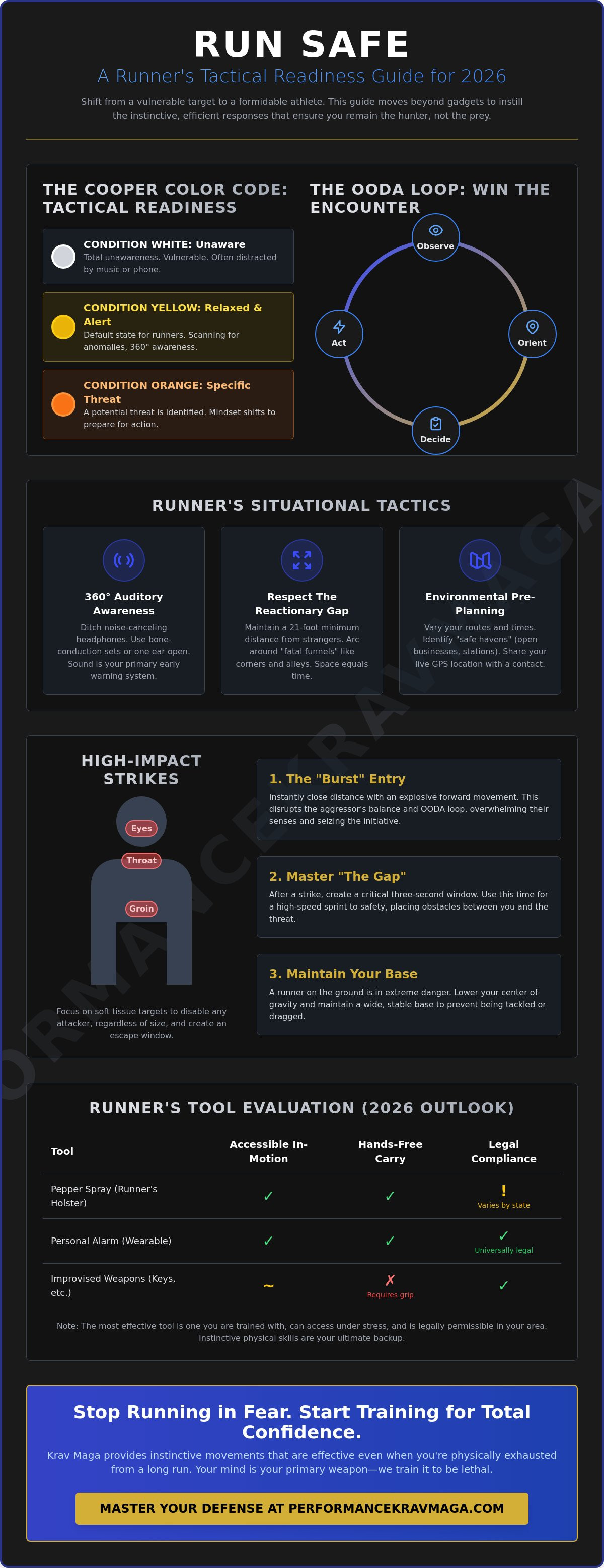
Elite athletes don't just train their lungs; they train their eyes. Effective self defense for runners begins long before a physical altercation occurs. It starts with the Cooper Color Code, a system of tactical readiness that moves you from Condition White, which is total unawareness, to Condition Yellow. In Yellow, you are relaxed but alert. You are scanning for anomalies. If a specific threat emerges, you shift to Condition Orange. This mental transition is the foundation of situational awareness. It ensures you aren't the person caught by surprise. You are a hard target because you are paying attention.
Maintain 360-degree auditory awareness by ditching noise-canceling headphones. While music drives pace, it also creates a sensory vacuum. If you cannot hear approaching footsteps or a vehicle's engine, you've already lost your primary early warning system. Tactical runners use bone-conduction sets or keep one ear open at all times. Sound is your fastest indicator of a closing threat. Don't sacrifice your safety for a playlist.
Scan "fatal funnels" with intent. These are corners, alleyways, and dense brush where visibility is restricted and escape routes are limited. Don't just run past them. Arc your path to see deeper into the space before you arrive. Simultaneously, respect the 21-foot reactionary gap. This is the minimum distance required to react to a sudden charge. If a stranger enters this space, your alert level must spike to Orange immediately. Space equals time, and time is the only thing that allows you to deploy a defense.
The OODA Loop for Runners
The OODA Loop is a decision-making cycle that determines who wins an encounter. It is a core component of self defense for runners because it prioritizes speed of thought over raw strength. First, Observe: identify anything out of place. Second, Orient: quickly assess if that individual is a threat based on their behavior or positioning. Third, Decide: commit to an immediate course of action. This might be crossing the street or preparing to strike. Finally, Act: execute your decision with 100% explosive commitment. Hesitation is the enemy of survival. Once you decide to move, you move with purpose.
Environmental Pre-Planning
Don't let your route become a routine. Predictability is a liability. Vary your start times and paths to prevent anyone from mapping your habits. Identify "safe havens" along every mile, such as open businesses, fire stations, or well-lit public intersections. Before you lace up, share your live GPS location with a trusted contact. This digital tether provides a final layer of security for the modern athlete. Knowing exactly where you can go for help reduces panic when things go wrong.
Essential Krav Maga Techniques for Runners
Physical intervention is the final layer of your safety net. When situational awareness fails, your body must transition instantly from a rhythmic run to an explosive defense. Organizations like the Road Runners Club of America emphasize the importance of being prepared for the unexpected, and their Runner Safety Tips from RRCA suggest that physical training is a vital component of a runner's toolkit. In a high-stress ambush, you don't have time for complex martial arts choreography. You need movements that are instinctive, efficient, and devastating. Mastering self defense for runners requires a shift in focus from sport to survival.
Effective defense focuses on "Soft Tissue" targets. If you're being overpowered by a larger attacker, striking the eyes, throat, or groin provides the highest probability of creating a window for escape. These areas are vulnerable regardless of the aggressor's size or strength. We utilize the "Burst" entry to close the distance or create space, effectively crashing into the attacker to disrupt their OODA loop. By overwhelming their senses with immediate, aggressive movement, you seize the initiative and force them into a defensive posture. It's about changing the dynamic from victim to victor in a single second.
Stability is your lifeline. A runner on the ground is a runner in danger. You must maintain a wide, stable base and lower your center of gravity to prevent being tackled or dragged. This physical stability is fueled by warrior mindset training. Developing elite mental resilience allows you to process the inevitable adrenaline dump without freezing. It's the difference between panic and controlled, tactical aggression. If you want to build these instincts in a controlled environment, consistent self-defense classes are the most direct path to mastery.
Escaping Common Grabs and Holds
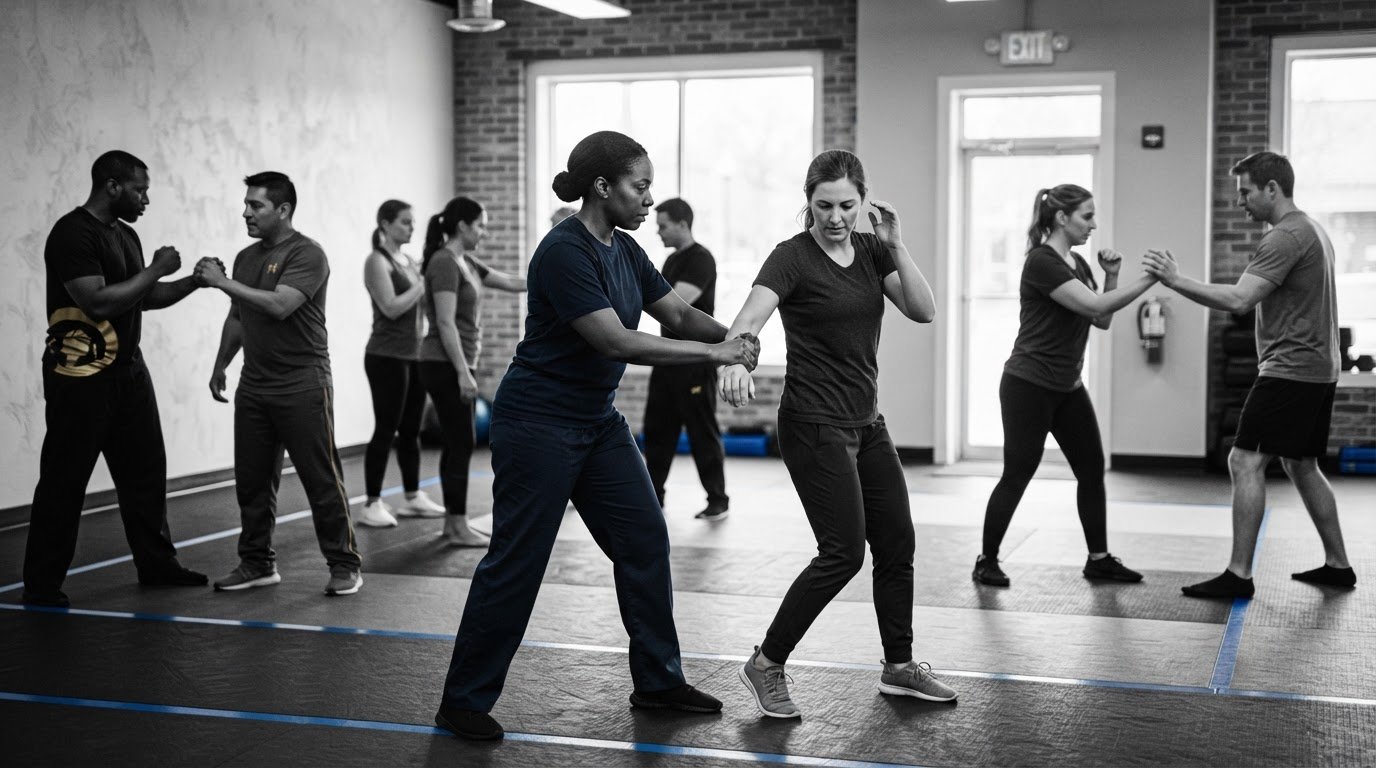
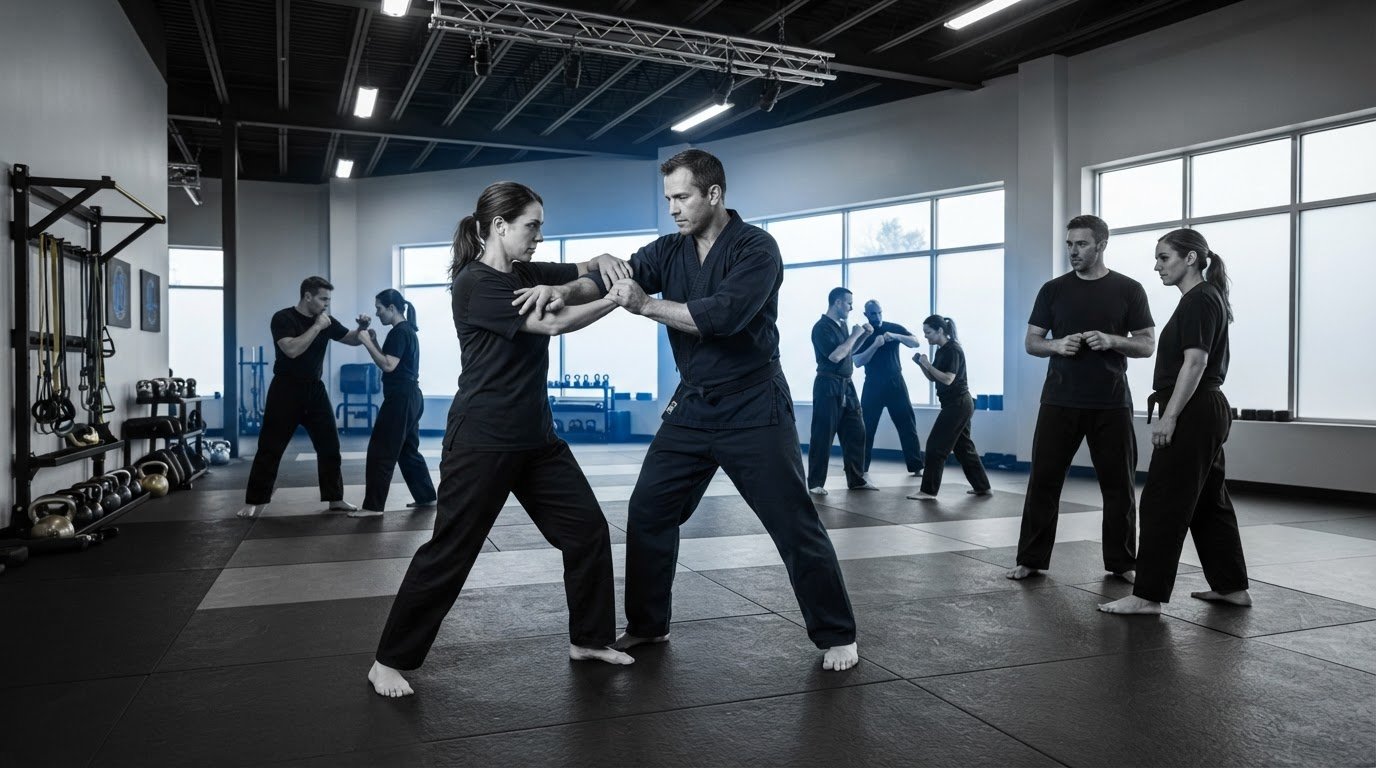
If an attacker seizes your wrist, don't pull away. Rotate your arm toward the attacker's thumb. This is the weakest point of the grip and allows for an immediate release. In a bear hug situation, drop your weight instantly. This makes you significantly harder to lift or move. For a choke from the front or back, use the "pluck" technique. Hook your hands like C-clamps around their thumbs and pull down with explosive force to clear your airway. Once the grip is broken, transition immediately to a counter-strike.
The Power of the Counter-Attack
Never defend without a simultaneous or immediate counter-strike. In Krav Maga, we don't block and then wait. We hit while we defend. Use the "hard" parts of your body, like your knees and elbows, against their "soft" parts. A well-placed knee to the groin or an elbow to the jaw can end a fight in seconds. Continue striking until the threat is neutralized or you've created enough distance to use your primary skill: speed. Strike with 100% commitment until you can safely disengage.
Evaluating Self-Defense Tools: A Runner’s Comparison
Hardware is a force multiplier, not a substitute for skill. When considering self defense for runners, your gear must meet three uncompromising criteria: accessibility, legality, and hands-free capability. A tool buried in a hydration pack is a liability. As of June 2026, the legal landscape for these items remains complex. For instance, while pepper spray is legal in all 50 states, New Jersey strictly limits canisters to 0.75 ounces. If you run across state lines, you must know the local statutes. True tactical self defense requires knowing exactly what you carry and, more importantly, when to rely on your hands instead of a gadget.
Practice under stress is non-negotiable. If you haven't deployed your tool while your heart rate is at 160 beats per minute, you don't truly own that skill. Adrenaline degrades fine motor movements. You need a tool that integrates into your natural running motion, allowing for an instinctive draw without breaking your stride or fumbling with complex safety latches. Efficiency is the difference between a successful deterrent and a dropped piece of plastic.
Pepper Spray vs. Personal Alarms
Pepper spray remains a top-tier choice for distance management. Products like the SABRE Runner Pepper Gel, priced at $12.99 in 2026, offer high stopping power with reduced wind blowback compared to traditional sprays. However, personal alarms are excellent for drawing immediate civilian attention in urban environments, though they offer zero physical stopping power. Avoid the "Stun Gun" myth. While legal in most states, civilian stun guns require prolonged contact with an attacker to be effective. For a runner, staying in close contact is the opposite of your primary goal: disengagement.
Wearable Defense: Rings and Kubatons
Go Guarded rings: These are low-profile, serrated tools that stay on your finger. They are always accessible but require you to be in extreme close-quarters to be effective.
Kubatons: These reinforced sticks are excellent for targeting pressure points. They require significant grip strength and specialized training to use effectively against a larger opponent.
Tactical pens: These provide a dual-purpose defensive option. They are sturdy and effective for striking, but they can be difficult to deploy rapidly while moving at high speeds.
Choose one tool and master it. Carrying multiple gadgets leads to "choice paralysis" during a high-stress encounter. Your focus should remain on the environment, not on deciding which tool to grab. One practiced response is always superior to five half-remembered ones.
Disengagement Strategies: Using Speed as a Shield
Speed is the most significant advantage an athlete possesses. However, simply turning your back on a threat is a tactical error that can lead to being tackled from behind. Effective self defense for runners treats disengagement as a deliberate, aggressive maneuver. You don't just run; you escape with purpose. The goal is to maximize the distance between you and the aggressor until the cost of pursuit becomes too high for them to maintain.
Creating "The Gap" is your first priority. If an aggressor has closed the distance, you must use an explosive strike or a violent shove to buy yourself a three-second window. This isn't about winning a fight or standing your ground. It's about buying the time necessary to reach your top sprint speed. Once you've created that window, move. Use the environment to your advantage by putting cars, fences, or steep terrain between you and the threat. These obstacles force the attacker to navigate a barrier, which usually breaks their momentum and psychological commitment to the chase.
If you're confronted by more than one individual, the complexity of your escape increases. You must utilize multiple attacker defense strategies to avoid being pinned. Identify the "alpha" or the most aggressive individual and avoid letting them get behind you. Your goal is to exit through the "weakest link," which is the person providing the least resistance or the largest physical gap in their formation. Keep your feet moving and never allow yourself to be cornered. To develop the reflexes needed to handle these high-pressure scenarios, we recommend enrolling in professional Krav Maga classes where you can pressure-test these movements.
Tactical Voice Commands
Your voice is a powerful deterrent. Use short, loud, guttural commands like "STOP!" or "STAY BACK!" to project authority and startle an attacker. If you need to attract civilian help, yell "FIRE!" or "CALL 911!" instead of just screaming. These specific words are proven to cut through the "bystander effect" more effectively. De-escalation is a valuable skill, but once an attacker enters your reactionary gap, the time for talking has passed. Transition immediately to your physical defense protocol.
Post-Incident Protocol
Adhere to the "Check-Back" rule: never stop running until you are in a secured, well-lit, and populated area. Once you're safe, call emergency services immediately. Document the attacker’s description while it's fresh, focusing on height, weight, specific clothing marks, and their direction of flight. Finally, seek a professional evaluation. Even if you don't feel injured, the psychological stress of a confrontation requires proper processing to ensure you can return to your training with confidence.
Training for Real-World Readiness in Egg Harbor City
The most dangerous place to test a theory is on a dark, isolated trail. While traditional sport martial arts provide excellent athletic benefits, they often fail in the "no-rules" environment of a real-world ambush. In a competition, you have a referee, a flat mat, and weight classes. On the street, you face concrete, uneven terrain, and an attacker who doesn't care about fair play. Effective self defense for runners requires a transition from sport-based combat to survival-based tactics. Performance Krav Maga is dedicated to modern martial arts that prioritize efficiency and instinct over tradition or points. We focus on what works when you're exhausted, surprised, and fighting for your life.
Krav Maga is uniquely suited for the running community because it relies on natural, gross motor movements. When you're miles into a long run, your fine motor skills are degraded by fatigue and heart rate elevation. You don't need complex choreography. You need movements that are already hard-wired into your nervous system. By joining our community of South Jersey athletes, you're not just learning a set of moves. You're adopting a disciplined, protective lifestyle that ensures your safety is never left to chance. Training here means preparing for the reality of the trail, not the safety of the gym.
Why Runners Choose Krav Maga
Efficiency is the hallmark of our curriculum. Runners have demanding training schedules and need to learn high-impact techniques in a fraction of the time required by traditional arts. Our self defense for runners programming focuses on the most common threats you'll face. Additionally, our classes double as high-intensity conditioning sessions that improve your anaerobic threshold and overall running performance. We don't just talk about stress; we simulate it. Through pressure testing, we recreate real-world scenarios so you don't freeze when it matters most. You'll learn to fight through exhaustion and make tactical decisions under fire.
Get Started at Performance Krav Maga
Our facility is located in Egg Harbor City, serving athletes across the broader Atlantic County area. We offer introductory classes designed specifically for beginners with no prior combat experience. These sessions provide a low-friction entry point into a formidable discipline. For those looking for targeted skills, we host customized training workshops for individuals and specialized sessions for local run clubs. Don't wait for a close call to realize you're unprepared. Build the confidence that comes from physical competence and ensure every run you start is one you finish safely.
Secure Your Path for 2026 and Beyond
Real-world safety isn't a product you buy; it's a capability you build. By shifting from Condition White to Yellow and mastering the mechanics of the "Burst" entry, you've already begun the transition from athlete to hard target. You now understand that your primary weapon is your awareness, while your physical skills serve as the ultimate insurance policy. Mastering self defense for runners means you no longer have to compromise your training schedule for fear of the unknown. You have the tools to identify threats early and the power to neutralize them if necessary.
True readiness requires more than reading a checklist. It demands pressure-tested training under professional guidance. As the National Headquarters for the KMFA, Performance Krav Maga offers practical, reality-based training for all fitness levels. Led by Chief Instructor Greg Dziewonski, our facility provides the elite mentorship needed to turn these concepts into instinctive reactions that work even under extreme stress. Don't wait for a reason to be ready.
Join an Elite Krav Maga Class in Egg Harbor City and Build Your Real-World Defense
Take the first step toward a stronger, safer version of yourself. Your best runs are the ones where you feel completely in control of your environment and your own safety. We'll see you on the mats.
Frequently Asked Questions
Is pepper spray legal for runners in New Jersey?
Yes, pepper spray is legal for self-defense in New Jersey, but it's subject to specific volume restrictions. As of June 2026, state law limits canisters to a maximum of 0.75 ounces of chemical substance. It's critical to ensure you aren't carrying it in restricted areas like government buildings. Always verify local municipal codes if your route crosses into different jurisdictions or state lines.
Can I really defend myself against a much larger attacker?
You can absolutely defend yourself against a larger attacker by prioritizing biomechanics over raw strength. Effective self defense for runners focuses on "soft tissue" targets like the eyes, throat, and groin, which remain vulnerable regardless of the aggressor's size. By using your body's "hard" parts, such as knees and elbows, against these sensitive areas, you create the necessary window to disengage and escape.
What is the best self-defense tool for a solo female runner?
The best tool is a combination of high-level situational awareness and a reliable deterrent like pepper gel. Pepper gel is superior to traditional spray because it's less susceptible to wind blowback, which is a common risk on open trails. Many runners also carry a personal alarm to draw immediate civilian attention. However, no tool replaces the need for instinctive physical response training that doesn't rely on a gadget.
How often should I practice self-defense moves to stay sharp?
To maintain tactical readiness, you should practice your primary defensive movements at least once or twice a week. Muscle memory is perishable, so short, high-intensity drills are more effective than infrequent, long sessions. Integrating "shadow-boxing" or sprawl drills into your post-run cool-down ensures these responses remain sharp and accessible even when you're physically exhausted from a long-distance effort.
Will taking a self-defense class interfere with my running training?
Taking a self-defense class won't interfere with your running; it actually serves as a highly effective form of cross-training. The explosive movements and anaerobic drills found in Krav Maga improve your power and cardiovascular recovery. Most athletes find that the increased core strength and mental discipline gained in class directly translate to better performance and faster times on the road.
What should I do if an attacker has a weapon?
If an attacker has a weapon, your primary goal is survival, which often means compliance if they only want your property. However, if the threat is immediate and physical, you must use specific techniques to redirect the line of fire or the blade's path while simultaneously counter-attacking. Weapon defense requires specialized, hands-on training that focuses on controlling the weapon arm and neutralizing the threat with explosive aggression.
Are there specific self-defense classes for runners near Egg Harbor City?
Performance Krav Maga in Egg Harbor City offers comprehensive self-defense classes that are ideal for runners in the Atlantic County area. While we don't offer a class exclusively for runners, our curriculum focuses on reality-based scenarios that are directly applicable to trail and road environments. We provide the foundational skills necessary to transform from a vulnerable athlete into a formidable, hard target.
How do I overcome the "freeze" response during an attack?
Overcoming the "freeze" response is achieved through stress inoculation and scenario-based training. Freezing happens when the brain is overwhelmed by a sudden threat. By repeatedly practicing your OODA loop (Observe, Orient, Decide, Act) in a controlled but high-pressure environment, you train your nervous system to bypass the freeze and move directly into action. Consistent training turns panic into a tactical, aggressive response.
Comments