
Martial Arts for Building Discipline: How Training Builds Consistency

Discipline isn’t a trait you either have or lack. It grows through repeated choices, and martial arts for building discipline gives those choices a clear structure: show up, practise a skill, use feedback, and return for the next session. Progress comes from consistency, not from choosing a particular style.
If routines are hard to maintain without outside accountability, a class can provide a regular time and place to practise. Training won’t create discipline overnight, and your first class doesn’t need to feel like a test. With steady practice, repetition and coaching give you opportunities to work on patience, focus, and follow-through, one session at a time.
This article explains what those habits look like in training, how to assess whether a class feels supportive and appropriately challenging, and how to take a practical first step. You’ll also see how tailored Krav Maga programs at Performance Krav Maga in Egg Harbor City offer a structured way to practise consistency and self-defense in an energetic, no-ego environment.
Table of Contents
How Can Martial Arts Help Build Discipline?
Keeping a routine can be difficult when work, family, energy, or motivation shifts from day to day. A plan that depends on feeling ready is easy to postpone. Martial arts can offer a recurring place to practise, with instruction and a defined activity to return to. A scheduled class gives you a practical opportunity to make time for training, while your progress depends on how you take part and what you bring to each session.
Discipline is choosing a behavior and returning to it consistently, even when motivation changes. It isn’t toughness, natural talent, or perfection. In practice, it can mean attempting a movement again after a correction, listening to instruction, or resuming after an absence instead of deciding that one missed session has erased all progress.
Martial arts includes a wide range of styles and reasons for practice. A broad overview of martial arts helps put that variety in context; no single style name should be treated as a shortcut to discipline. A more useful question is what a training environment asks you to practise and how its structure fits into your life.
What does discipline mean in martial arts?
Discipline isn’t simply obeying rules, suppressing emotion, or never missing a session. It’s the ability to stay engaged with a chosen practice: pay attention, apply instruction, and make another attempt. Consistency means returning over time, not performing perfectly every time. People learn at different rates, so progress may look different from one student to another.
For example, a student may find a new sequence awkward at first. Listening to a correction and trying the movement again gives them a concrete way to practise patience and follow-through. The value is in the repeated effort, not in expecting every class to feel easy or every skill to click immediately.
Why do people connect martial arts with self-discipline?
A scheduled class creates a predictable opportunity to practise, which can help when self-directed routines are hard to maintain. During instruction, students have a task to focus on and a chance to try it, receive feedback, and adjust. That cycle provides structure, while the decision to keep participating remains personal.
Support matters, too. Clear guidance and a respectful training atmosphere make it easier to ask questions, work at an appropriate pace, and return after a difficult session. The practical measure is whether the routine gives you a realistic opportunity to show up and engage.
That’s the useful starting point for martial arts for building discipline: look beyond the idea of becoming tougher and notice the behaviors you can practise. A class provides structure; consistency develops through choices repeated over time.
How Martial Arts Training Can Turn Repetition into a Habit
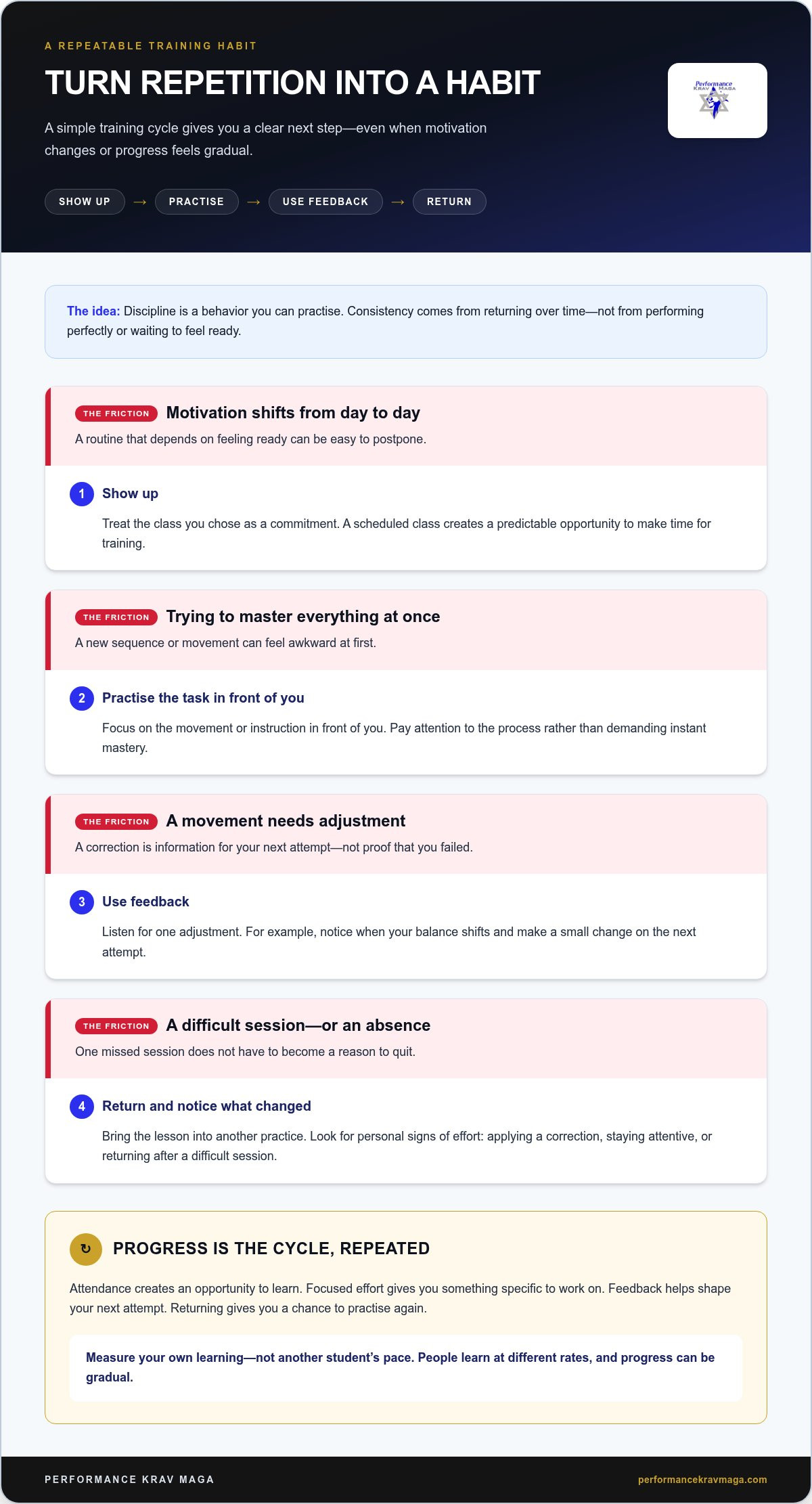
A training habit is built through a sequence you can repeat, not a burst of motivation. You show up, practise a skill, use feedback, and return to training. Each part has a purpose: attendance creates an opportunity to learn, focused effort gives you something specific to work on, and feedback helps shape your next attempt. Repeating that cycle can make practice feel more familiar over time, though the pace will differ for each person.
Repeated practice can support consistency by giving you a clear next step, even when progress feels gradual.
Show up: Make space for the class you’ve chosen, treating attendance as a commitment rather than waiting for ideal motivation.
Practise: Focus on the movement or instruction in front of you instead of trying to master everything at once.
Use feedback: Listen for one adjustment that can make your next attempt more controlled or effective.
Return: Bring that lesson into another practice and notice what feels different, without demanding instant results.
How repetition and feedback support steady effort
Repeating a movement is a chance to pay attention to process. A student might try a technique, notice that their balance shifted, then make a small adjustment on the next attempt. That’s not failure; it’s useful information. Instructor feedback can point to what to change, while the student supplies the effort to apply it. The aim is to learn from each attempt and keep working with care, not to master a skill instantly.
This approach also gives patience a practical role. A skill may take repeated effort before it feels more familiar, and improvement can be subtle: better focus, a more deliberate movement, or a quicker response to a correction. Instructors can help students recognize those signs of effort and adjustment, while students focus on their own learning rather than matching someone else’s pace.
How accountability can make practice easier to sustain
A regular class commitment can act as an external cue in a busy week. Rather than deciding from scratch each day whether to practise, you have a planned opportunity to engage. Instructors guide your efforts, and training partners can offer a sense of shared purpose. That support can make returning feel easier, while your schedule and priorities determine how you maintain the routine.
Measure progress against your own earlier efforts, not another student’s pace. Someone else may have different experience, goals, or demands on their time. Your useful markers are personal: Did you return after a difficult session? Did you apply a correction? Did you stay attentive through a challenging exercise? Those observations keep the focus on learning and make steady effort easier to recognize.
For readers exploring martial arts for building discipline, practical Krav Maga training brings skill practice and self-defense learning into the same recurring activity. Local readers can explore in-person Krav Maga classes at Performance Krav Maga in Egg Harbor City as one structured setting for putting this cycle into practice.
Choosing Martial Arts for Discipline: Look Beyond the Style
A style name can describe the kind of martial arts being practised, but it can’t tell you whether the class fits your life or helps you maintain a routine. The training experience matters: how instruction is delivered, whether practice feels purposeful, and whether you can imagine returning consistently. For martial arts for building discipline, focus less on labels and more on the conditions that let you practise effort, attention, and follow-through.
What should you look for in a martial arts class?
Look for instruction that’s clear enough to follow and practice with a purpose you can understand. Notice whether corrections help you know what to adjust, and whether the environment feels respectful and appropriate for your comfort level. A class can challenge you while still making questions and learning at your own pace feel welcome.
Use these criteria to compare the experience, not to score one style against another:
These are practical observations, not guarantees. A class might offer strong instruction yet still be a poor fit for your schedule or comfort. The right environment is one where you can engage, learn, and see a realistic path to returning.
Does one martial arts style build more discipline than another?
There’s no style name that automatically creates discipline. Different martial arts have distinct methods and training aims, but a student’s experience also depends on the quality of instruction, their reasons for practising, and whether they participate consistently. Consider the value of structured learning without expecting any one discipline to guarantee a particular personal result.
Krav Maga may appeal to someone seeking practical self-defense training, while another person may be drawn to a different martial art. The useful comparison is not which label promises more discipline, but which learning environment helps you focus, accept guidance, and keep practising at a sustainable pace.
For a local example, Krav Maga classes in Egg Harbor City offer tailored training for different skill levels in a no-ego, family-like atmosphere. Use the same criteria you would anywhere: consider whether the instruction and setting support the kind of consistent practice you want to build.
Build Discipline Through Martial Arts: A Practical Starting Plan
You don’t need to arrive already disciplined or highly athletic to begin. You need a reason to start and a first goal that fits your life. If you’re considering martial arts for building discipline, keep the plan simple: choose a practice you can realistically return to, then pay attention to what you learn along the way. The aim isn’t perfect attendance. It’s building a routine you can resume.
How to start training when you feel unprepared
Start by naming what you want from training. Maybe you’re looking for more structure, practical self-defense skills, fitness, or a combination. Being clear about your priority helps you focus on whether the practice suits your needs. You don’t have to feel confident before beginning, and there’s no fixed timeline for developing confidence, fitness, or skill. Start where you are.
Identify your reason. Write one sentence about what you hope practice will add to your life. Keep it personal and specific, such as wanting a structured activity or learning self-defense.
Choose a manageable routine. Look at your real commitments and decide what training opportunity you can reasonably make room for. A modest, sustainable goal is more useful than a demanding plan built around an ideal week.
Practise with attention. During training, focus on listening, attempting the skill, and applying guidance. You don’t need to master everything at once; the immediate task is to take part and learn.
Review your effort. After practice, reflect briefly: What did I try? What did I learn? What would help me return? These questions track your experience without relying on performance measures or comparing your progress with someone else’s.
How to keep going when motivation dips
Motivation will vary. When it does, revisit the reason you started and choose one manageable next step, such as preparing for your next training opportunity or deciding what you want to focus on. Keep the goal realistic enough to work alongside your responsibilities, and adjust it when life changes rather than treating flexibility as failure.
A missed session is a pause, not proof that you can’t build a routine. Notice what interrupted the plan, then decide how to return without demanding that you make up for lost time. Look for signs of effort: you came back, listened closely, tried again, or made room for practice. Measure those choices against your own experience, not another student’s pace.
Consistency isn’t never stopping; it’s choosing to return to practice after an interruption. If a structured Krav Maga practice fits your goals, explore in-person training at Performance Krav Maga in Egg Harbor City.
Practise Martial Arts Discipline at Performance Krav Maga in Egg Harbor City
After considering what makes training supportive and sustainable, local readers can explore Performance Krav Maga in Egg Harbor City. The school offers tailored training for different skill levels in an energetic, no-ego, family-like environment. Its programs focus on practical Krav Maga and self-defense instruction. That structure gives students a place to practise consistently while building practical skills through their participation.
How Performance Krav Maga connects practical training with personal development
Training gives students opportunities to work on focus, patience, and follow-through while learning self-defense skills. Chief Instructor Greg Dziewonski is a 5th-degree black belt (Dan 5) and holds Krav Maga Expert Certification from Israel’s Wingate Institute. His instruction supports students as they work toward their own goals.
The available programs include:
Self-defense Fundamentals, for practical self-defense training.
Weapons Defense, focused on defense against weapons.
Ground Defense, addressing self-defense on the ground.
A testimonial from David Maxwell describes training with his 11-year-old daughter and highlights discipline and respect. It offers one family’s perspective on their experience. The school’s no-ego, family-like atmosphere is a natural fit for people who want to train in a welcoming setting while working toward personal goals.
Which Performance Krav Maga option may fit your starting point?
For busy individuals looking for a defined training option, the 6-week Self-defense Course offers practical Krav Maga training. Its set duration gives you a clear timeframe for taking part in self-defense practice. Consider how this option fits your priorities and circumstances, and choose a goal you can focus on throughout the course.
Performance Krav Maga’s Online Learning package includes a 420-page book and an online video course that runs 4 hours 20 minutes. The course covers material from Yellow Belt through Black Belt Dan 5. These resources offer structured material for independent study alongside the school’s in-person programs.
For anyone interested in martial arts for building discipline, Performance Krav Maga offers local, tailored in-person programs that connect practical self-defense instruction with ongoing practice. In Egg Harbor City, you can explore the programs and choose an option that aligns with your goals and preferred way to learn.
Make Your Next Step a Practical One
You don’t have to solve your whole routine before you begin. Choose one reason to train, make room for a realistic first step, and give yourself permission to learn as you go. The value of martial arts for building discipline is the chance to practise showing up with intention and make adjustments as your needs evolve.
As you consider training, focus on what would help you keep returning: useful instruction, a respectful atmosphere, and a practice that connects with your goals. Progress can start with a simple decision to explore, then grow through the effort you choose to bring. At Performance Krav Maga, Chief Instructor Greg Dziewonski’s experience and the school’s family-like, no-ego approach offer a local setting for practical training. If you’re in Egg Harbor City, explore Performance Krav Maga training and take your first step toward becoming unstoppable.
Frequently Asked Questions
Can martial arts really help build discipline?
Yes, martial arts can give you a setting to practise disciplined choices, though the result depends on your participation. For example, you might focus on one instruction during class, try it, and decide to keep working on it even if it feels unfamiliar. These moments give you opportunities to practise attention and follow-through. Martial arts for building discipline is best understood as a way to develop habits through participation, not a substitute for personal effort.
Which martial art is best for self-discipline?
No single martial art is best for everyone’s self-discipline. Look for a class whose instruction and approach match what you want from training, whether that’s practical self-defense, physical activity, or learning in a structured setting. A useful fit is one you can keep participating in and where guidance helps you understand what to work on. A style’s reputation alone can’t tell you whether its training experience will suit your goals.
Do you need to be fit or disciplined before starting martial arts?
No, you don’t need to arrive already fit or disciplined to explore martial arts. Performance Krav Maga tailors programs for different skill levels, so you can begin from your own experience rather than measure yourself against classmates. At first, you might focus on understanding instructions and becoming familiar with the practice. Keep expectations realistic: individual fitness and skill development vary.
How long does it take to build discipline through martial arts?
There’s no set timeline for developing discipline through martial arts. A useful sign to notice is whether you’re making room for practice and engaging with it more regularly, even as other responsibilities shift. Performance Krav Maga’s Self-defense Course lasts 6 weeks, but that describes the course duration, not a fixed timeline for developing discipline. Personal progress depends on each student’s circumstances, aims, and participation.
Can children develop discipline through martial arts?
Martial arts classes give children opportunities to practise listening, following directions, and working through a skill, though each child’s experience is different. Performance Krav Maga serves people of different ages and skill levels. In a testimonial, David Maxwell describes training with his 11-year-old daughter and notes discipline and respect as part of their experience. That account offers one family’s perspective on training together.
Can online martial arts learning build discipline?
Online learning can offer a way to practise independent study by setting aside time to review lessons and return to the material. Performance Krav Maga’s Online Learning package includes a 420-page book and a 4 hours 20 minutes video course covering material from Yellow Belt through Black Belt Dan 5. These resources provide structured learning material alongside the school’s in-person training.
Comments