
College Self Defense Classes Near Me: 2026 Safety Guide

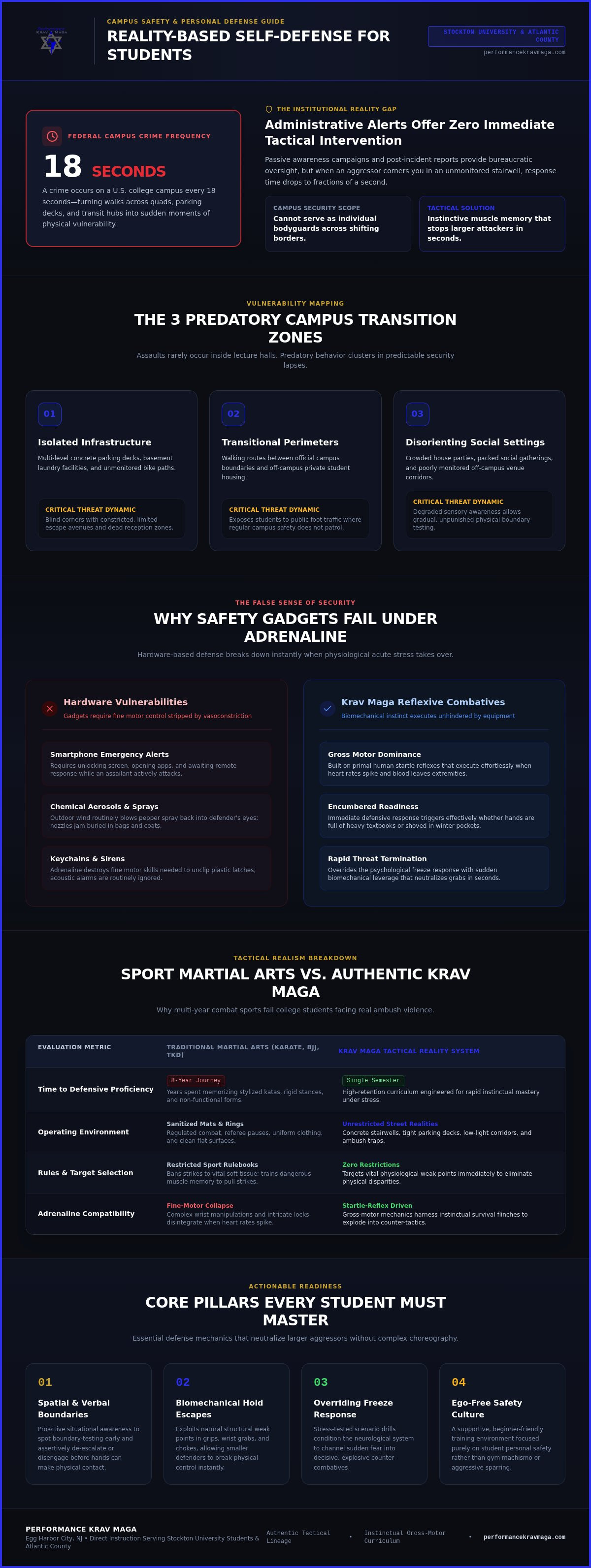
A crime occurs on a U.S. college campus every 18 seconds, turning routine walks across dark quads, transit hubs, and isolated parking decks into moments of genuine vulnerability. If you are searching for self defense classes for college students near me, you don't have years to spend memorizing complicated forms or surviving an intimidating gym culture. You already know that when adrenaline spikes, choreographed martial arts collapse. Real personal safety requires simple, instinctual mechanics that neutralize aggressive grabs and stop larger attackers in seconds.
Discover how authentic Krav Maga equips college students with reflexive self-defense skills to navigate campus life with total confidence, regardless of your prior experience or physical size. In this 2026 safety guide, we break down vital situational awareness habits to spot danger early, explain how reality-based training overrides the freeze response under stress, and show you how to find a reputable, beginner-friendly training center near Stockton University and Atlantic County.
Table of Contents
Why College Students Need Reality-Based Self-Defense Training
University life moves between disparate environments within minutes. You might spend midday in a bustling academic commons, evening in a secluded library corridor, and late night navigating a poorly lit parking deck or off-campus transit stop. These shifting borders create predictable security lapses. Modern student personal safety is situational readiness combined with physical decisiveness. Passive awareness campaigns and institutional emergency reports provide administrative oversight, but they offer zero tactical intervention when an aggressor corners you in an unmonitored stairwell. If someone closes distance with hostile intent, you have seconds to respond.
Campus Threat Vectors Beyond the Classroom
Most campus assaults do not occur inside lecture halls. Instead, predatory behavior clusters in predictable transition zones:
Isolated infrastructure: Multi-level concrete parking garages, unmonitored bike paths, and basement laundry rooms create blind corners with limited escape avenues.
Transitional perimeter zones: Walking from campus boundaries into off-campus student housing exposes individuals to foot traffic that campus security does not patrol.
Disorienting social settings: House parties and crowded venues degrade sensory awareness, making it difficult to spot boundary-testing behavior until physical space is already breached.
Campus security cannot act as a personal bodyguard. That operational reality explains why so many young adults search for verified self defense classes for college students near me before their freshman or sophomore terms begin.
The Reality of Personal Safety Gadgets vs. Muscle Memory
Relying on hardware creates a false sense of security. Smartphone emergency alerts require you to unlock a screen, launch an interface, and await a response while an assailant actively attacks. Sprays and sirens frequently malfunction in dynamic encounters. Wind blows aerosol chemical agents back into your own eyes, nozzles jam inside bag pockets, and loud alarms are routinely ignored by passersby. In dynamic encounters, adrenaline strips away the fine motor coordination needed to disengage a plastic safety latch.
Real protection relies on ingrained biomechanics. By training in Krav Maga, students replace hesitation with reflexive combatives that execute instantly regardless of what you carry. Authentic self defense classes for college students near me build instinctive motor patterns, ensuring that whether your hands are full of textbooks or shoved in your coat pockets, your immediate response to a sudden grab is explosive, effective, and unhindered by broken gadgets.
Traditional Martial Arts vs. Krav Maga for Student Safety
Traditional martial arts hold immense cultural and physical value, but they operate on conventions that real-world violence ignores. Disciplines like Karate, Taekwondo, and competitive Brazilian Jiu-Jitsu revolve around weight divisions, ring rules, referee pauses, and matched combatants. Street violence features none of these courtesies. Assailants pick targets based on physical advantage, ambush from behind, and leverage closed surroundings. Federal campus crime data underlines the volatility of these encounters, where hesitation leads to immediate injury. Surviving physical conflict requires terminating the threat instantly rather than attempting to outscore an opponent on points.
College schedules leave little room for an eight-year path to a black belt. Undergrads need practical, high-retention tactics they can absorb over a single semester. Enrolling in elite Krav Maga classes in Egg Harbor City bridges this tactical divide by focusing entirely on rapid defensive proficiency instead of stylized sport sparring.
Why Choreographed Katas Fail Under Adrenaline
Choreographed forms fall apart the second fear hits. Under acute stress, heart rates skyrocket, triggering vasoconstriction that drains blood from extremities. This physiological reaction destroys fine motor control. Intricate joint locks, spinning kicks, and delicate wrist manipulations become nearly impossible to execute under duress. Sport rules also create hazardous muscle memory; sparring sports ban attacks to vital soft tissues, training participants to pull their punches precisely where decisive force is required for survival.
Gross Motor Tactics Built on Natural Human Reflexes
Krav Maga bypasses artistic complexity by turning natural human startle responses into instant tactical defenses:
Exploiting the flinch reflex: When surprised by an incoming strike, your hands instinctively raise to shield your face. Krav Maga builds on this reflex, transforming an involuntary flinch into an aggressive frame and simultaneous counter-strike.
Simultaneous defense and counter-attack: Waiting to block before launching an attack gives an assailant momentum. Krav Maga teaches you to disrupt their structural balance the microsecond an assault initiates.
Targeting vulnerable anatomy: You cannot condition an eye socket, windpipe, or groin against physical trauma. Strikes to these vulnerable structures equal the playing field, allowing a smaller student to neutralize a significantly larger assailant.
Seeking out qualified self defense classes for college students near me ensures you spend training hours mastering gross motor survival tactics rather than memorizing theatrical routines that vanish the instant violence becomes real. When you want to cultivate functional combative skills that stick for life, you can explore beginner sessions at Performance Krav Maga to experience true reality-based preparation firsthand.
Core Defensive Tactics Every Student Should Master Immediately
Personal defense begins long before a physical blow lands. Establishing an invisible perimeter around your space denies an aggressor the tactical advantage of a sudden reach. Grounded in the mindset explored in our guide on tactical self-defense principles, personal safety requires active spatial control rather than passive compliance. Many major academic institutions prioritize realistic self-defense tactics because physical readiness stops escalating assaults early. When verbal de-escalation fails, your mechanical response must be immediate, violent, and directed toward total extrication.
Pre-Fight Recognition and Verbal Boundary Setting
Predatory behavior rarely starts with an unprovoked punch. Instead, attackers use "forced teaming" to invent premature familiarities, feign needing assistance, or adopt an interview stance to gauge your willingness to resist. Defending yourself means spotting these boundary tests early:
Direct eye contact and upright posture: Shrinking back signals compliance; standing balanced with open, raised hands signals readiness without triggering legal escalation.
Verbal stop-commands: Issue short, loud commands like "Step back" or "No." This alerts bystanders and sets a distinct legal boundary.
Controlling distance: Maintain at least two arm-lengths of buffer space. Anyone crossing that line uninvited enters your defensive strike zone.
Neutralizing Grabs, Chokes, and Hostile Bearhugs
Physical attacks on campus environments frequently involve sudden, controlling grabs designed to overpower mobility. In quality self defense classes for college students near me, training focuses on exploiting leverage rather than matching muscle strength:
Rotational wrist releases: Assailants grip hard, but the thumb and fingers never completely fuse. Rotating your forearm against the attacker's thumb creates an instant exit path.
Plucking defenses against chokes: Static neck chokes cut off airway and carotid blood flow. Hooking your hands into rigid "plucks" pulls their thumbs off your throat while your hips drive simultaneous combatives forward.
Base-dropping against bearhugs: If grabbed from behind to be dragged toward a vehicle, immediately drop your center of gravity, strike rearward to the groin, and pivot into the attacker to clear the hold.
Confined Space and Rideshare Defensive Maneuvers
Violent incidents don't happen in wide-open rings. They happen in tight stairwells, packed elevators, and backseats of rideshare vehicles. When pinned against a wall or seated, wide roundhouse strikes are impossible. Tactical combatives rely on short-range tools: compact elbow drives, palm heel strikes to the chin, and vertical hammerfists. Ground defense is equally non-negotiable. If knocked down, you must create a protective shield with your legs, kick upward at knees and ankles, and execute a tactical technical stand-up to regain your feet immediately.
What to Look for in Local College Self-Defense Programs
Walking into a training center for the first time should inspire focus, not anxiety. A professional academy weeds out toxic machismo immediately, prioritizing a culture where beginners build competence safely without fear of injury. The training mat must be a collaborative laboratory. Look for environments that teach realistic, legal defensive tactics rather than theatrical stunts designed for action movies. Flashy spin kicks look impressive on social media, but they will get you trapped against a concrete curb. Review our practical self-defense training guidelines to recognize high-standard instruction before signing up.
Assessing Instructor Lineage and Training Authenticity
Lineage separates genuine tactical preparation from commercial martial arts trends. Anyone can purchase a generic certificate online and advertise self-defense workshops. Authentic systems trace directly back to proven source organizations. When vetting self defense classes for college students near me, look for these hallmarks:
Recognized federation oversight: The program should affiliate directly with established bodies, such as the Krav Maga Federation (KMFA), ensuring standardized curricula and quality control.
Active head instructor credentials: Lead trainers should hold continuous, national-level certifications rather than outdated regional belts.
Proportional use of force: Instructors must articulate the legal parameters of self-defense, teaching you how to neutralize threats and disengage without exposing yourself to avoidable liability.
Balancing Rigorous Training with University Life
Academic calendars change every sixteen weeks. Between midterms, lab reports, and shifting lecture blocks, rigid athletic programs often fall by the wayside. The ideal academy offers flexible weekly session schedules that fit around demanding collegiate life, providing an outlet where students release intense academic pressure through purposeful physical movement.
Physical readiness also demands total conditioning. Striking pads, driving through defensive sprints, and drilling under elevated heart rates build functional cardiovascular stamina alongside technical skill. You leave each session stronger, sharper, and mentally prepared to handle stressful academic deadlines and unpredictable social spaces alike. If you are ready to evaluate a professional training mat in person, schedule an introductory session at Performance Krav Maga to experience certified instruction firsthand.
Start Training at Performance Krav Maga in Egg Harbor City
Stockton University students and South Jersey commuters don't have to settle for vague internet tutorials or commercial sport franchises. Performance Krav Maga operates right here in Egg Harbor City as the national headquarters for the Krav Maga Federation (KMFA). Led directly by Chief Instructor Greg Dziewonski, our facility provides authentic Israeli Krav Maga classes engineered specifically for rapid skill acquisition and functional combative readiness. Here, self-defense isn't treated as an artistic diversion; it is taught as an essential life-saving discipline.
Every drill on our mats focuses on reality-based problem solving. Rather than requiring years of tedious study to build functional competence, our training system delivers usable protective skills within weeks of consistent practice. Female students seeking specialized strategies against gender-specific predatory behaviors can also explore our practical women's self-defense insights alongside comprehensive co-ed group classes.
Authentic KMFA Instruction in South Jersey
Training at the national headquarters connects you directly to the root source of tactical fighting systems. Chief Instructor Greg Dziewonski brings elite oversight to every drill, ensuring the mechanics you practice mirror proven field tactics rather than watered-down interpretations. You learn how to neutralize incoming violence, control the confrontation, and disengage safely under the guidance of top-tier professionals who understand the legal realities facing young adults today.
How to Take Your First Defensive Training Step
Starting out does not require martial arts experience or extreme baseline fitness. If you are researching self defense classes for college students near me, stepping into our Egg Harbor City center is simple:
No special gear required: Arrive in comfortable athletic clothes and supportive footwear, ready for dynamic movement.
Ego-free atmosphere: Our training floor is built on mutual respect and encouragement. Beginners train alongside experienced practitioners who help you refine form without judgment or reckless sparring.
Structured introductory progression: Your first session introduces basic strikes, defensive framing, and reflexive releases so you build instant confidence.
Campus life should be defined by academic discovery and social freedom, not constant worry about vulnerable parking lots or late study commutes. Investing in credible self defense classes for college students near me gives you the physical ability and psychological presence to walk across any quad with genuine composure.
Take Command of Your Personal Safety
Navigating campus life with confidence isn't about luck or relying on digital panic buttons; it comes down to decisive habits and practical muscle memory. Choreographed sport katas won't protect you in a dim parking garage, but reflexive combatives that target vulnerable anatomy will. When you search for self defense classes for college students near me, choose an academy that prioritizes rapid survival over sport trophies.
At Performance Krav Maga, you train directly at the national headquarters for the Krav Maga Federation (KMFA). Under the direct oversight of Chief Instructor Greg Dziewonski, you will master a battle-tested Israeli self-defense curriculum built for rapid competence and real-world resilience. Don't wait for a close call to reveal a gap in your personal security. Claim your introductory trial class at Performance Krav Maga today, and step onto campus knowing you have the skills to protect yourself wherever life takes you.
Frequently Asked Questions
Can a college student with zero athletic background learn Krav Maga?
Yes, absolutely. Authentic Krav Maga is designed around instinctual human reflexes rather than acrobatics or pre-existing athleticism. You don't need martial arts experience, extreme flexibility, or prior combat knowledge to start. Instructors introduce fundamental strikes, stance mechanics, and situational awareness step-by-step. The curriculum naturally builds your stamina and coordination while teaching you functional combatives, making it fully accessible for complete novices stepping onto the mat for the first time.
How quickly can a student master practical self-defense techniques?
Most students master foundational escape releases and defensive framing within just a few weeks of consistent training. Unlike traditional martial arts that demand years of rehearsing complex katas, Krav Maga focuses on high-retention gross motor skills. Searching for self defense classes for college students near me often leads to sport gyms, but our tactical system instills deployable habits rapidly, ensuring students acquire functional protection techniques during their very first semester.
Is Krav Maga training safe for young adults and beginners?
Yes, professional instruction prioritizes student safety above all else. Controlled drills, heavy striking pads, and progressive intensity levels prevent avoidable injuries while building genuine muscle memory. At Performance Krav Maga in Egg Harbor City, training takes place in an ego-free, disciplined atmosphere led directly by certified instructors. Students practice combatives at manageable speeds before adding stress, ensuring everyone learns how to defend themselves without suffering injuries in class.
Are self-defense classes effective against much larger or stronger attackers?
Yes, reality-based self-defense relies on physics, biomechanical leverage, and targeting non-conditionable soft targets rather than brute strength. Strikes direct explosive impact into vulnerable areas like the throat, eyes, groin, and balance points, which cannot be strengthened through weightlifting. These mechanics allow smaller individuals to break heavy grips, escape pins, and neutralize aggressors twice their size quickly enough to sprint to safety and summon campus security.
Can college students fit Krav Maga classes into busy academic schedules?
Yes, class structures are built to accommodate demanding university course loads. Most students attend two to three sessions weekly to maintain high skill retention without disrupting their study hours, exams, or campus jobs. If you are comparing self defense classes for college students near me, choosing an academy close to Stockton University ensures convenient access between study blocks, allowing you to relieve academic pressure while gaining vital life skills.
What should a student wear and bring to their first self-defense class?
Wear standard athletic clothing that permits comfortable, unrestricted movement, such as a t-shirt, athletic shorts or sweatpants, and clean cross-training sneakers. Bring a water bottle and an open mindset ready for disciplined physical activity. You don't need personal martial arts equipment or retail gear to get started. The training facility supplies all necessary pads and collaborative training gear for your introductory sessions on the mats.


Comments