
How to Escape Common Restraints: A Safety-First Self-Defense Guide

What if the safest answer to how to escape common restraints isn’t a clever trick, but a clear set of priorities? Freezing or panicking in a frightening situation is understandable. Advice that sounds simple online may not be safe or realistic for everyone. Strength and size matter less than people often assume, but no generic technique can guarantee an escape.
This guide explains how to think through a restraint emergency with safety first: assess immediate danger, look for a safe opportunity to get help, and avoid treating one tactic as a universal solution. You’ll learn why context matters, how to judge the limits of common advice, and how supervised practice can help you build skills without relying on guesswork. Krav Maga and self-defense classes provide a structured setting to practise, receive feedback, and build confidence at your own pace. In Egg Harbor City, Performance Krav Maga offers practical self-defense instruction in a supervised setting.
Table of Contents
How to Escape Common Restraints: Start with Safety, Not a Guaranteed Move
Being grabbed or held can trigger fear, confusion, and an urgent need to act. That reaction is human. But advice that promises one move will work in every situation can create false confidence. The person restraining you, your surroundings, and your ability to move all affect what may be possible. This section offers context for thinking about how to escape common restraints, not a guaranteed way out.
A common restraint means unwanted physical control that limits your movement or your ability to reach help. It might involve someone gripping an arm, pulling clothing, or holding you in place. In an assault, the goal is to protect yourself and, when a safe opportunity arises, get to help. Safety-first self-defense prioritizes survival, access to help, and sound judgment over winning a confrontation.
Context also includes whether the restraint is part of an assault or a lawful detention by authorities. This article addresses personal-safety awareness in assault-related situations. It doesn’t explain how to evade lawful detention or escape handcuffs. The broad principles of self-defense involve different approaches and legal considerations, so don’t treat general online guidance as a determination of what is lawful in a particular circumstance.
Which situations does common-restraint advice refer to?
An unwanted wrist or arm grab is one example, but it isn’t the same as someone gripping clothing or holding a person’s body in place. Clothing may affect movement differently, while a hold may leave less freedom to move or call for assistance. Those differences matter when assessing risk, not when choosing a universal release sequence. This article leaves out handcuff escapes and detailed choke-hold methods because they call for specialized instruction and can carry serious risks.
What matters before trying to break free?
If you can, take a moment to notice what affects your immediate priorities. Is there an imminent threat of injury? Are you near an exit, other people, or a place where you could call for help? Can you move safely, or could an injury, disability, or your position limit your options? These factors can shift quickly. A choice that seems possible in one setting may increase danger in another.
Online descriptions can’t see your surroundings, judge another person’s actions, or account for your physical condition. Treat them as general information, not a real-time assessment. If you can safely attract attention or move toward other people or an exit, those options may matter more than trying to overpower someone. If moving could increase danger, don’t assume confrontation is the only response. Look for a safer opening and focus on reaching help rather than proving strength.
There is no single response that fits every restraint or guarantees safety. Clear judgment is a skill to develop. Supervised self-defense practice can help you explore decisions in a controlled setting instead of testing forceful actions on your own.
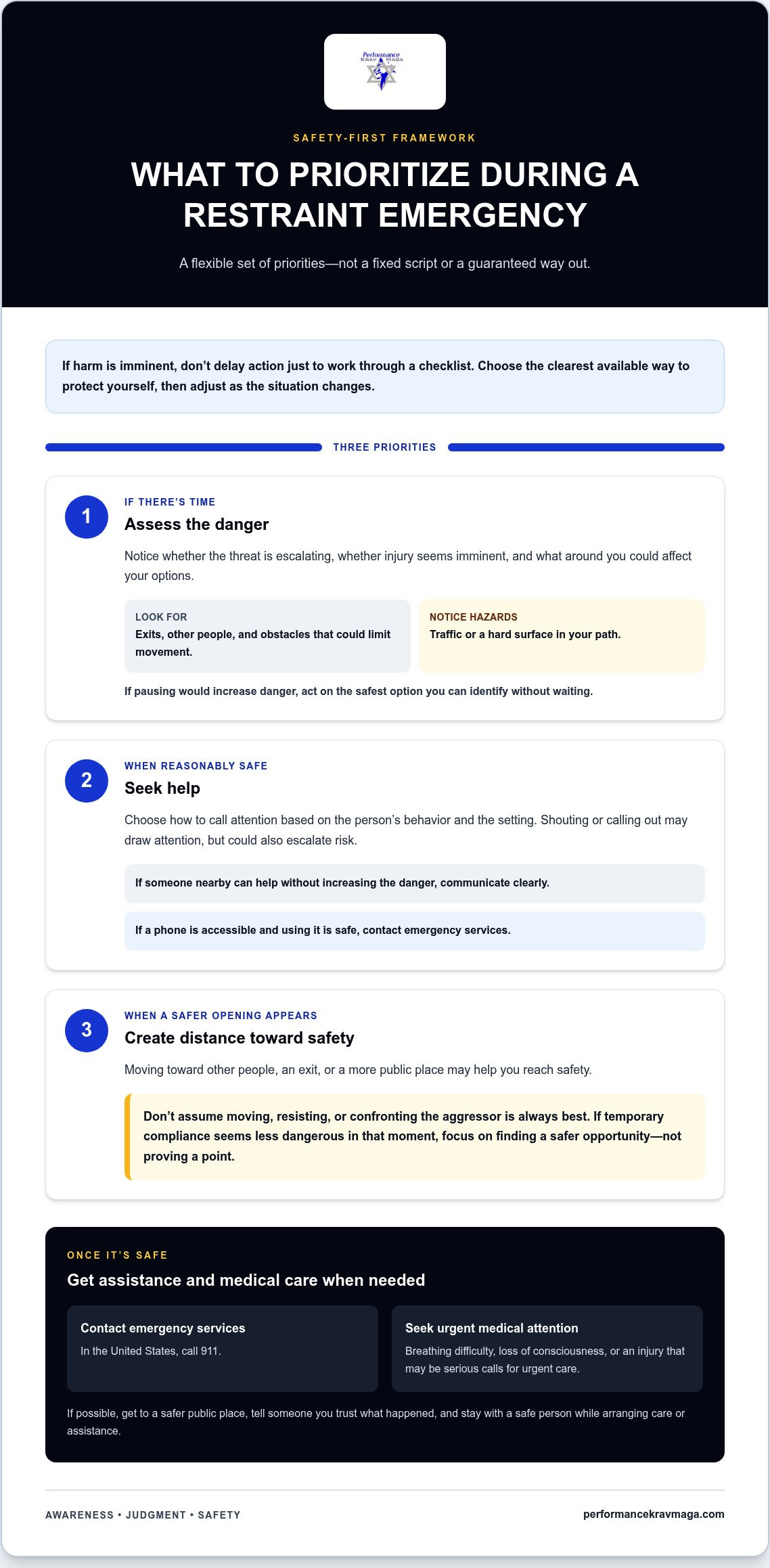
What to Prioritize During a Restraint Emergency
There’s no fixed script for a dangerous moment. If harm is imminent, don’t delay action just to work through a checklist. Use the clearest available option to protect yourself, then adjust as the situation changes. These priorities are a flexible framework, not a sequence you must complete in every circumstance.
The safest response depends on immediate danger, surroundings, and access to help. The five principles of self-defense include awareness and preparation. These ideas can help you think about choices before a crisis, but general guidance can’t assess a live emergency for you.
Assess danger if there’s time. Notice whether the threat is escalating, whether there’s an immediate risk of injury, and what is around you. Look for exits, other people, obstacles that could limit movement, and hazards such as traffic or a hard surface. If pausing would increase danger, act on the safest option you can identify without waiting.
Seek help when it’s reasonably safe. Depending on the person’s behavior and the setting, shouting or calling out may draw attention, but it could also escalate risk. If someone nearby can help without increasing the danger, communicate clearly. If a phone is accessible and using it is safe, contact emergency services.
Create distance when a safer opening appears. Moving toward other people, an exit, or a more public place may help you reach safety. Don’t assume that moving, resisting, or confronting the aggressor is always the best choice. If temporary compliance seems less dangerous in that moment, the priority remains finding a safer opportunity, not proving a point.
Assess danger and look for a safer opportunity
Pay attention to details that could change the risk: a blocked doorway, someone nearby who notices, a hazard in your path, or a route that leads toward help. You don’t need to map every detail. If a safer path is apparent and moving toward it seems reasonable, take the opportunity. If movement could worsen immediate danger, don’t treat escape as an automatic command.
Get help and seek medical attention when needed
Once it’s safe to do so, contact emergency services. In the United States, call 911. Breathing difficulty, loss of consciousness, or an injury that may be serious calls for urgent medical attention. If possible, get to a safer public place and tell someone you trust what happened. Stay with a safe person while you arrange care or assistance.
These priorities take practice to consider under stress. In a supervised setting, Krav Maga and self-defense instruction can help you explore awareness and decision-making progressively, with feedback rather than surprise or uncontrolled drills.
Why Restraint Escapes Depend on Context, Not Strength Alone
A wrist grab, a grip on clothing, and a hold that limits broader movement can look similar in a short online clip, but they don’t create the same conditions. Visibility, balance, freedom to move, nearby help, and injury risk all shape what may be safest. The examples below are illustrative, not a diagnosis of any real incident.
How different restraint situations change the risks
Think in terms of changing risks, not a specific move. The same kind of restraint can become more or less dangerous depending on the people involved and the environment.
Wrist or arm grab: Other people may be able to see what is happening, but movement and balance can still be affected. Consider whether help is nearby and whether sudden movement could cause a fall or strain.
Clothing grab: Fabric can restrict movement or pull a person off balance. Loose clothing or nearby objects may add hazards. Witnesses may be able to help, but only if they can respond safely.
Being held: Mobility, visibility, and access to assistance may be more limited. A wall, furniture, traffic, or an uneven surface can increase injury risk, so the surrounding space matters as much as the hold itself.
Why a universal escape technique is a false promise
A short article can’t reliably tell you how to escape common restraints in every situation. Physical encounters change quickly. A person may be surprised, frightened, tired, injured, or unable to move as expected. Stress can narrow attention. Differences in size or strength may affect the available options, while poor footing, tight spaces, or nearby hazards can change the risks of moving.
Greater strength, speed, or pain tolerance doesn’t guarantee success, and memorizing one move isn’t a substitute for judgment. A technique practised in a calm setting may feel different under pressure, and it may not suit the circumstances. Don’t treat an online demonstration as a test of what you should do in a real emergency. The priority is to make a decision that accounts for the actual risk, not to prove that a move works.
Practical learning focuses on recognizing changing conditions and making choices under controlled supervision, rather than promising a single answer. Practical self-defense classes in Atlantic County offer a structured setting to build awareness and practise skills with feedback. Training can help you explore options, but no class or technique can guarantee a particular outcome.
How to Practise Restraint Awareness Without Creating More Risk
Practice should build judgment, not recreate danger. If you’re learning how to escape common restraints, avoid surprise drills, forceful demonstrations, or copying an isolated clip with a friend. Without instruction, even a well-meant attempt can cause injury or make someone feel trapped. Start in a supervised, consent-based setting where the goal is to learn safely, not to prove toughness.
Set clear boundaries before partner practice
Before any exercise involving physical contact, everyone should give explicit consent and agree on a clear stop signal. Discuss what the practice will involve, what is off-limits, and how either person can pause or end the activity. Consent is ongoing. Agreeing to begin doesn’t mean someone has to continue.
For beginners, an instructor can introduce practice gradually and adjust it for each person’s comfort and ability. Keep intensity controlled, follow the instructor’s guidance, and don’t add force or surprise. Stop immediately if anyone experiences pain, panic, breathing difficulty, or simply feels unsafe. Pausing is useful feedback, not a failure.
Build judgment alongside physical skills
Good practice isn’t only about movement. Notice exits and other people in the space. Consider distance, communication, and whether stepping away or disengaging could be safer than staying engaged. These choices can be discussed and practised without turning the session into a realistic assault or using painful restraints.
Structured instruction helps because an instructor can explain a skill, observe how you respond, and offer feedback as you learn. A short video can’t see your balance, comfort level, or surroundings. Copying a move without context may leave you with the wrong lesson. Practice in a controlled setting gives you room to ask questions, make adjustments, and understand why awareness and decision-making matter alongside physical skills.
Keep the boundary clear: a classroom is controlled, and a real emergency is unpredictable. Practice can help you think through options, but it can’t reproduce every source of stress or guarantee a particular result. The Krav Maga classes guide offers broader context on practical instruction and structured learning.
If you’re in Egg Harbor City, explore supervised Krav Maga and self-defense classes to develop practical skills with instruction and feedback. Start at a pace that supports learning, with safety first.
Learn Restraint Awareness Through Krav Maga Training in Egg Harbor City
Understanding how to escape common restraints begins with recognizing that a written guide can’t replace supervised practice. A structured class gives students the chance to build awareness and physical skills progressively, with instruction and feedback as they learn. The aim isn’t to promise a result in a real emergency. It’s to develop practical skills and sound decision-making over time.
What beginners can gain from supervised self-defense instruction
You don’t need prior martial arts experience to start learning. In a coached setting, an instructor can explain skills clearly, help students practise at an appropriate level, and give feedback on their responses. That makes it easier to understand what a drill is meant to teach instead of copying a move without knowing its purpose.
Confidence grows through practice, not promises. Repeating foundational skills can help students become more familiar with movement, attention, and decision-making under controlled conditions. As experience develops, instruction can build on that foundation. Each person’s progress is individual, and practice can’t predict exactly how anyone will respond in an unpredictable emergency.
Restraint awareness also fits within broader self-defense learning. Students can consider how to notice changes in a situation, what choices may be available, and how physical skills relate to reaching safety. These are useful questions to work through with an instructor rather than testing forceful techniques alone.
Take a practical next step in Egg Harbor City
Performance Krav Maga provides Krav Maga and self-defense instruction in Egg Harbor City, New Jersey, for people at different experience levels. The school is owned and operated by Chief Instructor Greg Dziewonski and serves as the national headquarters for Krav Maga Federation (KMFA). Its local classes focus on practical self-protection and physical conditioning.
If you’re new to martial arts, you can begin by exploring the classes and learning what supervised training involves. You don’t need to arrive with a background in self-defense. Bring a willingness to learn, ask questions, and practise deliberately. Progress comes step by step, with attention to your own comfort and experience.
For local readers ready to explore instruction, Explore Performance Krav Maga training. Train deliberately, stay alert, and put safety first.
Build Readiness One Practice at a Time
Confidence doesn’t come from finding a perfect answer online. It grows as you learn, reflect, and practise in a way that respects your limits. Let what you’ve learned about how to escape common restraints guide a more useful question: what would help you make thoughtful decisions under pressure? That question can lead to steady progress without expecting yourself to master everything at once.
Choose a first step that feels manageable. You might focus on becoming more aware of your surroundings, getting comfortable with basic movement, or learning in a coached environment where you can ask questions and receive feedback. Progress is personal. There’s no need to rush or compare your experience with anyone else’s.
For a practical next step, take a look at Krav Maga training options at Performance Krav Maga. A willingness to learn is enough to begin exploring. Keep your expectations grounded, practise deliberately, and carry that calm attention into daily life. Each thoughtful step can help you feel more prepared to make choices that put safety first.
Frequently Asked Questions
Is there one technique that works for every common restraint?
No single technique can be relied on in every situation. Position, surroundings, injuries, and access to other people can all affect what may be safest. Treat online advice about how to escape common restraints as general education, not a guaranteed solution. If you want to practise, an instructor can help you learn progressively. In an actual emergency, prioritize urgent help and medical care when needed.
Can someone escape a restraint without being physically strong?
Strength is only one factor, and no article can predict what will happen to a particular person. Awareness, timing, physical condition, surroundings, and access to help may also shape the available options. Be cautious of advice promising that a smaller or inexperienced person can always get free. Beginners in Egg Harbor City can build judgment and movement skills through supervised self-defense instruction, without assuming training guarantees an outcome.
What should I do after getting away from someone who restrained me?
Move toward a safer place with other people if you can do so without increasing the danger. If emergency help is needed in the United States, call 911. Seek medical attention for injuries, breathing problems, or possible loss of consciousness, even if you’re unsure how serious they are. Tell someone you trust what happened. Don’t return to confront the person or delay urgent care to retrieve belongings.
Is it safe to practise restraint escapes with a friend at home?
Unsupervised practice can cause injury or distress, especially if someone applies force or affects another person’s breathing. Don’t surprise a partner, apply painful pressure, or continue after a stop signal. Physical practice belongs in a controlled setting with explicit consent, agreed boundaries, and supervision. Stop immediately if anyone feels pain, panic, or difficulty breathing. You can build awareness without physically restraining a friend.
Can I use self-defense advice to escape handcuffs or lawful detention?
No. This guide doesn’t provide instructions for escaping handcuffs or evading lawful detention. Avoid physical resistance during a detention and seek legal advice as appropriate. If you face immediate danger or need urgent medical help, clearly communicate that need and contact emergency services when possible. Physical resistance can create serious risks for everyone involved, so don’t apply assault-related self-defense advice to a law-enforcement encounter.
How can a bystander help when someone appears to be restrained?
Keep your own safety in mind and don’t rush into a physical confrontation that could increase the danger. From a safe location, call 911 if someone appears to face immediate harm, give the dispatcher clear location details, and follow their directions. If it’s safe, attract attention or guide others toward help. A brief, specific description of what you see can help responders assess the situation.


Comments