
Self-Defense for Students Studying Abroad: A Practical Safety Checklist

You step off a train in a city you’ve never visited, your phone map stalls, and someone starts closing the distance. You don’t need to assume the worst, but you do need a plan. Self defense for students studying abroad starts before departure, with practical habits that help you stay aware and make clear choices in unfamiliar settings.
It’s natural to feel uncertain about local customs, getting around alone, or what to do when a situation feels wrong. Preparation can make those moments easier to handle. This checklist will help you create a personal safety plan, use destination-specific guidance, and decide how to respond if you feel unsafe. Physical self-defense is one part of readiness, not a substitute for prevention or local help.
You’ll also learn how realistic self-defense training fits into your preparation. For students in Egg Harbor City and South Jersey, Krav Maga and self-defense classes at Performance Krav Maga provide a place to practice practical self-protection skills. Training is one part of readiness. Sound decisions and knowing how to seek help matter just as much.
Table of Contents
Self-defense for students studying abroad starts before departure
Preparing to study abroad can feel exciting and uncertain at the same time. You’re looking forward to new places and routines, while wondering how you’ll get around, who to contact for help, and what local expectations may be different. Planning ahead isn’t a prediction that something will go wrong. It’s a practical way to make decisions with less guesswork when everything is new. Self defense for students studying abroad begins with information, communication, and a plan you can actually use.
Research your destination and campus before you leave
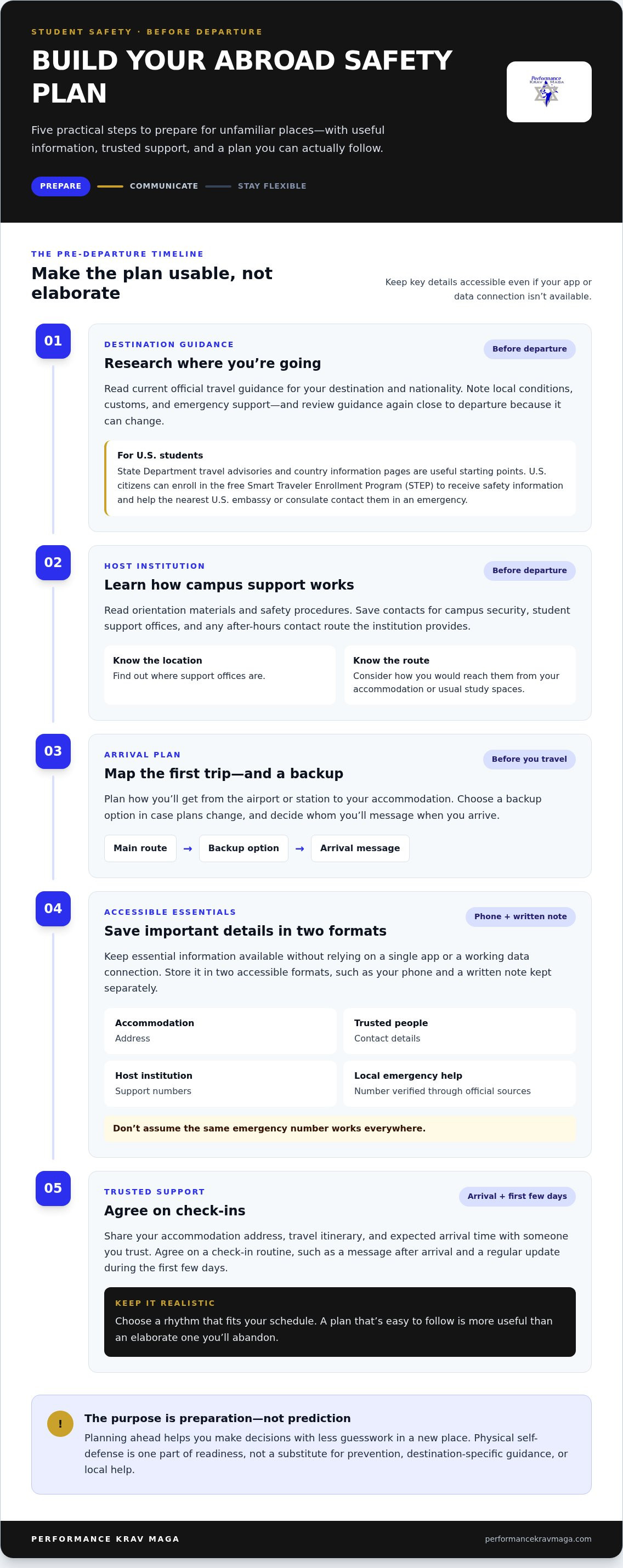
Start with current official travel guidance for your destination and your nationality. Read the destination’s government travel advice and country information, and note guidance on local conditions, customs, and emergency support. If you’re a U.S. student, the State Department’s travel advisories and country information pages are useful starting points. U.S. citizens can also enroll in the free Smart Traveler Enrollment Program (STEP) to receive safety information and help the nearest U.S. embassy or consulate contact them in an emergency. Guidance can change, so review it again close to departure.
Next, read your host institution’s orientation materials and safety procedures. Save the details for campus security, student support offices, and any after-hours contact route the institution provides. Find out where these offices are and how you would reach them from your accommodation or usual study spaces. For a broader introduction to self-defense principles and practices, including prevention and physical responses, remember that general information doesn’t replace destination-specific advice or your school’s procedures.
Set up a simple personal safety plan
Keep the plan compact enough to maintain. Share your accommodation address, travel itinerary, and expected arrival time with someone you trust. For arrival day, plan how you’ll get from the airport or station to your accommodation, choose a backup option in case plans change, and decide whom you’ll message when you arrive. Keep these details accessible without relying on a single app or a working data connection.
Save essential information in two accessible formats, such as your phone and a written note kept separately. Include your accommodation address, trusted contacts, host institution support numbers, and the local emergency number after verifying it through official sources. Don’t assume the same number works everywhere. Agree on a check-in routine with someone you trust, such as a message after arrival and a regular update during the first few days. Choose a rhythm that fits your schedule. A plan that’s easy to follow is more useful than an elaborate one you’ll abandon.
Pre-departure checklist:
Review official destination guidance and host institution safety information.
Save campus support contacts and local emergency details offline.
Share your itinerary, accommodation address, and arrival plan with a trusted person.
Set a realistic check-in routine and identify a backup arrival option.
Do the basics before you pack. Once you arrive, your plan gives you a clear starting point for learning the local environment and making informed choices.
Everyday self-defense habits for navigating life abroad
Daily safety isn’t about treating strangers as threats or avoiding every unfamiliar situation. It’s about staying engaged with your surroundings, making deliberate choices, and keeping options open if plans change. Local customs, transport systems, and practical risks differ from place to place, so use current guidance from your host institution and trusted local sources rather than assuming one rule fits every destination.
Think of self defense for students studying abroad as a set of ordinary habits. Before taking an unfamiliar route, check how you’ll get there and how you’ll return. Keep enough attention free to notice where you are, who is nearby, and whether the environment feels comfortable. If you’re using your phone for directions, pause somewhere appropriate to check it instead of walking with your attention fixed on the screen.
Make everyday movement more deliberate
For a new trip, compare routes and transport options using current, reliable local information. Notice where you can ask for assistance, and keep a backup plan in mind in case a service is delayed or your route changes. If a journey takes you somewhere unfamiliar or your plans shift substantially, let a trusted person know when appropriate. You don’t need to report every routine movement. Focus on changes that affect your expected arrival or whereabouts.
Accommodation deserves its own routine. Learn how to enter and exit the building, keep access details private, and follow the residence’s security procedures. When you arrive, locate the front desk, resident staff, or other support contact if one is provided. Use screen locks on your devices and be thoughtful about sharing live location, accommodation details, or travel plans publicly. These steps reduce avoidable distractions and help you stay in control of your information.
Use clear boundaries in social situations
Social plans can change quickly, especially when you’re meeting new people or visiting an unfamiliar venue. Stay connected with a trusted friend when that helps you feel comfortable, and agree on a simple way to check in or leave together. You’re allowed to change your mind. If an interaction or location feels uncomfortable, leave, move toward a more public or staffed area, or contact someone you trust. You don’t owe anyone a lengthy explanation.
Asking for help is a sound decision, not a failure to manage the situation alone. Venue staff, campus support, or a trusted local may be able to point you toward a safer next step. The U.S. Department of State provides security awareness training resources that include material for study abroad administrators. Students can also ask their host institution what guidance applies to their program.
For students in Egg Harbor City and South Jersey, practical self-defense training at Performance Krav Maga complements these everyday habits by providing a place to practice awareness, movement, and boundaries. Keep the priority clear: notice, adjust, and seek support when needed.
What self-defense can, and cannot, do for students abroad
Self-defense is preparation, not a guarantee. No class, checklist, or technique can ensure that a person will stay safe in every situation, especially in a place with unfamiliar routines, language, and local procedures. A more realistic goal is to make informed choices, recognize when to change course, and know how to seek support. For self defense for students studying abroad, a physical response is only one part of a wider safety plan.
Useful preparation builds options; it never promises complete protection.
Why self-defense is broader than physical techniques
Awareness, boundaries, and decision-making matter before any physical skill does. If a route, interaction, or setting feels uncomfortable, you can leave, change plans, move toward a staffed or busier place, or contact someone you trust. Getting away early is a successful response, not a failure to stand your ground. The priority is to avoid danger where possible, create distance if needed, and reach help.
Training gives students a structured place to practice noticing cues, communicating boundaries, moving with purpose, and considering how they might respond under pressure. That practice may make choices feel more familiar, but it doesn’t replace judgment or local guidance. A technique learned in class cannot account for every person, environment, or circumstance. Instead of asking, “Can I handle anything?” ask, “What choice gives me a safer next step?”
How to judge advice without adding fear
Safety advice is most useful when it’s tied to a clear source and context. Prioritize current official travel guidance, your host institution’s procedures, and destination-specific information from reliable local sources. Check when advice was published and whether it applies to your destination and situation. A general tip may be worth considering, but it shouldn’t override guidance from authorities or your program.
Be cautious with dramatic anecdotes, stereotypes, and unsupported claims about particular groups or neighborhoods. One story cannot establish what is typical, and broad warnings can make ordinary life feel more dangerous than the available evidence supports. Separate a specific, practical precaution from a sweeping assumption. For example, follow the transport advice issued for your location rather than deciding that an entire category of people or places should be avoided.
For students in Egg Harbor City and South Jersey, practical self-defense classes, including Krav Maga instruction, complement destination research with a place to practice movement, boundaries, and decision-making. Performance Krav Maga’s instruction focuses on practical self-protection and is designed for people with different experience levels. Training helps you practice, while sound choices, local procedures, and asking for help remain essential parts of a safety plan.
A response checklist for students who feel unsafe abroad
If something feels unsafe, focus on the next practical step rather than trying to solve everything at once. The right response depends on what’s happening and where you are, but a useful starting sequence is to move toward safety, contact support, and follow local emergency guidance. Keep your host institution’s contacts and local emergency information accessible so you’re not searching for them under pressure.
Move to a safer place, reach trusted support, and follow the guidance that applies locally. If there’s immediate danger, contact local emergency services using the verified emergency number for your location. Don’t assume one number works everywhere. Use information from your host institution or official local sources, and prioritize reaching help over gathering details or explaining the situation.
If an immediate situation feels unsafe
When possible, head toward a public, staffed, or otherwise safer place, such as a staffed campus building or an open business. If you’re with a trusted companion, ask them to stay with you or help contact support, provided doing so doesn’t increase danger. If you can’t safely reach someone you know, seek assistance from staff or local emergency services.
Move toward safety. Choose a safer nearby place if you can do so without escalating the situation.
Contact support. Call or message a trusted person, campus contact, international office, or accommodation staff member who can help safely.
Follow local emergency guidance. If there’s immediate danger, use the verified local emergency number and follow the operator’s directions.
Your campus international office can explain the program’s response procedures and connect you with appropriate support. Trusted residence staff or accommodation personnel may also help you reach the right contact. If a particular option isn’t safe or available, move to the next practical source of help.
After an incident or serious concern
Once you’re in a safer setting, follow your host institution’s reporting and support procedures. Depending on the concern and your program’s guidance, contact the international office, student support services, campus security, or accommodation staff. If someone needs urgent medical attention, seek local emergency or medical help first. Don’t delay urgent care to complete a report.
When it’s safe and useful, write down essential details while they’re fresh, such as the time, location, and people or offices you contacted. Keep notes factual. Save relevant messages or contact information if doing so feels appropriate, but don’t put yourself at risk to collect evidence. You can also seek emotional support through campus services or trusted people. If you’re a U.S. citizen and need consular assistance, contact the nearest U.S. embassy or consulate using official contact information.
For students in Egg Harbor City and South Jersey, practical self-defense instruction at Performance Krav Maga provides a place to practice awareness, boundaries, and responses before travel. Explore self-defense classes at Performance Krav Maga as one part of preparation, alongside local guidance and your institution’s support plan.
Build practical self-defense skills before studying abroad
Reading safety guidance helps you understand local procedures. Practice adds another layer: it gives you a chance to rehearse movement, boundaries, and decision-making in a structured setting before you leave home. For self defense for students studying abroad, the value isn’t mastering a move that works in every situation. It’s learning, receiving guidance, and building familiarity with practical responses while keeping prevention and sound judgment at the center.
Instruction for different experience levels can introduce students to basic movement, communicating a boundary, and responding to pressure in a controlled learning environment. These are skills to develop over time, not instant expertise. No single class can prepare someone for every circumstance, and training doesn’t replace destination-specific guidance, campus procedures, or getting help when needed.
What to look for in practical self-defense instruction
Useful instruction explains why an exercise is being practiced and what its limits are. Clear coaching helps students understand what to focus on, ask questions, and adjust as they learn. A welcoming learning environment should account for different experience levels, so beginners can build familiarity without being expected to perform like experienced students.
Consistency matters. Repeated practice can help movements and decisions become more familiar, but progress takes time and doesn’t guarantee a particular outcome. Treat each class as a chance to learn and refine, not a promise of protection.
As you prepare, connect training to your travel plans in a grounded way. Think about how you communicate a boundary, where you might move if you need space, and how you would seek help in the setting you’re in. Keep those ideas flexible: the safest response depends on the circumstances, and leaving or contacting support may be a better choice than using a physical skill.
Prepare with Performance Krav Maga in Egg Harbor City
Students in Egg Harbor City and South Jersey can build practical skills through Krav Maga and self-defense classes at Performance Krav Maga. The school’s instruction focuses on practical self-protection and is designed for people at different experience levels. Chief Instructor Greg Dziewonski owns and operates the school, which also serves as the national headquarters for the Krav Maga Federation.
Training provides a place to practice with guidance, become more familiar with movement and boundaries, and develop confidence through learning. It can’t predict the conditions you’ll encounter abroad or replace informed choices once you arrive. Pair practice with your host institution’s safety procedures and current local guidance, then adapt your decisions to the situation in front of you.
If you’re preparing to travel, explore practical self-defense classes in Atlantic County at Performance Krav Maga. Start with the basics, keep expectations realistic, and build your preparation one step at a time.
Take one confident step toward your next chapter
Before departure, choose one part of your preparation to make more familiar. You might rehearse how you’ll find support on campus, practice stating a clear boundary, or decide whom you’ll contact if plans change. Small steps can make a new environment feel more manageable without turning travel into something to fear. The aim of self defense for students studying abroad isn’t to predict every challenge. It’s to give yourself more options and the confidence to make a considered choice.
If you’d like to add guided practice to your preparation, explore practical self-defense training at Performance Krav Maga in Egg Harbor City. Classes offer a place to practice movement and responses, while your judgment and local guidance remain essential wherever you go.
Your time abroad is an opportunity to learn, connect, and grow. Prepare thoughtfully, stay open to new experiences, and trust yourself to take the next sensible step.
Frequently Asked Questions
Is self-defense training useful for students studying abroad?
Yes, self defense for students studying abroad can help you rehearse choices before travel, especially small decisions that may feel harder in a new place. If you miss a stop or a social plan changes, practiced awareness and boundary-setting may help you pause and consider a next step. Training won’t tell you exactly what to do in every circumstance, so pair practice with current local information and your program’s procedures.
Can I prepare for studying abroad if I have never taken a self-defense class?
Yes. You don’t need martial arts experience to begin preparing or to join instruction designed for different experience levels. Start by learning your program’s orientation process and saving the contacts it provides. If you take a class, tell the instructor you’re new and focus on understanding each exercise before trying to move faster. A steady learning pace helps you build familiarity without expecting instant expertise.
What should I do if I feel unsafe while studying abroad?
If you feel unsafe, prioritize getting help in a way that fits the moment. If speaking aloud could draw unwanted attention, move toward staff or another safer setting first, then contact a trusted person when you can. If someone is with you, agree on a simple signal that means you want to leave. For immediate danger, use the verified local emergency service rather than waiting to explain everything to your school.
Should students studying abroad carry a self-defense weapon?
Don’t pack an item for self-defense until you’ve checked current official guidance for your destination and the rules that apply to your travel and accommodation. An item permitted at home may be restricted elsewhere, and carrying it can bring practical complications. Consider whether it could create difficulty during transit or at your residence. Planning how to get help and keeping important contacts accessible are preparation steps that don’t depend on carrying a weapon.
How can I find emergency help in another country?
Ask your host institution during orientation how to report an urgent concern and which offices handle different situations. Save those details with the local emergency number and the nearest relevant campus contact. If you’re a U.S. citizen, keep the nearest U.S. embassy or consulate information available for consular assistance. Write key phone numbers on paper as well, so you can access them if your phone battery dies or you can’t use an app.
Can Krav Maga help me feel more prepared for daily life abroad?
Krav Maga classes provide structured practice with practical self-protection skills, helping students become more familiar with movement and responding under instruction. They can’t predict a situation or replace local knowledge and sound judgment. Students in Egg Harbor City can build these skills through Performance Krav Maga classes. Treat class as practice that supports your broader readiness, not as a guarantee that every challenge will be manageable.


Comments