
Martial Arts for Improving Balance: Build Control Through Training

What if better balance came less from standing perfectly still and more from learning to recover when your position shifts? That’s the skill at the heart of martial arts for improving balance: controlling movement, shifting weight, and finding a stable base again. If everyday movement or exercise leaves you feeling unsteady, it’s understandable to wonder whether martial arts training is too demanding. It doesn’t have to start with fast kicks or complex techniques.
Good training begins with fundamentals. Controlled steps, weight shifts, turns, and simple stances challenge coordination while helping you notice how your body moves. Progress should be gradual, with movements adapted to your experience and comfort. Balance work is about control, not pushing through discomfort.
This guide explains how balance is used in martial arts, which beginner-friendly training elements let you practise it, and how to approach training safely and consistently. You’ll also learn how structured Krav Maga practice can develop controlled movement and physical readiness. At Performance Krav Maga in Egg Harbor City, instruction welcomes different experience levels, so you can begin with the basics and build at a measured pace.
Table of Contents
How martial arts for improving balance works beyond standing still
Balance isn’t just the ability to hold a pose without wobbling. It’s the ability to keep or regain control of your body while standing, stepping, turning, or changing direction. The National Institute on Aging describes balance as the ability to keep steady while standing or moving, a practical skill for everyday actions as well as exercise.
What does balance mean during movement?
Your base of support is the area beneath you that helps keep you steady, such as the space between your feet. Your center of mass is the point around which your body’s weight is balanced. When you step, your base changes. Staying in control means adjusting your position so your center of mass remains supported.
Picture turning to step around a bag on the floor. You shift your weight, place a foot in a new direction, and steady yourself before moving on. That sequence uses dynamic balance, or control in motion. Static balance means staying steady in one position, while coordination is organising body parts to move together. Body awareness is sensing where your body is and how it’s moving, even without watching every step.
These are skills to practise, not a test of toughness or natural athletic talent. A movement can be slowed down, simplified, and practised with attention to control. The aim isn’t to force a perfect stance; it’s to notice a shift and respond deliberately.
Why martial arts challenges more than one balance skill
Martial arts movements often involve changing direction, stance, distance, and body position. With footwork, you shift weight from one leg to the other while keeping your posture organised. A stance transition asks you to move your feet and adjust your body at the same time, combining stability with coordination and attention. Even a basic step involves sensing where your weight is, placing your foot, and settling into the new position.
That’s why martial arts for improving balance involves more than holding a deep stance. A stance may practise steadiness, but stepping out of it and recovering control asks your body to manage movement. As practice develops, an instructor can vary pace or direction to increase the challenge without jumping straight to complex or fast drills. The Martial Arts Therapy overview discusses kinesthetic balance, or awareness of the body’s position and movement, as one area associated with martial arts practice.
Different movements place different demands on balance. A controlled turn challenges orientation; a stance change asks for a stable transition; moving in response to a partner adds attention to another person’s position. These examples show how training creates opportunities to practise control, but they don’t mean that any single class guarantees measurable improvement. The value lies in structured repetition, appropriate challenge, and learning to move with awareness rather than relying on stillness alone.
How martial arts drills train footwork, stability, and recovery
Balance becomes practical when your body has to move, adjust, and settle again. Martial arts footwork offers manageable chances to practise these actions: stepping forward, retreating, turning, or changing stance while staying in control. The goal isn’t to move as quickly as possible. Make each shift deliberate, then build complexity as control improves.
Balance practice is more than holding a wide stance; it includes controlling weight shifts and recovering a stable position as you move. A broad base may feel steady while you’re still, but everyday movement and martial arts require you to adapt as your feet and body position change.
Footwork and stance changes build moving control
Advancing and retreating move your weight over a changing base of support. A turn asks you to redirect your body, while a stance change requires your feet and posture to work together. Practised at a controlled pace, these movements help you notice how weight shifts from one leg to the other and whether you can finish each step steady.
Good posture is adaptable, not rigid. Locking your knees or bracing your whole body can make it harder to respond smoothly. An instructor can keep early practice simple, then adjust pace, distance, or direction as you become more comfortable. A smaller step done with control is useful practice.
Recovery and coordination matter as much as stability
Movement doesn’t always end exactly where you expect. Balance practice includes noticing a shift and making a controlled adjustment, such as taking a step to regain a comfortable stance. Visual attention helps you track where you’re moving, while body awareness helps you sense changes in weight and posture.
You can practise these skills without contact. For example, an instructor may give a direction to step toward or away from, allowing you to respond at a measured pace. If partner movement is introduced, it should be supervised, controlled, and matched to your experience. The aim is coordinated practice, not proving that training makes someone immune to slips or impacts.
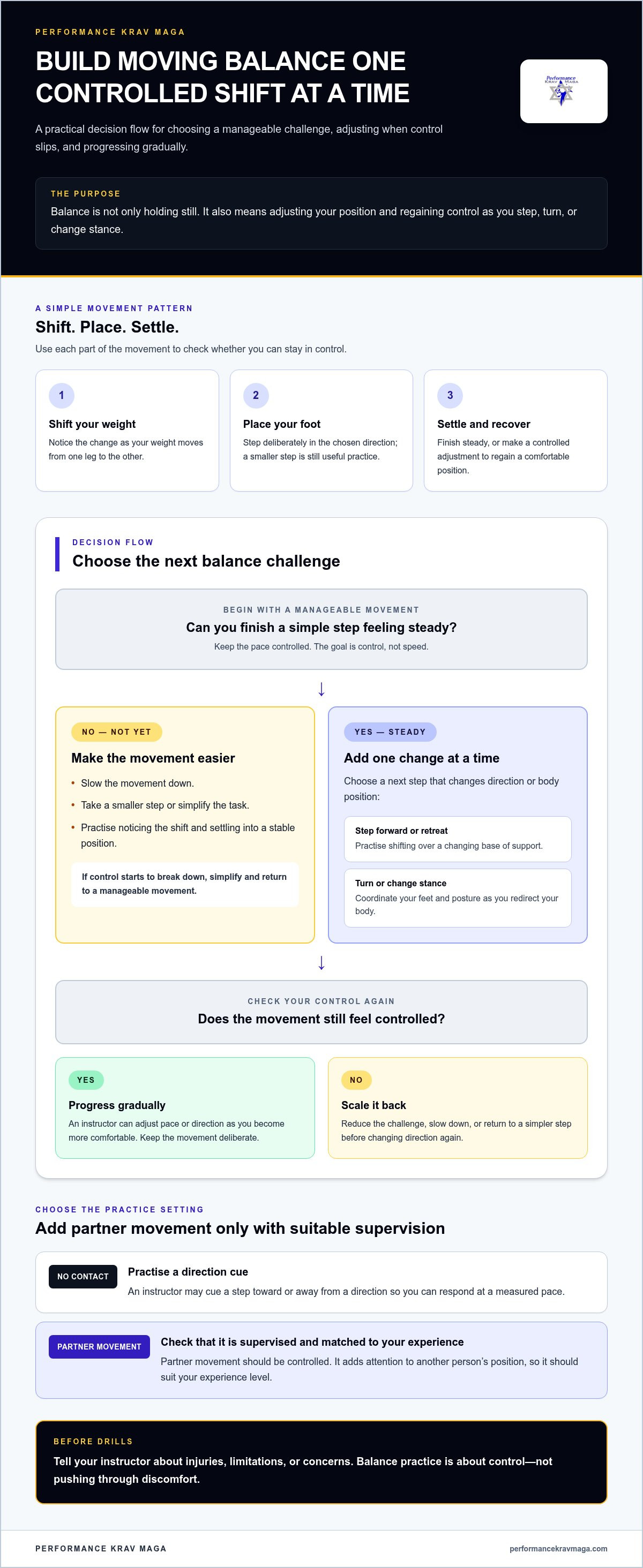
Challenge should increase gradually. An instructor might first ask for a steady step in one direction, then introduce a turn or change of pace once the movement feels manageable. If control starts to break down, simplify the task: slow it, shorten the step, or return to a familiar stance. Adjusting the drill is part of learning, not a setback.
Step: Shift weight and place the foot with control.
Settle: Find a comfortable, ready posture before the next movement.
Adjust: Change pace or direction only as control allows.
These principles inform structured Krav Maga and self-defense instruction in Egg Harbor City, where practice can progress across different experience levels. Martial arts for improving balance is a steady process of learning to move, notice, and regain control, rather than a test of how long you can hold still.
Which martial arts training features are most useful for balance?
Rather than searching for a martial arts style that claims to be best for balance, look at what students practise. Do they work through controlled changes in direction and stance, or spend most of the session practising techniques in one position? Schools and instructors emphasize different movement patterns, so class structure and individual fit matter more than a style’s label.
Compare movement demands, not martial arts labels
Stationary technique practice can build familiarity with posture and positioning. Moving drills add the task of coordinating steps, weight shifts, and changes in direction. Neither format is automatically better for every student, but varied, controlled movement gives learners opportunities to practise balance while changing position. The comparison below describes the demands involved, not a ranking of martial arts.
Training feature
Movement challenge
Beginner access and supervision
Directional footwork
Shifting weight while stepping forward, back, or to the side.
Often easy to scale with small steps and a measured pace; an instructor can guide direction and posture.
Stance transitions
Changing foot position and body alignment while keeping movement controlled.
Can start with simple transitions; coaching helps students adjust range and speed.
Controlled partner movement
Responding to another person’s position while maintaining awareness of your own movement.
Should be supervised and matched to experience, with clear boundaries and manageable demands.
Stationary technique practice
Holding a position while focusing on posture and the technique itself.
Can offer a straightforward starting point; supervision supports safe positioning and useful feedback.
Use the comparison to see whether a class progresses from familiar, steady movements toward more varied footwork. A session doesn’t need to be fast or complicated to be useful. Clear repetition gives beginners time to understand a movement before adding a new direction or response.
What to notice in a beginner-friendly class
Look for clear demonstrations, manageable progressions, and enough room to practise at a controlled pace. Attentive coaching matters: an instructor can offer a simpler version, point out a posture adjustment, or reduce the movement’s range when needed. These features support learning, but they don’t guarantee a specific balance result.
For martial arts for improving balance, choose practice that challenges movement without making control feel out of reach. A class that welcomes different experience levels can help students work on footwork, transitions, and coordination at an appropriate pace. Focus on whether instruction helps you move with attention and control, not on claims that one art is universally superior.
How to begin balance-focused martial arts practice safely
You don’t need strong balance or prior martial arts experience to begin. Start with a class where movements can be scaled, instructions are clear, and you can build control before adding speed or complexity. Share relevant concerns early, and treat adjustments as part of effective practice, not a reason to push harder.
Build challenge gradually instead of forcing difficult movements
Use a simple progression. Stay with each step until it feels manageable, then move forward with instructor guidance:
Assess your comfort. Notice how you feel standing, stepping, and changing position. Tell the instructor about limitations, previous injuries, or concerns before drills begin.
Learn basic footwork. Start with comfortable steps and controlled weight shifts. Focus on maintaining a steady, relaxed posture.
Add direction. Practise moving in a new direction or making a simple turn at a pace you can manage.
Build complexity gradually. Add one challenge at a time, such as greater range, a quicker pace, or a more involved sequence.
Progress is not a race. If a movement becomes difficult to control, reduce its range or slow it down rather than forcing the next step. Consistent, supervised practice is a more sensible foundation than attempting fast turns, unstable surfaces, or other high-risk drills alone.
Follow the class setting and instructor’s directions for footwear. Some training environments call for bare feet, while others may require supportive footwear; don’t assume one is right for every class. Wear what the instructor recommends for that setting.
When balance concerns need professional attention
Wanting to become more confident with ordinary movement is different from experiencing a sudden or unexplained change in balance. If difficulty is new, worsening, persistent, or affecting daily activities, seek medical assessment before treating it as a training issue. An instructor can adapt practice, but martial arts is not a substitute for medical care or physical therapy.
Pay attention during and after training. Stop if you feel pain or unusual symptoms, and seek qualified medical advice. Don’t train through warning signs. If you’re unsure whether a movement feels appropriate, pause and speak with the instructor before continuing.
For beginners, safe practice depends on clear communication and a pace that respects individual ability. Instructors can explain movements, offer adjustments, and guide progression, but each student should report changes in comfort and avoid comparing their pace with someone else’s. This makes martial arts for improving balance a structured learning process rather than a test of toughness.
Krav Maga and self-defense instruction at Performance Krav Maga in Egg Harbor City serves different experience levels and offers a guided setting for practising controlled movement.
Explore balance-building martial arts training in Egg Harbor City
Balance is built through movement that asks you to stay aware, adjust, and regain control, not simply hold a position. In practical Krav Maga training, footwork and body positioning are part of learning to move with purpose. Performance Krav Maga provides Krav Maga and self-defense instruction for different experience levels in Egg Harbor City, with physical conditioning also included in classes. This gives students a structured setting to work on movement and physical readiness without promising a particular balance outcome.
How structured Krav Maga practice fits the balance discussion
Controlled footwork and changes in body position connect directly to movement-based balance practice. Beginners can focus on understanding how a movement feels and maintaining control as they learn, rather than trying to match the pace of more experienced students. Instruction can be adapted to a student’s experience, so foundational movement is approached as a skill to develop over time.
Class quality matters to that process. Clear instruction helps students understand what they’re practising, while attentive guidance can help them make adjustments. Consistent practice provides repeated opportunities to work on controlled movement, but individual experiences differ. The purpose is broader than balance alone: Krav Maga and self-defense instruction also develop practical movement and physical readiness.
Readers interested in the training context can also explore Elite Krav Maga Classes in Egg Harbor City: Real-World Self-Defense and The Krav Maga Workout: Build Elite Fitness and Real-World Readiness. These topics connect local instruction with self-defense practice and physical conditioning, without suggesting that every class or student has the same focus or experience.
Take the next step at Performance Krav Maga
If you’re new to training, learn at your own pace and communicate openly about your experience, concerns, or limitations. You don’t need polished technique to begin. Focus on listening, understanding the movement, and practising within a range that feels manageable. If balance difficulties are new, persistent, or unexplained, seek medical advice before treating them as a training issue.
For local readers, Performance Krav Maga offers structured Krav Maga and self-defense instruction in Egg Harbor City. Consider whether guided practice fits your goals, then take a measured first step toward learning. Martial arts for improving balance isn’t a promise of a particular result; it’s a way to approach movement with attention, consistency, and coaching suited to your experience.
Take your next step toward controlled movement
Confidence in movement grows through practice, patience, and a willingness to begin at your current ability. You don’t need to master every technique before stepping onto the training floor. Let your first goal be simple: learn, stay attentive to how your body responds, and build from there. That measured approach makes martial arts for improving balance a practice in control, not a test of toughness.
In Egg Harbor City, Performance Krav Maga provides practical Krav Maga and self-defense instruction for different experience levels, with physical conditioning as part of training. The school is owned and operated by Chief Instructor Greg Dziewonski and serves as the national headquarters for Krav Maga Federation (KMFA). Training is an opportunity to work toward physical readiness with guidance, without expecting a guaranteed result.
Ready to take a steady first step? Explore Krav Maga training at Performance Krav Maga and find a starting point that fits your experience. Progress begins with showing up, learning the fundamentals, and giving yourself room to improve.
Frequently Asked Questions
Can martial arts improve balance?
Yes, martial arts practice can challenge balance through repeated movement, though results vary by person and training. A 2025 meta-analysis reported that Taekwondo training enhanced static and dynamic balance, with particularly notable findings among adult females. That research doesn’t guarantee the same effect for every student or style. Look for sessions that give you time to learn and repeat movement with appropriate guidance.
Which martial art is best for improving balance?
There isn’t one martial art that’s best for everyone. Research has examined disciplines such as Taekwondo and Karate, but class demands differ between schools and instructors. Consider whether training includes movement you can practise at a manageable level, and whether the teaching fits your interests and physical needs. A well-matched class is a more useful starting point than choosing a style based on a broad ranking.
Is martial arts suitable for beginners with poor balance?
It may be suitable if the class can accommodate your current ability, but significant unsteadiness deserves careful attention. For example, if you feel unsure during a simple turn, tell the instructor before taking part and ask for an easier way to approach the movement. Notice how your body responds and stop if you feel unsafe. If poor balance is new or worsening, seek medical guidance before starting.
How often should I practise martial arts to improve balance?
Frequency depends on your health, recovery, and the demands of training. The American College of Sports Medicine recommends neuromotor exercise, including balance and coordination work, two to three days weekly for 20 to 30 minutes per session. This is general guidance, not a martial arts prescription or a guarantee of results. Build a routine you can sustain, and account for other exercise and rest as you plan.
Can martial arts help older adults with balance?
It may offer older adults a way to practise movement and coordination, provided the training suits their abilities. One study found that five weeks of community-level Karate training improved dynamic balance and strength in older adults. A single study can’t predict an individual’s outcome, so consider health status, comfort, and instructor guidance. Anyone with a fall history or a medical concern should discuss new exercise with a qualified health professional.
Should I try martial arts or physical therapy for balance problems?
For sudden, persistent, worsening, or unexplained balance problems, seek medical assessment rather than relying on martial arts training. A clinician can help identify the right next step, which may include physical therapy or another form of care. Martial arts classes can be a fitness and skill-building activity, but they don’t diagnose balance problems or replace individualized treatment. If you’re medically cleared to exercise, discuss suitable training options with your care team.


Comments