
Self-Defense for Cyclists and Bikers: How to Ride Safer

What if the safest response to a confrontation on two wheels isn’t to fight back, but to create a chance to leave? That’s the core of self defense for cyclists and bikers: prevent what you can, make distance when needed, and prioritize getting away. A helmet, handlebars, or motorcycle can affect your movement, so your plan should fit the ride you’re actually taking.
You don’t need to escalate a tense encounter to protect yourself. A clear plan can help you make safer choices before a ride and respond with purpose if someone threatens or confronts you. This guide covers practical prevention habits, ways to create distance and leave, and how structured self-defense training can help you practise decision-making. At Performance Krav Maga in Egg Harbor City, practical instruction helps students develop self-protection skills across different experience levels. The goal isn’t to turn every ride into a threat assessment. It’s to ride with awareness, control, and confidence.
Table of Contents
Self-defense for cyclists and bikers starts with understanding the ride
On the road, self-defense can’t control another person’s choices. It’s a way to think clearly about reducing exposure, responding as safely as circumstances allow, and reaching a safer place. A cyclist might change direction toward a public, occupied location. A motorcyclist might create space and choose a safe place to stop. The right decision depends on the situation and what your ride allows you to do.
That context matters. Bicycles and motorcycles differ in speed, handling, stopping distance, protective equipment, and the options available when leaving the roadway. Traffic, weather, road surface, luggage, and experience can also change your choices. Start with the bike, route, and conditions you actually have, not a generic scenario.
Prevent exposure, create distance, and leave for a safer place. Self-defense on a ride is about getting clear, not winning a fight.
How bicycle and motorcycle situations differ
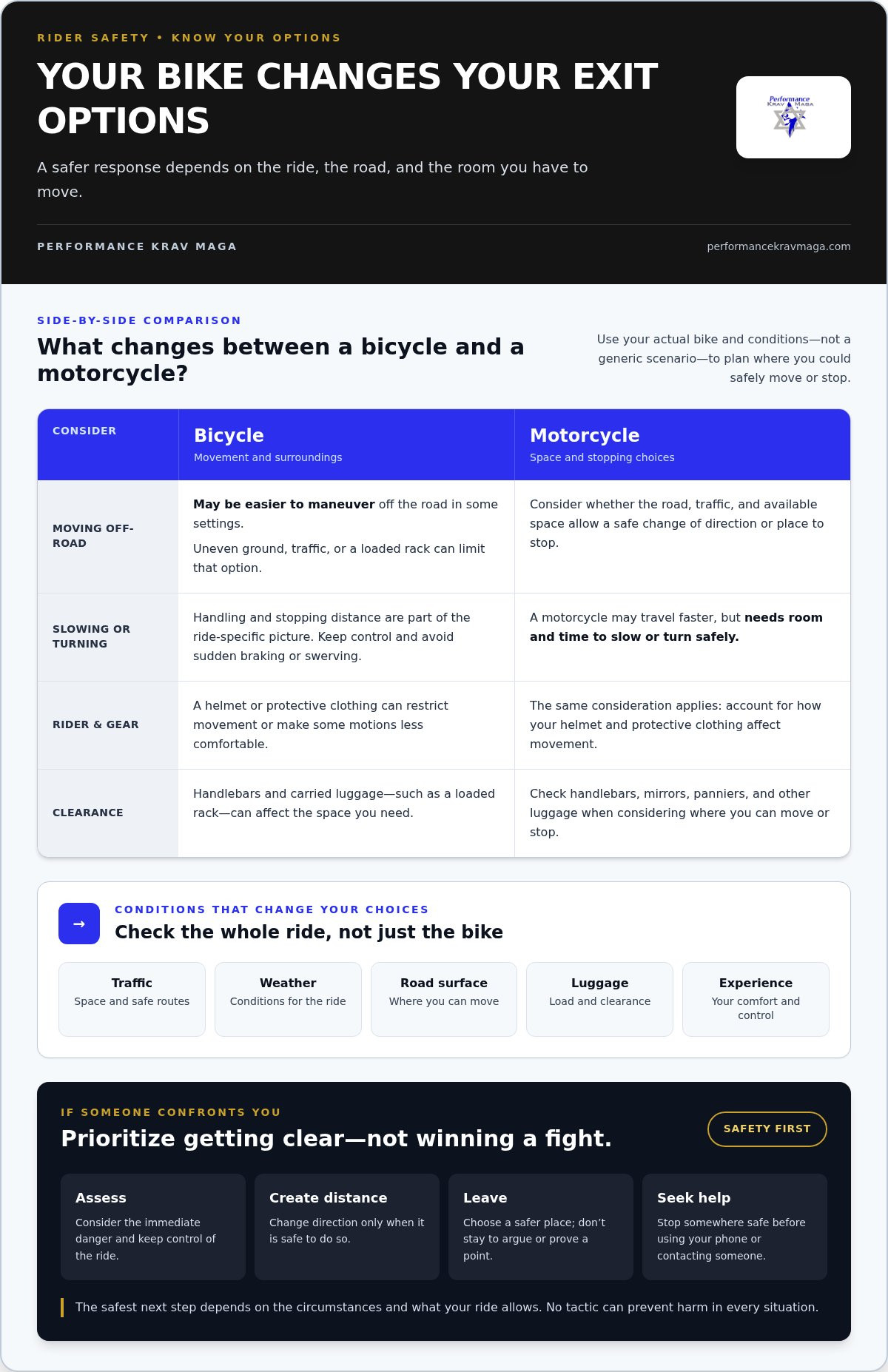
A bicycle may be easier to maneuver off the road in some settings, but uneven ground, traffic, or a loaded rack can limit that option. A motorcycle may travel faster, yet it needs room and time to slow or turn safely. Helmets and protective clothing can restrict movement or make certain motions less comfortable. Handlebars, mirrors, panniers, and other luggage affect clearance, too. Consider your own bike, route, and conditions before deciding where you could safely stop or move.
What self-defense means when you are on the road
Awareness means noticing meaningful changes, such as a vehicle following unusually closely or a person moving into your path, without fixating on them or taking your attention off traffic. Keep control of the ride first. If you need to respond, prioritize a clear exit over confrontation. Leaving, going somewhere public, seeking help, and reporting what happened are valid outcomes. Understanding Self-Defense offers general background, but real situations depend on their circumstances. No tactic can prevent harm in every situation.
Self defense for cyclists and bikers is a decision-making framework, not a set of moves to use regardless of context. Ask yourself: Can I safely change direction? Is there somewhere to stop that won’t leave me isolated or exposed to traffic? Can I get help without increasing the danger? If continuing to ride would be unsafe, don’t assume staying on the bike is your only option. Focus on making the next safe choice, not proving a point.
How to reduce risk before and during a ride
A few deliberate checks can make a ride easier to manage if plans change. When practical, choose a familiar, populated route and think ahead about places where you could pause safely. A quieter shortcut may look efficient, but consider whether it leaves you with fewer options if you need help or a route change. Check the weather, daylight, and planned stops before setting out. Let someone you trust know your route and expected arrival time.
Build a simple pre-ride safety routine
Make preparation repeatable. Charge your phone and keep it reachable without interfering with steering or balance. Store essential communication items so you can access them without rummaging through a bag while riding. Consider visibility in the conditions, including whether your clothing and lights make you easier to see. For general bicycle guidance on visibility, equipment, and safe riding, consult the NHTSA Bicycle Safety Guidelines.
Before leaving: Review your route, weather, daylight, and planned stops.
Share the plan: Tell a trusted person where you’re going and when you expect to arrive.
Check your setup: Keep your phone charged and accessible, and confirm that anything you carry won’t obstruct control.
Keep the routine practical, not complicated. The aim is to start with useful information and a workable communication plan, not to monitor a screen throughout the ride.
Stay aware without losing control of the ride
Notice changes, but don’t let concern pull your attention away from traffic, road surface, and other hazards. Someone repeatedly following your direction, a blocked path, or verbal behavior that becomes more aggressive may be a reason to reassess where you’re headed. These signs don’t prove what someone intends. Treat them as cues to make a calm, safety-focused decision, not as a reason to confront or pursue anyone.
If you decide to change direction, do it only when it’s safe. Avoid sudden braking, swerving, or turning across traffic. For example, if someone appears to be following you, keep control of your bike and consider a gradual turn toward a populated place where you can stop and seek help. Don’t use your phone while riding. Wait until you’re safely stopped to call or message.
Preparation supports safer decisions, but it can’t eliminate every risk. That principle is central to self defense for cyclists and bikers: plan ahead, stay attentive, and preserve options without sacrificing control of the ride. Reading advice can help you think through choices; structured instruction gives you a setting to practise decision-making and self-protection. Riders interested in building those skills can explore practical self-defense classes at Performance Krav Maga.
What to do if someone confronts you while riding
A confrontation can narrow your attention and make it hard to choose what to do next. Use a simple priority: assess the immediate danger, create distance if you can do so safely, leave, and seek help. You don’t have to stay and argue, defend your pride, or prove that you can handle the situation. Getting clear is a sound outcome.
There’s no single move that fits every rider or encounter. A bicycle, motorcycle, traffic lane, nearby people, and the other person’s behavior all affect your options. Don’t rely on a risky maneuver or assume a particular response will guarantee safety. Keep the next decision small: identify an exit, maintain control, and move toward help when it’s safe.
Assess: Notice whether the person is approaching, blocking your way, or making an immediate threat. Keep track of traffic and other hazards, too.
Create distance: If there’s a safe route away, use it without stopping to argue or engage.
Leave: Move toward a populated, well-lit place if the route there is safe. Choose a destination where you can reach other people or ask for help.
Get help: Once you’re in a safer position, contact someone you trust or emergency services, depending on the level of danger.
Create distance and look for an exit
Look beyond the person confronting you. A staffed business, public area, or other place with people nearby may be a safer destination than an isolated stretch of road. Don’t turn toward it if doing so means riding into traffic or another hazard. Whether to stop or dismount depends on your bike, balance, road conditions, and the immediate threat. There isn’t one response for every situation.
Stopping suddenly can put you in danger from traffic, while continuing to ride may be unsafe if your path is blocked or your control is compromised. Make a measured choice based on the space you have. If the person is speaking aggressively but hasn’t blocked your route, leaving without engaging may be possible. If you can’t safely move away, focus on getting help rather than trying to force past them.
After reaching a safer place
Once you’re away from immediate danger, pause somewhere you can safely make a call or message. Contact emergency services if someone faces immediate danger or needs urgent assistance. Otherwise, let a trusted person know what happened and where you are. Don’t return to the confrontation to gather information or retrieve details.
If it won’t draw attention or put you at risk, note useful details while they’re fresh, such as the location, time, and what you remember about the person or events. Don’t prioritize photos or notes over getting to safety. Seek medical attention for injuries, even if they seem minor at first, and write down what happened afterward. These steps can help you make sense of the incident and decide what support you need.
For self defense for cyclists and bikers, success isn’t measured by winning an exchange. It’s measured by choosing the safest available next step and reaching help when you can.
Turn your regular routes into a practical safety plan
A route you know well can still feel different at another time of day, in poor weather, or when traffic and road conditions change. Turn familiar rides into a simple plan: identify places where you could stop safely, consider another way to continue, and decide how you’d communicate a change of plans. This isn’t about predicting every problem. It’s about knowing your options before you need them.
Plan for the ride you actually take
Use a checklist that fits your vehicle and route. Bicycle riders can consider how exposed a stretch feels, visibility, traffic, and whether there are safe, practical places to pause. Motorcyclists can identify suitable pull-off options and think carefully about the risks of stopping on the road. In either case, adapt your plan to your experience, conditions, and the ride you’re taking, rather than relying on a one-size-fits-all rule.
Route: Note exposed or less familiar sections and consider an alternative.
Stops: Identify places where you could pause away from moving traffic and reach other people if needed.
Conditions: Reassess for visibility, weather, traffic, and road conditions on the day.
Vehicle: Account for your bike’s handling, stopping needs, and any luggage or gear that affects your options.
For rides around Egg Harbor City, base your decisions on the conditions you encounter rather than assuming a route will always be quiet or easy to navigate. Reassess your options before setting out and as conditions change.
Make the plan usable under pressure
Keep your response easy to remember. Choose a straightforward destination or action, such as heading to a familiar public place when it’s safe, and agree with a trusted contact how you’ll let them know if your plan changes. A short plan is more practical than a complicated set of instructions, especially when you need to keep your attention on riding.
For a broader look at decision-making and readiness, explore this guide to tactical self-defense guidance. A route plan can help you think ahead, while structured practice gives you a chance to work on responses with instruction. Performance Krav Maga offers practical self-defense classes in Egg Harbor City focused on real-world self-protection.
Preparation is useful only if you can recall it. Keep the essentials simple: know a safer direction, identify a place to stop, and have a way to reach someone you trust. That gives self defense for cyclists and bikers a practical role in everyday riding without letting planning become a distraction. To practise decision-making and self-protection through instruction, explore practical self-defense classes at Performance Krav Maga.
Practise rider self-defense with training in Egg Harbor City
Reading can clarify priorities, but it can’t replace practising how to make decisions under pressure. In a structured class, instruction gives you a chance to work on awareness, movement, and choosing a response, rather than relying only on advice you’ve considered on the page. For riders, those skills support the practical priorities covered here: avoid unnecessary risk, create distance, leave when possible, and seek help.
Performance Krav Maga in Egg Harbor City offers practical Krav Maga and self-defense classes for people with different experience levels. The training focuses on real-world self-protection and physical conditioning. Classes provide practice in decision-making and movement, but they don’t guarantee a particular outcome or replace sound riding choices. Keep managing traffic, road conditions, and your route with care.
What practical self-defense training can add
It’s one thing to understand a safety sequence and another to practise responding to changing situations with instruction. Krav Maga classes offer structured practice in self-protection skills, including thinking through options such as creating space, moving away, and deciding when to seek help. This is general self-defense instruction, not a reason to assume every movement transfers directly to a bicycle or motorcycle. Your vehicle, gear, and surroundings still shape what’s safe.
For local training, explore Krav Maga classes in Egg Harbor City. Use what you learn alongside your ride plan: stay attentive to the road, avoid escalating an encounter, and prioritize getting to a safer place. Practical self defense for cyclists and bikers involves sound choices as much as physical readiness.
Start with a steady, realistic mindset
You don’t need prior martial arts experience to begin learning. Classes are designed for different experience levels, so beginners can approach instruction step by step and build a foundation. Ask questions, focus on clear fundamentals, and connect what you practise to decisions you can make safely in everyday life. There’s no need to frame training as preparation to fight; the goal is practical self-protection.
Keep the ride-safety plan in place, too. Training complements preparation; it doesn’t make a route, confrontation, or road hazard risk-free. If you’re ready to add supervised practice to the steps you’ve considered in this guide, explore self-defense training with Performance Krav Maga. Take the next step at a pace that feels right, and build readiness through practical instruction.
Build readiness one decision at a time
Make your next ride an opportunity to put your plan into practice. Before setting out, choose one part of your routine to strengthen, such as telling someone your expected arrival time or identifying a safe place to pause. Small, repeatable habits can help you feel more prepared without turning every ride into a source of worry.
For riders who want to develop beyond planning, supervised instruction offers a place to practise decision-making and self-protection. Performance Krav Maga is the national headquarters for the Krav Maga Federation, bringing a focused training environment to Egg Harbor City. Training can support readiness, but no class replaces sound judgment on the road or guarantees how a confrontation will unfold.
Self defense for cyclists and bikers is ultimately about building options, not seeking conflict. Take the next step at a pace that feels right for you: explore practical self-defense training in Egg Harbor City. Build readiness through instruction, and ride with greater confidence.
Frequently Asked Questions
Should I stop and confront someone who is threatening me while riding?
Usually, don’t stop to argue or prove a point if you can safely leave. A confrontation can change quickly, and stopping may reduce your options or place you near traffic. Keep your attention on controlling the bike and choose a safe way to move toward other people. If the person blocks your path or the danger feels immediate, focus on reaching help rather than engaging. Call emergency services if someone is in immediate danger.
Can cyclists and motorcyclists use the same self-defense plan?
They can share broad priorities, but the details should fit the ride. A cyclist might be able to use a pedestrian-accessible route or move the bicycle out of traffic; a motorcyclist needs to consider space to slow, turn, and stop without losing control. Luggage, protective clothing, speed, and road conditions also affect choices. For self defense for cyclists and bikers, make a plan around your actual vehicle and riding environment, not an imagined average rider.
Does wearing a helmet make a rider safer during a confrontation?
A helmet is important riding protection, but it shouldn’t be treated as a shield against another person or a reason to approach a confrontation. It may affect hearing, peripheral awareness, or how easily you move your head, depending on the helmet and fit. Keep it on while riding, and don’t assume it makes a dangerous encounter safe. If you reach a secure place, assess whether it’s comfortable and safe to remove it.
What should I carry for self-defense while cycling or riding a motorcycle?
Prioritize items that support communication and basic ride needs, not objects intended to provoke or injure someone. A charged phone, identification, and personal essentials can be useful if kept secured and reachable without interfering with control. Avoid adding bulky items that shift, snag, or make riding harder. Rules for carrying particular items can vary, so don’t assume an item is lawful or appropriate everywhere you ride.
Is self-defense training suitable for a beginner who rides?
Yes. You don’t need martial arts experience to start learning practical self-protection. Performance Krav Maga in Egg Harbor City offers instruction for different experience levels, so a beginner can focus on fundamentals and build understanding step by step. Training can help you practise awareness and decision-making in a structured setting, but it doesn’t replace safe riding habits or guarantee how a real incident will turn out.
What should I do after a road-rage incident while cycling or motorcycling?
First, get yourself and your bike to a place where you can pause without creating another road hazard. If anyone is hurt or still in immediate danger, contact emergency services. Once safe, tell someone you trust what happened and seek medical care for injuries. Write down what you remember, such as the time, location, and vehicle description, while details are fresh. Don’t follow the other person or put yourself at risk to gather evidence.


Comments