
Defensive Tactics Against Grabs and Holds: A Practical Safety Guide

If someone grabs you, should your first move be to overpower them? Usually, the safer priority is to break contact, create space, and move toward an exit or help, rather than meet force with force. That’s the foundation of practical defensive tactics against grabs and holds, especially when stress makes it harder to think clearly.
It’s understandable to worry that self-defense depends on strength or a complicated move you may not remember under pressure. A more useful starting point is to protect your balance, notice the space around you, and move toward safety when you can. No tactic can guarantee an outcome, but a clear framework can help you make deliberate choices.
In this guide, you’ll learn how to think through common grabs and holds with safety first, why distance and an escape route matter, and how to avoid getting stuck in a strength-for-strength contest. You’ll also see how supervised, progressive practice in Krav Maga or self-defense classes can build familiarity without promising certainty in a real encounter.
Table of Contents
Defensive Tactics Against Grabs and Holds: What to Prioritize First
Defensive tactics are the decisions and actions you use to reduce immediate danger and move toward safety. The goal isn’t to win a contest or prove you’re stronger. It’s to recognize what’s happening, preserve your options, and leave when you can.
Start before contact whenever possible. Notice when someone is closing distance in a way that feels unsafe, set a clear boundary, and move toward people, open space, or another safer location. Prevention isn’t always possible, but awareness can give you more choices than waiting until your movement is restricted.
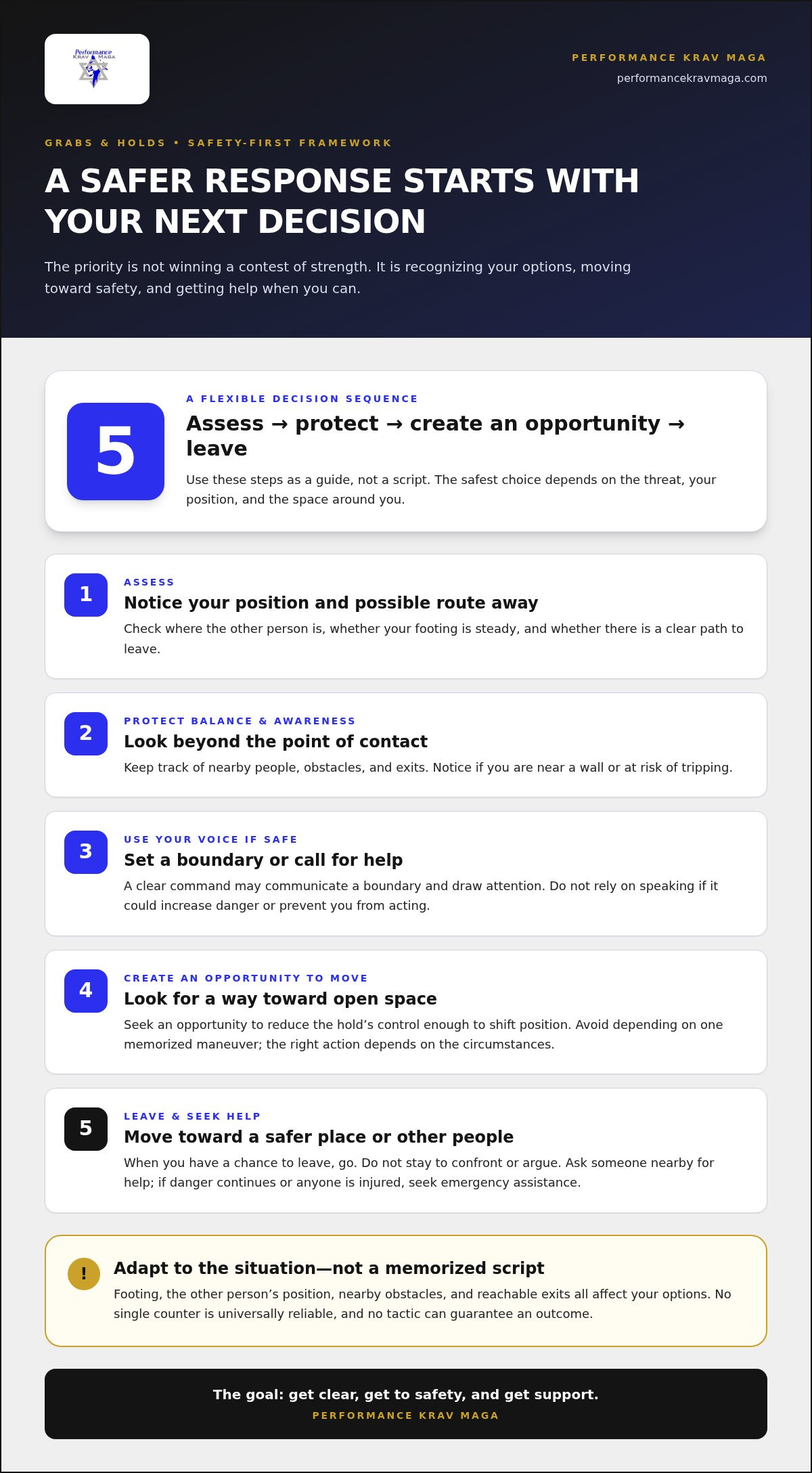
Assess, protect, create space, escape, seek help. Treat this as a flexible guide, not a script. A response that makes sense in one situation may be unsuitable in another. If an exit is available, prioritize leaving over trying to overpower or punish someone.
What counts as a grab or hold?
A wrist or arm grab may limit one hand or redirect your movement. A clothing grab can pull you off balance, while a hold may restrict movement more broadly. The details matter: where the other person is, whether your footing is stable, what obstacles are nearby, and which exits are reachable. The broader field of grappling techniques includes ways people control movement, but no single counter should be treated as universally reliable. First understand your position and identify a safer direction to move.
Why escape is the goal, not a contest of strength
Stress can narrow your attention. You might focus only on the hand holding you and miss a clear path away, or react forcefully without noticing that your balance is compromised. Take a deliberate moment to register your footing, the other person’s position, and what lies between you and an exit. If a table, doorway, or other obstacle affects your movement, account for it rather than pushing blindly into it.
Balance and access to space can matter as much as strength. A force-for-force struggle may keep you engaged when your priority is to disengage. A controlled shift toward open space may create an opportunity to leave. That objective differs from sport grappling, where participants may seek control or a submission within agreed rules. In a self-protection situation, getting away and seeking help come first. Defensive tactics against grabs and holds should support that aim, not promise a guaranteed outcome.
How to Respond to a Grab: A Safety-First Decision Sequence
A grab can trigger an immediate urge to pull away or fight back. Before committing to a move, take in what’s around you and focus on your next safest action. This framework can help organize your thinking, but real situations demand judgment and adaptation. No fixed sequence fits every person, position, or environment.
Assess. Notice where the other person is, whether your footing is steady, and whether there’s a clear route away.
Protect your balance and awareness. Don’t focus only on the point of contact. Keep track of nearby people, obstacles, and exits.
Use your voice if it’s safe. A clear command or call for help may draw attention and communicate a boundary. Don’t rely on speaking if it could increase danger or prevent you from acting.
Create an opportunity to move. Look for a way to reduce the hold’s control enough to shift toward open space. Avoid depending on one memorized maneuver.
Leave and seek help. Move away from the immediate danger and toward a safer place or other people when possible.
The safest response depends on the threat and your surroundings, so adapt your choices to the clearest route toward safety.
What to consider when movement is restricted
Check your footing: are you steady, near a wall, or at risk of tripping over an object? Notice whether other people are nearby and whether a doorway or open area offers a possible route away. A small shift that reduces the hold’s control may create room to move, but the right action depends on the circumstances. Defensive tactics against grabs and holds are best learned as adaptable principles, not as a single maneuver promised to work every time.
After you create an opportunity to move
Go. Don’t stay to confront, argue with, or punish the other person once you have a chance to leave. Head toward a populated or otherwise safer place if feasible, and ask someone nearby for help. If the danger continues or anyone is injured, seek emergency assistance. Your aim is to get clear and get support, not prolong the encounter.
Structured practice can help you rehearse these choices with guidance rather than relying on isolated demonstrations. In Egg Harbor City, Krav Maga classes in Egg Harbor City offer a way to develop practical self-protection skills progressively.
Do You Need Strength to Escape? Grab-and-Hold Myths
Strength can matter, but it isn’t the only factor. A person’s size and power, the type of hold, the surroundings, and the time available to respond all affect what may be possible. Claims that one move works regardless of circumstances are misleading. Effective preparation isn’t about finding a magic counter. It’s about noticing options and making a purposeful choice under pressure.
Timing, balance, awareness, and practiced movement can all influence a response. For example, recognizing an opening to move may be more useful than pulling hard in a direction that worsens your balance. Training can help you rehearse decisions, but it can’t guarantee an outcome. Defensive tactics against grabs and holds should be taught as adaptable skills, not as promises that physical differences won’t matter.
Does a smaller person have options?
Yes. Training can help people of different sizes recognize choices, practice movement, and respond with greater familiarity. Controlled resistance can introduce challenge gradually, helping students learn how balance and positioning change as a partner applies pressure. Still, size differences, fatigue, restricted space, and obstacles may affect which choices are available. For a related discussion, read practical self-defense strategies for smaller people.
Why online demonstrations are not a substitute for practice
A video can illustrate an idea, but watching a movement doesn’t reproduce timing, pressure, surprise, or the need to make decisions while someone is resisting. Unsupervised imitation may also lead to unsafe practice, especially with forceful or high-risk counters. A demonstration can leave out important context, including when a response might be appropriate, how to scale practice, and when to stop.
In a structured class, an instructor can offer feedback on positioning and help partners practice at an appropriate intensity. Progression matters: begin with clear communication and cooperative movement, then add challenge only when it can be managed safely. This creates room to learn from errors without treating practice like a real confrontation. Krav Maga and self-defense classes provide a setting to build familiarity over time, while keeping the limits clear: practice can prepare you to think and move, but no technique works identically for every person or situation.
How to Practice Defensive Tactics Against Grabs and Holds Safely
Good practice builds judgment, not just a rehearsed movement. Begin with clear communication and a cooperative training partner who understands the drill, agrees on its intensity, and knows how to stop. Keep the first repetitions slow. The purpose is to learn awareness, decision-making, controlled movement, and safe disengagement, not to overpower your partner.
Progress only with qualified supervision. Add challenge gradually, and pause if a movement becomes painful, practice feels unsafe, or either person wants to stop. Agree on a clear stop signal before starting. Conditioning can support training, but it’s only one part of preparation. Explore the Krav Maga workout and readiness guide for more on its role.
A beginner-friendly practice progression
Start with verbal boundary-setting and noticing when someone enters your personal space. Next, rehearse simple movement and identify an exit without adding speed or resistance. Once those basics feel familiar, an instructor can introduce controlled scenarios, provide feedback, and increase difficulty in measured steps. Agree on a stop signal, such as saying “stop” or tapping, and honor it immediately.
Track progress with practical questions: Did you notice the change in distance? Could you keep your movement controlled? Did you identify a route away and disengage safely? These are more useful measures than whether you performed a technique perfectly. Structured Krav Maga and self-defense classes can guide you as you build those skills. To practice with support, explore Krav Maga classes.
When a situation involves a choke hold
A choke hold is different from an ordinary wrist, arm, or clothing grab because breathing or consciousness may be threatened. Treat it as urgent. Don’t use this section as a substitute for specific instruction; read the guide to escaping a choke hold for focused information. If breathing or consciousness is at risk, seek emergency assistance as soon as you can.
Train Grab-and-Hold Defense with Performance Krav Maga in Egg Harbor City
Reading about defensive tactics against grabs and holds can help you understand what to prioritize, but applying those ideas under pressure takes practice. Structured Krav Maga and self-defense classes give students a place to work on awareness, movement, and controlled responses with guidance. The aim is to build familiarity progressively while recognizing that practice can’t guarantee how a real encounter will unfold.
Performance Krav Maga offers practical Krav Maga and self-defense instruction for people with different experience levels in Egg Harbor City. Whether you’re new to training or have prior experience, guided practice can help you explore how to respond, adjust your movement, and make safety-focused decisions without relying on a single memorized answer.
What guided practice can add
In a supervised setting, an instructor can help you understand a movement and make adjustments as you practice. Rather than jumping straight into speed or intense resistance, students can build skills in stages, paying attention to awareness, balance, and opportunities to disengage. This connects technique with decision-making: notice what’s happening, identify a safer direction, and move with control.
For more information about local training, read about Krav Maga classes in Egg Harbor City.
Choosing a practical next step
Think about what you want from training, what experience you already have, and how comfortable you are with progressive physical practice. You don’t need to arrive with every movement figured out. A willingness to learn, communicate, and build skills at a manageable pace is a solid starting point.
For readers in Egg Harbor City, Performance Krav Maga offers a local setting to develop practical self-protection skills through Krav Maga and self-defense instruction. Explore Performance Krav Maga classes and take a confident first step toward training.
Build Safer Responses Through Practice
The central principle is simple: use defensive tactics against grabs and holds to reduce danger, create an opportunity to move, and reach safety. Strength may play a role, but balance, awareness, timing, and the ability to recognize an exit also matter. No response works the same way in every situation, which is why thoughtful practice focuses on adaptable decisions, not a guaranteed move.
Structured, supervised training can help you build familiarity with controlled movement and safety-focused choices at a progressive pace. In Egg Harbor City, Performance Krav Maga offers practical Krav Maga and self-defense instruction for different experience levels. The school is owned and operated by Chief Instructor Greg Dziewonski and serves as the national headquarters for the Krav Maga Federation.
Ready to take a practical next step? Explore Performance Krav Maga classes in Egg Harbor City. Start where you are, keep learning, and build confidence through steady practice.
Frequently Asked Questions
What should you do first if someone grabs you?
First, assess your balance, the other person’s position, and the nearest safe route rather than reacting with a strength contest. If it’s safe, use a clear voice to draw attention, then look for an opportunity to create space and leave. Defensive tactics against grabs and holds should adapt to the situation; no single response fits every hold or environment. Seek help once you’re clear.
Can you escape a grab without being stronger than the other person?
It may be possible, but no method can guarantee escape regardless of circumstances. Strength can matter, while timing, balance, awareness, and the opportunity to move can also affect your options. Training can help you recognize openings and rehearse controlled movement, but factors such as the type of hold, surroundings, and physical differences still matter. Focus on creating a chance to reach safety, not proving strength.
How do you practice self-defense against grabs safely?
Begin with clear communication and a cooperative partner who agrees to the drill and its intensity. Start slowly with awareness, boundary-setting, and simple movement toward an exit. Add resistance or complexity only gradually under qualified supervision, using a clear stop signal. Stop if practice becomes painful or unsafe. The goal is to improve decision-making and controlled disengagement, not to recreate a dangerous encounter or test who can overpower whom.
What is the difference between a grab and a hold?
A grab usually describes someone taking hold of a wrist, arm, or clothing, while a hold more broadly restricts movement or limits your ability to leave. The terms can overlap, and the practical difference depends on how much movement is restricted and what is happening around you. Consider your footing, the other person’s position, nearby obstacles, and possible exits instead of assuming one response fits every situation.
Should you fight back or try to get away from a hold?
Prioritize getting away when you can do so safely. Staying to confront or punish the other person can prolong danger and take your attention away from an exit. If movement is restricted, make a safety-focused decision based on the immediate threat and your surroundings rather than relying on a fixed rule. The purpose of self-defense is to reduce danger and reach safety, not to win a fight.
Can Krav Maga teach defensive tactics against grabs and holds?
Krav Maga classes can provide structured practice in awareness, movement, and controlled responses to self-defense situations. At Performance Krav Maga in Egg Harbor City, practical Krav Maga and self-defense instruction is available for different experience levels. The school is owned and operated by Chief Instructor Greg Dziewonski and serves as the national headquarters for the Krav Maga Federation. Training can build familiarity, but it can’t guarantee an outcome in a real encounter.
What should you do after escaping a grab or hold?
Keep moving away from the immediate danger rather than stopping to argue or confront the other person. If feasible, go to a populated or otherwise safer place and ask someone for help. If the danger continues or anyone is injured, seek emergency assistance. Once safe, take time to address any injuries and consider telling someone you trust what happened. Prioritize your immediate safety and support.


Comments