
How to Defend Yourself in a Confined Space: A Practical Safety Guide

In a confined space, awareness and a clear route to safety can matter more than force. If you’re wondering how to defend yourself in a confined space, start by recognizing the challenge: a narrow hallway, crowded vehicle, or small room can limit movement and make it harder to decide whether to speak, leave, or call for help. Freezing is a common fear, but a simple plan can help you keep your options open.
This guide covers ways to notice warning signs, create distance where possible, and choose actions that prioritize reaching safety. You’ll learn how to use awareness and verbal de-escalation, look for exits and help, and think carefully before using force. Self-defense laws vary by state and situation, so the legal context matters too.
Space may be limited, but your choices don’t have to be. We’ll break down practical decisions under pressure and explain how supervised self-defense training can help you practice movement and judgment safely. Performance Krav Maga offers practical instruction for students of all experience levels in Egg Harbor City.
Table of Contents
Why Confined Spaces Change Your Self-Defense Priorities
A confined space is any environment where movement, visibility, or exits are limited. A parked car, crowded bus, narrow hallway, or small room can each create different constraints. This practical use of the term is broader than some technical definitions; for general background, see Confined Space.
Confined-space awareness means reading your surroundings and preserving routes to safety, not looking for a fight. Less room can increase pressure because you may have fewer ways to step back, see what’s happening, or leave quickly. That doesn’t mean a confrontation is inevitable. It means your priorities should be to avoid escalation, keep your options open, and move toward safety when you can.
What makes a tight-space encounter different?
In an open area, you may be able to change direction or create distance. A seat can restrict movement; a wall, crowd, or closed door can block a route. Noise may make it harder to hear, stress can narrow your attention, and limited visibility may prevent you from spotting what’s nearby. The setting matters: the options in an elevator aren’t the same as those in a bus aisle. No single response fits every situation.
Take in the details you can use. Notice where the exits are, what might obstruct your path, and whether other people or staff are nearby. Keep the assessment simple. The goal isn’t to predict every possibility; it’s to avoid getting so focused on one concern that you miss a safer option.
Why prevention and early decisions matter
Discomfort can be a cue to pay attention, but it isn’t proof that someone intends harm. A person standing too close, ignoring a request for space, or repeatedly blocking your path may prompt you to reassess your position. You don’t need to accuse or challenge them to make a safety-minded choice.
If it’s safe and practical, move closer to an exit, choose a seat with a clearer route out, or position yourself near other people. A calm, direct phrase such as “Please give me some space” can set a boundary without raising the temperature. If speaking feels unsafe, focus instead on creating an opportunity to leave or get help.
When considering how to defend yourself in a confined space, start before physical action feels like the only choice. Small decisions can preserve options: keep an exit in view, avoid unnecessary distractions, and change position when something feels wrong. The aim isn’t to control the other person. It’s to make your next safe move easier.
How to Defend Yourself in a Confined Space: A Safety-First Sequence
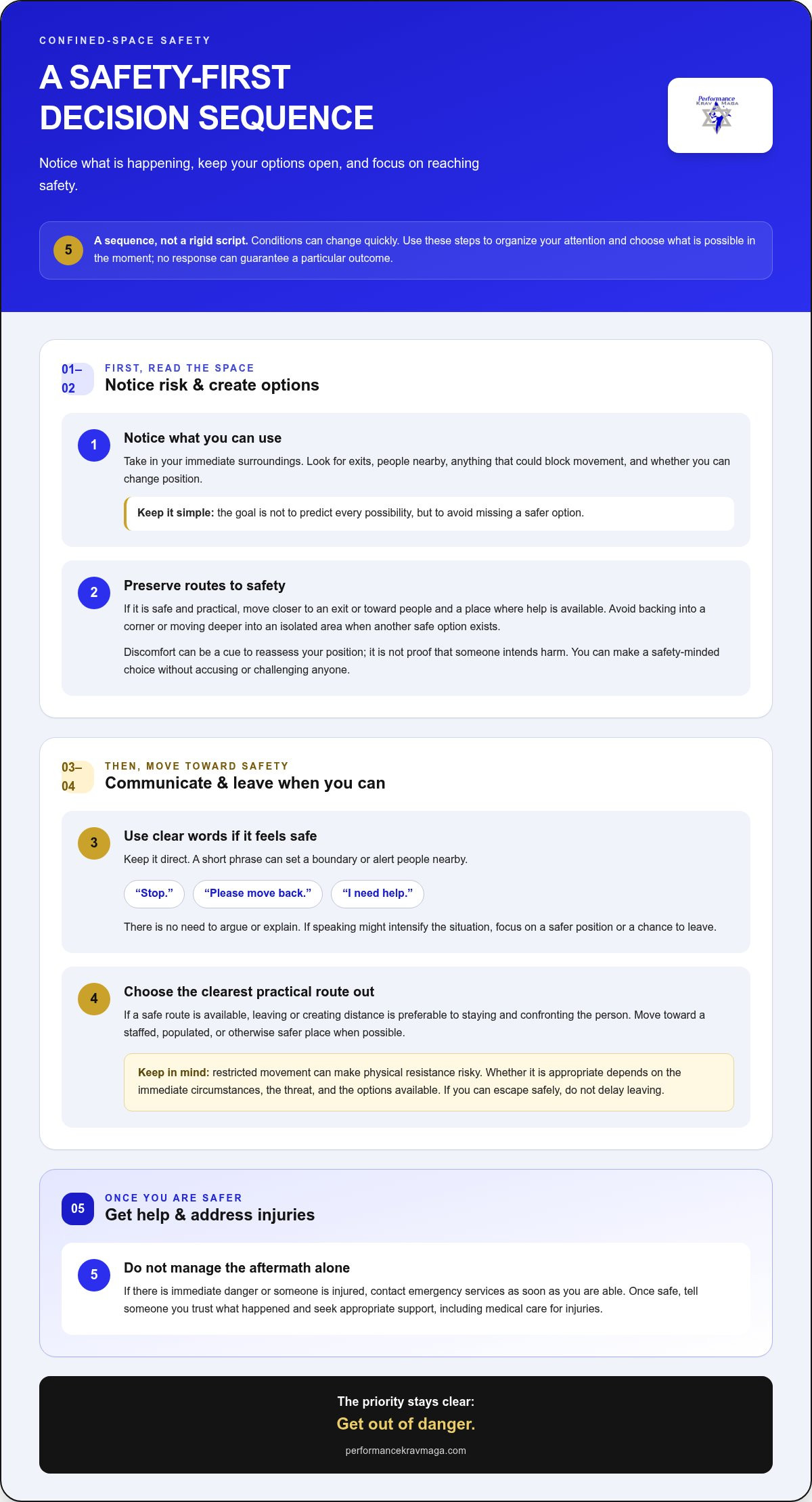
Use a simple sequence to focus on the next useful decision: notice, create options, communicate, move toward safety, and get help. It isn’t a rigid script. Conditions can change quickly, so focus on what’s possible in the moment rather than trying to follow steps perfectly.
This sequence can guide your choices, but it can’t guarantee a particular outcome. Treat it as a way to organize your attention, not a checklist you must complete in order.
Notice, create options, and communicate
Take in your immediate surroundings: where the exits are, who’s nearby, what could block movement, and whether you can change position. Look for a route toward people or a place where help is available. Avoid backing yourself into a corner or moving deeper into an isolated area if another safe option exists.
If speaking feels safe and useful, keep your words clear and direct. “Stop,” “Please move back,” or “I need help” can communicate a boundary or alert people nearby. You don’t need to argue or explain. If speaking might intensify the situation, prioritize a safer position or a chance to leave instead.
Move toward safety and get help
If there’s a safe route out, leaving or creating distance is preferable to staying and confronting the person. Move toward a staffed, populated, or otherwise safer place when possible. Choose the clearest practical route, and avoid being drawn into an area with fewer exits or fewer people who could help.
Physical resistance can carry risks, especially when movement is restricted. Whether it’s appropriate depends on the immediate circumstances, the threat, and the options available. If you can escape safely, don’t delay leaving. Keep the priority clear: get out of danger.
If there’s immediate danger or someone is injured, contact emergency services as soon as you’re able. Once safe, tell someone you trust what happened and seek appropriate support, including medical care for injuries. You don’t have to manage the aftermath alone.
Knowing how to defend yourself in a confined space is partly about having a usable decision process, not memorizing a perfect response. Practical self-defense instruction can provide a supervised setting to work on awareness, movement, and decision-making. Students of all experience levels can explore Krav Maga classes in Egg Harbor City as one way to build practical skills.
How Cars, Elevators, and Public Transit Change Your Options
The same safety goal can call for different choices depending on the space. A car has doors, seatbelts, and traffic to consider; an elevator may have no exit between floors; transit offers stops and other passengers, but crowds can restrict movement. Use the comparison as a planning guide, not a fixed script. Choose only actions that make sense for the conditions around you.
Vehicle and elevator safety considerations
Think ahead before you enter. Confirm your pickup and destination, and notice whether there’s a safer option if you feel uncomfortable, such as waiting for another elevator or choosing a different vehicle. In a car, a seatbelt may limit movement, while opening a door can be hazardous if the vehicle is moving. Don’t attempt to exit into traffic. Wait for a safe opportunity to get out and move toward other people if possible. Avoid improvised weapons; they can create added risks and distract from finding a safer route.
Public transit and crowded-space choices
On a bus or train, note where staff or visible help points are and keep track of upcoming stops. If someone’s behavior concerns you, changing seats or cars may be an option when the vehicle is stopped and the route is clear. You can also move closer to staff or other passengers if that feels safer. Keep bags and belongings from blocking an aisle, door, or access to help. Stay alert without assuming that a crowded space is automatically dangerous.
These differences matter when deciding how to defend yourself in a confined space. Plan around the actual vehicle, exits, and people nearby. If a safe way to leave or create distance is available, prioritize it over confrontation.
What to Do During and After a Threatening Encounter
In a threatening situation, your safety matters more than a phone, bag, or other property. If you can leave safely, go. Don’t delay your exit to retrieve belongings or protect something that can be replaced.
If leaving is not immediately possible
Keep your attention on what may help you reach safety: possible exits, nearby people, and places where assistance may be available. If it’s safe to speak, use clear words to set a boundary or call for help. For example, “I need help” may alert someone nearby without requiring you to explain everything.
There’s no physical technique that works reliably in every situation. A response that seems possible in one space may be unsafe in another, especially if movement is restricted or other people are close by. Focus on making the safest available choice, and follow local emergency guidance if danger continues.
Once you reach safety
Move away from the immediate danger and toward a place where you can get assistance. If the threat remains immediate, or someone is injured, contact emergency services as soon as you can. Seek medical attention for injuries, even if they seem minor at first, and tell someone you trust what happened so you’re not handling the aftermath alone.
Later, if you’re safe and have the capacity, write down details you remember, such as the location, timing, and what occurred. Don’t let record-keeping delay urgent care or help. Your first task is to get safe and address immediate needs.
Understanding how to defend yourself in a confined space includes knowing what to do after an incident, not only how to respond in the moment. Practicing awareness can help you notice changes in your surroundings and consider your options earlier. Explore practical self-defense training to build awareness and decision-making through guided instruction.
Build Confined-Space Readiness Through Safe, Practical Training
Reading about self-defense can help you think through choices, but it can’t reproduce the pressure of making them while moving, listening, and responding in real time. A written guide can’t show whether a movement feels manageable in a particular space or help you adjust when your first idea isn’t practical. Guided, controlled practice gives you a chance to work through decisions with instruction and feedback, without treating training as a real confrontation.
What useful self-defense practice should develop
Readiness involves more than physical skills. It also means noticing changes in your surroundings, communicating clearly, moving with purpose, and deciding when to leave or seek help. In a confined-space scenario, for example, practice might focus on recognizing an available route and making a deliberate choice about how to move, rather than assuming there’s one correct response for every setting.
Good instruction builds these skills progressively. Drills should be supervised, controlled, and adapted to the student’s experience so beginners can learn at a manageable pace. The goal is to understand and practice decisions safely, then develop confidence through repetition. Training can build skills and improve readiness, but it can’t guarantee safety or predict how any real incident will unfold.
That’s why advice about how to defend yourself in a confined space should be treated as a starting point, not a substitute for practice. Keep your expectations grounded: awareness and preparation can help you respond more deliberately, while circumstances will always shape the choices available to you.
Continue learning with Performance Krav Maga
Performance Krav Maga provides practical Krav Maga and self-defense instruction for students of all experience levels in Egg Harbor City. Guided training offers a setting to work on awareness, movement, communication, and judgment as connected skills, with room to learn progressively. For related reading, explore the site’s articles on elite Krav Maga classes in Egg Harbor City and tactical self-defense and personal readiness.
If you’re ready to take a next step, explore Performance Krav Maga classes and learn more about practical self-defense instruction.
Build Readiness One Decision at a Time
In a tight space, your first priority is preserving options, not proving you can fight. Notice exits and potential help, communicate calmly when it’s safe, and move toward safety whenever a clear route is available. If you can’t leave immediately, keep looking for a safer opportunity. Afterward, focus on getting help and care for any injuries.
Knowing how to defend yourself in a confined space takes more than memorizing advice. Guided practice can help you develop awareness, movement, communication, and judgment in a controlled setting. It can’t guarantee what will happen, but it gives you a chance to build skills and confidence progressively.
In Egg Harbor City, Performance Krav Maga provides practical self-defense instruction for students of all experience levels. Founded and led by Chief Instructor Greg Dziewonski, the school also serves as the Krav Maga Federation’s national headquarters. Explore Performance Krav Maga classes and take a practical next step toward greater readiness. Start where you are, and keep building.
Frequently Asked Questions
Is it better to fight or escape in a confined space?
Leave if a safe exit is available. Creating distance and reaching help is generally a safer priority than trying to win a confrontation, but every situation is different. A route may be blocked, or leaving may increase immediate danger. Physical resistance carries risk and depends on the circumstances. If you’re considering how to defend yourself in a confined space, focus first on the safest available way to reduce danger and get support.
What should I do if someone makes me feel unsafe in an elevator?
If you feel unsafe before the doors close, step out if you can do so safely, or wait for another elevator. If you’re already inside, consider exiting at a populated floor and moving toward other people or staff. A clear boundary, such as “Please give me space,” may help if speaking feels safe. You can seek assistance, but no position or action guarantees protection. Choose based on what’s happening around you.
How can I protect myself in a car if I feel threatened?
Plan ahead by choosing a pickup or destination where other people or help are nearby, and stay attentive to your route. Avoid distractions while driving. If you feel threatened, don’t exit a moving vehicle or step into traffic; leave only when the vehicle is safely stopped and conditions allow. Move toward a safer place and contact emergency services if immediate danger exists. Prioritize your safety over belongings.
Can you defend yourself in a crowded space without hurting someone?
No response can guarantee that nobody will be hurt, especially when movement is restricted and people are close together. Start with options that may reduce risk: create distance if possible, communicate clearly, and move toward an exit, staff member, or other source of help. Avoid actions that could escalate the situation or put nearby people at greater risk. The safest choice depends on the threat and the space available.
What is the safest thing to do when you cannot leave a confined space?
Stay alert to changes, including a newly available exit or someone nearby who can help. If it’s safe, communicate clearly and ask for assistance. Avoid moving deeper into an isolated area if another option is available, and be ready to move toward safety as soon as a route opens. There isn’t one response for every situation. The best choice depends on the immediate danger, surroundings, and options you can access.
Do I need martial arts experience to learn confined-space self-defense?
No prior martial arts experience is needed to begin learning foundational awareness and decision-making. Progressive instruction can help beginners practice noticing surroundings, communicating, and moving with purpose before building on those basics. Learning foundational skills is different from mastering every possible response, and practice takes time. Performance Krav Maga offers practical Krav Maga and self-defense instruction for all experience levels in Egg Harbor City. Training can build readiness, but it can’t guarantee protection.
How can I practice self-defense for tight spaces safely?
Practice in a supervised, controlled setting with clear boundaries and drills that progress at a manageable pace. Begin with awareness, communication, and decisions about movement and exits; add physical skills only with appropriate instruction. Don’t rehearse risky techniques on friends or family without guidance, since mistakes can cause injury or build unsafe habits. A responsible learning environment helps you practice thoughtfully while recognizing that no drill can reproduce every real-world situation.


Comments