
How to Practice Situational Awareness Daily: A Practical Guide

What if staying safer didn’t mean watching everything, all the time? Learning how to practice situational awareness daily isn’t about suspicion or staying on high alert. It’s about building a calm, repeatable habit of noticing what matters, especially when your phone or routine pulls your attention elsewhere.
It’s understandable to wonder which details matter, or whether paying closer attention will make you more anxious. The goal is to observe without jumping to conclusions, then make a considered choice about where to move or position yourself. A brief check can help you notice changes, locate exits, and stay engaged with your surroundings without treating ordinary moments as threats.
This guide offers practical ways to build that habit into familiar parts of the day, from walking through a parking area to entering a public space. You’ll learn what cues to look for, how to respond without overreacting, and when guided practice may help you feel more confident. Situational awareness is a skill you can develop, one deliberate moment at a time.
Table of Contents
How to Practice Situational Awareness Daily Without Staying on High Alert
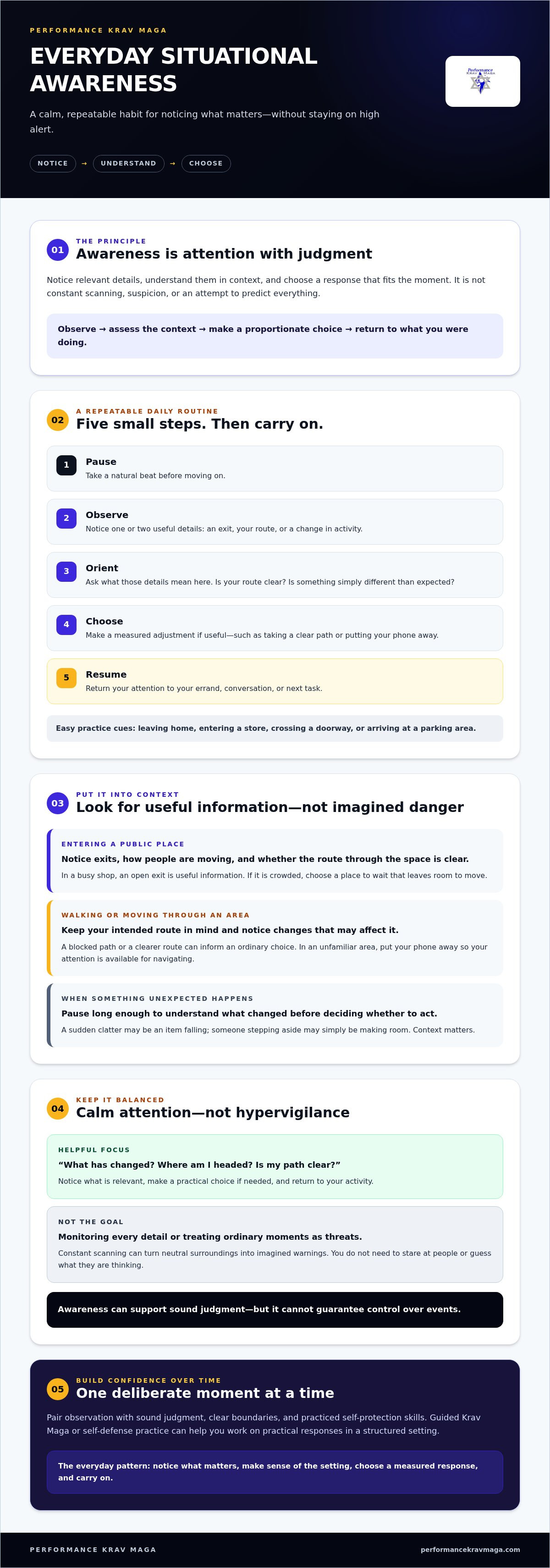
Situational awareness isn’t a constant search for danger. It’s the ability to notice relevant details, understand them in context, and choose a response that fits the moment. A useful shorthand is: Notice what’s happening, make sense of it, then decide whether anything needs to change. This reflects the perception, comprehension, and projection framework described in Situational awareness, a concept used in fields where sound decisions depend on understanding what’s happening around you.
In everyday life, the aim is informed attention, not suspicion or perfect prediction. You don’t need to scan every face or treat every unexpected sound as a warning. Learning how to practice situational awareness daily means giving your surroundings a measured amount of attention, making a practical choice when useful, and then returning to what you were doing.
What does situational awareness look like in everyday life?
Imagine entering a busy shop. You might notice where the exits are, how people are moving, and whether the checkout line is shifting. You don’t need to stare at anyone or guess what they’re thinking. An open exit is simply useful information. If the shop is crowded, you could wait somewhere that leaves room to move instead of standing in the flow of foot traffic.
Context matters. A sudden clatter may come from an item falling, while someone stepping aside could simply be making room. Pause long enough to understand what changed before deciding whether it calls for action. Awareness helps you choose where to walk, sit, or wait based on the setting, not assumptions about strangers.
Why calm attention matters more than constant scanning
When your attention is absorbed by a phone, conversation, or familiar routine, you may miss changes that could inform an ordinary decision, such as noticing a blocked path or a clearer route. That doesn’t mean you need to stay tense or monitor every detail. Constant scanning can turn neutral surroundings into a stream of imagined warnings, which isn’t the goal.
Use flexible attention instead: observe, assess, and return to your activity. If something changes, consider the context and choose a proportionate next step, such as moving around an obstruction or giving yourself more space. If nothing needs your response, let the moment pass. Calm awareness supports judgment, but it can’t guarantee control over what happens.
A Simple Daily Situational Awareness Routine You Can Repeat
A routine works best when it’s brief enough to use without interrupting your day. Try this five-step prompt when you enter a new place or move between settings: Pause, observe, orient, choose, and resume. It’s a practical reminder to gather useful information and make a deliberate choice, not a guarantee of safety or a reason to stay on alert.
Pause: Take a natural beat before moving on.
Observe: Notice one or two relevant details, such as the nearest exit, your route, or a change in activity.
Orient: Ask what those details mean in this setting. Is your route clear? Is anything simply different from what you expected?
Choose: Make a proportionate adjustment if one would help, such as taking a clear path or putting your phone away.
Resume: Return your attention to your errand or conversation.
Use everyday transitions as practice cues
Attach the check to something you already do: leaving home, entering a store, or arriving at a parking area. Notice your intended route, where you could exit, and whether activity around you has changed. Keep it short. A quick check as you cross a doorway or get out of your car is easier to repeat than a long scan that makes an ordinary errand feel like a drill.
When you enter an unfamiliar place, pause just inside and orient yourself before getting absorbed in the next task. You don’t need to memorize every detail. Identify what could help you navigate, then carry on.
Build attention without relying on fear
Choose neutral questions: What has changed? Where am I headed? Is my path clear? These prompts focus on information and decisions, not on searching for threats. If you’re crossing a street or navigating an unfamiliar area, put your phone away so your attention is available for the task. Notice one useful detail, make any needed adjustment, and continue.
For a deeper look at structured awareness and personal safety, see the training resource from Columbia University Public Safety. You can adapt the principle without turning every transition into a formal exercise. The goal is a steady habit, not perfect observation.
That’s how to practice situational awareness daily: use a familiar cue, make one clear observation, choose a sensible next step, then return to the moment. The sequence can support better decisions, but it can’t control every situation. If you’d like guided instruction in practical self-protection, explore Krav Maga and self-defense classes at Performance Krav Maga in Egg Harbor City.
How to Apply Situational Awareness at Home, in Public, and on the Move
The same awareness habit looks different depending on where you are. At home, it may mean noticing a change in a familiar routine. In a public place, it could mean knowing where staff are or which route feels comfortable. On the move, attention shifts to paths, traffic, and changes around you. The aim isn’t to use one rigid response everywhere, but to make choices that fit the setting.
At home and during familiar routines
Notice practical changes, such as an entry path becoming cluttered or a light that usually works being out. Keep commonly used routes clear, and know how you’d contact someone for help if needed. Before opening the door, use your usual, comfortable way to check who’s there. This is an ordinary household habit, not a reason to assume a visitor has bad intentions.
Prioritize what supports your comfort and everyday safety. If something about a situation feels unclear, you can take time before answering or opening the door.
In public places and while traveling around Egg Harbor City
During a local errand in Egg Harbor City, take note of the exits, where staff are available, and a route through the space that feels easy to navigate. In a shopping center or parking area, focus on your destination, the path you’ll use, and nearby vehicle or pedestrian movement. The U.S. Army’s guidance on situational awareness also connects noticing your surroundings with making safer choices. These are practical prompts, not claims about local risk.
On foot, give crossings your attention and limit screen distraction so you can respond to traffic and changes in your path. While driving, keep your focus on the road and surrounding traffic; don’t handle your phone. If a public situation makes you uncomfortable, you can leave or seek assistance from staff or someone you trust. If you believe there’s an immediate emergency, contact local emergency services.
Let the context guide your response. A blocked walkway may call for a simple detour; a routine change at home may be worth checking later. You don’t need to confront, follow, or investigate someone who seems unusual. Observe what matters, choose a reasonable next step, and move on. That’s how to practice situational awareness daily across familiar settings, with attention directed toward useful choices rather than assumptions.
Situational Awareness Is Not Hypervigilance: How to Practice Safely
Useful awareness doesn’t mean staying tense, searching every face for danger, or trying to predict what someone might do. Situational awareness is calm attention to relevant information; hypervigilance is feeling compelled to stay on guard. The first supports considered choices. The second can make ordinary surroundings feel threatening.
Observation has limits. You can notice a change and choose how to respond, but you can’t control every event or guarantee an outcome. Let what you see, the context, and your own comfort inform your decisions. A feeling of unease can be worth noticing, but it isn’t proof that danger is present.
How do you stay observant without becoming anxious?
Keep the practice brief and neutral. Ask, “What has changed?” or “What choice would help me feel comfortable?” Avoid turning an unfamiliar person, an unexpected noise, or ambiguous behavior into a conclusion about threat. Once you’ve made a quick check and chosen what to do, return your attention to the conversation, errand, or walk in front of you.
If the exercise increases distress, stop or scale it back. You don’t have to push through. If anxiety or a sense of being constantly on guard persists or interferes with daily life, consider speaking with a qualified mental health professional. Building awareness should support your wellbeing, not consume it.
What should you do when something feels wrong?
Choose a low-risk option before considering anything confrontational. Create distance, leave the area, or seek help from staff or someone you trust. Don’t follow or investigate a person to confirm a suspicion. If you believe there’s immediate danger, move toward a safer place if possible and contact local emergency services.
A feeling can be one useful signal, especially if you can identify a concrete reason for it, but intuition isn’t always accurate. Check it against what’s observable and the context. You can take a sensible precaution without deciding you know another person’s intent.
Learning how to practice situational awareness daily should leave room for calm and normal activity. If you want to develop practical self-protection skills with guided instruction, explore Krav Maga and self-defense classes at Performance Krav Maga in Egg Harbor City. Classes are available for students at different experience levels.
Turn Daily Awareness Into Practical Self-Defense Readiness
Start small: choose one familiar transition, such as leaving home or arriving at a store, and repeat a brief awareness check there. Notice what’s relevant, make a considered choice, then continue with your day. That simple habit turns how to practice situational awareness daily into something manageable, not another task that demands constant attention.
Awareness is one part of personal safety. It can help you notice options, but your decisions, boundaries, and practiced skills matter too. For a broader look at personal readiness, see Tactical Self-Defense: Beyond Gear to Elite Personal Readiness. The point isn’t to control every situation. It’s to make informed choices and have useful skills to draw on when they’re needed.
When does guided self-defense training make sense?
Guided instruction may be worth exploring if you want to practice responses, not just think through them. A class offers a structured setting to work on skills with instruction and build familiarity through practice. It’s an option, not a requirement, and training can’t remove every risk or guarantee a particular outcome.
Performance Krav Maga offers Krav Maga and self-defense classes in Egg Harbor City for people at different experience levels. If you’re curious but unsure where to begin, read Elite Krav Maga Classes in Egg Harbor City: Real-World Self-Defense for more context on the training.
A low-pressure next step for beginners
You don’t need to make a decision before you’re ready. Learn about the class options, note what matters to you, and ask questions before choosing whether to take part. You might want to understand how instruction works for different experience levels or what to expect from a class. Check current class details directly before making plans.
If guided practice feels like a useful next step, explore Performance Krav Maga classes. Keep building the daily habit either way: notice, decide, and move forward with calm purpose.
Build Awareness One Deliberate Moment at a Time
Situational awareness doesn’t require constant scanning. A brief check during a familiar transition can help you notice useful details, interpret them in context, and choose a sensible next step. Then return to your day. That’s the practical heart of how to practice situational awareness daily: stay attentive without letting worry take over.
Use the approach that fits your setting, whether you’re at home, running errands in Egg Harbor City, or moving through a public space. Observation can inform your choices, but it doesn’t guarantee control over events. Pair it with clear boundaries, sound judgment, and practiced skills for a more complete approach to personal safety.
Performance Krav Maga offers practical Krav Maga and self-defense classes in Egg Harbor City for people at different experience levels. Explore Performance Krav Maga classes to learn more about the training.
Start with one calm check today. Small, repeatable steps can help you move through everyday life with greater confidence.
Frequently Asked Questions
What are the five steps of situational awareness?
A practical five-step prompt is pause, observe, orient, choose, and resume. Pause briefly, notice relevant details, consider what they mean in context, choose a proportionate action, then return to your activity. For example, when entering a public building, you might note a clear exit and your route before continuing inside. This sequence is a useful reminder, not a guarantee of safety or a substitute for sound judgment.
How can I improve my situational awareness every day?
Build the habit into a familiar transition, such as leaving home, entering a store, or arriving at a parking area. Ask a neutral question like, “What has changed?” Notice one useful detail, such as your route or an exit, and then continue with your task. Learning how to practice situational awareness daily means repeating calm, brief checks, not monitoring every person or sound around you.
Can situational awareness be learned, or is it instinctive?
Situational awareness can be practiced and developed; it doesn’t depend only on instinct. Start by noticing your surroundings during routine activities, considering what the details mean, and making a deliberate choice when useful. Experience may help you recognize patterns, but it doesn’t make anyone infallible. Stay open to context, avoid jumping to conclusions, and adjust your practice to the setting and your comfort.
Is situational awareness the same as hypervigilance?
No. Situational awareness is calm attention to relevant details so you can make considered choices. Hypervigilance involves feeling persistently on guard or interpreting ordinary events as potential threats. You don’t need to scan constantly to be aware. Keep checks brief, focus on information you can use, and return your attention to the present activity. If practice increases distress or constant alertness, pause and consider seeking qualified support.
How do I practice situational awareness in public without looking suspicious?
Keep your behavior ordinary. As you enter a shop or other public place, casually notice the layout, exits, staff, and the route you plan to take. You don’t need to stare at people, linger, or make assumptions about anyone’s intentions. While walking, give crossings and your path your attention, and put away your phone when you need to navigate. A brief, natural check is enough.
What should I do if something feels wrong?
Treat unease as one piece of information, not automatic proof of danger. Consider what you’ve noticed and choose a sensible, low-risk response: create distance, leave, or seek help from staff or someone you trust. Don’t confront, follow, or investigate someone to test a suspicion. If you believe there’s immediate danger, move toward a safer place if possible and contact local emergency services.
Does self-defense training help improve situational awareness?
Self-defense training can give you a structured setting to practice awareness alongside decisions and physical skills, though it can’t guarantee safety or prevent every risk. Performance Krav Maga offers practical Krav Maga and self-defense classes for people at different experience levels in Egg Harbor City. If you’re considering instruction, learn about current class options and ask questions to decide whether the training is a fit for you.


Comments