
Knife Defense Training: Survival Strategies for Real-World Edged Weapon Encounters

What if the choreographed blocks you practiced in a brightly lit studio are the very things that fail when an attacker initiates a high-speed "sewing machine" stab in a dark alley? It's a terrifying thought, but you aren't alone in feeling physically unprepared for a sudden, violent encounter. You've likely seen enough conflicting martial arts advice to know that many systems prioritize aesthetics over survival. You're right to demand something more practical.
This guide will show you how to cut through the noise and engage in knife defense training that actually works when your life is on the line. We'll help you learn the brutal reality of edged weapon defense and how to forge the tactical skills necessary to survive an ambush. You'll move from vulnerability to strength by developing instincts that don't buckle under high-stress scenarios. It's about building the formidable readiness of a quiet professional.
We will examine the core principles of simultaneous defense and counter-offense, the critical need to control the weapon-bearing limb, and why modern training must include stress inoculation to be effective. It's time to stop guessing and start building the confidence that comes from professional, real-world competence.
Key Takeaways
Recognize why traditional static blocks fail against the rapid, repetitive "sewing machine" attack style common in high-stress encounters.
Discover how professional knife defense training utilizes 360-degree protection to shield your vital organs from every possible angle of engagement.
Learn the tactical advantage of simultaneous defense and counter-attack to immediately overwhelm an aggressor and seize control of the situation.
Identify the dangerous myths of stylized wrist locks and why realistic resistance is required to build skills that work in the real world.
Explore how progressive stress inoculation drills forge the mental and physical toughness needed to survive a sudden edged-weapon ambush.
Table of Contents
The Brutal Reality of Edged Weapon Attacks
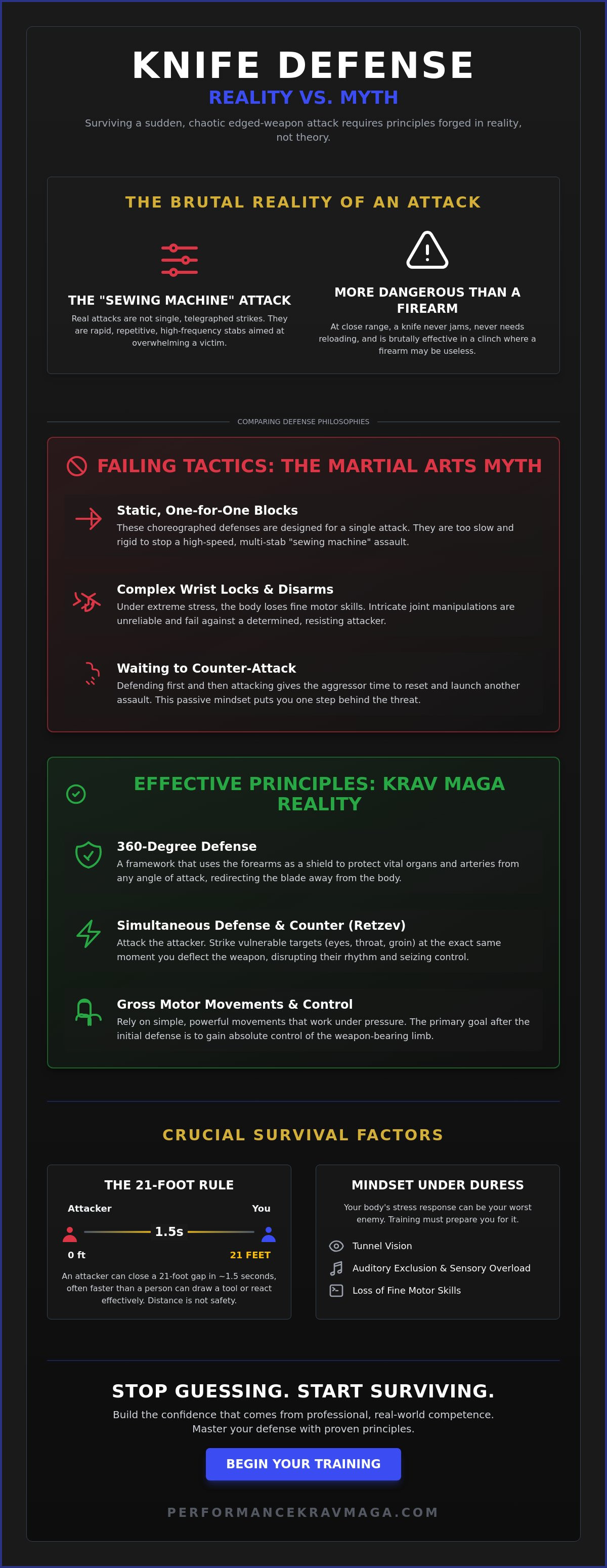
Real-world violence is chaotic, fast, and unforgiving. Effective knife defense training is not a collection of flashy martial arts movie moves; it's a specialized system designed to mitigate lethal damage during an unexpected attack. It prioritizes survival over style. Most traditional systems fail because they treat an encounter like a duel. In reality, an edged weapon attack is often a high-frequency "sewing machine" strike. This involves rapid, repetitive stabs that easily bypass static blocks designed for single, choreographed movements. If you rely on a rigid defense, you won't keep up with the speed of a determined aggressor.
At close range, a blade is frequently more dangerous than a firearm. A knife never jams, it never needs to be reloaded, and it functions perfectly in a clinch. Understanding modern tactics for knife combat reveals that the speed of a drawing motion can outpace a defensive response in a heartbeat. You must understand that you aren't there to trade blows or "win" the fight. Your sole objective is to neutralize the immediate threat, create an opening, and escape with your life. Survival is the only metric of success.
Ambush vs. Confrontation: Understanding the Threat
An ambush typically follows a calculated progression: victim selection, stalking, and a sudden, explosive strike. Most victims don't even realize a weapon is involved until they feel the impact. Situational awareness is your first line of defense, as it allows you to identify pre-attack indicators like target glancing or hidden hands before the distance is closed. The 21-foot rule states that a suspect can close a distance of seven yards in approximately 1.5 seconds, which is often faster than a person can draw a defensive tool or react effectively.
The Psychology of the Blade
The moment a blade is introduced, your body enters a state of extreme physiological stress. You will likely experience sensory overload, tunnel vision, and the loss of fine motor skills. Knife defense training prepares you for this by replacing panic with a "Warrior Mindset." This mindset allows you to maintain a proactive stance, moving through the fear to execute gross motor movements that work under pressure. It's a disciplined transition from vulnerability to strength. By training your instincts, you ensure that your response is efficient, aggressive, and focused entirely on stopping the threat.
The Core Principles of Krav Maga Knife Defense
Krav Maga operates on the principle that the shortest distance between two points is a straight line. In high-stakes knife defense training, this translates to aggressive, efficient movement that prioritizes the preservation of life. The foundation of this system is the 360-degree defense. This framework is designed to protect the body's "plumbing"-the vital organs and major arteries-from attacks coming from any trajectory. By using the outer edge of the forearm to create a solid shield, you deflect the incoming blade while simultaneously moving into a safer position.
Effective defense requires a reliance on gross motor movements. Under extreme stress, your ability to perform intricate wrist locks or complex finger manipulations evaporates. Krav Maga solves this by utilizing simple, instinctive actions that remain functional even when your heart rate is redlining. This includes "Bursting," an explosive movement where you close the distance between yourself and the attacker. While your instinct might be to move away, staying at the end of the attacker's reach keeps you in the "kill zone." Bursting allows you to overwhelm the aggressor and take away the space they need to build momentum for another strike.
Simultaneous Defense and Counter (Retzev)
Waiting to see if your block worked before you strike is a recipe for failure. If you give an aggressor a window of time, they will reset and strike again. This is why Krav Maga emphasizes Retzev, or continuous motion. You must strike the face, throat, or groin at the exact moment you make contact with the weapon arm. This immediate counter-attack disrupts the attacker's cognitive process and forces them into a defensive posture. It's the "quiet professional" approach to violence: no wasted motion, no hesitation, and total commitment to the objective. If you want to develop these instincts, joining disciplined Krav Maga classes is the most effective way to bridge the gap between theory and survival.
Controlling the Weapon Arm
Once you've made initial contact and delivered a counter-strike, you must isolate the blade. This is achieved through tactical grips like the "C-clamp," where you use your hand as a vice to secure the attacker's wrist or forearm. Control isn't about arm wrestling; it's about leverage. You should use your entire body weight to pin the weapon arm, neutralizing a stronger attacker by utilizing your larger muscle groups against their smaller ones. Knife defense training teaches you to stabilize the threat first. Only after the arm is secured and the attacker is sufficiently dazed do you transition to a takedown or a tactical disarm. Stabilization ensures you aren't chasing a moving blade, which is how most untrained defenders get injured.
360-Degree Defense: Creates a protective perimeter around vital targets.
Bursting: Closes the gap to kill the attacker's range and momentum.
Retzev: Uses simultaneous movement to overwhelm the aggressor's OODA loop.
C-Clamp Control: Isolates the weapon arm using leverage rather than raw strength.
Why Most 'Martial Arts' Knife Defenses Fail
Static drills are a lie. When you train with a partner who offers zero resistance, you develop a dangerous level of overconfidence that evaporates the second a real attacker moves with intent. This is the "Static Drill Trap." Most traditional systems teach you to respond to a single, lunging strike that stays frozen in time. In the real world, an attacker doesn't leave their arm extended for you to admire. They pull back, they strike again, and they use their free hand to grab or punch. If your knife defense training relies on a compliant partner, it isn't training; it's choreography. Real violence is lawless and unpredictable.
The "Sport" mindset is another common pitfall. In a ring, there are rounds, referees, and weight classes. In a street encounter, there are no rules and no resets. Elite Krav Maga classes strip away the fluff and focus on raw instinct. We don't teach you to win a trophy; we teach you to survive a predator. This requires a fundamental shift in how you view movement. You must prioritize efficiency over elegance, choosing simple techniques that hold up when your fine motor skills fail. It is about being a quiet professional who knows exactly how to stop a threat without wasted motion.
The Myth of the 'Clean' Disarm
Movies have convinced many people that a "clean" disarm is the goal. Trying to "take the knife" before you have neutralized the attacker's ability to fight is a fast way to get stabbed. Your priority must always be: Redirect, Control, and Neutralize. You redirect the line of fire, control the weapon arm to prevent a second strike, and neutralize the threat through aggressive counter-attacks. Only then do you consider a disarm. You must also accept a hard truth: you might get cut. Effective training teaches you to maintain focus and stay in the fight regardless of a minor injury. Stopping the lethal blow is what matters most.
Live Resistance and Pressure Testing
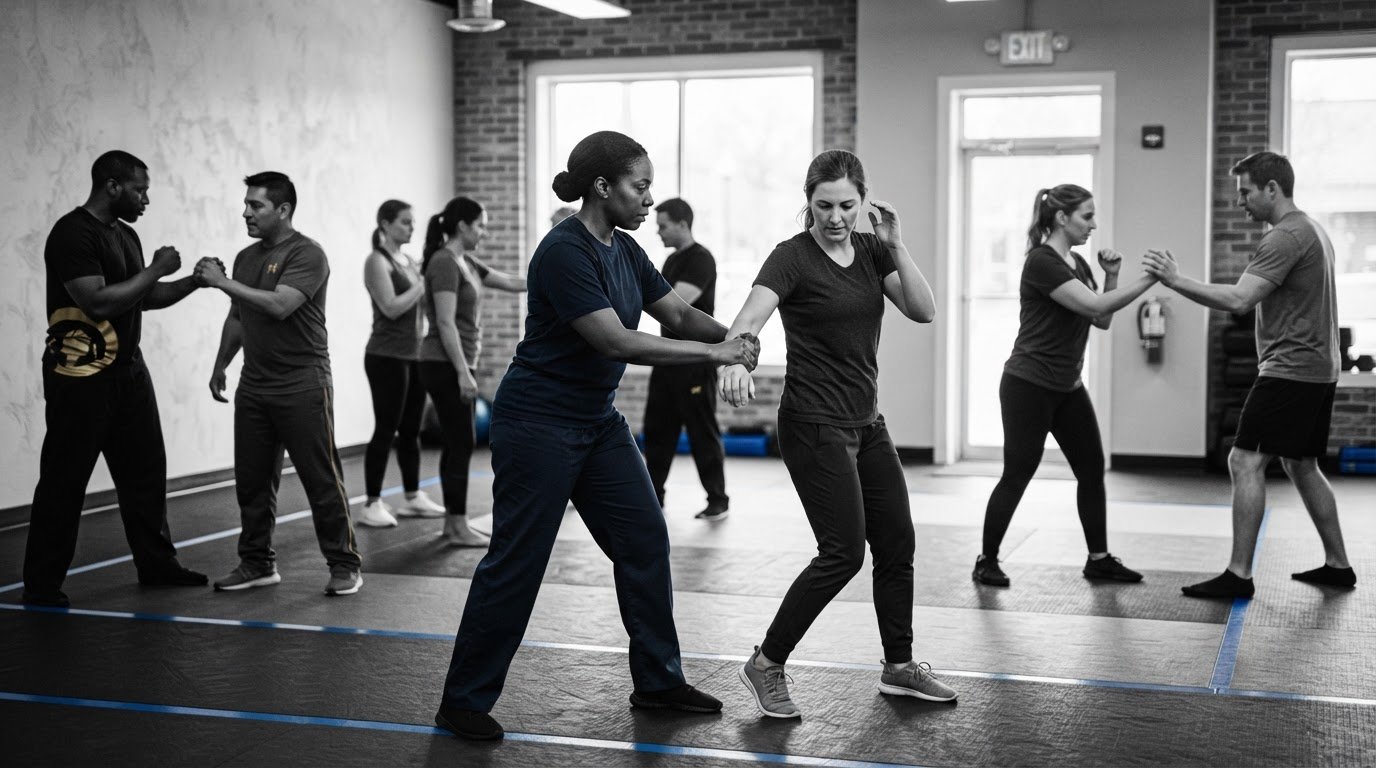
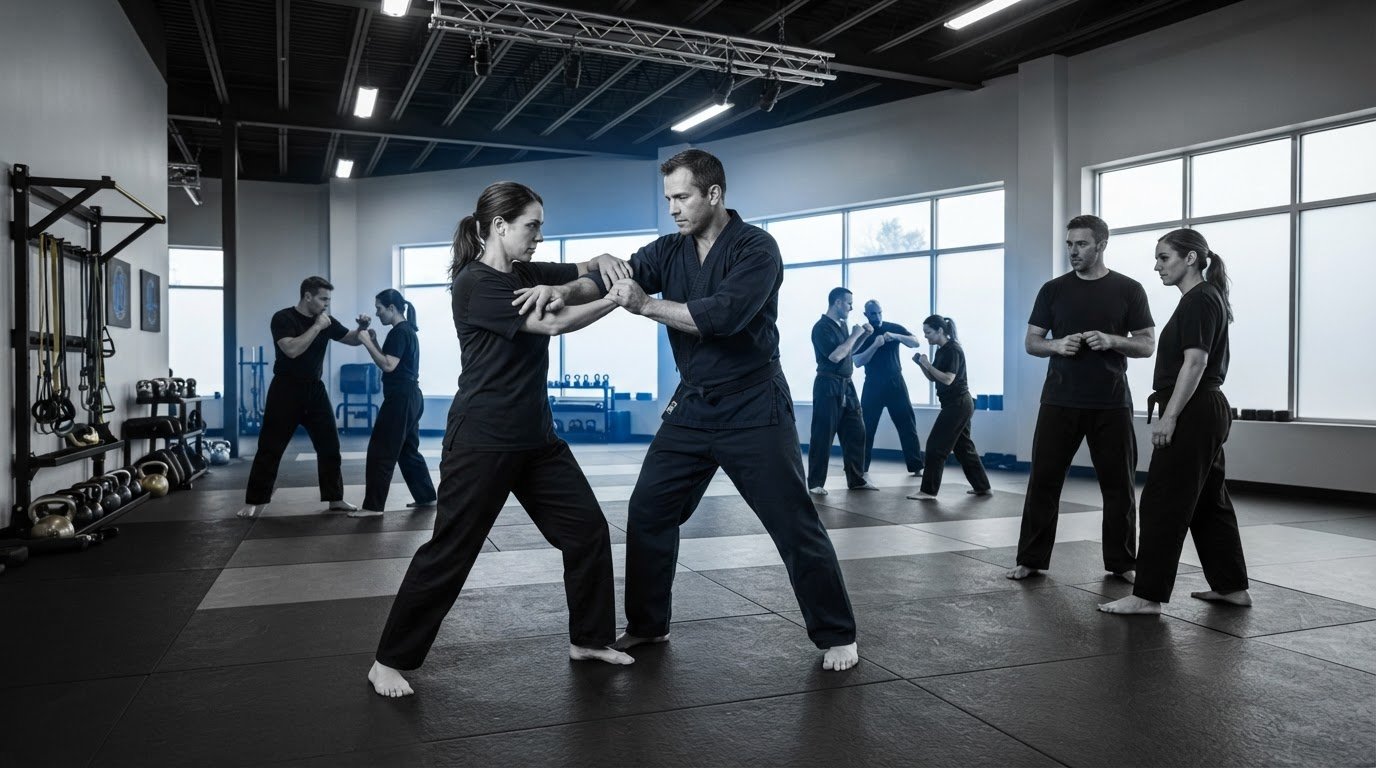
To be effective, martial arts lessons for adults must incorporate "micro-fights." These are short, high-intensity bursts where a partner offers genuine resistance. This type of pressure testing is essential for stress inoculation. It forces your brain to process information and make decisions while your heart rate is elevated. At Performance Krav Maga, we use realistic scenarios to ensure your response is a reflex, not a thought process. We bridge the gap between the safety of the mats and the chaos of the street. This disciplined approach to knife defense training ensures that when the adrenaline hits, your body knows exactly what to do.
Training for the Ambush: Drills and Stress Inoculation
Survival isn't a matter of luck. It's the result of a disciplined, progressive training methodology that transforms fear into tactical action. Effective knife defense training must move beyond the "if-then" scenarios of a textbook and into the chaotic reality of the street. This process begins with a structured five-step progression designed to build an unbreakable defensive foundation.
Step 1: Master fundamental 360-degree blocks against static, predictable attacks to cement technical mechanics.
Step 2: Introduce dynamic movement and solo "shadow boxing" with a training blade to develop spatial awareness and footwork.
Step 3: Engage in "Slow-Work" with a resisting partner, moving at a controlled pace to build the neural pathways necessary for complex responses.
Step 4: Transition to high-intensity stress drills, defending against multiple attackers or fighting through extreme physical exhaustion.
Step 5: Perform scenario-based testing in everyday clothing, such as jackets or heavy boots, to simulate real-world restrictions.
Building the 'Fail-Safe' System
Repetitive, high-stakes drills are the only way to ensure your body reacts before your mind has time to freeze. This muscle memory is what allows a quiet professional to operate with efficiency under fire. The Krav Maga workout serves a critical role here, as it conditions your cardiovascular system to handle the explosive demands of a fight. Training while fatigued is essential because it simulates the "adrenaline dump" that occurs during a real ambush. If you can't execute a block when you're tired in the gym, you won't execute it when you're terrified in an alley. You don't rise to the occasion; you sink to the level of your training.
Scenario-Based Training in Egg Harbor City
We don't believe in training in a vacuum. In Egg Harbor City, our knife defense training extends into realistic environments like parking lots, stairwells, and confined spaces. These settings force you to account for environmental obstacles and limited exit routes. We also emphasize verbal de-escalation as a primary defensive tool, teaching students how to identify pre-attack cues and potentially diffuse a situation before a blade is even drawn. For South Jersey residents seeking formidable self-protection, these workshops offer a direct path to physical competence. If you're ready to forge these life-saving instincts, sign up for our next tactical seminar and start your journey today.
Master Your Defense at Performance Krav Maga
The difference between knowing a technique and being able to execute it under fire is the quality of your instruction. Performance Krav Maga stands as the premier tactical training center in South Jersey, providing a space where theory meets the unforgiving reality of the street. Led by Chief Instructor Greg Dziewonski, our facility serves as the national headquarters for the Krav Maga Federation of America (KMFA). This pedigree ensures that you aren't just learning a sport; you're receiving the same high-level instruction used by professionals to neutralize threats. Our community is built on a family-like support system that guides every student through the transition from vulnerability to formidable strength.
We believe that true confidence comes from physical competence. You've read about the "sewing machine" attack and the necessity of 360-degree blocks, but these concepts only become life-saving instincts through disciplined repetition. At our center, we bridge the gap between understanding a threat and having the grit to stop it. We offer a path for those who refuse to be victims, focusing on the psychological boost that comes from knowing you can protect yourself and your family.
Authentic Israeli Krav Maga in Atlantic County
We're ruthlessly focused on what works in the modern world. There's no room for ego or traditional fluff in our knife defense training sessions. We utilize a structured curriculum that takes you from the absolute basics of movement and awareness to the mastery of complex, high-stress scenarios. Whether you're a local athlete looking to add a tactical edge to your fitness or a complete beginner who's never stepped onto a mat, our doors are open. We've created an environment in Atlantic County that respects tradition but is bold enough to innovate based on real-world data and violent trends. Our Krav Maga classes are designed to be accessible yet challenging for everyone.
Your First Step Toward Readiness
Stepping into your first lesson might feel intimidating, but you'll immediately find a supportive, disciplined classroom. You can expect to be challenged both physically and mentally as we strip away ineffective habits and replace them with efficient, life-saving instincts. Our brand promise is simple: we build formidable individuals. We don't just teach you how to fight; we teach you how to survive an ambush and walk away with your dignity intact. Egg Harbor City residents have a definitive authority on self-defense classes right in their backyard. It's time to stop feeling unprepared and start forging the skills that matter. Visit our facility in Egg Harbor City and seize the opportunity to transform your readiness today.
Secure Your Future Through Disciplined Action
Survival in a violent encounter isn't a matter of luck; it's the result of how you prepare before the crisis begins. You've learned that neutralizing an edged weapon threat requires more than just static blocks. It demands aggressive, simultaneous movement and the grit to stay in the fight. Investing in professional knife defense training is the only way to replace panic with the life-saving instincts of a quiet professional. It's about building the physical competence that leads to true mental confidence.
Performance Krav Maga is the National Headquarters for the Krav Maga Federation (KMFA). Under the guidance of Chief Instructor Greg Dziewonski, we serve Egg Harbor City and the greater South Jersey area with authentic, no-nonsense tactical training. Our family-like community is ready to support your transition from vulnerability to formidable strength. Forge your warrior mindset and start your training at Performance Krav Maga today. You don't have to face the world unprepared. Take the first step toward your own readiness and join us on the mat.
Frequently Asked Questions
Is it actually possible to defend against a knife attack?
Yes, survival is possible if you prioritize redirecting the blade and neutralizing the threat immediately. It isn't about "winning" a duel but rather mitigating lethal damage to vital areas. Success depends on moving from a reactive state to a proactive one by closing the distance and seizing control of the weapon arm.
What is the best martial art for knife defense?
Krav Maga is the premier choice because it's built for real-world survival rather than sport. It utilizes instinctive movements that work under extreme physiological stress. By focusing on simultaneous defense and counter-attack, it provides a logical path to safety that traditional, choreographed arts often lack.
Will I get cut if I try to defend myself against a knife?
You must accept the reality that you might get cut, but professional knife defense training ensures those injuries aren't fatal. The objective is to shield your vital "plumbing" and stop the attacker before they can deliver deep, repetitive stabs. Staying in the fight is a mental and physical requirement for survival.
How long does it take to learn basic knife defense skills?
Fundamental mechanics like the 360-degree block can be grasped in a few sessions. However, developing the muscle memory to react instinctively during an ambush takes consistent effort. Most dedicated students report a significant increase in their confidence and defensive readiness within three to six months of regular practice.
Do I need prior martial arts experience to start training?
No previous experience is required to begin our knife defense training or general self-defense classes. We designed our curriculum to take uninitiated beginners and transform them into formidable individuals. We focus on natural body movements that are easy to learn and retain regardless of your athletic background.
What kind of equipment do I need for knife defense classes?
You only need comfortable athletic clothing and a focused attitude for your initial lessons. As you advance, we incorporate training blades and protective gear to safely simulate high-pressure scenarios. We provide the necessary tools during class so you can focus entirely on your tactical development without worrying about sourcing supplies.
How is Krav Maga different from traditional knife fighting?
Traditional knife fighting usually involves two armed opponents engaging in a stylized duel. Krav Maga is a utilitarian system for the unarmed person facing a sudden, violent ambush. It prioritizes efficiency and the removal of obstacles, focusing on neutralizing the threat and escaping rather than staying to "fight."
Can a smaller person effectively defend against a larger attacker with a knife?
Leverage and aggression are the great equalizers in a violent encounter. Krav Maga teaches you to use your full body weight against the attacker's joints and to strike vulnerable targets like the eyes and throat. This allows a smaller person to overwhelm a larger aggressor by disrupting their ability to continue the attack.
Comments