
Martial Arts: Building Confidence from Vulnerability

True confidence isn't a feeling you can simply summon through positive thinking; it's a byproduct of earned competence forged under pressure. Many people walk through life feeling a quiet sense of powerlessness in high-stress situations or anxiety about their physical safety. You might feel that your reactions are dictated by fear rather than personal agency. This is where learning how to build confidence with martial arts changes the internal equation. It's not about bravado or seeking conflict. Instead, it's about acknowledging your vulnerability and systematically replacing it with the tactical readiness that comes from reality-based training.
In this guide, you'll discover how reality-based martial arts training replaces uncertainty with the unshakeable confidence of earned competence. We'll explore the transition from feeling exposed to becoming a quiet professional who remains calm when others panic. You'll learn how the mental hardening required on the mats translates directly into social and professional resilience. By the end, you'll understand why improved physical fitness is just a byproduct of a much deeper psychological transformation. It's time to stop hoping you'll be okay and start knowing you can handle whatever comes your way.
Table of Contents
What Does It Mean to Build Confidence with Martial Arts?
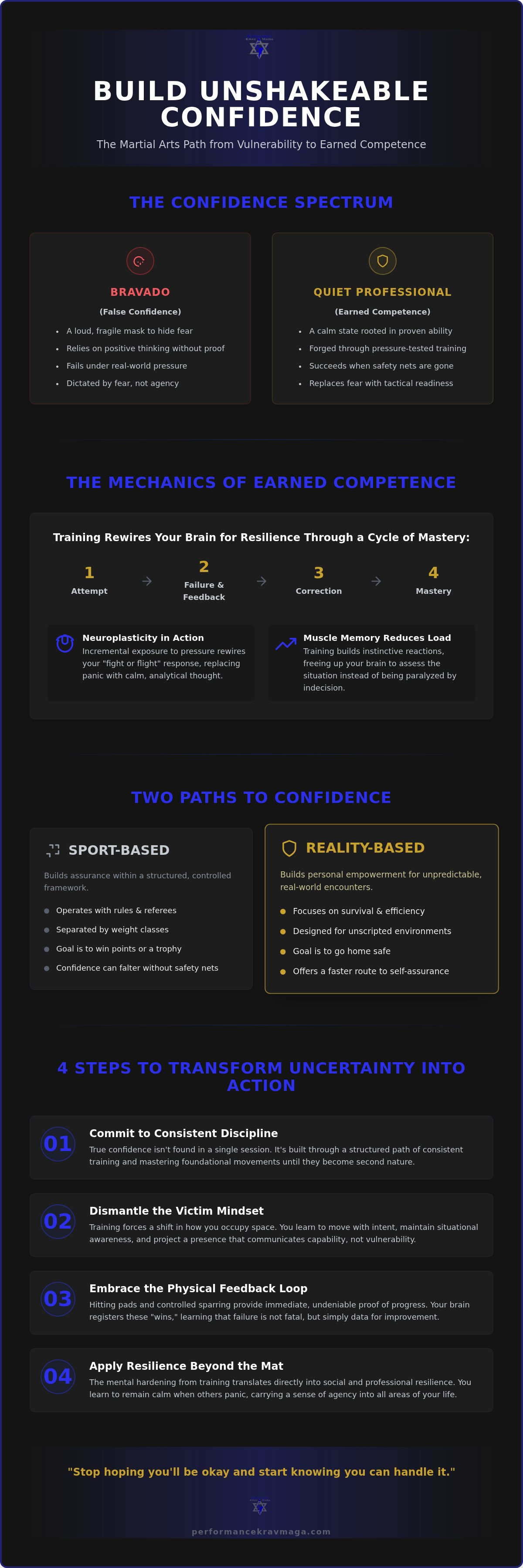
Confidence in a high-stress environment isn't something you can manifest through a morning mantra or a positive thinking exercise. It's a calculated psychological state rooted in the certainty that you possess the tools to handle a crisis. Many people mistake bravado for confidence, but the two are opposites. Bravado is a loud, fragile mask used to hide fear; true confidence is the "quiet professional" vibe of a person who knows exactly what they're capable of. Learning how to build confidence with martial arts requires moving past abstract theories and into the world of physical evidence.
While many practitioners seek out these disciplines for the physical benefits, the true value lies in the mental and spiritual development that occurs when you test your limits. Traditional positive thinking fails because it lacks a feedback loop. Physical training succeeds because it provides immediate, undeniable proof of your progress. When you successfully defend a strike or escape a hold, your brain registers a win that no self-help book can replicate. This physical autonomy creates a direct link to mental resilience, allowing you to carry that same sense of agency into your career and social interactions.
The Difference Between Sport and Reality-Based Confidence
Sport-based martial arts are impressive, but they operate within a framework of rules, weight classes, and referees. This creates a specific type of assurance that may falter when those safety nets are removed. Reality-based systems, such as the training offered at Performance Krav Maga, focus strictly on survival and efficiency in unscripted environments. The psychological boost is different because it's grounded in real-world utility. You aren't training to win a trophy; you're training to ensure you and your loved ones go home safe. For a beginner, this tactical focus provides a much faster path to self-assurance because the movements are designed to work regardless of athletic pedigree.
Moving from Vulnerability to Formidable Strength
Building true strength starts with dismantling the victim mindset. This mindset is often characterized by a submissive posture and a lack of situational awareness. Training forces you to change how you occupy space. You learn to move with intent, maintain eye contact, and project a presence that suggests you aren't an easy target. This shift in body language isn't just for show; it's a reflection of your internal state. As you master how to build confidence with martial arts, you begin to see yourself as a defender rather than a potential casualty.
Martial arts confidence is earned competence through repeated, successful action.
The Mechanics of Earned Competence: How Your Brain Changes
Confidence isn't a personality trait. It is a biological result of competence. When you understand how to build confidence with martial arts, you stop looking for motivation and start looking for methodology. The core of this process is self-efficacy, which is the psychological belief in your own capacity to execute a specific task under pressure. This isn't built through theory. It's built through the relentless cycle of attempt, failure, correction, and eventual mastery. Each repetition on the mats serves as a brick in the foundation of your new self-image.
Hitting pads and engaging in controlled sparring are essential for psychological hardening. These activities provide immediate physical feedback that no book can offer. If your strike is weak or your guard is down, the result is instantaneous. This feedback loop forces the brain to adapt. Research shows that this type of consistent stress-testing enhances psychological resilience, particularly in high-stakes environments. You learn that failure isn't fatal; it's just data. Over time, you begin to welcome the challenge because you know you have the tools to solve the problem.
Neuroplasticity and Stress-Testing
The brain is remarkably plastic. Through incremental exposure to pressure, you can rewire your "fight or flight" response. Instead of panicking, you learn to stay calm and analytical. This is the foundation of the Warrior Mindset. By reducing your cognitive load through muscle memory, you ensure that your body reacts before your mind has time to second-guess the situation. This physical competence naturally lowers cortisol levels, leading to a more regulated emotional state in your daily life. Mastering how to build confidence with martial arts means training your nervous system to remain steady during the storm.
The Role of Discipline in Mental Clarity
Structure creates freedom. The disciplined environment of a training center fosters a level of focus that is rarely found in modern life. There is a direct relationship between physical discipline and emotional regulation. When you commit to self-discipline training, you are training your mind to remain steady regardless of external chaos. This mental clarity is what allows you to move from vulnerability to a state of formidable strength. You become the quiet professional who doesn't need to shout to be heard.
If you're ready to see how this neurological shift feels in practice, consider joining a self-defense class to start your own journey toward earned competence.
Overcoming the #1 Barrier: 'I'm Not the Martial Arts Type'
The most common reason people never start training is the belief that they aren't the "martial arts type." This self-imposed barrier is built on the myth that you need to be an elite athlete or a natural aggressor to step onto the mats. In reality, the most successful students are often those who walked in feeling the most vulnerable. Understanding how to build confidence with martial arts begins with the realization that everyone starts at zero. You don't get in shape to start training; you train to get in shape. The physical conditioning is a byproduct of the work, not a prerequisite for entry.
The fear of looking foolish in front of experienced practitioners is a powerful deterrent, yet it's entirely misplaced. At Performance Krav Maga, we operate under an "elite but humble" mentor philosophy. Our community is family-like, focusing on the individual journey rather than ego-driven competition. Extensive research into the psychological benefits of martial arts confirms that the most significant gains are rooted in the development of resilience and the ability to embrace challenges. This mental shift happens most effectively in a supportive environment where every senior student remembers exactly what it felt like to be a beginner.
Dismantling the 'Tough Guy' Stereotype
Modern media often portrays martial artists as aggressive or hyper-masculine, but the truth is quite the opposite. The most dangerous people in the room are frequently the most humble. They have nothing to prove because their competence is already earned. This transition from being intimidated to being the person others look up to is a core part of the process. By focusing on your own progress instead of comparing yourself to others, you dismantle the "victim mindset" mentioned in previous sections. You're not competing for a trophy; you're building a version of yourself that is prepared for reality. This process of building character and self-assurance is equally beneficial for children, with programs like Bushi Ban Child Care offering specialized after-school martial arts and fitness training to help the next generation develop a strong sense of personal agency.
Your First Lesson: What to Actually Expect
When you walk into our national headquarters in Egg Harbor City, you won't find a room full of people trying to outdo one another. Instead, you'll find a welcoming, professional atmosphere led by Chief Instructor Greg Dziewonski. Your first lesson is designed to be a low-friction introduction to fundamental movements. Instructors guide you through the initial "clumsy" phase with patience and technical precision. If you're looking for martial arts lessons for adults, you'll find that our curriculum is specifically designed to bridge the gap between where you are now and where you want to be. We focus on instinctive movements that work under stress, ensuring you see practical results from day one.
4 Practical Steps to Build Unshakeable Confidence
Confidence is a structure you build brick by brick. It isn't a gift granted to a lucky few; it's a result of deliberate, focused action. Understanding how to build confidence with martial arts requires moving beyond the "why" and focusing on the "how." These four steps provide a roadmap for transforming vulnerability into a formidable presence.
Commit to a consistent schedule: Discipline is the bedrock of confidence. When you show up on the mats even when you're tired, you prove to yourself that your goals matter more than your comfort.
Master foundational movements: You don't need a thousand techniques. You need a few that you can execute without thinking when the pressure is high. Drill them until they become instinctive.
Engage in scenario-based drills: Test your skills under simulated stress. These drills bridge the gap between theory and reality, ensuring your competence is valid in the real world.
Adopt the "Quiet Professional" mindset: Carry the calm you find during high-intensity training into your career and personal life. True confidence doesn't need to shout to be heard.
By following this progression, you stop hoping you'll be okay and start knowing you can handle a crisis. This transition is what separates those who talk about empowerment from those who actually live it. Every repetition is an investment in your own resilience. Mastering how to build confidence with martial arts is a lifelong journey, but the results manifest in your very first weeks of training.
Mastering Situational Awareness
True confidence is often silent because it doesn't need to prove itself. A significant part of this comes from situational awareness training. When you are aware of your surroundings, you remove the element of surprise. You identify potential threats before they escalate, which often prevents the need for physical conflict entirely. Knowing that you won't be caught off guard provides a level of peace that most people never experience. It's the ultimate proactive tool for personal safety.
Setting and Achieving Micro-Goals
Personal growth is measured in small, tangible wins. Whether you are moving through a belt system or mastering specific levels, these micro-goals track your progress. Every time you remove a physical obstacle or master a difficult technique, you're building a reservoir of success. These small wins in the gym translate directly to big wins in the boardroom. You learn that difficult tasks are just a series of smaller steps. If you're ready to start building your own roadmap, find a self-defense class and take the first step today.
Why Krav Maga is the Fast-Track to Personal Empowerment
Many traditional martial arts require years of dedication before a practitioner feels truly capable in a crisis. They often focus on complex forms, aesthetic movements, or sport-specific rules that don't translate to the chaos of the street. Krav Maga is different. It is a utilitarian survival system designed for maximum efficiency and immediate application. If you're searching for how to build confidence with martial arts without spending a decade in a dojo, Krav Maga provides the most direct route. It leverages your body's natural, instinctive reactions, which means you can see practical results in weeks rather than years.
The tactical nature of this training builds a unique brand of "readiness" confidence. It's the psychological certainty that you can handle a threat even if you're caught off guard or exhausted. While sport-based systems like Muay Thai or Brazilian Jiu-Jitsu offer incredible physical benefits, they often involve steep learning curves and rules that don't exist in reality. Krav Maga removes the fluff. It focuses entirely on what works in a modern, unscripted environment. This efficiency is why it serves as the ultimate tool for personal empowerment, allowing you to walk with a sense of quiet authority.
The Performance Krav Maga Advantage
Performance Krav Maga in Egg Harbor City isn't just another local training center. It serves as the national headquarters for the Krav Maga Federation (KMFA), positioning it as a definitive authority in the field. Under the leadership of Chief Instructor Greg Dziewonski, students receive instruction with an elite pedigree that is rare to find outside of professional security circles. The curriculum is ruthlessly focused on real-world self-defense rather than point-scoring or trophies. Despite the intensity of the methodology, the atmosphere remains supportive and family-like. This South Jersey community is dedicated to your individual transformation from vulnerability to formidable strength.
Take the First Step in Atlantic County
Waiting until you "feel ready" is the only way to ensure you never start. Confidence doesn't happen in a vacuum; it happens on the mats through action. By joining the community of formidable individuals in Egg Harbor City, you're choosing to take control of your personal safety and mental resilience. You've explored how to build confidence with martial arts through discipline, neuroplasticity, and tactical readiness. Now, it's time to apply that knowledge. Replace vulnerability with strength today. Take the first step toward a more capable version of yourself and discover what you're truly capable of achieving.
Step into Your New Reality
True confidence isn't found in a book or a motivational speech. It is forged through the deliberate practice of reality-based skills that hold up under pressure. You've learned that vulnerability is the necessary starting point for growth and that your brain can be rewired for resilience through consistent stress-testing. By focusing on instinctive movements and situational awareness, you replace the "victim mindset" with the calm authority of a quiet professional. Learning how to build confidence with martial arts is a commitment to your own safety and mental hardening.
Performance Krav Maga is Egg Harbor City's premier tactical training facility and the national headquarters for the KMFA. Led by Chief Instructor Greg Dziewonski, our family-like community is ready to support your individual journey from uncertainty to formidable strength. Don't wait until you feel ready to take control of your personal agency. Claim your introductory Krav Maga lesson at Performance Krav Maga today! You have the capacity to be more capable than you ever imagined. We'll see you on the mats.
Frequently Asked Questions
How long does it take to feel more confident after starting martial arts?
You'll likely experience an initial boost in morale after your very first session. However, developing the unshakeable sense of how to build confidence with martial arts typically takes about six to twelve weeks of consistent training. During this period, your brain begins to automate foundational movements. This neurological shift reduces the cognitive load during stress, allowing you to remain analytical rather than reactive when facing high-pressure situations in your daily life.
Can martial arts help with social anxiety and public speaking?
Physical training provides a unique foundation for mental resilience. When you master your physical space, your brain stops perceiving social interactions as survival threats. This shift significantly lowers the anxiety associated with public speaking or social confrontation. The Warrior Mindset you develop on the mats in Egg Harbor City translates directly into a more grounded, present, and assertive version of yourself in professional and social settings.
Is Krav Maga better than traditional martial arts for building confidence?
Krav Maga is often considered a fast-track because it prioritizes efficiency over tradition. Unlike systems that focus on aesthetic forms or sport-specific rules, Krav Maga uses instinctive movements that work under real-world pressure. This tactical focus allows you to see defensive results much sooner than in traditional disciplines. For many, this immediate utility is the most effective way to understand how to build confidence with martial arts quickly.
Do I need to be in good shape to start building confidence through training?
You don't need to be an athlete to begin your journey at Performance Krav Maga. We view physical fitness as a byproduct of the instruction rather than a prerequisite for entry. Our instructors guide you through foundational drills that match your current physical capacity while gradually increasing the intensity. Starting where you are is the only way to build genuine competence, and our family-like community ensures you're supported through every step.
Will martial arts make me more aggressive or more calm?
Training at our Egg Harbor City facility is designed to make you significantly more calm. True aggression is frequently a mask for insecurity or a lack of capability. As you become more formidable, you'll find that the need to prove yourself disappears. This transformation leads to the quiet professional mindset, where you possess the skills to handle conflict but have the emotional regulation to avoid it whenever possible.
What is the 'quiet professional' vibe mentioned in Krav Maga training?
The quiet professional vibe is a hallmark of elite tactical training. It describes a person who is capable, ready, and efficient without the need for empty bravado. In our classes, we emphasize that competence is silent. You'll learn to project a presence that is formidable yet accessible. This mindset focuses on readiness and the psychological boost that comes from knowing you can handle a high-stakes environment with calm precision.
How does situational awareness contribute to overall self-confidence?
Situational awareness is your first line of defense. It contributes to your confidence by removing the element of surprise, which is the primary source of panic in a crisis. When you learn to identify potential threats before they escalate, you gain a sense of control over your environment. This proactive approach ensures you aren't just reacting to the world, but navigating it with a strategic and prepared mindset.
Are there specific classes for beginners at Performance Krav Maga?
Performance Krav Maga offers specialized sessions tailored specifically for those with no prior experience. As the national headquarters for the Krav Maga Federation, our Egg Harbor City facility provides a structured path for beginners. Chief Instructor Greg Dziewonski ensures that every new student is welcomed into a supportive classroom environment. You'll be guided through instinctive self-defense techniques that prioritize your safety and individual growth from your very first lesson.


Comments