
Self-Defense for Apartment Living: A Practical Safety Guide

What if a safer apartment routine had less to do with confronting a threat and more to do with the decisions you make before one arises? Shared entrances, busy hallways, and building access you can’t fully control can make home feel less predictable. A practical approach to self defense for apartment living starts with steady habits, not fear or complicated tactics.
If you’re unsure what you can change as a renter or what to do when something feels wrong, you’re not alone. You can make thoughtful choices within your own space and build a clear plan for responding calmly and seeking help.
This guide will help you create a repeatable routine, pay attention to your surroundings, and think through what to do when a concern arises. You’ll also learn how structured self-defense training can help you practise decision-making and physical skills in a supervised setting. Preparation can build confidence, but it can’t guarantee safety.
Table of Contents
Self-Defense for Apartment Living Starts With Everyday Preparedness
In an apartment, safety can feel shared. You may pass unfamiliar visitors in the hallway, use a common entrance, or have little say over exterior lighting and building access. Those concerns are reasonable, but preparation doesn’t mean treating every neighbor or unexpected sound as a threat. Self defense for apartment living combines prevention, awareness, sound decisions, and proportionate responses. The aim is to notice what’s happening and choose a safer option, not to seek confrontation.
Environmental design can also affect how residents experience a space. The principles of Crime Prevention Through Environmental Design (CPTED), including natural surveillance and access control, offer a useful way to assess features such as obstructed views or poorly lit common areas. They can help you identify concerns to report, but they are not a personal security guarantee.
What does self-defense mean in an apartment?
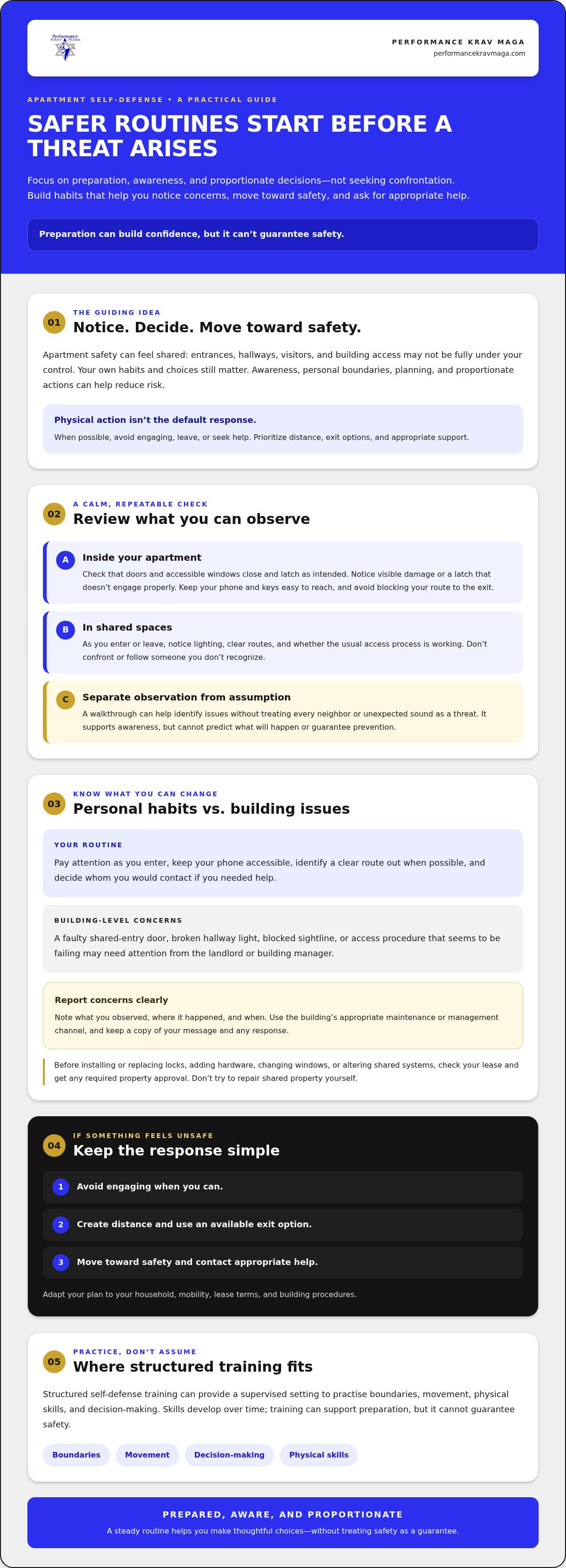
Apartment self-defense is the use of awareness, personal boundaries, planning, and proportionate actions to reduce risk and move toward safety. Everyday choices work together: notice who’s nearby, keep a clear route to leave when possible, and decide whom you’d contact if you needed help. If a situation feels wrong, avoid engaging when you can. Leave or seek help if those options are available. Physical action isn’t the default response.
Which apartment safety concerns can residents influence?
You can shape your own habits, such as paying attention as you enter, keeping your phone accessible, and deciding how to respond to an unexpected visitor. Building features are different. A faulty shared-entry door, broken hallway light, or blocked sightline may need attention from a landlord or manager. Don’t alter locks or shared systems without permission.
When reporting a concern, be specific: note what you observed, where it happened, and when. Use the building’s appropriate maintenance or management channel, and keep a record of your message and any response. This helps distinguish a concern you can address through your routine from one that needs building-level action. Awareness and planning can support safer decisions, but they can’t guarantee that an incident will be prevented or determine its outcome. Avoid advice that encourages retaliation or risky confrontations. Prioritize distance, exit options, and appropriate help.
How to Check Your Apartment and Shared Spaces Without Creating False Confidence
A calm walkthrough can help you spot what needs attention without turning your home into a source of constant worry. Check what you can observe and manage, then separate it from repairs or systems that belong to the landlord or building management. This supports self defense for apartment living, but it can’t guarantee that an incident will be prevented or predict what will happen.
What should renters notice around doors and windows?
Check that your apartment door and accessible windows close and latch as intended. Look for visible damage, a latch that doesn’t engage properly, or hallway lighting that repeatedly fails. Before installing or replacing locks, adding hardware, or modifying windows, check your lease and get any required property approval. For reversible steps, keep your phone and keys easy to reach, avoid blocking your route to the exit, and note any concerns you need to report.
Keep reports factual: record the location, what you observed, and when it occurred. Send the information through the building’s stated maintenance or management channel, and keep a copy. A written record makes it easier to follow up on a recurring issue without trying to repair shared property yourself.
How should residents think about hallways and shared entrances?
As you enter or leave, notice whether the common area is well lit, your route is clear, and the building’s usual access process is working. Don’t confront or follow someone you don’t recognize. If an access procedure seems to be failing, or a shared door or light remains damaged, report the specific concern through building channels. For broader routine ideas in shared residences, see the University of Texas at Austin’s residence hall safety guidelines.
A simple review can include:
At home, check that doors and windows close and latch as intended.
In shared areas, notice lighting, clear routes, and visible maintenance problems.
Identify how to contact building management and whom you could call for support.
Before adding a renter-friendly device or making a change, check your lease and ask the responsible party whether approval is needed.
Use this checklist as a prompt, not proof that your apartment is secure. Revisit it when something changes, and focus on observations you can act on calmly. Residents who want to practise awareness and decision-making in a supervised setting can explore Krav Maga and self-defense classes.
What to Do When an Apartment Situation Feels Unsafe
Uncertainty can make it harder to choose a next step. Use a simple sequence: recognize the concern, create distance, move toward safety, and contact appropriate help. You don’t need to investigate or prove that something is wrong before choosing not to engage. For self defense for apartment living, leaving calmly or calling for help is often a more practical priority than confronting someone.
Match your response to the urgency. A loose entry latch or repeatedly failing hallway light is a concern to document and report through building channels. Someone trying to force entry, a credible threat, or an immediate risk of harm calls for urgent help. If you’re unsure, prioritize distance and contact a trusted person or emergency services based on what’s happening. The right response and available help depend on the situation.
How can you respond to an unexpected visitor?
If you don’t know who’s at the door or why they’re there, you’re not obligated to open it. If available, use a safer way to communicate, such as an intercom, phone, or speaking through the closed door. Keep your response brief. Don’t share personal details or let someone in just because they seem impatient. Follow your building’s visitor procedures, and contact management or another appropriate resource if the concern is non-urgent. If the person’s behavior suggests immediate danger, move away from the entrance and seek urgent help.
No script guarantees safety. Choose an option that lets you maintain distance and communicate without exposing yourself to greater risk. Don’t go into a hallway to challenge or follow someone. If another household member is with you, agree on a simple way to alert each other and move to a safer place.
What should you do if a concern becomes urgent?
Move away from the danger if you can do so safely. If leaving isn’t safe, use a room or barrier between you and the source of concern, and contact emergency services when immediate help is needed. Explain where you are and what’s happening as clearly as possible, then follow the dispatcher’s instructions and local emergency guidance. Don’t delay a call to collect belongings or investigate.
When it’s safe, share relevant information with a trusted contact, such as your location and whether help has been called. For a non-urgent access or maintenance issue, note what happened and report it through the appropriate building channel instead. Keep the priority clear: create distance, communicate, and get help. Physical confrontation should not be the goal.
Build an Apartment Safety Routine You Can Actually Maintain
A useful routine should be simple enough to follow on an ordinary day. Choose a few repeatable actions for arriving home, securing your space, and communicating about concerns. Adapt them to your mobility, household needs, lease terms, and building procedures. A plan that fits your real life is easier to remember than a long checklist.
Arriving: Keep your keys accessible, pay attention to your immediate surroundings, and use the building’s normal entry process.
Settling in: Close and check your door and windows as appropriate, and keep your phone where you can reach it.
Raising a concern: Know how to contact building management about non-urgent issues and whom you trust for personal support.
How can you make a personal apartment safety plan?
Choose one or two trusted contacts and decide how you’ll reach them if you feel uneasy. Think ahead about where you could move and whom you’d contact if leaving were appropriate. The safest choice depends on the situation. Make your plan easy to recall by saving important contact details and keeping any written notes accessible to everyone who may need them.
How can roommates or household members coordinate?
Agree on a straightforward check-in method and discuss expectations for visitors. Make sure everyone can say they feel uncomfortable without being pressured to explain. Household members should know how to contact one another and where to find the shared plan. Don’t circulate sensitive access information more widely than necessary, and revisit arrangements when someone moves in or household needs change.
Keep the routine current. Review it after a move, a change in household members or building procedures, or a maintenance issue that affects access. If part of the plan no longer works, replace it with a practical alternative. The goal is consistency, not perfection.
Preparation can also include practising how to set boundaries, move, and make decisions under pressure. Guided instruction won’t replace a household plan, but it can help you rehearse skills in a supervised setting. Readers interested in local options can explore this guide to practical self-defense classes in Atlantic County. For structured practice, explore self-defense classes and build skills over time.
How Self-Defense Training Can Support Apartment Residents
A safety routine helps you decide what to do. Coached practice gives you a chance to rehearse movement, setting boundaries, and decision-making under supervision. These skills can support self defense for apartment living, but they develop over time. Training can’t guarantee safety, replace emergency services, or fix a building maintenance problem.
What should beginners look for in self-defense classes?
Look for clear instruction, supervised practice, and respect for different starting points. Ask how instructors explain safe participation, what a typical class involves, and how they accommodate students with different experience levels. You don’t need prior training to ask questions or learn what to expect. Readers considering local instruction can learn more about Krav Maga classes in Egg Harbor City.
Useful practice should connect physical skills with judgment: recognizing options, communicating boundaries, and choosing when to disengage. No single technique or class can predict how a real situation will unfold. Treat training as a way to build and refine skills, not a reason to take unnecessary risks or assume you’ll always be able to control an encounter.
How can local training fit into a broader safety plan?
Classes are one part of preparation. Keep using your household communication plan, follow building procedures, and report maintenance concerns through the appropriate channels. Training doesn’t replace repairs, property management, or emergency help when it’s needed. Egg Harbor City-area readers interested in a related perspective can explore tactical self-defense and personal readiness.
Performance Krav Maga offers Krav Maga, self-defense, and martial arts instruction for different experience levels in Egg Harbor City, New Jersey. If you’re interested in supervised practice, explore self-defense classes and consider how training could complement the routine you’ve built at home.
Make Your Next Safety Step a Practical One
Apartment safety isn’t about expecting the worst. It’s about building habits that help you notice concerns, choose a sensible response, and seek help when needed. A simple routine for entering and securing your home, clear communication with household members, and timely reports about building issues can make your plan more useful and manageable.
Self defense for apartment living also means preparing your decisions, not just your surroundings. Training can provide supervised practice with movement, boundaries, and awareness. Skills develop over time, and no approach can guarantee safety.
For renters in Egg Harbor City, New Jersey, Performance Krav Maga offers practical Krav Maga and self-defense instruction for different experience levels. To explore structured practice, contact Performance Krav Maga about self-defense classes. Start with one realistic step, then build from there. Preparation grows through consistency.
Frequently Asked Questions
Is self-defense for apartment living different from self-defense elsewhere?
Yes. Apartment settings bring practical considerations such as shared entrances, nearby neighbors, lease limits, and common areas you don’t control. The core priorities in self defense for apartment living remain prevention, awareness, creating distance, and seeking appropriate help. Follow your building’s procedures and adapt your plan to your circumstances. A hallway or confined layout isn’t a reason to confront someone. Choose a safer option when possible.
Can renters improve apartment safety without making permanent changes?
Often, renters can improve routines and communication without altering the property. For example, you can coordinate with household members, follow building entry procedures, and report a damaged shared door to the responsible property contact. Before installing or changing hardware, check your lease and ask the landlord or manager whether permission is needed. No single step guarantees safety, so choose practical measures that fit your home and circumstances.
What should I do if someone I do not know knocks on my apartment door?
You don’t have to open the door if you feel uncertain. If available, communicate from a safer position or use an intercom, and follow your building’s visitor procedures. Don’t go into the hallway to confront or question the person. If their behavior feels threatening, move away from the entrance and contact appropriate help. There’s no universal response for every situation, so prioritize distance and safety.
How can I make a self-defense plan for an apartment?
Start with a short plan: identify trusted contacts, decide how to reach them, and consider where you could move if you feel at risk. Account for household members’ needs and your building’s procedures. Think through whether leaving or contacting help is appropriate, since the right choice depends on the circumstances. Keep the plan accessible and easy to remember, then review it when your household or living situation changes.
Do self-defense classes teach apartment-specific techniques?
Class content varies, so ask whether instruction addresses everyday environments and how scenarios are practised safely. For beginners, look for clear explanations, supervised practice, space to ask questions, and consideration of different experience levels. You can also ask what a typical class involves before deciding whether it suits you. Training develops skills over time. It can’t promise a particular outcome or replace a practical household safety plan.
Can Krav Maga help me feel more prepared at home?
Krav Maga classes can provide structured practice in practical self-defense skills, movement, and decision-making. The value depends on the instruction and your continued practice, and no class can guarantee safety. Ask an instructor how beginners are supported and what to expect in class. Performance Krav Maga offers Krav Maga and self-defense instruction for different experience levels in Egg Harbor City, New Jersey, giving local residents an option to explore supervised training.
Should I confront someone who is acting suspiciously in my apartment building?
No. Don’t assume that confronting or questioning someone is the safest response. Keep your distance, use building communication channels, and report a concern to the appropriate property contact when it’s safe. If you believe there’s immediate danger, move away and contact emergency services. Context matters, and you don’t need to investigate before choosing to leave an area or seek help. Prioritize safety over trying to resolve the situation yourself.


Comments