
Self-Defense for Public Transit: A Practical Safety Guide

What if your best self-defense move on a crowded train isn’t a strike, but a step toward a safer exit? When a stranger’s behavior feels threatening and space is tight, it can be hard to know what to do next. Self defense for public transportation starts with a simple sequence: notice what’s changing, create space where you can, exit when it’s safe, and get help. You don’t need to predict every situation. You need a plan you can remember under pressure.
This guide helps you build that plan for before boarding, during the trip, and after an incident. You’ll learn practical ways to use your position, nearby exits, and other people to create distance and seek assistance. You’ll also learn why safety tools must be checked against your transit system’s specific rules. Finally, we’ll look at how realistic, supervised Krav Maga and self-defense practice can help you rehearse awareness, movement, and decisive responses. The goal isn’t to guarantee safety or invite confrontation. It’s to help you respond calmly, make a clear choice, and move toward help.
Table of Contents
Public Transportation Self-Defense Starts Before You Board
For many commuters, public transit is a practical necessity, not an optional choice. You can still make deliberate decisions to support your safety without treating every stranger as a threat or trying to control what you can’t predict. Preparation helps reduce risk, but it can’t promise that nothing unexpected will happen. The goal is to know your options before you need them, so stress doesn’t have to make every decision for you.
Start with awareness, not alarm. Situational awareness means noticing changes around you and choosing a useful response. That might mean registering that a platform has become quieter, someone is repeatedly closing distance, or a nearby exit offers a clearer route to other people. The principles of self-defense include more than physical techniques. Practical preparation and sound judgment matter too.
Plan the route, timing, and check-in
Before leaving, review your route and service information, especially if the trip is unfamiliar. Note where you’ll transfer and what alternatives may be available if service changes. Charge your phone and keep it accessible, but avoid staying absorbed in the screen. If useful, share your basic itinerary and expected arrival time with someone you trust. Keep the plan simple enough to follow while moving.
A charged phone can help you check updates, contact someone, or look for transit assistance, but it isn’t a complete safety plan. Think ahead about what you’ll do if your usual route is disrupted or a stop feels uncomfortable. You don’t need to memorize every detail of the system. Knowing your next useful step is a strong start.
Choose a position that preserves options
There’s no single seat or standing spot that works for every rider. When practical and comfortable, choose a place near other passengers or staff, with room to move instead of a position that leaves you boxed in. As you board, notice doors, exits, help points, and the path toward a staffed area. Layouts differ, so scan the space you’re actually in.
On a bus, that may mean noticing the doors and where the driver is. On a train or platform, look for an intercom, staff, or a busier area. Don’t put yourself at risk to reach an ideal position. Keep belongings manageable, and avoid blocking your own movement with bags or turning your headphones up so high that you miss what’s happening around you.
These small checks make self defense for public transportation more practical because they preserve choices before pressure rises. You’re not trying to predict danger or force a confrontation. You’re building a mental map: where you are, what has changed, and where you can move to find distance or assistance. Rehearse that scan on ordinary trips. Calm preparation is useful because it leaves room to adapt.
How to Respond When a Transit Situation Feels Unsafe
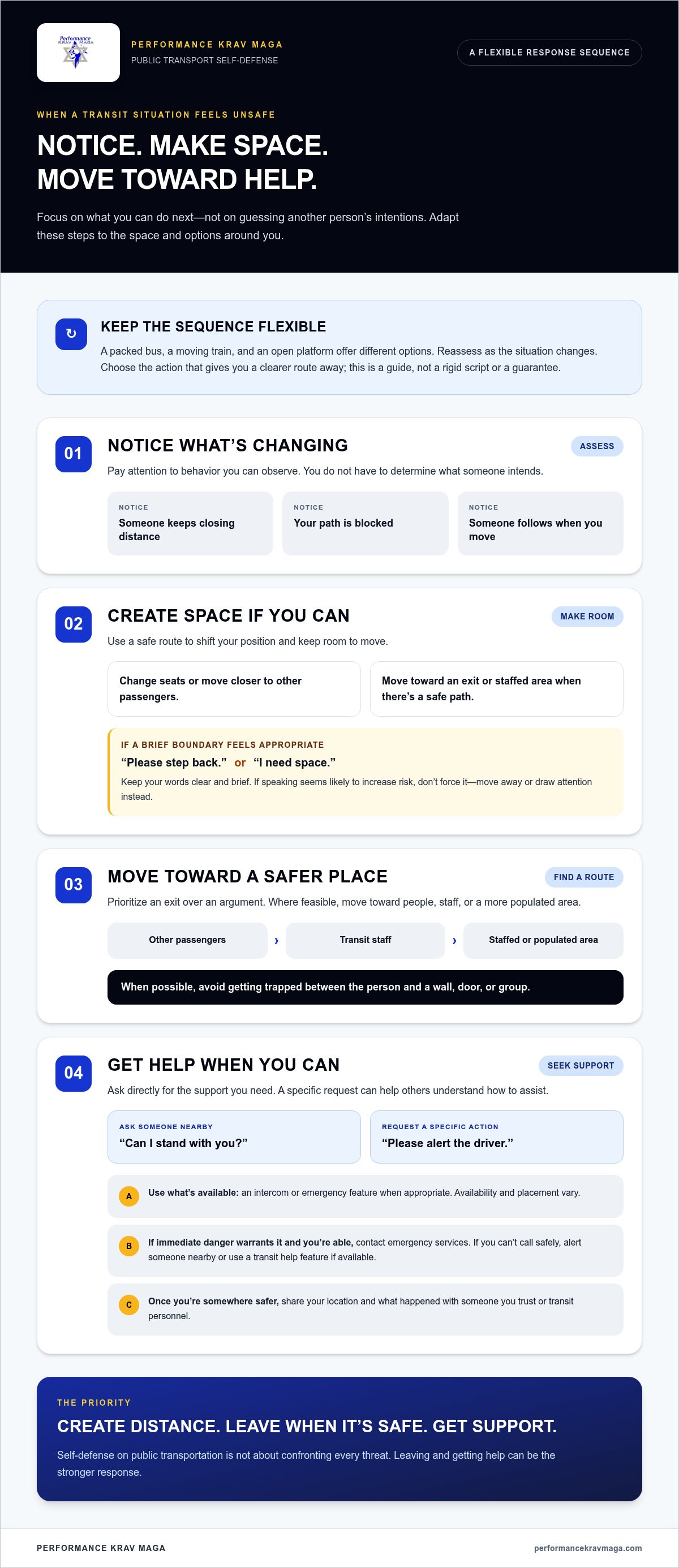
In a confined space, a small change can matter: someone keeps closing in, blocks your path, or follows when you move. You don’t have to decide what that person intends. Focus on what you can do next. A flexible sequence helps: notice the behavior, create distance if possible, move toward a safer place, and seek assistance.
Notice, make space, move toward safety, and get help when you can. This is a guide, not a guarantee or a rigid script. A packed bus, a moving train, and an open platform offer different options. Reassess as the situation changes, and choose the action that gives you a clearer route away rather than trying to prove a point or manage the other person.
Use distance and a clear boundary when appropriate
If there’s a safe path, change seats, move closer to other passengers, or step toward an exit or staffed area. Keep enough space to move, and avoid getting trapped between the person and a wall, door, or group if you can. If the person approaches or engages you, use a short, steady phrase such as “Please step back” or “I need space.”
Keep your voice clear and your words brief. A simple boundary can communicate your intent without inviting a long exchange. Keep your posture ready to move: face the direction you may need to go, keep your hands free, and avoid gestures that could unnecessarily escalate the moment. If speaking seems likely to increase risk, don’t force it. Move away or draw attention to the situation instead.
Adapt to what’s happening. There’s no phrase that works in every encounter, and you don’t need to follow a script if it doesn’t fit. On a crowded vehicle, creating space may mean shifting beside other riders and asking someone nearby for help. On a platform, it may mean moving toward staff or a more populated area. Prioritize an exit over an argument.
Move toward help instead of handling it alone
When feasible, move toward other passengers, transit staff, or a staffed public area, and make your request direct: “Can I stand with you?” or “Please alert the driver.” Being specific helps people understand what you need. If you’re on a vehicle with an intercom or emergency feature, use it when appropriate. Availability and placement vary, so act on the features present rather than searching for one while the situation develops.
If immediate danger warrants it and you’re able, contact emergency services. If you can’t call safely, alert someone nearby or use a transit help feature if available. Once you’ve reached a safer place, share your location and what happened with someone you trust or transit personnel. Self defense for public transportation is not about confronting every threat. Leaving and getting support can be the stronger response.
These choices can be rehearsed. Practical Krav Maga and self-defense training can help you practice moving, setting a boundary, and making a decision under pressure, while recognizing that encounters don’t all unfold the same way.
Self-Defense Tools or Practical Skills: Make a Transit-Smart Choice
Safety isn’t a piece of equipment you can simply carry. A useful plan combines awareness, communication, knowledge of transit help options, and practiced decisions. Each can help in different circumstances, but none guarantees a particular outcome. This comparison can help you consider your choices before a commute without assuming any item is permitted everywhere.
Why skills matter when equipment is unavailable
Skills travel with you. Noticing where space opens, moving toward other people, and deciding when to leave don’t depend on having an object in hand. Equipment can be inaccessible, unsuitable in a crowded car, or restricted by transit rules. Even when a tool is allowed, it doesn’t choose a route, call for help, or make a judgment for you.
Space shapes the response. A packed bus may leave little room to move, while a platform might offer a clearer path to a staffed area. An exit may be nearby but blocked by riders or an approaching train. Practical self-defense training gives you a supervised setting to rehearse awareness, movement, and decision-making. Practice can build familiarity, but it can’t guarantee that harm will be prevented.
Check transit rules before carrying a safety tool
Don’t assume a tool permitted in one place is allowed on every bus, train, or station. Policies may differ by transit authority, vehicle type, and jurisdiction, and rules can change. Check the official, current guidance for the specific system you’ll use and the places your trip crosses. General online lists may not reflect the rules that apply to your route.
Keep the priority clear: judgment first, an exit plan next, and tools only as a considered option. If you can’t confirm that an item is permitted, don’t rely on assumptions. Self defense for public transportation is strongest when your choices remain flexible: know how to get attention, where you might move, and how to seek assistance, whether or not you carry a personal-defense tool.
A Practical Public-Transit Safety Plan for Before, During, and After a Trip
A repeatable plan helps you avoid having to invent every next step under pressure. Use this checklist as a starting point, then adjust it to the route, vehicle, and space around you. Self defense for public transportation includes preparation, movement, communication, and getting support, not just a response in the moment.
Run through a simple commuter checklist
Before travel: Review your route and service information, keep your phone charged, and identify how to reach transit staff or emergency help. If useful, share your expected route and arrival time with someone you trust.
While boarding: Notice the layout and the options available. On a bus, be aware of the doors and driver; on a train, note exits and visible help features. At a station or platform, look for staff or a populated area. Don’t assume every system has the same setup.
During the trip: Stay aware of changes around you and keep room to move where possible. If something concerns you, choose a practical next step: shift position, approach other passengers or staff, or move toward an exit when safe. Avoid getting drawn into an unnecessary confrontation.
If you need help: Make a clear request to someone nearby or use an onboard or station help feature if one is available. Contact emergency services when immediate danger warrants it and you’re able to do so.
Keep the checklist flexible. In a crowded car, moving toward an exit may not be possible right away. Getting the attention of nearby riders or staff may be the better first move. At a platform, you may have room to move toward a staffed area, but avoid stepping into an unsafe path to get there. Reassess as conditions change. Your goal is a useful next step, not a perfect script.
After an incident, focus on safety and support
Once you can move safely, get to a more populated place before making non-urgent calls or reports. If you’re injured or feel unwell or distressed, seek medical attention. If there’s immediate danger or an urgent medical need, contact emergency services as soon as you safely can.
When you’re safe, write down factual details you remember, such as the time, location, route, and what happened. Share them with transit staff or the appropriate authority if you choose to report the incident. Don’t delay urgent care or stay exposed just to record details. If words are part of your plan, practicing verbal self-defense and de-escalation can help you consider how to set a boundary without prolonging an exchange.
For commuters who want to rehearse awareness, movement, and decisions in a supervised setting, explore practical self-defense classes. Practice can build familiarity, while every situation still calls for judgment and adaptation.
Build Transit Self-Defense Readiness Through Realistic Practice
A commute can change quickly, and pressure can make even a simple choice feel difficult. Supervised practice gives you a place to rehearse noticing what’s happening, choosing a response, and moving with purpose. The goal isn’t to predict every threat or perform a perfect technique. It’s to make useful actions more familiar, so you have options to draw on when a situation feels uncertain.
What useful transit-focused practice can develop
Practice can develop awareness, distance management, clear communication, and movement toward an exit. In a controlled scenario, a student might notice a change, decide whether to move or speak, then practice choosing a route toward safety. The exercise is a rehearsal, not a real incident. It allows time to pause, discuss choices, and try a different response without implying that any single technique can prevent harm.
Useful training develops decision-making as well as movement. For example, the best response may be to leave, ask someone nearby for help, or set a clear boundary rather than engage physically. A crowded space also changes what’s practical: there may be little room to step back, or an exit may be blocked. Practice can help you consider those constraints while keeping judgment and adaptation at the center.
People have different commutes, needs, and comfort levels, so there’s no one skill set every rider must acquire. Training can help you explore options and build confidence over time, but it can’t guarantee safety or dictate exactly how a future encounter will unfold. For a broader look at preparation beyond specific transit situations, explore this tactical self-defense guide.
Start training with a beginner-friendly mindset
You don’t need prior martial arts experience to start learning. Begin with curiosity and focus on steady practice rather than expecting instant confidence. With repetition and guidance, basic actions such as scanning a space, keeping room to move, and making a clear decision can become more familiar. Progress is personal. The aim is to keep learning, not to match someone else’s pace.
Performance Krav Maga offers practical instruction in Egg Harbor City for people with varied experience levels. Its supervised Krav Maga and self-defense classes help students work on awareness, movement, and decisive responses in a structured learning environment. These skills can support readiness while leaving room for the judgment each situation requires.
If you’d like to explore a local starting point, take a look at Krav Maga classes in Egg Harbor City. You can learn more about the approach and consider whether it fits your goals. Building readiness for self defense for public transportation is a process, not a promise: practice helps you develop options, one repeatable decision at a time.
Make Readiness Part of Your Next Step
Confidence grows through choices you can practice and refine, not through trying to control every commute. Start with one small step: notice your surroundings on your next trip, identify where you could go for help, or explore supervised practice that builds awareness and movement. Self defense for public transportation is a personal process, and your next step can match your experience and goals.
At Performance Krav Maga in Egg Harbor City, instruction is led by Chief Instructor Greg Dziewonski. The school also serves as the national headquarters for the Krav Maga Federation. If you’re ready to develop practical skills in a structured training environment, explore practical Krav Maga training in Egg Harbor City.
Begin where you are. With steady practice, you can build familiarity and make clearer decisions as part of your daily routine. Explore Krav Maga and self-defense classes at Performance Krav Maga in Egg Harbor City to take your next step.
Frequently Asked Questions
Is public transportation safe for someone traveling alone?
It can be, but no commute is risk-free, and conditions differ by route, time, and setting. For solo trips, consider choosing a well-used route when practical, keeping someone you trust informed of major delays, and deciding in advance where you could pause for help if plans change. Confidence comes from having options, not from assuming something will happen or believing you can control every circumstance.
Can I carry pepper spray on public transportation?
Don’t assume pepper spray is allowed just because you can legally carry it elsewhere. Rules may vary between transit agencies, vehicle types, and jurisdictions, and an item permitted on one system may be restricted on another. Before carrying it, read the current official guidance for every transit system on your trip. If the policy is unclear, contact the relevant transit authority or choose a plan that doesn’t depend on carrying it.
What should I do if someone follows me after I get off a bus or train?
Head toward a populated, staffed place rather than continuing into an isolated area or going directly home. If it’s safe, enter an open business or return to a transit area with staff, and tell someone clearly that you’re being followed. Call emergency services if you face immediate danger and can do so safely. Avoid approaching the person to challenge them. Prioritize reaching other people and getting help.
Should I intervene if another passenger is being threatened?
Help without putting yourself or the targeted passenger at greater risk. If safe, get the attention of transit staff, use an available emergency feature, or ask specific bystanders to call for help. A calm, direct interruption from a safe distance may draw attention, but don’t assume that physically stepping between people is the right choice. If violence appears imminent, contact emergency services and follow instructions from responders or staff.
What information should I give transit staff after an incident?
Share what you observed, not guesses about someone’s motives. Give the route or line, direction of travel, approximate time, nearest stop or station, and a factual description of the behavior and people involved. Mention whether anyone is injured, where the person went, and whether witnesses may be available. If you have relevant messages or notes, preserve them when safe. Don’t delay medical care or put yourself at risk to collect details.
Can self-defense training help if I have never taken a martial arts class?
Yes. You can begin without previous martial arts experience and build familiarity through guided practice at a pace suited to your starting point. For self defense for public transportation, useful learning can include recognizing changing situations, communicating clearly, and making movement decisions in a controlled setting. Progress takes practice. Training can support confidence and readiness, but it can’t guarantee safety. People in Egg Harbor City can explore instruction that develops practical self-defense skills.


Comments