
Self-Defense Mindset Development: Build Calm, Practical Readiness

What if a self-defense mindset isn’t about feeling fearless, but about having a useful next step when something feels wrong? It’s natural to wonder what to notice in an unfamiliar situation, or whether fear might make it hard to respond. Self defense mindset development isn’t about becoming suspicious or confrontational. It’s about building awareness, emotional control, and the ability to choose a practical response.
You’ll learn how to notice potential concerns, create space, set clear boundaries, and consider options before a situation escalates. Fear can affect anyone under pressure, so readiness doesn’t depend on pretending it won’t happen. It grows through deliberate decisions and realistic practice that make useful responses more familiar.
Awareness, calm communication, and consistent self-defense training can work together. Coached practice gives you a chance to rehearse decisions, not just talk about confidence. The goal is steady, practical readiness: avoid conflict when possible, act assertively when needed, and treat physical action as a last resort.
Table of Contents
What Does Self-Defense Mindset Development Really Mean?
Being prepared doesn’t mean treating every unfamiliar person or place as a threat. A useful self-defense mindset is calm, flexible, and focused on keeping your options open, not on looking for conflict. It helps you respond thoughtfully to what’s happening rather than defaulting to suspicion or assuming you must physically confront someone.
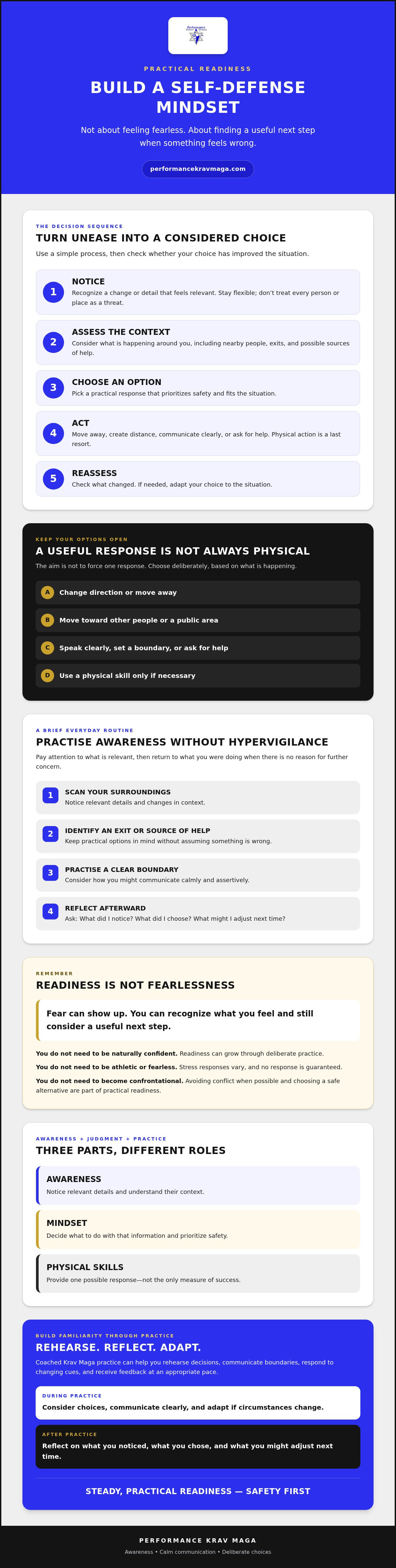
Self-defense mindset development is the practice of noticing what’s happening, assessing your options, and choosing actions that prioritize safety. That may mean changing direction, moving toward other people, speaking clearly, asking for help, or, if necessary, using a physical skill. The aim isn’t to force one response. It’s to make a deliberate choice based on the situation.
Mindset is more than a collection of techniques. Physical skills can give you options, but judgment helps determine whether to use them and when another choice may be safer. A practiced technique without sound decision-making may not fit the moment. Good judgment can help you avoid needing one at all.
Is a self-defense mindset the same as being fearless?
No. Fear may show up, and it doesn’t make you weak or incapable. Readiness means recognizing what you feel and still considering a useful next step. You don’t have to eliminate fear before you can make a thoughtful decision.
For example, if an interaction feels uncomfortable, you might end the conversation and move to a public area. You can feel uneasy and still choose to leave calmly. That isn’t backing down. It’s using your judgment to prioritize safety without escalating the moment.
How mindset differs from awareness and physical skills
Situational awareness is noticing relevant details in your surroundings and understanding their context. Mindset guides what you decide to do with that information. If a space feels uncomfortable, for example, you might move closer to an exit or ask someone for assistance.
Physical skills are one possible response, not the only measure of success. Creating distance, leaving, or getting help may be more appropriate. Awareness helps you recognize what’s happening; a self-defense mindset connects that information to a considered action, with safety as the priority.
How Self-Defense Mindset Development Works Under Pressure
Pressure can make a situation feel harder to read. Some people notice their attention narrowing or their thoughts speeding up; others may feel temporarily unsure what to do. Stress responses vary, so readiness isn’t about predicting exactly how you’ll react. It’s about having a decision process to return to.
Notice what changes, assess the context, choose a practical option, act, and reassess. Each step helps turn a vague sense of unease into a choice. If someone’s behavior or the setting makes you uncomfortable, notice what changed, consider nearby people and exits, and choose whether to move away or ask for help. Then check whether your choice has improved the situation.
Self defense mindset development doesn’t mean scanning every person or treating ordinary surroundings as dangerous. Useful alertness is flexible: pay attention to what’s relevant, then return to what you were doing when there’s no reason for further concern. Prolonged hypervigilance, by contrast, can keep someone focused on possible threats when the context doesn’t call for it.
What happens to decision-making when stress rises?
Stress can affect attention and decision-making, and some people may find complex choices harder in the moment. That doesn’t mean everyone freezes or reacts the same way. Keeping a few simple options in mind, such as creating distance, moving toward other people, or asking for assistance, can give you a place to start. It can’t guarantee an automatic or perfect response.
Why rehearsal and reflection matter
Guided practice gives learners a controlled setting to consider choices, communicate boundaries, and respond to changing cues. The aim isn’t to predict every situation. It’s to become more familiar with making a decision and adapting if circumstances change.
After an exercise, reflect briefly: What did you notice? What did you choose? What might you adjust next time? This turns practice into useful feedback rather than a pass-or-fail test. Structured Krav Maga classes can offer coached practice for people with different experience levels. Explore Krav Maga classes as one option for rehearsing decisions with guidance.
Self-Defense Mindset Myths: Confidence, Aggression, and Fear
You don’t have to be naturally confident, athletic, or fearless to develop a self-defense mindset. Readiness isn’t a bold personality or a promise that you’ll never feel uncertain. It’s a willingness to consider your options and choose a response that fits the situation. Sometimes the strongest choice is also the quietest one.
Self-defense prioritizes safety, not winning a confrontation. Leaving, creating distance, or seeking help can be sound decisions. Preparedness should support good judgment, not replace it.
Myth
Reality
Readiness means aggression.
Readiness means having options, including avoiding conflict and leaving.
Awareness means paranoia.
Awareness is paying attention to relevant context, not treating everyone as a threat.
Confidence means invulnerability.
Confidence can mean trusting your judgment while recognizing limits and asking for help.
Does developing a self-defense mindset make you more aggressive?
No. Preparedness is compatible with calm boundaries and a deliberate effort to avoid escalation. Assertive communication can be brief and clear, such as saying, “I don’t want to continue this conversation,” then moving away. It isn’t the same as threatening, provoking, or trying to dominate someone. Training may help you practise responses, but restraint and sound judgment still matter. The situation matters too.
Do you need confidence or athletic ability before you start?
No special starting point is required. Beginners can build self defense mindset development progressively by learning to recognize choices, communicate clearly, and practise skills at a manageable pace. Confidence may grow as someone becomes more familiar with their options, but it isn’t an entry requirement, and people’s experiences vary. Athletic ability also doesn’t determine whether you can make thoughtful safety decisions. Start with choices you can practise now, then build from there.
How to Practise Self-Defense Mindset Development in Everyday Life
Keep practice brief and grounded in ordinary routines. The aim of self defense mindset development is to strengthen attention and decision-making, not to turn errands or commutes into threat searches. Choose a familiar setting and notice what’s around you without assuming anything is wrong.
A simple awareness-and-choice practice
At a café, library, or transit stop, take a moment to notice the layout, the people nearby, and where assistance might be available. Then consider two reasonable options if you needed to change plans, such as moving to a busier area or speaking with staff. You’re not predicting danger. You’re practising how to recognize choices while staying engaged with your day.
Afterward, take a short moment to reflect:
What details did I notice about the setting?
What options did I identify?
Would I make the same choice again, or adjust it?
Keep the review neutral. It’s a chance to learn from your observations, not criticize yourself for missing something or choosing differently than you might in hindsight. These small exercises build attention and decision practice; they can’t guarantee protection from harm.
Practising calm boundaries and de-escalation
Clear language can help you communicate a limit without turning the exchange into an argument. Try a simple phrase such as, “I’m going to step away now,” and follow through by disengaging if the interaction feels uncomfortable. You don’t need to justify a boundary at length. If continuing to talk feels unsafe, prioritize leaving the conversation and seeking appropriate support.
To explore how everyday readiness fits into a broader framework, look for a tactical self-defense guide. Pairing reflection with structured physical practice can also help connect decisions to movement. A Krav Maga workout guide may offer ideas for that physical side, while coached instruction provides a setting to practise with feedback.
If you want to explore practical training in a structured setting, learn about Krav Maga classes at Performance Krav Maga. Instruction is designed for different experience levels.
Develop Your Self-Defense Mindset Through Structured Krav Maga Training
Everyday reflection can help you think through choices, but coached practice adds another layer: a chance to rehearse decisions, receive feedback, and try again in a structured setting. Krav Maga is one practical training option for exploring how awareness, communication, and physical skills can fit together. It isn’t a guarantee of safety or a replacement for sound judgment. The aim is to learn and practise, not to assume one technique fits every situation.
What can guided practice add to mindset development?
An instructor can guide learners through practice that involves noticing cues, choosing a response, and considering what to adjust. Feedback can make decision-making more concrete: Did you recognize your options? Was your response clear? What else could you consider? The focus is on supporting learning at an appropriate pace, not judging a beginner for getting something wrong.
Before choosing a class, ask how beginners are supported, how instructors give feedback, and how practice is adapted to different experience levels. These questions help you assess whether the learning environment suits your needs. Consistent participation may offer opportunities to practise, but individual experiences and progress differ.
Choosing a first step in Egg Harbor City
If you’re considering training locally in Egg Harbor City, think about what you want to learn and share your experience level, including if you’ve never trained before. Performance Krav Maga offers structured Krav Maga, self-defense, and martial arts instruction for different experience levels. When comparing instruction options, ask how the class supports beginners and how coached practice connects skills with decision-making.
Self defense mindset development grows through informed choices, practice, and reflection. If learning in a coached setting feels like a useful next step, explore Krav Maga classes at Performance Krav Maga and ask how instruction can fit your starting point.
Build Readiness One Deliberate Step at a Time
A practical self-defense mindset isn’t about fearlessness or confrontation. It grows through noticing what’s happening, weighing your options, and choosing a response that puts safety first. Everyday reflection can help you practise those decisions, while guided training offers a place to work through them with feedback.
That’s the heart of self defense mindset development: making calm, considered choices, not expecting confidence or perfect reactions every time. Krav Maga can be one way to practise, but training doesn’t replace judgment or guarantee an outcome.
For a local next step, Performance Krav Maga offers instruction for different experience levels in Egg Harbor City. The school is owned and operated by Chief Instructor Greg Dziewonski and serves as the national headquarters for the Krav Maga Federation. Explore Krav Maga training in Egg Harbor City to learn more about the classes.
Start where you are. With thoughtful practice, you can build readiness at your own pace. To take a next step, explore Performance Krav Maga’s classes in Egg Harbor City.
Frequently Asked Questions
What does self-defense mindset development mean?
Self-defense mindset development means practising how to notice what’s happening, assess the context, consider your options, and choose a response with safety as the priority. It isn’t about expecting danger everywhere or preparing to confront people. Depending on the circumstances, a useful response might be to leave, create distance, set a boundary, or seek help. Physical techniques are one possible option, not the whole mindset.
Can you develop a self-defense mindset if you are not confident?
Yes, you don’t need to feel confident before you start. You can build decision-making skills gradually by reflecting on everyday choices and, if you choose, practising in a structured class. Confidence may grow as you become more familiar with your options, but people’s experiences differ. You can begin as a beginner, ask questions, and focus on learning at a pace that feels appropriate to you.
Does self-defense training make people more aggressive?
Self-defense training doesn’t have to mean seeking conflict. A safety-focused approach supports restraint, calm communication, and leaving when that’s the wiser choice. Assertiveness means expressing a clear boundary, not threatening or provoking someone. Training can provide skills to consider, but it doesn’t replace judgment. The situation matters, and avoiding an unnecessary confrontation can be a sound outcome.
How can I practise a self-defense mindset every day?
Practise noticing useful details during ordinary routines without treating each place as dangerous. For instance, note where you could go for assistance in a public setting, then consider a couple of reasonable options if you wanted to leave. Afterward, reflect on what you noticed and what you chose. Keep the exercise calm and brief. It supports attention and decision practice, but can’t guarantee protection from harm.
What is the difference between situational awareness and a self-defense mindset?
Situational awareness is noticing and understanding relevant details in your surroundings. A self-defense mindset uses that information to guide a choice. You might recognize that an area is becoming crowded, then decide to move somewhere more comfortable. Awareness informs the decision; mindset connects observation to action. Neither requires constant scanning, and an appropriate choice may be as simple as changing plans or asking for help.
Can Krav Maga help develop a self-defense mindset?
Krav Maga classes can provide a structured setting to practise self-defense skills and decisions with instruction, though no class can guarantee how someone will respond in every situation. Performance Krav Maga offers Krav Maga and self-defense instruction for different experience levels in Egg Harbor City. If you’re considering classes, ask how beginners are supported and how the instruction fits your experience and learning goals.


Comments