
The Performance Krav Maga Curriculum: A Roadmap from Instinct to Mastery

If you find yourself in a violent confrontation, your body won't remember a complex 12-step sequence or a choreographed sport maneuver designed for a referee. It will remember its instincts. The Performance Krav Maga curriculum is engineered to weaponize those very instincts, stripping away the fluff often found in traditional martial arts classes to focus on what actually works under duress. You're likely here because you want to know if you're truly ready for the next level or if you're just spinning your wheels in a gym that prioritizes memberships over mastery. It's normal to feel anxious about whether your training will hold up when it matters most.
At Performance Krav Maga in Egg Harbor City, we provide a transparent roadmap that takes you from a raw beginner to an elite practitioner with surgical precision. You'll discover the exact progression of techniques and the tactical mindset required to move through our ranks. This guide breaks down the Level 1 through 5 journey, explains the rigorous technical pedigree led by 5th-degree black belt Greg Dziewoński, and clarifies how our testing process ensures you're never just wearing a belt, but possessing the skills to back it up. Get ready to transform your natural reactions into a professional defensive system.
Key Takeaways
Master the logic of the Krav Maga curriculum to see how foundational movements serve as the building blocks for complex, life-saving maneuvers.
Pinpoint the technical requirements for Levels 1 and 2, focusing on immediate street readiness and counter-attacks against common grabs.
Explore the transition to advanced mastery where you'll learn to neutralize weapons and manage high-stress tactical scenarios.
Clarify the testing standards and timelines so you'll know exactly what's required to earn your next belt through rigorous stress drills.
Recognize the value of learning at a National Headquarters from an instructor with a direct, high-level Israeli pedigree.
Table of Contents
The Architecture of Survival: Understanding the Krav Maga Curriculum
The Krav Maga curriculum isn't a collection of sports rules or points-based techniques. It's a survival blueprint. Unlike traditional martial arts that reward pageantry and aesthetic form, this system focuses on the brutal reality of the street. Every movement is vetted by the Krav Maga Federation (KMFA) to ensure it meets strict global standards for efficiency and reliability. We don't train for trophies. We train for the moment when your life depends on your ability to react without thinking. At Performance Krav Maga, our instruction follows the direct lineage of the KMFA AC, led by National Director Greg Dziewoński, ensuring every student receives authentic, battle-tested knowledge.
We utilize a "Building Block" theory. This means your Level 1 palm strike isn't just a punch. It's the mechanical foundation for your Level 4 knife defense. By mastering core mechanics early, you build a library of movements that remain consistent even as the threats become more complex. Speed and simplicity are the only metrics that matter here. If a technique requires perfect conditions to work, it doesn't belong in our Krav Maga curriculum. We prioritize what works when you're tired, surprised, and outnumbered.
The Logic of the Level System
We start with natural reflexes rather than complex katas. In a high-stress encounter, your fine motor skills disappear. You won't remember a twenty-step sequence. You'll remember how to flinch and strike. As you progress through the levels, the focus shifts from personal survival to the tactical responsibility of protecting others. In the modern threat landscape of 2026, the curriculum must account for evolving dangers like active threats and close-quarters weapon retention. We adapt because the world doesn't stay static. You'll learn to handle reality, not a sanitized version of it.
Integrating the Warrior Mindset
Technical skill is useless without the psychological "switch." Our training emphasizes situational awareness and identifying pre-fight indicators before the first blow is ever landed. You'll learn to manage the "adrenal dump" that causes tunnel vision and shaking hands. We use high-stress drills to condition your mind to stay calm while your body becomes explosive. It's about moving from de-escalation to decisive action in a heartbeat. You don't just learn to fight. You learn to survive the psychological weight of a violent encounter and come out the other side.
Level 1 & 2: Building the Foundation of Street Readiness
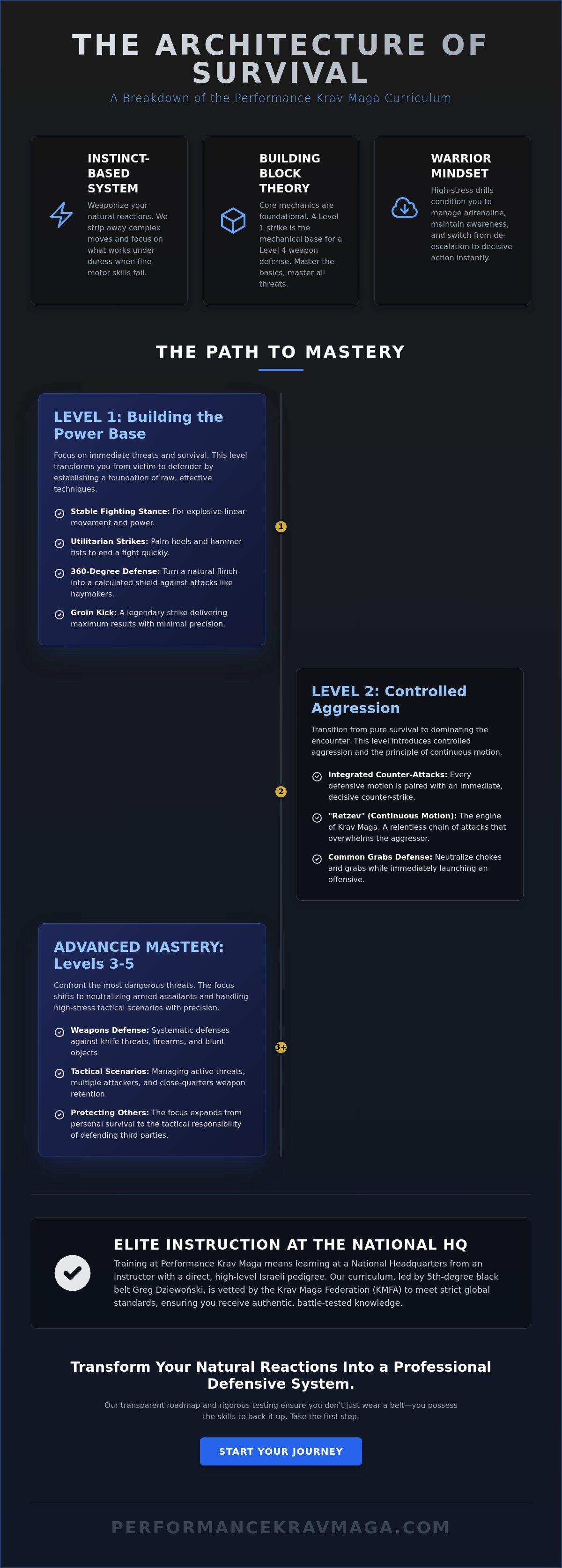
The first two tiers of the Krav Maga curriculum represent the critical transition from victim to defender. In Level 1, we don't worry about flashy high kicks or cinematic grappling. We focus on the immediate. You'll learn to drop into a stable fighting stance that allows for explosive linear movement and weight distribution. This level is about establishing your power base through utilitarian strikes like palm heels and hammer fists. We also introduce the 360-degree defense, which is built on the body's natural reaction to a sudden threat, transforming a panicked movement into a calculated shield. It's a raw but highly effective method of streetfighting that prioritizes neutralizing the threat so you can escape safely. As you move into Level 2, the system demands more than just survival; it demands controlled aggression. You start to integrate counter-attacks into every defensive motion, ensuring that the aggressor's first mistake is their last. This progression is designed to build "Retzev," or continuous motion, which is the engine of our system. It's the transition from a single defensive block to a relentless chain of offensive strikes that removes the attacker's ability to process what is happening.
Level 1: Establishing the Power Base
Your journey begins with the most common street scenarios: the haymaker punch and the front choke. We teach you to use your natural flinch response to create a barrier. Level 1 mastery involves the legendary Krav Maga groin kick, a strike that requires minimal precision but delivers maximum results. You'll learn to move with purpose. Every step is calculated to keep you off the "X" while staying within range to counter-attack. This isn't about looking good. It's about ending the fight before the aggressor realizes you've fought back.
Level 2: Intermediate Strikes and Grab Escapes
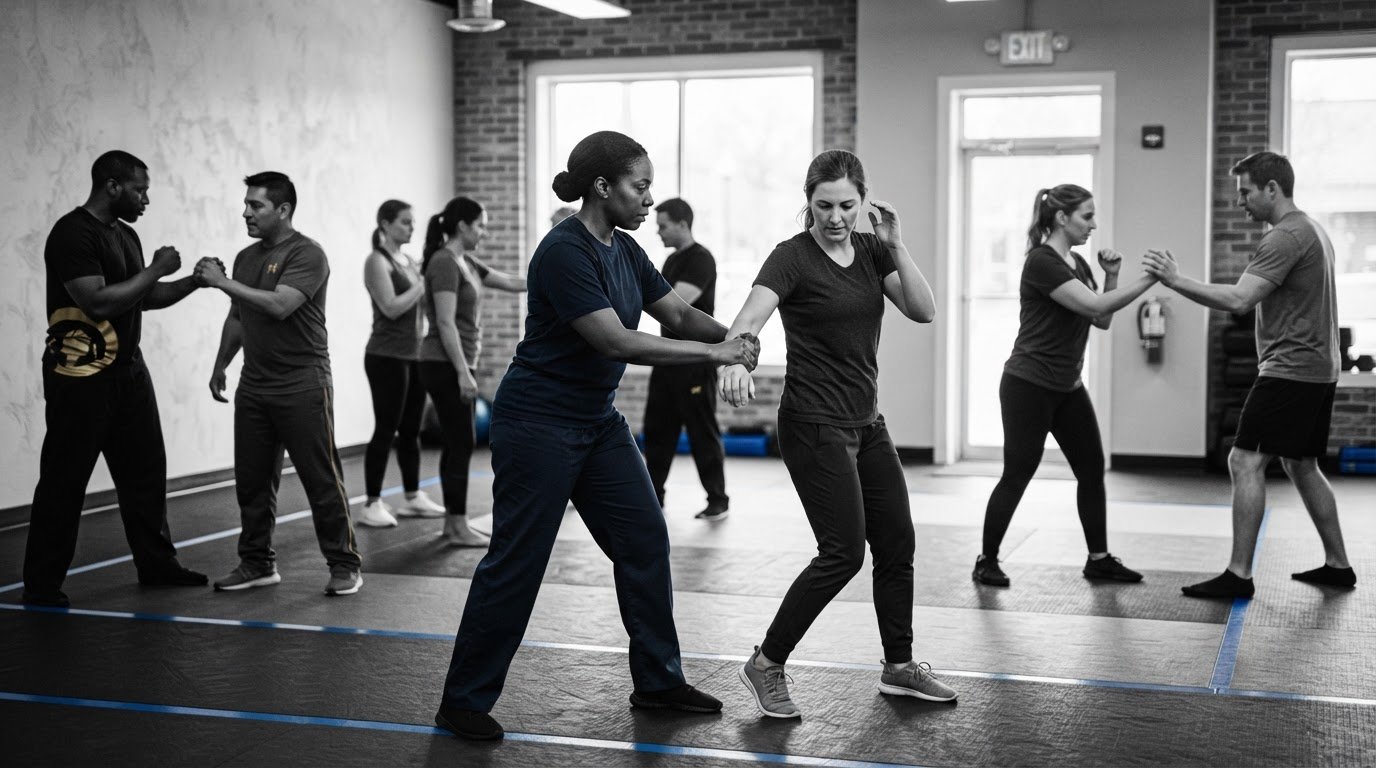
Once your foundation is set, Level 2 of the Krav Maga curriculum introduces complexity through circular strikes like hooks and uppercuts. We tackle the biomechanics of grab escapes, using leverage and physics to break bear hugs and headlocks. This level emphasizes "revolving" defenses, where you strike while being grabbed to force a release. If the fight goes to the floor, we cover ground survival basics to get you back to your feet instantly. Experience these transitions firsthand in our Krav Maga classes to build real-world confidence.
Advanced Mastery: Weapons Defense and Tactical Scenarios
As you move beyond the foundational tiers, the Krav Maga curriculum undergoes a significant shift. It's no longer just about your physical output or individual strikes. It becomes a game of tactical geometry and rapid decision-making. You're training to solve high-stakes problems under the most extreme conditions imaginable. Level 3 through Level 5 represent the pinnacle of civilian self-defense, where the environment is unpredictable and the threats are often lethal. At this stage, we move from the "hit and run" mentality of a beginner to the "control and neutralize" requirements of an elite practitioner. You'll learn that survival in these scenarios depends as much on your positioning and awareness as it does on your technical execution.
Level 3: The Chaos of Multiple Attackers
Level 3 introduces the terrifying reality of facing more than one aggressor. You can't afford to trade punches when you're outnumbered. Instead, you'll master the art of "stacking," a tactical movement that keeps attackers in a line, forcing them to trip over each other while you look for an escape route. This type of training is physically demanding and requires a high level of cardiovascular endurance. You'll need a solid Krav Maga workout to sustain the explosive energy needed for these multi-person drills. We also cover advanced ground survival, teaching you how to use fall breaks and rolls to regain your feet instantly, even on uneven or dangerous terrain. Movement isn't just a skill here; it's your primary defense.
Levels 4 & 5: Edged Weapons and Firearm Disarms
Levels 4 and 5 represent the transition to lethal threat management. The Krav Maga curriculum at this stage is ruthlessly focused on weapons. For edged weapons, we adapt the 360-degree defense you learned in Level 1, but with a focus on absolute control of the weapon arm and immediate neutralization. Knife defense is never clean, but our system is designed to minimize damage while stopping the threat. Firearm disarms require a deep understanding of the "line of fire" and the "action vs. reaction" gap. You'll learn to move your body out of the path of the bullet before the attacker can process your movement and pull the trigger. This level also introduces third-party protection. You'll learn the tactical protocols for shielding a child or spouse while simultaneously engaging a threat, moving from the role of a survivor to the role of a protector. This is where your training meets the ultimate responsibility of keeping your family safe.
The Road to Black Belt: Progression and Testing Standards
Earning rank in the Krav Maga curriculum is a journey of disciplined transformation. It isn't a passive process where time served equals promotion. Instead, it's a merit-based architecture where every belt represents a verified ability to survive. At Performance Krav Maga, we adhere to the global standards set by the Krav Maga Federation (KMFA), ensuring that a belt earned here carries weight anywhere in the world. Chief Instructor Greg Dziewoński, a 5th-degree black belt and National Director of the Krav Maga Federation – AC, personally oversees the certification process to maintain this technical pedigree. This rigorous oversight ensures that the "Building Block" theory remains intact, with each level reinforcing the last through consistent, high-level instruction.
How Long Does It Take to Learn Krav Maga?
Expect to spend approximately 4 to 6 months in Level 1 before you're eligible for your first test. Your individual progression depends on three critical variables: consistency in attendance, your baseline physical fitness, and your dedicated "mat time." We caution against schools offering "fast-track" belts or guaranteed weekend certifications. In the self-defense industry, these are significant red flags because real skill takes time to bake into your muscle memory. During your first 12 months, you'll move from mastering basic strikes to managing intermediate grabs and multiple attackers, provided you show up and do the work. It's a steady climb toward competence.
The Testing Experience: More Than Just Moves
A belt test is a high-pressure evaluation designed to push you to your mechanical and psychological limits. It's one thing to execute a palm strike in a calm classroom; it's another to do it after two hours of intense physical exertion. We use "stress drills" to simulate the adrenal dump of a real encounter. You'll face verbal aggression, physical fatigue, and sudden-startle scenarios that test your ability to switch from a resting state to explosive defense. This process ensures your technique holds up when you're exhausted and your brain wants to quit. It's about testing your spirit as much as your mechanics. If you're ready to begin this journey, our Krav Maga classes provide the structured environment you need to succeed.
Don't wait for a crisis to realize you're unprepared. Start your journey today by joining our martial arts classes in Egg Harbor City and build the confidence that comes from true mastery.
Elite Instruction at Performance Krav Maga: Your Path to Mastery
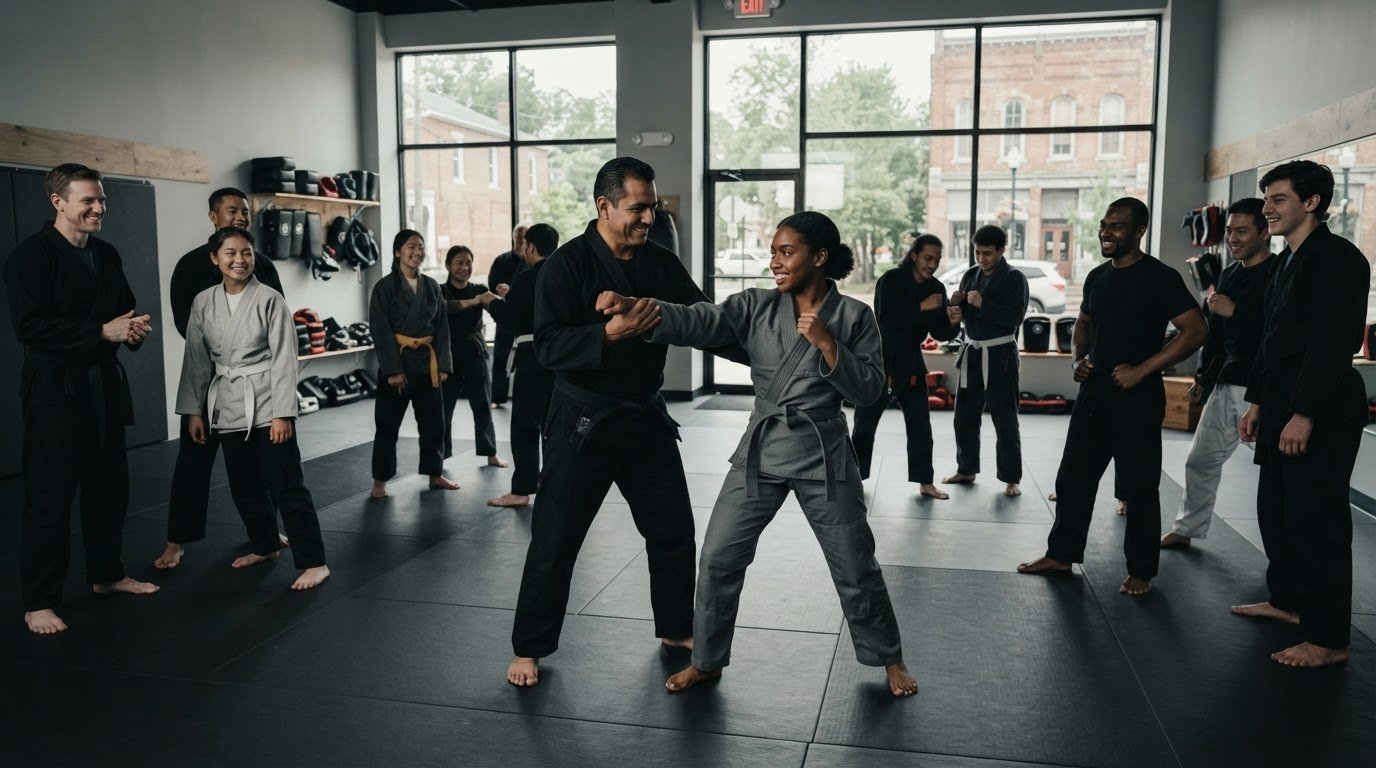
Training at the KMFA National Headquarters in Egg Harbor City offers a distinct advantage that you won't find in a standard commercial gym. Here, the Krav Maga curriculum is delivered with a level of technical fidelity that honors its authentic Israeli roots. You're learning directly under Greg Dziewoński, a 5th-degree black belt and the National Director of the Krav Maga Federation – AC. This lineage ensures that every strike, block, and tactical maneuver you learn is battle-tested and refined for modern threats. We maintain a "quiet professional" atmosphere where the focus remains on your progress rather than the instructor's ego. It's a disciplined environment that feels like a family, providing the psychological safety needed to push your physical limits while building a formidable skillset.
Our methodology is designed to be as utilitarian as the techniques themselves. We don't waste time on fluff or choreographed movements that fail under pressure. Instead, we focus on the efficiency of movement and the removal of obstacles. This approach creates a sense of momentum that guides you from your first day to your eventual mastery. By training at the source, you gain access to a deep well of historical and technical context that grounds your physical competence in a tradition of survival. You aren't just joining a class; you're entering a community of practitioners dedicated to readiness and resilience.
South Jersey’s Premier Defense Training
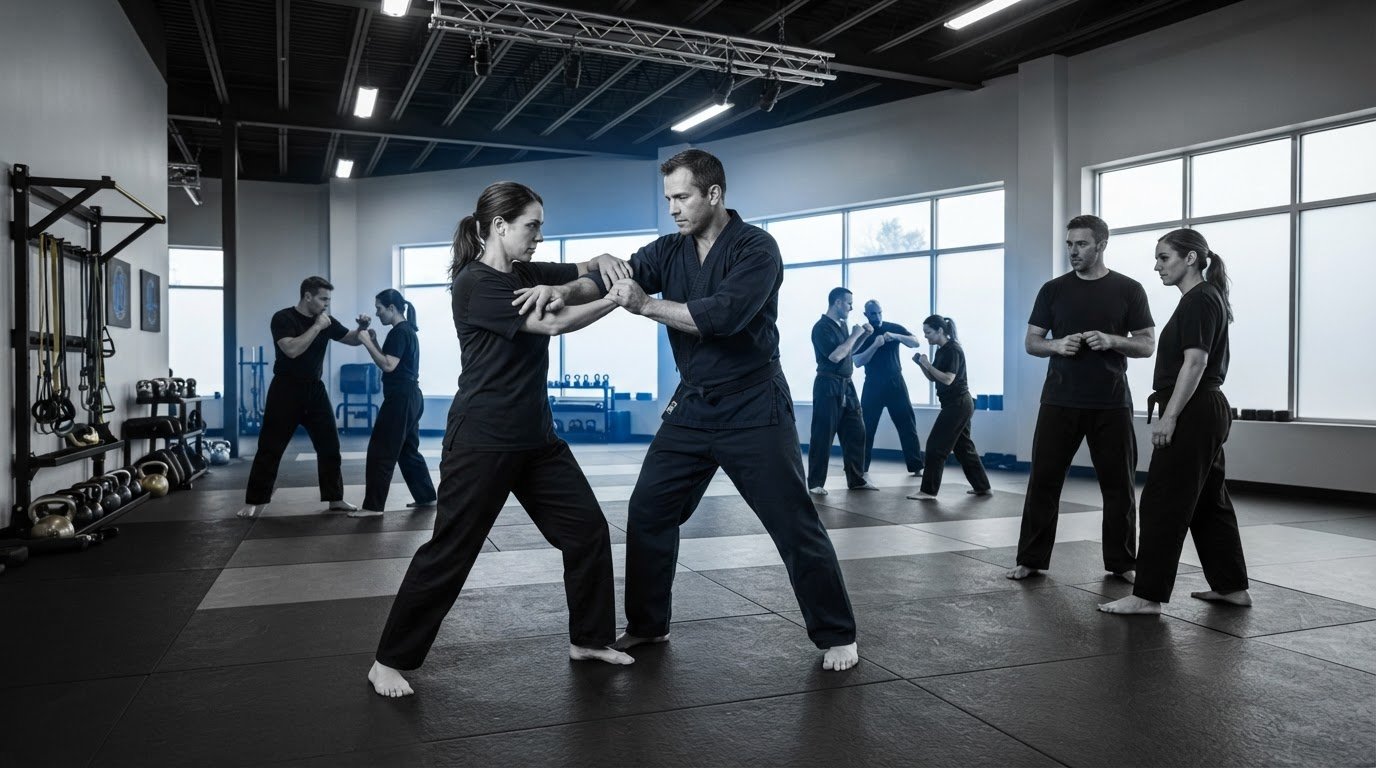
Our facility serves as a tactical hub for Egg Harbor City, Mays Landing, and the surrounding Atlantic County area. We've equipped our space with dedicated training mats and professional tactical gear to provide a realistic environment for our Krav Maga curriculum. If you're searching for self defense classes Atlantic County, you'll find that our school offers a level of instruction that is as utilitarian as it is empowering. We bridge the gap between theory and survival, ensuring you have the tools to protect yourself and your loved ones in any environment.
Start Your Journey Today
Your transition from vulnerability to strength begins with a single introductory lesson. You don't need prior experience or elite fitness to start; you just need the willingness to show up and do the work. Wear standard gym attire, bring water, and prepare for a high-energy session that introduces you to our foundational principles. We offer flexible membership options for individuals and families who want to train together and build a shared culture of safety. Don't wait until you're forced to defend yourself to realize you lack the necessary skills. Join our Krav Maga classes today and take command of your personal safety. It's time to become your own first responder.
Master Your Survival Blueprint
You now have the roadmap. The Krav Maga curriculum isn't just a list of moves; it's a tiered architecture designed to transform your natural flinch response into a tactical advantage. From the foundational strikes of Level 1 to the high-stakes firearm disarms of Level 5, every step is built on the "Building Block" theory of survival. You've seen how stress drills and technical proficiency ensure you aren't just earning a belt, but possessing the skills to defend your life. It's a journey from vulnerability to strength.
Training at the National Headquarters of the Krav Maga Federation (KMFA) gives you an edge that few schools can match. Under the guidance of Chief Instructor Greg Dziewonski, you'll benefit from an authentic Israeli self-defense lineage that prioritizes efficiency over aesthetic form. This is where your transformation begins. View our class schedule and start your Level 1 journey at Performance Krav Maga. The world doesn't wait for you to be ready. Take the first step toward becoming your own first responder and join a community that values discipline, safety, and results. We'll see you on the mats.
Frequently Asked Questions
How is the Krav Maga curriculum different from Brazilian Jiu-Jitsu or Karate?
Krav Maga is a reality-based survival system rather than a sport with referees or point systems. While BJJ focuses on ground grappling and Karate often emphasizes traditional forms or katas, our curriculum prioritizes immediate threat neutralization and escape. We utilize whatever works in a chaotic environment, including strikes to vulnerable areas that are strictly prohibited in competitive martial arts.
Do I need to be in peak physical shape to start Level 1?
You don't need to be an athlete to begin your first class. The training is designed to build your functional fitness and cardiovascular endurance as you progress through the levels. We meet you at your current physical state and use the curriculum to push your limits, ensuring your body becomes as resilient as your mindset. Strength is a byproduct of the work you do on the mats.
Are there specific requirements for women in the curriculum?
The curriculum remains consistent for everyone because physics and biomechanics don't change based on gender. Women learn the same strikes and defenses, with a heavy emphasis on using leverage and explosive movement to overcome larger, stronger aggressors. Our environment is inclusive and focuses on practical survival for all body types, ensuring every student feels formidable.
How often should I attend classes to progress through the levels?
Consistency is the primary driver of your advancement. Most students find that attending classes two to three times per week provides the necessary mat time to internalize the techniques and maintain momentum. This frequency allows your muscle memory to develop without causing excessive physical burnout, keeping you on track for testing within the standard four to six month window for early levels.
Is the curriculum safe for beginners with no prior experience?
Krav Maga was specifically engineered for people with zero combat background. We start with your natural reflexes and gradually layer on technical proficiency in a controlled, professional environment. Safety is our highest priority. We use progressive resistance to ensure you learn to handle pressure without unnecessary risk of injury, making it accessible for anyone ready to learn.
What happens if I fail a belt test?
Failing a test is a diagnostic tool that identifies gaps in your technical execution or mental resilience. You'll receive specific, actionable feedback from the instructors on which areas require more focus. This isn't a setback but a part of the disciplined path to mastery. You'll be encouraged to refine those skills before attempting the test again during the next cycle.
Does the curriculum include training for legal self-defense repercussions?
Yes, our training includes a focus on the force continuum and situational decision-making. You'll learn to distinguish between a situation that requires de-escalation and one that demands explosive defense. Understanding the legal landscape of self-defense is a critical component of the Krav Maga curriculum, ensuring you are a responsible practitioner in the real world.
Can I skip levels if I have a black belt in another martial art?
Every student starts at Level 1 regardless of their prior experience in other disciplines. While a background in other martial arts provides a solid foundation, the Krav Maga curriculum utilizes unique biomechanics and tactical priorities that must be learned from the ground up. This ensures you don't carry over sport habits that could prove dangerous in a life-or-death encounter.
Comments