
Walking Alone at Night: 2026 Safety Guide

What if the safest response to someone approaching in the dark is decided before they get close? Knowing how to protect yourself walking alone at night isn’t about assuming the worst or trying to win a confrontation. It’s about noticing changes early, choosing a safer route, and having a clear next move if someone ignores your boundaries.
It’s understandable to feel exposed on a poorly lit street, especially when anxious “what if” scenarios start to take over. Confidence doesn’t come from pretending risk doesn’t exist. It comes from replacing uncertainty with a practical plan you can use without panic or hesitation.
This guide covers psychological, environmental, and physical strategies: how to prepare before you leave, read your surroundings as you move, respond when someone approaches, and prioritize escape when possible. You’ll also learn how practical self-defense training, including Krav Maga at Performance Krav Maga in Egg Harbor City, can help you prepare for real-world situations. The goal is simple: move with more awareness, more options, and less fear.
Table of Contents
The Psychology of Nighttime Safety: Shifting from Vulnerability to Readiness
Nighttime confidence starts with what you notice, not how tough you look. Situational awareness means noticing what’s around you, considering what those details may mean, and anticipating what could happen next. On a familiar street, that might mean seeing someone change direction to match your pace or noticing that a normally open business is closed. Awareness gives you time to change course, move toward other people, or call for help before a situation becomes physical.
This is the foundation of staying safer when walking alone at night. It isn’t about treating every stranger as a threat or blaming someone for another person’s actions. It’s about staying engaged with your surroundings and keeping your options open.
Understanding the Predator Perspective
Some attackers look for signs of distraction or uncertainty. A slumped posture, eyes fixed on the ground, or hands buried in pockets may suggest that someone isn’t paying attention. These cues don’t predict who will be targeted, and no posture can guarantee safety. Still, standing upright, walking at a steady pace, and keeping your head up can help you appear attentive and ready to respond.
Victim profiling is the process by which criminals assess and select potential targets based on perceived vulnerability or opportunity.
Use brief, calm eye contact to acknowledge another person’s presence, then continue on your way. You don’t need to glare, challenge, or perform confidence. The aim is to communicate awareness without inviting unnecessary escalation. If someone’s behavior concerns you, create distance and move toward a safer, more public place.
Think of the shift as moving from “target” to “obstacle,” not by looking for a fight, but by staying alert, balanced, and prepared to act. Awareness can help you avoid contact altogether, which is often the safest outcome.
Overcoming the Freeze Response
Fear can trigger an automatic stress response. Your heart may race, your attention may narrow, and it can become harder to weigh options quickly. Freezing is one possible response, not a personal failure. A simple mental plan gives your attention a task: notice the concern, create distance, move toward people or light, and seek help.
Before you leave, try mentally rehearsing your route. Picture yourself passing a dim entrance, spotting someone whose behavior feels unusual, and choosing a different path rather than continuing on autopilot. This “shadow-walking” exercise won’t predict every event, but it can make your options easier to recall under stress.
Practice adds another layer. Disciplined training helps you turn basic decisions into actions you can access under pressure, rather than relying on a gadget to solve the moment for you. Performance Krav Maga’s practical self-defense classes in Atlantic County connect physical readiness with the mindset to recognize risk, set boundaries, and respond. Readiness isn’t fearlessness. It’s having a next move.
Environmental Assessment: Mastering Your Route and Surroundings
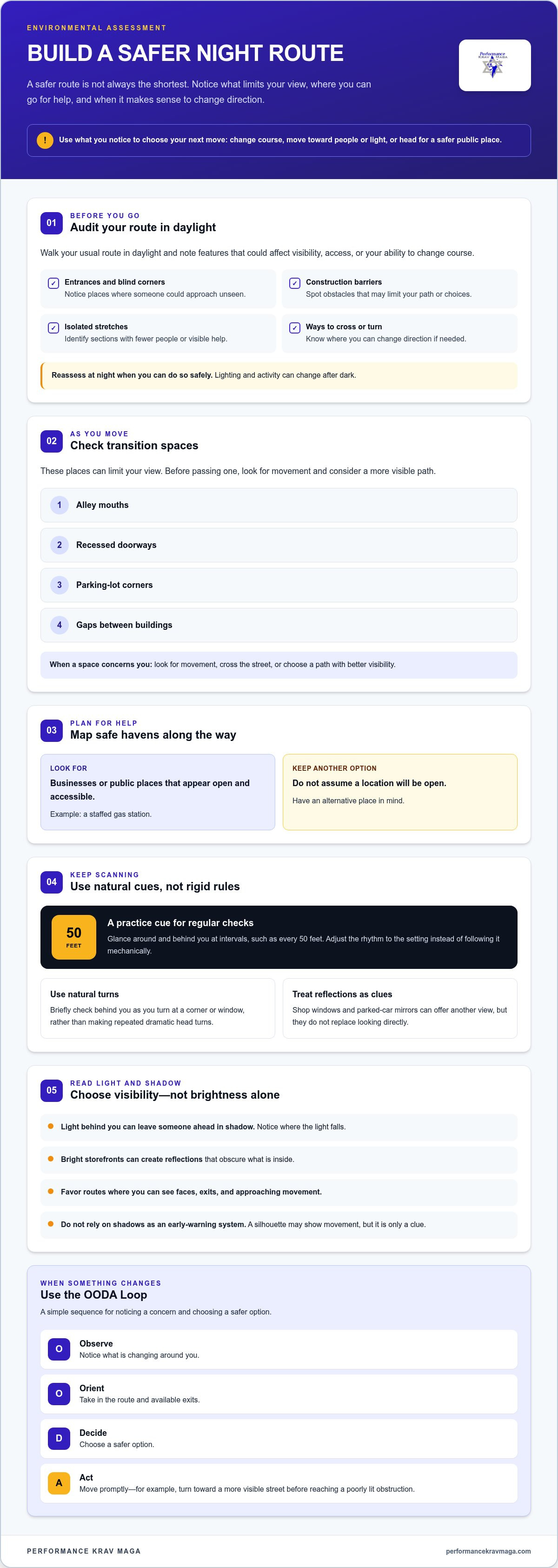
A safer route isn’t always the shortest one. Before walking it at night, consider where you can see clearly, where someone could approach unseen, and where you could go for help. This turns “trust your gut” into a repeatable process: notice a detail, consider what it means, then choose your next move.
Conduct a daylight audit. Walk your usual route in daylight and note entrances, blind corners, construction barriers, isolated stretches, and places where you can cross or change direction. Reassess the route at night when you can do so safely, because lighting and activity change.
Mark transition spaces. Alley mouths, recessed doorways, parking-lot corners, and gaps between buildings can limit your view. Before passing one, look for movement and consider crossing the street or taking a more visible path.
Map safe havens. Identify businesses or public places along your route that appear open and accessible, such as a staffed gas station. Don’t assume a location will be open; have another option in mind.
Build in a natural scan. As a practice cue, check your surroundings and glance behind you at regular intervals, such as every 50 feet. Adjust the rhythm to the setting instead of following it mechanically.
Lighting and Shadow Management
Bright doesn’t always mean safe. A strong light behind you can make you easier to see while leaving someone ahead in shadow. A bright storefront can also create reflections that obscure what’s inside. Notice where the light falls, and favor routes where you can see faces, exits, and approaching movement. Shadows may reveal a moving silhouette, but don’t rely on them as an early-warning system.
Use the OODA Loop: Observe what’s changing, Orient yourself to the route and available exits, Decide on a safer option, then Act promptly. For example, if a path ahead is blocked and poorly lit, turn toward a more visible street before you reach the obstruction.
The 360-Degree Awareness Perimeter
Check behind you with a brief glance as you naturally turn at a corner or window, rather than making repeated, dramatic head turns. Shop windows and parked-car mirrors can offer another view, but treat reflections as clues, not a substitute for looking directly. If someone closes the distance, move toward people, light, or an exit instead of waiting to confirm their intentions.
A 20-foot gap can be a useful planning goal when space allows, not a guaranteed safety boundary. Keep your distance where practical, and increase it if someone’s behavior concerns you. Streets and crowds won’t always allow a fixed buffer, so prioritize a clear route away.
Route assessment becomes more effective with practiced decision-making. Krav Maga training at Performance Krav Maga can help you rehearse practical responses and build confidence using them.
Beyond Gadgets: Why Physical Competence Trumps Passive Tools
Safety tools can help, but none can make decisions for you. An alarm may draw attention, a flashlight may help you see, and pepper spray may create an opportunity to escape. Each depends on being accessible, working as expected, and being familiar enough to use under stress. Skills matter because they stay with you, even when a device is forgotten, out of reach, or ineffective.
When planning how to protect yourself walking alone at night, treat equipment as support, not a complete plan. A phone can help you call for assistance, but staring at it divides your attention and can make you less responsive to changes around you. Keep it accessible, set your route before you start, and avoid typing or scrolling while walking.
The Smartphone Liability
Looking down at a screen narrows your attention and can make it harder to notice approaching people, obstacles, or changes in your surroundings. Headphones can also mask footsteps, traffic, and other useful cues. If you need audio, keep the volume low enough to hear your environment, or leave the headphones off.
Distraction-free walking means keeping your eyes and ears available to notice your surroundings instead of focusing on a screen or audio.
Practical Deterrents and Their Limits
A flashlight helps you see uneven ground, identify what’s ahead, and make yourself more visible. Some are marketed with bright or flashing modes, but don’t assume a beam will reliably disorient someone or stop an approach. Use light to assess your route and move toward a safer place, not as a substitute for distance and escape.
Pepper spray has practical limitations: wind can blow it off course, an expired canister may not work as intended, and retrieving and deploying it takes time. Learn how to handle any device you carry, follow its instructions, and understand the laws that apply where you are. An alarm can attract attention, but it won’t physically move you out of danger. Keep your priority clear: create space and leave.
Krav Maga’s practical approach prioritizes your ability to recognize a problem, move, and respond instead of depending on gear. Tools can support those actions, but physical competence and practiced decision-making help you use an opening. Tactical self-defense training can help you build readiness beyond what you carry. You are the constant; equipment is only a tool.
Tactical Movement: How to Walk and React if Approached
Good movement keeps options open. When walking alone at night, combine an alert posture with a plan to create distance and leave if someone’s behavior concerns you. The objective isn’t to look intimidating or invite a confrontation. It’s to stay balanced, notice changes, and move decisively toward safety.
Body Language as a Shield
Walk at a steady, purposeful pace with your head up and shoulders relaxed. Keep your hands out of your pockets and your phone put away so you can move freely. Let your elbows sit slightly away from your sides, without clenching your fists or holding a rigid fighting stance. Use your peripheral vision to register movement at the edges of your view, then turn to assess anything that needs a closer look. Don’t rely on peripheral vision alone.
A ready stance is simply a posture that lets you move, speak, or protect yourself without first untangling your hands or regaining your balance. If someone approaches and you feel uneasy, angle toward an open route rather than letting yourself be backed against a wall, vehicle, or doorway.
Immediate Response to Confrontation
If someone moves into your space, set a clear boundary early. A “fence” is a non-aggressive position with your hands raised around chest level, palms visible, and arms ready to protect your space. Pair it with a firm command such as “STOP,” “BACK OFF,” or “STAY THERE.” Speak loudly enough to be heard. Keep your attention on the person while looking for an exit or nearby people who can help.
If a person grabs you, prioritize breaking contact, creating distance, and escaping, rather than staying to trade blows. Krav Maga teaches protective responses, including the 360-degree defense, for dealing with attacks from different angles. The exact movement depends on the attack and requires coached practice; a brief written description can’t safely teach the mechanics. If you can disengage and get to a safer place, do so.
A “burst” response means acting decisively to make room to escape rather than freezing or hesitating. Move toward an exit or populated area, call for help when safe, and continue away from danger. Don’t depend on keys held between your fingers or improvised techniques. Unpracticed actions can fail or injure you, while structured training helps you rehearse and adapt your responses.
These skills are learned through repetition, not bravado. Performance Krav Maga offers practical training focused on real-world self-defense, with instruction for people at different experience levels. Build practical self-defense skills with Krav Maga training.
Building Real-World Resilience: Krav Maga in Egg Harbor City
Planning a route and carrying a phone can help, but neither teaches you how to respond when someone ignores your boundaries. Krav Maga adds active preparation through practical self-defense training focused on recognizing danger, responding under pressure, and creating a chance to get away. No system can promise safety or be called the single “most effective” choice for every situation. The value lies in learning and rehearsing useful responses, rather than relying on confidence alone.
Performance Krav Maga in Egg Harbor City is the KMFA National Headquarters, led by Chief Instructor Greg Dziewonski. Its authentic Israeli Krav Maga training emphasizes real-world safety and welcomes students at different experience levels. For readers considering women’s self-defense in Egg Harbor City, practical training can provide a structured way to build physical confidence and decision-making skills.
Why Krav Maga Builds Practical Readiness
Under pressure, complicated plans can be difficult to recall. Training gives you a chance to practice simple movements and decisions repeatedly, so you can respond with more purpose instead of freezing or depending on a device. This doesn’t make anyone invulnerable. It can help turn “What would I do?” into a sequence you’ve rehearsed: recognize the threat, protect yourself, create space, and move toward safety.
Street situations can involve poor visibility, limited room, or more than one source of pressure. A practical mindset prioritizes awareness and escape, not standing your ground to prove a point. Training is where you can develop physical competence in a controlled setting and learn to adapt your response to the situation.
Taking the First Step
You don’t need prior martial arts experience to begin. In a first class, focus on learning, asking questions, and becoming comfortable with the fundamentals at your own pace. The goal isn’t to master self-defense in one session; it’s to start building skills through instruction and practice. Performance Krav Maga’s classes are designed for people at different experience levels and fitness levels.
For anyone searching how to protect yourself walking alone at night, training can turn preparation into an ability you carry with you. Performance Krav Maga offers Krav Maga and self-defense classes in Egg Harbor City, where you can begin building readiness one practice at a time.
Make Your Next Walk a More Confident One
Nighttime safety isn’t about expecting danger at every turn. It’s about combining awareness, thoughtful route choices, and practiced responses so you have options if something feels wrong. Keep your attention on your surroundings, notice places where you can change direction or seek help, and prioritize creating distance and leaving if someone crosses your boundaries.
Knowing how to protect yourself walking alone at night also means looking beyond passive tools. A phone or alarm may support your plan, but physical readiness comes from learning and practicing skills. Krav Maga training can help you build that readiness in a structured setting.
In Egg Harbor City, Performance Krav Maga is the KMFA National Headquarters, led by Chief Instructor Greg Dziewonski and grounded in authentic Israeli Krav Maga training. Its practical focus supports students at different experience levels as they work toward greater confidence and real-world self-defense skills.
Take a deliberate first step toward feeling more prepared. Explore Krav Maga classes at Performance Krav Maga in Egg Harbor City and start building confidence through practice. You can grow stronger, more aware, and more ready, one step at a time.
Frequently Asked Questions
Is it better to run or fight if I'm approached at night?
If you can safely leave, create distance and go toward a populated, well-lit place rather than staying to confront the person. Running may be the best option when there’s a clear route and you can move safely. If you’re physically attacked and escape isn’t immediately possible, focus on protecting yourself and creating an opportunity to get away. Call emergency services as soon as you’re safe. No response fits every situation.
What are the best non-violent deterrents for walking alone?
Awareness, distance, and a clear exit plan are practical non-violent deterrents. Keep your phone accessible without walking absorbed in the screen, choose routes where you can see and reach other people, and use a firm voice to set a boundary if someone approaches. A personal alarm or flashlight may support your plan, but neither guarantees safety. Think of these as aids to help you attract attention, assess your path, and leave.
How can I improve my situational awareness quickly?
Start by putting away your phone and listening to what’s around you. Notice nearby people, entrances, changes in lighting, and possible places to go if you need help. Glance around naturally as you walk, including behind you at intervals, and ask yourself what you’d do if your route were blocked. This gives “how to protect yourself walking alone at night” a practical starting point: notice, assess, choose, and act.
Is Krav Maga effective for smaller people against larger attackers?
Krav Maga training emphasizes practical movement and decision-making rather than relying only on size or strength, which can make it useful for students with different body types and experience levels. No technique can guarantee success against a larger attacker, and training isn’t a substitute for avoiding danger or escaping when possible. In Egg Harbor City, Performance Krav Maga teaches practical self-defense through authentic Israeli Krav Maga training for students at varied levels.
Should I carry my keys between my fingers for self-defense?
No. Holding keys between your fingers can injure your hand, make it harder to use your keys normally, and create a false sense of security. Keep them accessible so you can unlock your door without searching through a bag, but don’t treat them as a self-defense technique. Focus on keeping distance, moving toward safety, and calling for help if you’re at risk.
How do I know if someone is following me?
You can’t know someone’s intentions from one glance or a single coincidence. Notice patterns instead: for example, whether a person continues matching your direction after you make a reasonable turn or change pace. Avoid confronting them to test your suspicion. Move toward a busy, staffed place, keep an exit available, and ask someone nearby for assistance if the behavior continues or makes you feel unsafe.
What should I do if I feel like I’m being followed?
Take your concern seriously enough to choose a safer action, even if you aren’t certain why the person is nearby. Don’t lead them to your home or a secluded location. Head toward a staffed business or a group of people, call someone you trust, and contact emergency services if you feel in immediate danger. If you’re driving, stay in a public place and seek help rather than stopping somewhere isolated.
Can I learn effective self-defense if I’m not in great shape?
Yes. You can begin self-defense training without being highly fit or having martial arts experience. Start by learning the movements at a manageable pace and build capability through regular practice. Performance Krav Maga in Egg Harbor City offers instruction for different experience levels, with practical skills focused on real-world self-defense. Tell your instructor about limitations or concerns so you can approach training safely and progress step by step.


Comments